
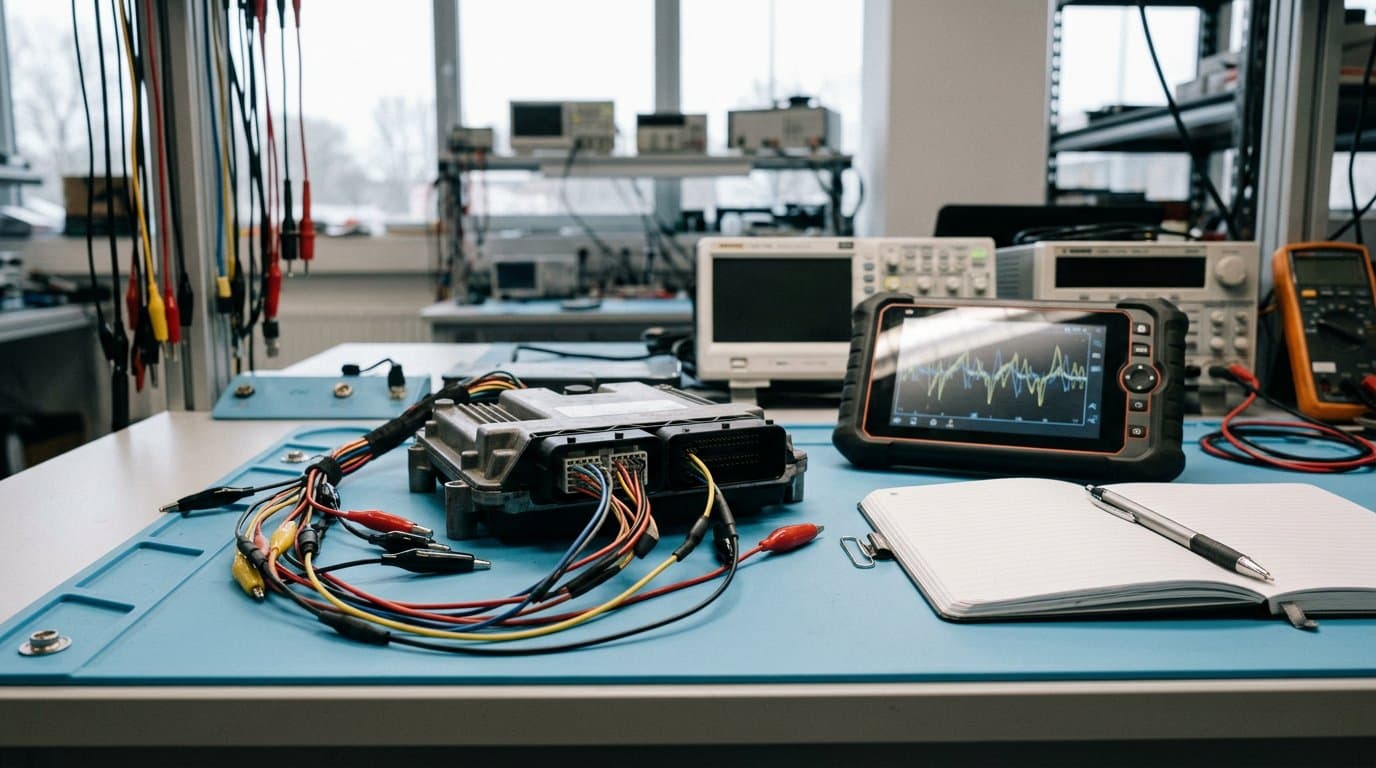
Failed ECM: New Dealer Module or Programmed Used Replacement?
When facing a failed ECM, the decision between purchasing a new module from the dealer or having a used module programmed to your VIN depends on three technical factors: the specific failure mode affecting your module, your vehicle platform's programming and security architecture, and whether board-level repair remains viable for your particular fault. This guide provides decision criteria for technicians evaluating replacement strategies based on failure characteristics, manufacturer requirements, and repair possibilities.
Automodulelab operates a nationwide mail-in board-level module repair service serving automotive technicians and diagnosticians. The analysis below addresses when each path—new dealer ECM, programmed used module, or circuit-level repair—makes technical sense for your specific failure scenario.
Understanding Your Three Technical Paths
The choice between new dealer ECM, programmed used module, or board-level repair requires evaluating different technical constraints for each approach. Each path addresses ECM failure from a different angle, with distinct requirements and limitations.
A new dealer ECM arrives as an unprogrammed blank module requiring VIN programming, calibration file installation, and immobilizer synchronization before the vehicle will operate. This path guarantees hardware compatibility with your vehicle's build specification and provides a module with no prior service history. The dealer handles programming through manufacturer-authorized equipment and current calibration files.
A used module programmed to your VIN requires sourcing a donor ECM with matching hardware specifications, then reprogramming it to replace the stored VIN and calibration data with your vehicle's parameters. Success depends on precise hardware variant matching between donor and vehicle, and whether your programming equipment can perform the required VIN write and calibration procedures. According to Apex and Octane, most vehicles built after 1995 require VIN programming for any replacement ECM, though reputable remanufacturers often pre-program modules with your VIN before shipping.
Board-level repair addresses the failed component or circuit inside your existing module, preserving the original VIN and calibration data without requiring any programming. This approach eliminates hardware matching concerns and programming requirements entirely while targeting the specific circuit fault that caused the failure.
When New Dealer ECM Becomes Necessary
Certain failure modes and vehicle conditions require new dealer module procurement rather than used module substitution or repair. Understanding these scenarios prevents pursuing repair paths that cannot succeed for your specific failure.
Physical damage to the circuit board that has destroyed multiple subsystems, widespread water intrusion causing corrosion across processor and driver circuits, or confirmed internal processor failure may require replacement rather than repair. When the circuit board substrate itself has cracked or delaminated, repair becomes impractical regardless of which specific components failed.
Warranty coverage often mandates the new dealer path. When your vehicle remains under manufacturer powertrain warranty or extended service contract, using dealer-supplied parts typically aligns with claim authorization requirements. Warranty administrators commonly require OEM part procurement to approve repair claims.
Some vehicle platforms implement security architectures that tightly couple the ECM to other modules through encrypted authentication that cannot be transferred to a used module without dealer-level programming access. Late-model vehicles may require online authorization from the manufacturer's server to complete ECM programming, with this authorization potentially granted only for new module VINs matching dealer parts network records.
The Used ECM Programmed to VIN vs New Dealer ECM Cost Guide examines the specific scenarios where dealer replacement becomes the required path rather than an optional one.
When Used Module Programming Makes Technical Sense
A used module programmed to your VIN represents a viable alternative when specific technical prerequisites align. The donor module hardware configuration must match your vehicle exactly: engine displacement, transmission type, emission certification level, and regional calibration requirements.
Hardware variant matching determines programming success or failure. Vehicles often use multiple ECM variants within the same model year based on equipment packages, build plant, or production date. The original ECM part number—printed on a label on the module housing—provides the most reliable compatibility reference compared to year/make/model lookup alone.
Your vehicle platform must permit VIN reprogramming using available diagnostic equipment. Some manufacturers allow VIN writes through enhanced scan tools that independent shops commonly own, while others restrict this function to dealer-level systems or require online authorization that independent facilities cannot obtain.
The immobilizer architecture determines whether a used module can authenticate with your vehicle's security system after VIN programming. Vehicles that store immobilizer keys in the ECM itself require those keys to be rewritten during the programming process, while systems that authenticate against a separate security module may require additional synchronization beyond VIN programming alone.
The donor module's service history matters for reliability prediction. A used ECM from a verified low-mileage collision vehicle with confirmed operational status before removal presents lower risk than a module sourced from an unknown-condition salvage environment where the module's failure history remains undocumented.
Before procurement, verify your programming equipment capabilities for your specific vehicle platform. The absence of proper programming tool support creates a non-viable replacement path regardless of donor module quality or hardware matching accuracy.
Board-Level ECM Repair as the Third Option
Board-level repair addresses the failed component or circuit inside your existing module rather than replacing the entire unit. This path preserves your original module with its factory VIN and calibration data intact, eliminating all programming requirements and hardware matching concerns.
Repair makes technical sense when the failure traces to discrete component faults: failed voltage regulator circuits, damaged driver transistors for injectors or coils, corroded connector interface circuits, or failed sensor input conditioning circuits. These component-level faults can be diagnosed and repaired at the circuit board level using appropriate bench test equipment and replacement components.
The absence of diagnostic trouble codes does not indicate the module is beyond repair. Many ECM failures prevent code storage or retrieval entirely because the fault disables the processor, corrupts memory, or interrupts communication circuits before the diagnostic system can log a fault. The module arrives at a repair facility without codes but with the circuit-level fault still detectable through bench testing.
Module repair fault logs matter most in the cases where scan tools contribute the least. When the ECM fails in a way that prevents communication or code storage, the vehicle-level diagnostic path ends, but circuit-level diagnosis at a repair facility continues with different equipment and test procedures.
The difference between a module that can be diagnosed on arrival and one that requires return contact for missing information consistently traces to what was documented before the module shipped. Technicians improve diagnostic efficiency by documenting failure symptoms, vehicle behavior before failure, scan tool observations, and any testing already performed at the vehicle level.
Confirming ECM Failure Before Pursuing Any Replacement Path
Before committing to new dealer purchase, used module programming, or board-level repair, confirm that the ECM is actually the failed component. Module-level failures often present with symptoms overlapping sensor faults, wiring problems, or failures in other control modules.
Power supply verification eliminates the most common misdiagnosis. Verify constant battery power, ignition-switched power, and solid ground connections at the ECM connector. Many no-start conditions trace to corroded power supply terminals or failed relay circuits rather than ECM internal faults. Measure voltage at the module connector under key-on and cranking conditions to eliminate power supply failure as the root cause.
Check communication circuit integrity when the scan tool cannot connect to the ECM. Communication faults often originate in damaged wiring between the diagnostic connector and the ECM, failed termination resistors on CAN bus networks, or short circuits caused by wire chafing or connector corrosion. Testing these circuits before module replacement prevents misdiagnosis of communication faults as ECM failures.
Document the specific failure mode and vehicle behavior before removal. Note whether the engine cranks but does not start, whether the scan tool communicates with the ECM at all, whether codes were present before communication loss, and whether the failure occurred suddenly or developed progressively. This documentation helps differentiate between failures requiring replacement and those that may be repairable at the circuit level.
The How to Know Which Module Failed Before You Ship It article provides systematic confirmation steps before removing the module from the vehicle, reducing the likelihood of shipping a functional module while the actual fault remains in vehicle wiring or another system.
Programming Architecture and Security Limitations
Vehicle manufacturers implement varying security and programming access levels that directly affect whether used module programming remains practical for independent repair facilities. These manufacturer-specific architectures determine equipment requirements, online authorizations, and procedural steps necessary to complete ECM replacement successfully.
General Motors vehicles generally permit VIN programming and calibration updates using aftermarket scan tools that support GM programming protocols. The immobilizer system on most GM vehicles stores authentication data in the body control module rather than the ECM itself, simplifying ECM replacement compared to platforms that embed immobilizer keys in the engine control module. The GM ECM PCM Programmed to VIN Replacement Guide addresses platform-specific considerations for General Motors vehicles, including hardware variant identification and programming prerequisite steps.
Chrysler, Dodge, and Ram vehicles equipped with immobilizer systems require VIN programming when installing a used PCM. Programming equipment must write VIN data and synchronize immobilizer authentication between the PCM and the vehicle's security system. The programming tool must connect to manufacturer programming servers to download calibration files matching the vehicle's specific build configuration.
Ford vehicles vary widely in programming requirements across model years and platforms. Some Ford ECMs can be programmed using aftermarket tools with Ford programming capability, while others require Ford-specific systems with active subscriptions to Ford's online services. Certain Ford security architectures require all replacement modules to be registered through dealer systems before the vehicle will start.
European manufacturers typically implement tighter integration between ECM, immobilizer, and other vehicle modules. BMW, Mercedes-Benz, and Volkswagen Group vehicles often require dealer-level programming equipment and online authorization to complete ECM replacement. A 2012 Volkswagen service bulletin documents PCM programming requirements for 2011 Routan vehicles, noting that dealers reprogram the PCM with updated software or replace the PCM when certain diagnostic trouble codes are present.
Asian manufacturers show varied approaches. Toyota and Lexus vehicles generally permit ECM programming using capable aftermarket equipment, though immobilizer registration procedures vary by model year. Honda implements security measures that sometimes require dealer involvement to complete immobilizer synchronization after ECM replacement.
Understanding your specific vehicle's programming and security architecture before committing to a replacement path prevents discovering mid-repair that the chosen strategy cannot be completed with available equipment. Verify these requirements before purchasing a used module or committing to dealer replacement to avoid misallocated parts expenditure and duplicated diagnostic time.
Frequently Asked Questions About ECM Replacement
Can I install a used ECM without programming it to my VIN?
Most vehicles manufactured after the mid-1990s implement immobilizer security systems that prevent engine starting when the ECM VIN does not match the vehicle's registered VIN in the immobilizer system. The engine may crank but will not start, or the vehicle may start briefly then shut down as the immobilizer detects the VIN mismatch. Some older vehicles without immobilizer systems may accept a used ECM without VIN programming, but verify this before installation rather than assume compatibility based on vehicle age alone.
What happens after VIN programming on vehicles with anti-theft systems?
According to Apex and Octane, many vehicles require an anti-theft relearn procedure after ECM replacement. On GM vehicles with Passlock, the procedure involves turning the key to RUN, attempting to start (it will stall), leaving the key in RUN while watching the SECURITY light for approximately ten minutes until it goes out, then turning the key to OFF for ten seconds. This cycle repeats three times total before the vehicle will start and run normally on the next key cycle.
Will a used module from a higher trim level work in my lower trim vehicle?
Hardware compatibility depends on the specific control strategies and output circuits required by your vehicle's equipment. An ECM from a vehicle with different engine displacement, transmission type, or emission certification will not function correctly even if it physically fits the connector. Within the same engine and transmission combination, some manufacturers use identical ECM hardware across trim levels and adjust functionality through calibration, while others use different hardware for different equipment levels. Verify exact hardware compatibility before procurement to avoid non-functional module installation.
How do I know if my ECM failure is repairable or requires replacement?
Many ECM failures stem from discrete component faults that can be repaired: voltage regulator failures, damaged driver circuits, failed communication interface components, or corroded connector pins. Complete internal processor failure, security chip failure, or widespread circuit board damage from water intrusion or physical impact may require replacement. Without circuit-level diagnostic equipment, distinguishing repairable failures from replacement-required failures is difficult at the vehicle level. Facilities performing board-level module repair can evaluate your specific module and determine whether the fault is repairable based on bench testing and circuit analysis.
What information do I need to source a compatible used ECM?
At minimum, you need your vehicle's VIN to identify the original ECM part number, engine specifications including displacement and fuel system type, transmission type, and emission certification level. The original ECM part number—typically printed on a label on the module housing—provides the most reliable compatibility reference. Some vehicle platforms use multiple ECM hardware variants within the same model year based on production date, build plant, or equipment packages, making VIN-based lookup more reliable than year/make/model alone.
Making the Correct Decision for Your ECM Failure
The decision between new dealer ECM, programmed used module, or board-level repair requires evaluating your specific failure characteristics, vehicle programming architecture, and module availability together rather than selecting based on initial cost comparison alone. Start by confirming that the ECM is genuinely the failed component through systematic power supply, ground, and communication circuit testing before committing to any replacement strategy.
For vehicles where immobilizer programming, calibration access, or security architecture create barriers to independent used module installation, board-level repair of your original module often provides the most practical path. The original module retains all factory VIN data and security synchronization, eliminating programming requirements entirely while addressing the circuit-level fault that caused the failure.
When replacement becomes necessary due to unrepairable internal damage, verify the specific programming requirements for your vehicle platform before sourcing a used module. Confirm that your available diagnostic equipment can perform the required VIN write, calibration update, and immobilizer synchronization procedures, or factor dealer programming service into the total cost comparison.
Automodulelab provides board-level ECM repair through nationwide mail-in service. Contact us with your vehicle information and failure symptoms for specific guidance on whether your module is a repair candidate or requires replacement. Documentation of the failure mode, scan tool observations, and testing already completed helps establish whether repair remains viable for your specific case.
The correct replacement strategy emerges from understanding what failed inside your ECM, what your vehicle's security architecture permits, and what resources you have available to complete the installation. Making this decision with complete information prevents the false starts, returned parts, and duplicated labor that occur when replacement paths are selected based on incomplete technical assessment of the failure mode and vehicle requirements.
Related reading
Ship your module today
Flat-rate pricing, typical 24-hour bench turnaround, return speed your choice at checkout. Most jobs back on your bench within a week.
More from the Lab
Remote TIPM VIN Programming for a Used TIPM (2026)
13 min · November 10, 2026
TIPM Repair Cost — Mail-In Bench Programming (2026)
11 min · November 9, 2026
BMW FRM Repair Cost — Mail-In Bench Programming (2026)
11 min · November 9, 2026

Fuel Pump Won't Prime? Relay, PCM Driver or Immobilizer
16 min · November 9, 2026