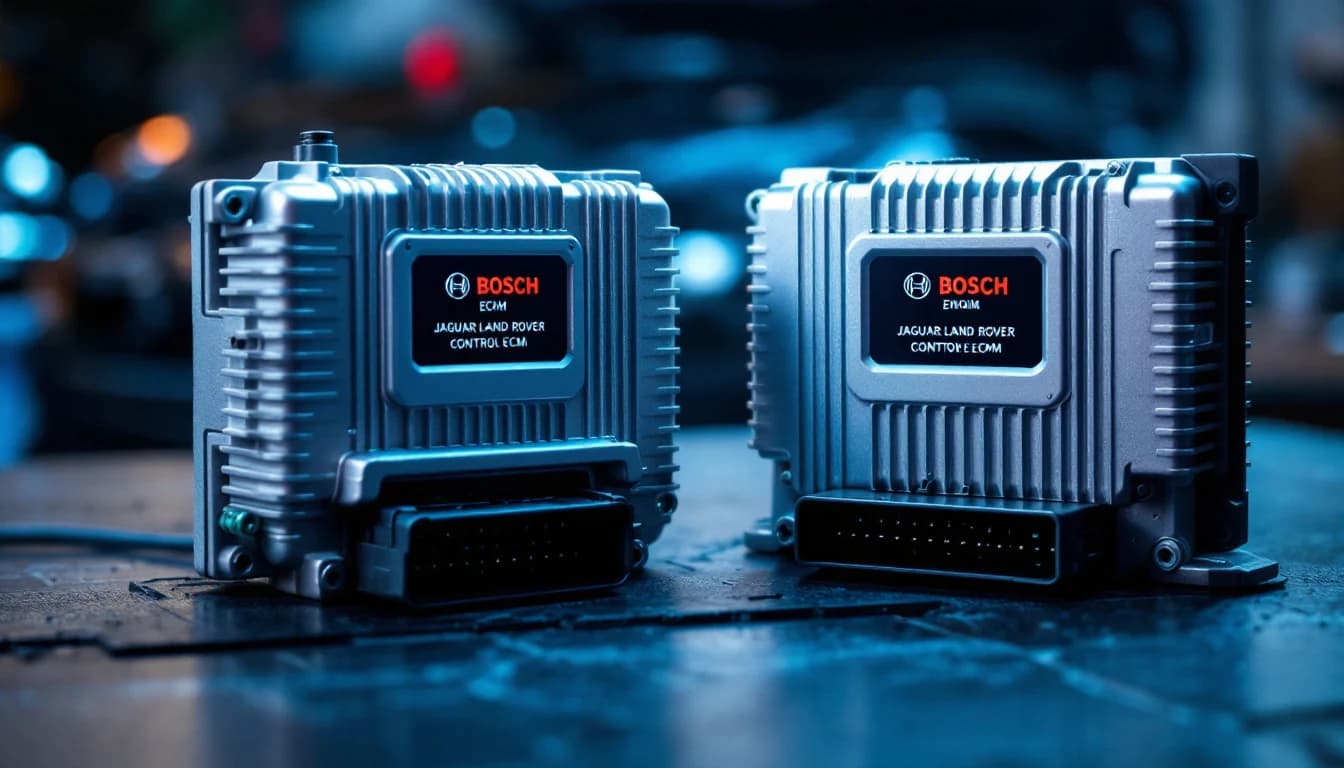
Land Rover & Jaguar CPLA ECM Failure
Who this is for
You are probably reading this with a Jaguar or Land Rover that does one of the following:
- Cranks strong but never fires — no start, no communication with the engine ECM on a scan tool
- Died while driving (often in or after heavy rain) and never restarted
- Shows a cascade of implausible engine codes, or U-codes from every other module saying they lost contact with the ECM
- Runs, but the shop diagnosed a failing internal driver in the engine computer and told you it is only a matter of time
- Already has a used ECM installed from eBay or a salvage yard — and now it cranks with no start and a security or immobilizer message
If the part number on the failed module reads CPLA-12B684-YE — or one of the earlier numbers it supersedes, C2D54092, C2D30319, or LR038618 — this article explains exactly what failed, why the used-module shortcut does not work on these vehicles, what the dealer route really costs, and how a mail-in CPLA ECM clone gets the car running for a flat $250 plus return shipping.
The module: Bosch MEDC17 in a decade of JLR products
The CPLA-12B684-YE is a Bosch engine control module from the MEDC17 family (internal reference 0261S08759). Bosch Mobility is one of the largest automotive suppliers on earth — its mobility division alone has reported annual sales well over 50 billion euros in recent years — and the MED17/EDC17 controller generation is among the most widely deployed engine-management platforms of the 2010s, used by Volkswagen, BMW, Porsche, Hyundai, and, in this application, Jaguar Land Rover.
JLR fitted this controller across a remarkable spread of product. Per the coverage we verify on every order, the CPLA-12B684-YE (and the part numbers it supersedes) appears on:
- Jaguar: F-Pace, F-Type, XE, XF / XFR / XFR-S, XJ / XJR
- Land Rover: Range Rover, Range Rover Sport, and Discovery where fitted
- Engines: the 3.0L supercharged V6 and the 5.0L V8, naturally aspirated and supercharged
- Years: roughly 2011–2021
That is most of the modern supercharged JLR lineup. Jaguar Land Rover has retailed well over 400,000 vehicles worldwide in a single fiscal year, and the 5.0L supercharged V8 ran for over a decade as the flagship engine — so the population of vehicles carrying this exact ECM is large, aging, and increasingly out of warranty. With the average vehicle on U.S. roads now roughly twelve and a half years old according to S&P Global Mobility, the typical CPLA-equipped car is squarely in pay-out-of-pocket territory when the module lets go.
How these ECMs die — and why water is the usual suspect
An engine ECM is a sealed aluminum box full of power drivers, processors, and memory, living in one of the harshest environments in the vehicle. On JLR applications the classic failure stories are:
Water intrusion. This is the one we see most. Depending on model, the ECM sits in the engine bay or a cowl/plenum area where drainage matters. Blocked drains, degraded seals, aggressive engine-bay washing, or deep standing water let moisture wick into the connector or the case. Corrosion starts on the pins and the board, and the module begins throwing intermittent faults months before it dies outright. By the time the car is a no-start, there is often visible green corrosion inside the connector shell.
Voltage events. Jump starts done backwards, welding on the vehicle without disconnecting the battery, or a failing alternator letting voltage spike — all of it stresses the ECM's power stages.
Age and thermal cycling. Fifteen years of heat soak next to a supercharged V8 eventually cracks solder joints and degrades components. No drama, no water — the module just stops communicating one morning.
Land Rover's reliability record makes owners particularly familiar with electrical gremlins: the brand has repeatedly placed below the industry average in the J.D. Power annual Vehicle Dependability Study, which in recent years has measured the industry at roughly 190–200 problems per 100 vehicles — with Land Rover posting meaningfully higher counts. None of that makes these bad vehicles; it makes them vehicles where a dead module strategy matters, because you will more likely face one.
If your no-start is on a Jaguar XF and appeared right after a flat, dead, or disconnected battery, stop here for a moment: that pattern usually is not the engine ECM at all. Low-voltage events on the XF famously corrupt the Central Junction Box (the body computer), producing "Smart Key Not Found" and no-start symptoms that mimic ECM death. We handle that failure with a separate remote Jaguar XF BCM/CJB recovery service — no shipping, the car stays where it sits. Diagnose before you pull the engine ECM.
Why a used ECM will not just plug in
Here is where most owners — and plenty of general repair shops — get burned. The logic seems obvious: the module is dead, used CPLA modules are all over eBay for a few hundred dollars, so buy one, plug it in, done. Then the car cranks and never fires, exactly like before, sometimes with a new immobilizer warning for good measure.
The reason is the vehicle's anti-theft architecture. Since the late 1990s, electronic immobilizers — which only allow the engine to run when the ECM, the security module, and a coded key all agree — have become effectively universal, and organizations like the Insurance Institute for Highway Safety and its affiliated Highway Loss Data Institute have documented how theft losses for immobilizer-equipped vehicles fell dramatically as the technology spread through the fleet. That security win has a repair-side cost: engine computers are married to the vehicle they left the factory in.
On a CPLA-equipped Jaguar or Land Rover, the ECM stores:
- The VIN, which every other module on the network cross-checks
- The immobilizer security data exchanged with the vehicle's KVM/RFA security module before each start
- The vehicle configuration — the option and calibration data matching that exact car
Drop in a used ECM and it still carries the donor car's VIN and security data. Your Range Rover's security module challenges it, the answer comes back wrong, and the ECM refuses to enable fueling and spark. The engine cranks forever. No amount of key cycling, battery disconnecting, or generic scan-tool "relearn" fixes it, because the mismatch is cryptographic, not procedural.
"The tow-ins I see every month are the same story: someone bought a used JLR engine computer, plugged it in, and assumed it would sync like an older domestic PCM. These cars don't work that way. The immobilizer data lives in the module, and unless someone moves your car's identity into that donor on a bench, it will crank until the battery dies. I stopped letting customers try it years ago — clone it or pay the dealer, those are the real options." — Independent Jaguar Land Rover driveability technician, 15+ years on JLR platforms (anonymized)
That leaves two legitimate paths: the dealer path, and cloning.
The dealer path vs cloning — real numbers
The franchise dealer fixes this the way the factory service manual says to: order a new ECM, program it to the vehicle with the factory online system, and complete the security pairing — which, depending on model and situation, can pull the key and security modules into the job too. Nothing wrong with it technically. The problem is the invoice. A new JLR engine ECM is a four-figure part by itself; programming time, security procedures, diagnosis, and in some cases towing (the car cannot drive there) stack on top. Owners and independent shops routinely report all-in dealer quotes in the $2,000–$4,000+ range for this failure, and outlets that track ownership costs — Car and Driver and Hagerty among them — have long documented that European luxury marques carry some of the steepest out-of-warranty electronics and repair bills in the business.
Cloning attacks the same problem from the opposite direction. Instead of buying a new blank module and programming your identity into it with factory tooling, we take your original module and a matching used donor, read the complete contents of the original on the bench, and write them to the donor — VIN, immobilizer data, configuration, calibration. The donor becomes an electronic twin of your original. It plugs in and the car starts, no dealer visit, no online programming session, no key pairing.
| Dealer replacement | Used ECM alone | Mail-in clone (this service) | |
|---|---|---|---|
| Parts | New ECM, four figures | Used ECM, ~$150–400 | Used donor ECM, ~$150–400 |
| Programming | Factory online session, dealer labor | None — and that is the problem | $250 flat bench clone |
| Immobilizer outcome | Re-paired to vehicle | Mismatch — crank, no start | Your data on the donor — starts |
| Vehicle needs to be there | Yes (tow a no-start) | — | No — modules ship, car stays home |
| Typical all-in | $2,000–$4,000+ | Wasted money | Donor + $250 + return shipping from $29.95 |
| Turnaround | Days to weeks (part availability) | — | Typically 24 hours on the bench after both parts arrive |
The math is not subtle. Even after buying a donor module, the clone path typically lands under a quarter of the dealer quote — and the vehicle never leaves your driveway or the shop's lot.
What the clone service does — and does not do
What we do on the bench:
- Verify both modules are the correct, matching part number (CPLA-12B684-YE / its superseded numbers) before any work
- Read the original ECM's full contents — VIN, immobilizer data, configuration — and archive it
- Write your original's identity onto the donor module
- Verify checksums so the donor is internally consistent before it ships
- Photograph the completed work and return both modules with tracking, typically 24 hours after both parts are received
What this is not:
- Not an emissions service. We do not offer emissions defeat, delete files, or emissions-bypass work of any kind — on this platform or any other.
- Not a mechanical fix. If the engine has a fuel, compression, or wiring problem, a cloned ECM will not cure it. Cloning fixes a dead or failing module; it does not diagnose the engine around it.
- Not magic on a completely dead original. The clone needs your original's data. The good news: even a damaged, partially readable original is usually enough — we can typically still recover the VIN and immobilizer data and move it to the healthy donor. If the original is truly unreadable, we tell you before any work and refund if the clone cannot be completed.
One more scope note. Because the immobilizer data we transfer is the vehicle's anti-theft identity, this is security-sensitive work — the same category as key programming — and we require proof of ownership documentation with security-related orders. A legitimate owner or repair shop has that paperwork on hand; it protects everyone.
Sourcing a donor — what "matching" means
The donor must be the same part number: CPLA-12B684-YE, or one of the interchangeable superseded numbers (C2D54092, C2D30319, LR038618). Matching the part number matters more than matching the donor's model — a donor pulled from an XJ can serve an F-Type if the numbers agree, because we overwrite the donor's identity entirely.
When shopping salvage or eBay listings:
- Photograph the label on your module first and match character-for-character
- Prefer donors sold as pulled from running, driving vehicles
- Avoid donors with corroded connectors or water staining — you would be cloning onto a module with the same disease that killed yours
- A vehicle-history check on the donor car through a service like Carfax is a cheap way to avoid modules pulled from flood cars, which are disproportionately common in salvage electronics after major storm seasons
If you are unsure whether a listing matches, text us the label photos before you buy — confirming fitment costs nothing and beats paying return postage on the wrong module.
The mail-in workflow, step by step
- Verify first. Send us your VIN and clear photos of your original module's label. We confirm the part number and application before you spend anything on shipping.
- Order the clone service on the CPLA ECM clone page and pick your return-shipping speed at checkout — Standard $29.95 (3–5 days), UPS 2-Day $54.95, or UPS overnight $94.95.
- Ship both modules — your original AND the matching donor — to PO Box 120241, Arlington TX 76012 if you ship USPS — or 1009 Oakwood Ln # 120241, Arlington TX 76012 if you ship UPS or FedEx (UPS and FedEx cannot deliver to a PO Box). Pack them padded, connectors protected, with a printed copy of your order confirmation, your VIN, both part numbers, and your contact details.
- Bench work. We read and archive the original, write its identity to the donor, and verify checksums.
- Return with tracking, typically 24 hours after both parts arrive, with photo proof of the completed work.
- Install. The donor plugs in as your original — no dealer programming session, no key pairing, no coding appointment.
Owners often ask whether pulling the ECM is DIY-friendly. On most of these applications it is a socket set and patience — disconnect the battery first, and photograph connector routing as you go. Before condemning the ECM at all, it is worth running the basics: battery health, main grounds, ECM fuses and relays, and checking for open recalls on your VIN through NHTSA, since JLR has issued campaigns touching engine-bay electrical components over these model years.
When cloning is not the whole answer
Cloning solves a failed engine ECM. Two adjacent JLR problems look similar but need different services:
- All keys lost, or a security-module fault. If the car needs keys rather than an engine computer, that is our Range Rover / Jaguar key programming service — mail in the KVM or RFA module and we cut and program a working smart key for 2010–2025 vehicles.
- A used security module that will not pair. A donor KVM or RFA locked to its old VIN needs to be wiped to factory-virgin state first — that is the KVM / RFA virginize service.
All three are bench jobs from the same Arlington workshop, and the full menu lives on the services hub. If you are not sure which failure you actually have, describe the symptoms and text us the module label photos — pointing you at the right service (or telling you it is not a module problem at all) costs nothing.
Frequently asked questions
How do I know my ECM is really dead? The classic signature is crank-no-start with no scan-tool communication on the engine ECM while other modules respond, often preceded by weeks of intermittent faults. Rule out battery voltage, grounds, and ECM fuses first — and on a Jaguar XF that failed right after a battery event, suspect the CJB/body module before the engine ECM.
Do I really have to send two modules? Yes. Cloning is a transfer — we read your original and write the donor. Without the original there is nothing to transfer; without the donor there is nothing to write to. Both ship in one box.
My original got wet and looks rough. Is it hopeless? Usually not. Even partially readable modules typically give up the VIN and immobilizer data we need. If yours is truly unreadable, we tell you before any work is done and refund if the clone cannot be completed.
Will the donor's mileage or history contaminate my car? No. We overwrite the donor's identity with your original's data. The donor becomes an electronic copy of your module — VIN, immobilizer, and configuration included.
Do I need a dealer visit or key programming afterwards? No. That is the point of cloning. The cloned donor carries your car's existing security data, so your existing keys keep working and the car starts on first install.
Can you clone it if the donor is a different part number? No — the donor must be a CPLA-12B684-YE or one of its superseded interchangeable numbers (C2D54092, C2D30319, LR038618). Text us label photos before buying a donor and we will confirm the match.
What does it cost, all in? $250 flat for the clone, plus your donor module (typically $150–400 on the used market) and return shipping chosen at checkout from $29.95. Compare that against a $2,000–$4,000+ dealer route and the decision usually makes itself.
The bottom line
The Bosch CPLA-12B684-YE engine ECM sits in a huge population of 2011–2021 Jaguar and Land Rover vehicles, and when it fails — water, voltage, or age — the car is stranded, because the module carries the vehicle's VIN and immobilizer identity. That identity lock is exactly why a used ECM from eBay cranks and never starts, and why the dealer's new-module route runs into the thousands.
Cloning is the engineered middle path: your original's identity, moved byte-for-byte onto a matching donor on a bench, checksum-verified, typically returned in 24 hours with photo proof — $250 flat, plus the donor you source and return shipping from $29.95 chosen at checkout. The car never leaves home, your keys keep working, and there is no dealer programming session at the end.
Start by confirming fitment: photograph your module's label, note your VIN, and see the Jaguar / Land Rover CPLA ECM clone service page — or text us the photos and we will verify the match before anything ships.
Ship your module today
Flat-rate pricing, typical 24-hour bench turnaround, return speed your choice at checkout. Most jobs back on your bench within a week.