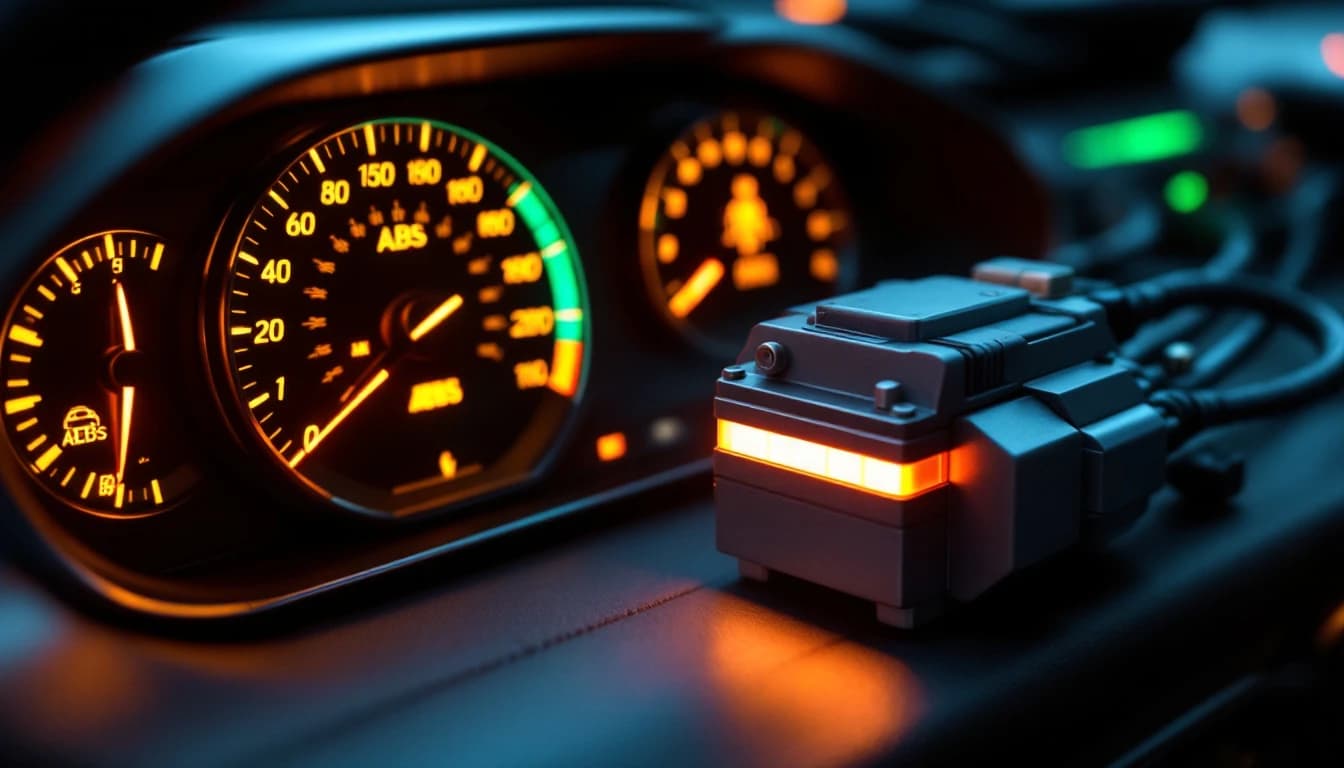
ABS, Traction & Brake Lights On Together
Three warning lights, one likely culprit
You start the car and the dashboard lights up: ABS, the traction-control or stability-control light (often a car with squiggly skid lines, labeled TCS, ESC, or StabiliTrak depending on the brand), and sometimes the amber or red brake warning too. They came on together, and they stay on. It feels alarming, and it should get your attention — but this specific cluster of lights has a well-worn diagnostic path, and in a large share of cases it points back to one component: the ABS module, also called the EBCM (Electronic Brake Control Module) or hydraulic control unit.
Why do all three light up at once? Because on modern vehicles they share hardware. The same module that manages anti-lock braking also runs traction control and electronic stability control, using the same four wheel-speed sensors and the same hydraulic valve body. When that shared module — or the wheel-speed data it depends on — faults, the vehicle can't guarantee ABS, can't guarantee traction control, and can't guarantee stability control, so it turns all of them off and tells you with the lights. On some vehicles a module fault also trips the brake warning light because the module can no longer confirm the full braking system is healthy.
The good news: this is diagnosable, and the fix is often far cheaper than the worst-case a parts counter might quote you. This guide walks through how to tell a genuine module failure from the cheaper problems that mimic it, then lays out the three real repair paths — including the mail-in bench repair that keeps your original, factory-coded module in the car.
Base brakes still work — but you've lost your safety nets
Before anything else, understand what you have and haven't lost, because it changes how urgently you should act.
With the ABS and traction/stability systems disabled, your base hydraulic brakes still function. Press the pedal and the car still stops — the master cylinder, brake lines, calipers, and pads all work exactly as they did. What you've lost is the electronic layer on top: anti-lock braking (which pulses the brakes to prevent wheel lockup and preserve steering during hard stops) and traction/stability control (which brakes individual wheels and cuts power to keep the car from spinning or plowing in a slide).
Those layers are not decoration. Electronic stability control is one of the most effective crash-avoidance technologies ever mandated. The National Highway Traffic Safety Administration required ESC on all new light vehicles under Federal Motor Vehicle Safety Standard 126, and NHTSA has estimated that stability control saves thousands of lives per year and dramatically reduces the risk of rollover crashes. The Insurance Institute for Highway Safety has likewise credited ESC with cutting the risk of fatal single-vehicle crashes by roughly half. So while you can drive to get the car fixed, you should treat a disabled ABS/ESC system as a "fix this soon" condition — especially before bad weather — not a light to ignore for months.
Before you buy anything: is it really the module?
This is where money is won or lost. The ABS/traction/brake light cluster can be caused by the module itself — but it can just as easily be caused by cheaper inputs that feed the module. Diagnosing before purchasing saves you from buying a module you didn't need.
The first step is always to pull the codes with a scan tool capable of reading ABS/chassis codes (a basic engine-only code reader won't show them). The specific code steers the whole diagnosis. Broadly, the causes fall into a few families:
- Wheel-speed sensor fault. Each wheel has a speed sensor. A single failed or dirty sensor, or a damaged sensor harness, will disable ABS and traction control and light the dash. Codes usually name the specific wheel (left-front, right-rear, etc.). This is one of the most common and least expensive causes.
- Tone ring / reluctor damage. The sensor reads a toothed ring that spins with the wheel. If that ring is rusted, cracked, or has a missing tooth, the signal goes erratic and sets a wheel-speed code — even though the sensor itself is fine.
- Wiring and connector problems. Corroded connectors, chafed harnesses near the wheel wells, and road-salt damage produce intermittent faults that come and go.
- Genuine module failure. Internally, the EBCM can lose a pump-motor driver or a solenoid control circuit, or suffer solder-joint and internal electronic failures. This is common on a number of GM EBCMs and shows up across many other brands too. When the fault is internal to the module, the codes typically point at the pump motor, valve relay, or an internal module fault rather than a single wheel.
The rule of thumb: wheel-specific codes point you first at that wheel's sensor, ring, and wiring; pump-motor, valve-relay, or internal control codes point at the module. Confirm with a meter and a look before you spend — a $60 sensor and a $499 module repair are very different bills, and diagnosing correctly is how you avoid paying for the wrong one.
An independent brake-system technician summed up the trap:
"Half the ABS modules people send me for a repair quote didn't need it — they had a wheel-speed sensor or a rotted tone ring, and somebody read the light instead of the code. Read the code first. If it's a specific wheel, chase the sensor. If it's the pump motor or an internal fault that follows the module no matter which car you plug it into, then it's the module, and then we talk repair." — Independent brake and chassis-electronics technician, 19 years (anonymized)
If it IS the module: your three options
Once you've confirmed with codes and testing that the fault is internal to the module — not a sensor, ring, or wire — you have three legitimate ways to fix it. They differ sharply in cost, programming hassle, and how well the repair matches your specific vehicle.
Option 1 — Repair and return your original module (bench)
This is what Auto Module Lab does. You remove your original EBCM and mail it in. On the bench, the failed internal component — the pump-motor driver, a solenoid circuit, a failed solder joint or electronic part — is repaired, and the module is returned to working order with your factory coding and VIN untouched. Because it's your original module going back into the car, there is no programming step and no coding mismatch — the vehicle sees the same part it left the factory with.
The ABS module repair is a flat $499 mail-in bench job, plus the flat-rate return shipping you choose at checkout (from $29.95). It's the lowest-hassle of the three because it eliminates the programming and matching problems that plague replacement modules.
Option 2 — Buy a used module
You can source a used EBCM from a salvage vehicle. The catch is that a used module carries the coding and calibration of the vehicle it came from, and on most modern vehicles it must be programmed and coded to your VIN to work correctly. Get the software level, hardware revision, or coding wrong and the ABS light stays on — you've bought a module and still don't have working brakes-plus. Used modules can work, but only when you also budget for the programming, and only when the donor part is a true match.
Option 3 — Dealer replacement
The dealer installs a brand-new EBCM and programs it to your VIN with factory tools. This is the most expensive path — a new hydraulic control module plus dealer programming labor, which on many vehicles runs well into four figures. It's the right call when the module is physically cracked, hydraulically damaged, or a manufacturer procedure specifically requires a new unit. But for a module with a repairable internal electronic fault, replacing the whole unit is usually far more than the situation demands.
Repair vs used vs dealer — the clear comparison
| Repair original (bench) | Used module | Dealer new module | |
|---|---|---|---|
| Programming needed | None — original coding kept | Yes — must code to your VIN | Yes — dealer programs it |
| VIN / coding match | Perfect (your module) | Mismatch risk if wrong donor | Coded to your VIN |
| Fixes internal electronic fault | Yes | Only if donor is healthy | Yes (new unit) |
| Relative cost | Lowest — $499 flat + return shipping from $29.95 | Variable (part + programming) | Highest (new part + labor) |
| Main risk | Must confirm fault is the module, not a sensor | Wrong software/coding leaves light on | Cost |
| Best for | Confirmed internal module fault | Physically damaged module, budget swap | Physical/hydraulic damage or required procedure |
The logic here is the same one that governs module work across the board: keeping your original, VIN-matched module and repairing what actually failed avoids the programming and mismatch headaches that come with swapping in another car's brain. If you want the deeper version of that argument — why "plug-and-play" used modules so often don't just plug in and play — read our breakdown of why used-ECU swaps fail versus cloning. Our full services hub lays out the same principle for engine, cluster, and body modules.
How the mail-in ABS module repair works
A bench service means you never bring a vehicle anywhere — you ship a part. Here's the full sequence:
- Diagnose first. Confirm with an ABS-capable scan tool that the fault is internal to the module (pump motor, valve relay, or internal control), not a wheel-speed sensor, tone ring, or wiring. Fixing a sensor problem by sending the module in won't cure a sensor problem.
- Confirm fitment. Text us the EBCM / ABS module part number off the case label, plus the year, make, model, and the codes you pulled. We confirm the module is one we repair before you ship.
- Remove and ship the module. Disconnect the battery, relieve any needed brake-line procedure per your service information, remove the module, and ship it to PO Box 120241, Arlington TX 76012 if you ship USPS — or 1009 Oakwood Ln # 120241, Arlington TX 76012 if you ship UPS or FedEx (UPS and FedEx cannot deliver to a PO Box). Pack it in an anti-static bag inside a padded box, and cap any hydraulic ports to keep debris out.
- Bench diagnosis and repair. On arrival we power and test the module on the bench, confirm the internal fault, and repair the failed component — the pump-motor driver, solenoid circuit, or electronic/solder failure.
- Bench verification. The repaired module is tested to confirm it powers up, communicates, and reports a clean state, with its original coding and VIN preserved.
- Return with tracking. The module ships back via the flat-rate return tier you chose at checkout (from $29.95, up to overnight). You reinstall it, bleed the brakes as required, and clear codes.
Because the diagnosis and repair happen on a controlled bench rather than under a car in a driveway, the failed component gets properly identified and tested rather than guessed at — which is exactly why confirming the fault is the module before you ship matters so much.
Why diagnosing first saves the most money
It's worth restating the single most valuable idea in this article, because it's the one that saves people real money.
The ABS, traction, and brake lights are symptoms, not a diagnosis. They tell you the safety systems are disabled; they do not tell you which part failed. A large share of "the ABS module is bad" assumptions turn out, on a proper scan, to be a $40-to-$80 wheel-speed sensor, a rusted tone ring, or a corroded connector. Sending a healthy module in for repair — or worse, buying a new one from a dealer — because you skipped the scan is how a small bill becomes a large one.
So the order of operations is always the same: read the codes, interpret the codes, test the suspected part, and only then decide. If the codes and testing point at an internal module fault that follows the module regardless of the vehicle, repairing your original on the bench is the cleanest, lowest-cost fix. If they point at a wheel sensor or wiring, you've just saved yourself the price of a module you never needed. Trusted repair and vehicle-cost references like Kelley Blue Book and consumer-facing guidance from the Federal Trade Commission both make the same broader point about car repair: understand the actual fault before authorizing the fix.
The ownership side
ABS module repair is not key or immobilizer work, so it doesn't carry the same proof-of-ownership requirement that security-related module services do. That said, we service modules for legitimate vehicle owners and their repair shops, and confirming the year, make, model, and part number up front is simply how we make sure the repair matches your vehicle. If your ABS problem overlaps with any security or anti-theft component, be aware that those services do require proof of ownership — but a standard EBCM repair for a braking fault does not.
Worth knowing before you spend: anti-lock braking and stability control are safety systems with a long, well-documented engineering history, and the underlying control strategies are covered extensively in the technical literature published by SAE International and by suppliers such as Robert Bosch, whose hydraulic control units sit behind a large share of the chassis families in the table above. That matters practically, because the same failure modes recur across brands that share a supplier - which is why a Mercedes and a Volkswagen can arrive with different badges and the same dead driver stage.
A last word on sequencing, because it is where the money is lost. The cheapest outcome on this whole page is the one where you never ship anything: a wheel-speed sensor, a rusted tone ring, or a green connector pin found before a module is ordered. The most expensive is a replacement assembly fitted to fix a fault that was never in the module. Pull the codes, read them for what they name, and only then decide whether anything needs to travel. When it does, text us the module label with your VIN first - confirming the part costs nothing and takes minutes.
Frequently asked questions
Is it safe to drive with the ABS and traction lights on? You can drive to get the car repaired, because your base hydraulic brakes still stop the car normally. What you lose is anti-lock braking and stability control, so treat it as a fix-soon condition — avoid hard stops on slick roads and get it repaired before bad weather.
How do I know if it's the ABS module or just a wheel-speed sensor? Pull the ABS codes with a chassis-capable scan tool: a code naming a specific wheel usually means that wheel's speed sensor, tone ring, or wiring, while a pump-motor, valve-relay, or internal-fault code points at the module. Testing the suspected part before buying anything is what keeps a $60 sensor from turning into an unnecessary module purchase.
Why repair my original module instead of buying a replacement? Repairing your original EBCM keeps your factory coding and VIN intact, so it drops back in with no programming and no mismatch risk. A used or new replacement module must be coded to your VIN, and getting the software level or coding wrong leaves the ABS light on.
Do all three lights always mean the module failed? Not always — the ABS, traction, and brake lights are symptoms that the safety systems are disabled, not a diagnosis of which part failed. A large share of cases trace to a wheel-speed sensor, rusted tone ring, or corroded wiring rather than the module itself, which is why reading the codes first is essential.
Does the ABS module repair require programming or coding to my car? No — because your original module goes back in with its factory coding and VIN untouched, there is no programming step and no coding mismatch. That is the main advantage of a bench repair over a used or dealer replacement, both of which require coding to your VIN.
Will I need to bleed my brakes after reinstalling the module? Yes, in most cases — because removing the EBCM opens the hydraulic circuit, you should bleed the brakes per your vehicle's service procedure after reinstalling the repaired module, then clear any stored codes to confirm the system reports healthy.
The bottom line
When ABS, traction control, and sometimes the brake light all illuminate together, the most common cause is the shared ABS/EBCM module or a wheel-speed input feeding it. Your base hydraulic brakes still stop the car, but you've lost anti-lock and stability control — protections the National Highway Traffic Safety Administration and IIHS credit with saving thousands of lives a year — so fix it promptly.
Before spending a dollar, diagnose: pull the ABS codes and separate a genuine internal module fault (pump-motor driver, solenoid, or electronic failure) from the cheaper mimics — a wheel-speed sensor, a rusted tone ring, or corroded wiring. If it truly is the module, you have three paths: repair and return your original module (keeps factory coding and VIN, no programming), buy a used module (needs programming, mismatch risk), or pay for a dealer replacement (most expensive). For a confirmed internal fault, repairing your original is almost always the smart move — a flat $499 mail-in bench job, plus return shipping from $29.95, with no programming and no coding mismatch.
Confirm the fault first, then see the ABS module repair service page to check fitment — text us your module part number and the codes you pulled, and we'll confirm we repair it before anything ships.
Ship your module today
Flat-rate pricing, typical 24-hour bench turnaround, return speed your choice at checkout. Most jobs back on your bench within a week.