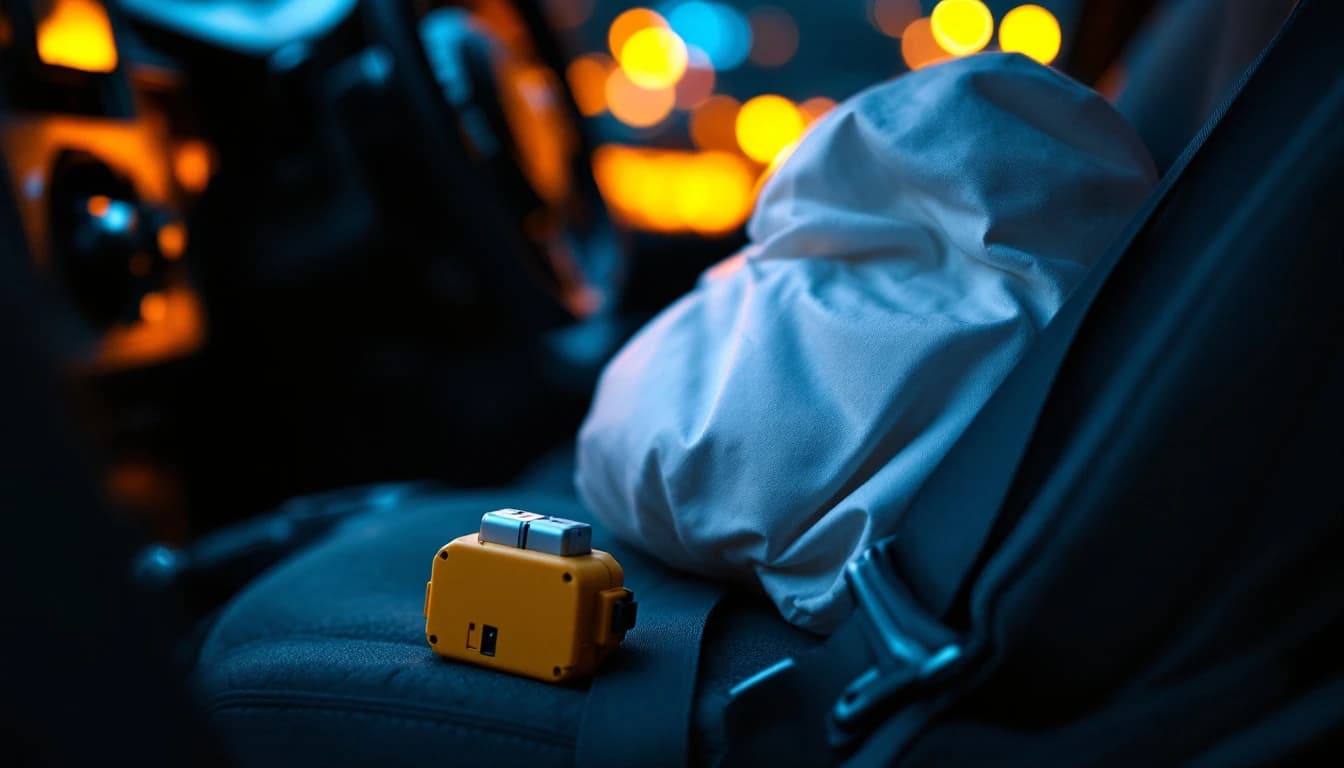
Airbag Light On After an Accident? Reset vs Replace
Why your airbag light is on after a crash
You had a collision — maybe a hard one that deployed the bags, maybe a lower-speed hit that didn't — and now the airbag warning light on your dashboard is stuck on. It won't clear with a scan tool, it won't reset by disconnecting the battery, and a shop told you the SRS module needs to be "replaced" or "reset." That light is not a bug. It's the restraint system telling you it has locked itself out.
Here's what happened in the fraction of a second during the impact. Your car's SRS (Supplemental Restraint System) control module — the small computer that decides when to fire the airbags and seat-belt pretensioners — sensed the deceleration, made its deployment decisions, and then wrote a permanent record of the event into its memory. That record is what technicians call crash data. Once it's written, most modules set a hard lock: they refuse to arm the system again and keep the warning light illuminated. The logic is deliberate and safety-driven — a module that has already "seen" a crash should not be trusted to protect you a second time until a human confirms the restraint hardware has been made whole.
This article explains, in plain terms, what crash data is, why the module locks, and the three real paths back to a working system: clearing the crash data on your original module, buying a used module, or a dealer replacement. It also draws a hard line that too many quick-fix sellers blur — clearing a code is not the same as repairing an airbag.
What "crash data" actually is
Crash data is not a single trouble code. It's a bundle of information the SRS module captures around the moment of impact, stored in non-volatile memory so it survives a dead battery. Depending on the manufacturer and model year, it typically includes:
- Deployment commands — which airbags and pretensioners the module told to fire, and in what sequence
- Hard codes — permanent faults latched by the deployment event (a fired squib circuit now reads as an open circuit, for example)
- Soft codes — recoverable faults that may clear on their own but were present at the event
- Event data — on many vehicles the module also holds Event Data Recorder (EDR) information such as change in velocity (delta-V), belt-buckle status, and how many milliseconds elapsed between the sensed impact and deployment
That EDR component is regulated. The U.S. National Highway Traffic Safety Administration has published federal rules governing event data recorders, and the vast majority of new light vehicles have carried EDR capability for years. According to NHTSA, event data recorders capture a short window of crash information used for research and reconstruction — which is one reason crash data should never be casually wiped from a vehicle that may be involved in an active insurance claim or legal matter. If your car is part of an open claim, confirm with your insurer or attorney before any restraint work is performed.
Why the module locks itself out
Think about what the SRS module is protecting against. Airbags are one-time devices — a pyrotechnic charge inflates the bag, and once fired that circuit is spent. Seat-belt pretensioners are the same: a small charge yanks the belt tight at impact, and once fired it's done. After a deployment, the module looks at its circuits and sees fired squibs reading as electrical faults. It has no way to know, on its own, whether those parts have been replaced.
So it takes the only safe position available: it latches a hard code and disables the system, holding the warning light on. This is by design. A module that silently re-armed over spent airbags would give a driver a false sense of protection. The lock forces a human — a qualified technician — into the loop to confirm the physical restraint hardware is sound before the system is allowed to arm again.
This matters because occupant restraints save lives at a scale worth respecting. The Insurance Institute for Highway Safety reports that frontal airbags reduce driver fatalities in frontal crashes by roughly a quarter, and side airbags that protect the head substantially cut driver death risk in driver-side crashes. Seat belts, per NHTSA, saved an estimated tens of thousands of lives in a single recent year. A restraint system is only as good as its readiness, and a locked module is a system that is honestly telling you it is not ready.
The three ways back to a working system
Once the module is locked, there are three legitimate routes to restore a functioning SRS. They differ enormously in cost, risk, and how well the repair matches your specific vehicle.
Option 1 — Clear the crash data on your original module
This is the bench service Auto Module Lab performs. You remove your original SRS module and mail it in. On the bench, the stored crash data and latched hard codes are cleared, and the module is returned to the same functional, code-free state it left the factory in — while keeping your vehicle's original VIN and factory coding intact. Because it is literally your module, there is no matching or programming risk: the part that goes back into your car is the part that was engineered, coded, and VIN-locked for it.
The airbag / SRS module crash-data clear is a flat $75 mail-in bench job, plus return shipping you select at checkout (from $29.95). It is the lowest-cost and lowest-risk of the three options — provided, and this is non-negotiable, the physical restraint hardware has already been made right.
Option 2 — Buy a used module
You can source a used SRS module from a salvage vehicle. The problem is that a used module carries the crash-data state, VIN, and coding of the vehicle it came from. If it was pulled from a wrecked car, it may itself be locked with crash data. Even a "clean" used module often needs to be reprogrammed and coded to your VIN to communicate properly on your vehicle's network, and a mismatch in software level or coding can leave the SRS light on or cause the module to misbehave. Used modules are a gamble unless you also account for the coding step.
Option 3 — Dealer replacement
The dealer will typically install a brand-new SRS module and code it to your VIN. This is the most expensive path — a new restraint control module plus dealer programming labor — and for many older vehicles the part cost alone dwarfs the value of the fix. It is the correct choice when a module is physically damaged or when a manufacturer requires a new module for a specific safety recall, but for a module that is simply locked with crash data, replacing it is often far more than the situation requires.
What clearing crash data does NOT do
This is the most important section in this article, so read it slowly.
Clearing crash data does not repair a single physical restraint part. It does not re-pack a deployed airbag. It does not replace a fired seat-belt pretensioner. It does not fix a crushed impact sensor, a torn wiring harness, or a bent seat-belt buckle. The crash-data clear operates on the module's memory — the stored record and the software lock — and nothing else.
What it does is restore the module to a clean, functional baseline so that a properly repaired restraint system can arm again. The correct sequence is always:
- A qualified shop inspects the vehicle and identifies every restraint component that fired or was damaged — airbags, pretensioners, impact sensors, clock spring, wiring.
- Those physical parts are replaced with the correct components.
- The SRS module — now facing sound hardware — has its crash data cleared so it can arm the repaired system.
- The system is verified: the warning light goes out and stays out, confirming the module sees healthy circuits.
If you clear the crash data on a module whose airbags are still deployed and whose pretensioners are still spent, you have created a dangerous situation: a warning light that may go out over a system that cannot protect anyone. The light exists to tell the truth. Never treat a crash-data clear as a shortcut to make an inspection light disappear on an unrepaired car.
An independent collision-restraint technician framed it this way:
"The module clear is the last ten minutes of a restraint repair, not the first. I've had people call wanting the light off so a car passes a glance in the driveway, still with a blown bag hanging out of the wheel. That's not what this is. You fix the bags, the belts, the sensors — then you clear the module so it can watch over parts that actually work." — Collision restraint systems technician, 16 years in airbag and SRS repair (anonymized)
Original module vs used vs dealer — the clear comparison
| Clear original module (bench) | Used module | Dealer new module | |
|---|---|---|---|
| VIN / coding match | Perfect — it's your module | Risk of mismatch; often needs recoding | Coded to your VIN by dealer |
| Crash-data state | Cleared to factory baseline | May arrive still locked | New, clean |
| Programming risk | None (same part goes back) | Moderate to high | Low (dealer handles it) |
| Relative cost | Lowest — $75 flat + return shipping from $29.95 | Variable (part + possible recoding) | Highest (new part + labor) |
| Turnaround | Fast mail-in bench job | Depends on sourcing | Depends on parts + appointment |
| Best for | A locked module on a repaired car | Physically damaged module, budget swap | Physical damage or recall requirement |
The pattern is the same one that shows up across module work generally: keeping your original, VIN-matched module and servicing its memory is almost always cleaner than swapping in another vehicle's brain. Our broader services hub explains the same original-versus-replacement logic for engine, cluster, and body modules.
How the mail-in crash-data clear works
The whole point of a bench service is that you don't drive anywhere — you ship a part. Here's the sequence, start to finish:
- Repair the hardware first. Before anything ships, your collision shop or mechanic should have already inspected and replaced the deployed airbags, fired pretensioners, and any damaged sensors or wiring. The module clear is the final step, not the first.
- Confirm fitment. Text us the SRS / airbag control module part number off the case label, plus the year, make, and model. We confirm the module is one we service before you send anything.
- Remove and ship the module. Disconnect the battery and follow proper SRS handling procedure, remove the module (usually located under the center console or dash), and ship it to PO Box 120241, Arlington TX 76012 if you ship USPS — or 1009 Oakwood Ln # 120241, Arlington TX 76012 if you ship UPS or FedEx (UPS and FedEx cannot deliver to a PO Box). Pack it in an anti-static bag inside a padded box.
- Bench read and archive. On arrival we power the module on a regulated bench supply, read its state, and archive the existing data before any change.
- Clear crash data and hard codes. The stored crash data and latched hard codes are cleared, returning the module to a functional, code-free baseline with your VIN and coding untouched.
- Verify communication. The module is tested on the bench to confirm it communicates and reports a clean, armed-ready state.
- Return with tracking. Your module ships back via the flat-rate return tier you chose at checkout (from $29.95, up to overnight). You reinstall it and confirm the SRS light goes out.
If you want the full mechanics of how mail-in module service works end to end — packaging, turnaround, and what happens on the bench — our mail-in module programming guide walks through the entire process, and our complete airbag SRS crash-data clear guide goes deeper on the SRS-specific details.
The ownership and legal side
Two responsibilities sit with the vehicle owner, and both deserve a plain statement.
Proof of ownership. Because the SRS module is a safety-critical, VIN-linked component, restraint work of this kind is performed only for the legitimate owner of the vehicle. Be prepared to show proof of ownership — a registration or title in your name — when you arrange service. This protects everyone: it keeps safety-system work tied to accountable owners and their repair shops.
Active claims and legal matters. As noted earlier, the crash data your module holds can be relevant to insurance claims and legal proceedings, because it may include event data used to reconstruct the crash. The National Highway Traffic Safety Administration treats EDR data as governed by federal rule, and access is generally limited to the vehicle owner or those the owner authorizes. If your vehicle is part of an open claim, confirm with your insurer or attorney before the data is cleared. Once cleared, that record is gone.
Why not just leave the light on?
Some owners, facing the cost of a full restraint repair, are tempted to simply live with the airbag light. That's a serious mistake for three reasons.
First, a locked SRS module means the system is disabled. In most vehicles a hard-coded SRS fault means the airbags and pretensioners will not deploy in a subsequent crash — the very protection the Insurance Institute for Highway Safety credits with cutting frontal-crash driver fatalities by roughly a quarter is switched off. You are driving without the airbags you paid for.
Second, an illuminated airbag light is a guaranteed inspection and safety-check failure in jurisdictions that check it, and a giant red flag to any future buyer. Vehicle-history services such as Carfax increasingly surface reported accidents and open safety issues, and a car with a lit SRS light is a hard sell.
Third — and this is the humane point — a crash you walk away from is exactly the scenario the next set of airbags is meant for. Restoring the restraint system properly is not a cosmetic fix. It's putting the safety net back.
Frequently asked questions
Can you just reset my airbag light without touching the module? No — a locked SRS module cannot be reset with a scan tool or by disconnecting the battery, because the crash data and hard codes are written to non-volatile memory. Clearing them requires the module to be serviced on a bench, which is exactly what our $75 crash-data clear does.
Does clearing crash data repair my deployed airbags? No, and this is the most important thing to understand. Clearing crash data only wipes the module's stored record and software lock. The physical airbags, seat-belt pretensioners, sensors, and clock spring must be inspected and replaced by a qualified shop first — the module clear is the final step that lets a properly repaired system arm again.
Why is clearing my original module better than buying a used one? Your original module already carries your vehicle's exact VIN and factory coding, so it drops back in with zero programming or mismatch risk. A used module from a salvage car may arrive still locked with crash data and usually needs recoding to your VIN to work correctly.
Is a used SRS module safe to install? A used module can work, but only if it matches your vehicle's software and coding and is itself crash-data free — many salvage modules are not. It's a gamble that often requires reprogramming, which is why servicing your own original module is the cleaner, lower-risk path in most cases.
Do I need proof of ownership for airbag module work? Yes. Because the SRS module is a safety-critical, VIN-linked component, this service is performed only for the legitimate vehicle owner — be ready to show a registration or title in your name when you arrange service.
Will the airbag light stay off after the crash-data clear? The light stays off only if the physical restraint hardware has been properly repaired first. Once the fired airbags, pretensioners, and any damaged sensors or wiring are replaced and your cleared module sees healthy circuits, the SRS light goes out and stays out.
How long does the mail-in crash-data clear take? Turnaround is fast once your module arrives — it's read, cleared, verified on the bench, and shipped back with tracking via the return tier you chose at checkout (from $29.95, up to overnight). Confirming fitment before you ship keeps the whole process quick.
The bottom line
After a collision your SRS module records crash data and locks itself, holding the airbag warning light on until that data is cleared or the module is replaced. Crash data is the stored record of the impact — deployment commands, hard and soft codes, and often regulated event data. The module locks on purpose, because it can't verify on its own that the fired airbags and pretensioners have been replaced.
You have three ways back: clear the crash data on your original module (cheapest, no VIN or coding risk), buy a used module (gamble on matching and possible recoding), or have a dealer install a new one (most expensive). For a module that is simply locked after a repaired crash, clearing your original is almost always the right answer — a flat $75 mail-in bench job, plus return shipping from $29.95, with your VIN and coding untouched.
But never lose sight of the line this article keeps drawing: clearing the code does not repair the airbags. The physical restraint system — bags, belts, pretensioners, sensors — must be inspected and replaced by a qualified shop first. The crash-data clear is the final step that lets a properly repaired module arm again over hardware that actually works. Repair the hardware, prove ownership, then see the airbag / SRS module crash-data clear service page to confirm fitment — text us your module part number and we'll confirm we service it before anything ships.
Ship your module today
Flat-rate pricing, typical 24-hour bench turnaround, return speed your choice at checkout. Most jobs back on your bench within a week.