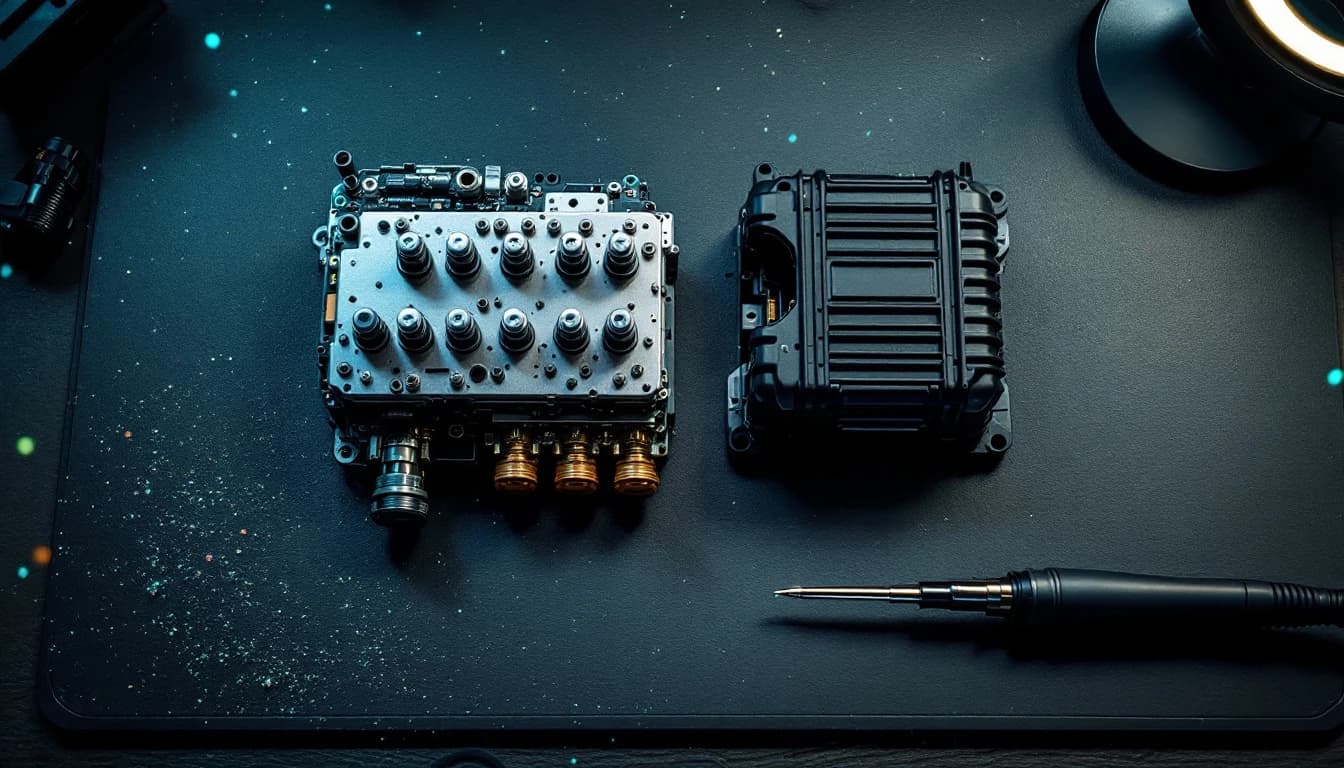
ABS Module Repair: Why Bench Beats Swapping (2026)
Who this is for
You're reading this because one of these is true:
- Your scan tool returned a code like C0040, C0245, 5DF0, or "ABS control module internal failure"
- The ABS warning light is on (often with traction control + stability control lights), but the car still drives and brakes mechanically
- A shop quoted you $1,200-$3,500 for a new ABS module / hydraulic unit
- You lost ABS comms entirely — the scanner can't see the ABS module at all
- You're an independent shop weighing whether to add controller-level bench repair to your offering
The short answer: ABS hydraulic blocks almost never fail. The controller board bolted to the top of the block — the electronics that drive those solenoids — fails constantly and predictably. Repair of that board is bench-level work that costs a fraction of a hydraulic swap.
If you want pricing and turnaround, see our ABS Module Repair service page. The rest of this guide walks the symptoms, patterns, and brand-specific failure modes.
What an ABS module actually is
Electronic ABS has been in series production since 1978, when Bosch launched it on the Mercedes-Benz S-Class, and the basic layout has not changed since. An anti-lock braking system module is two physically-attached parts:
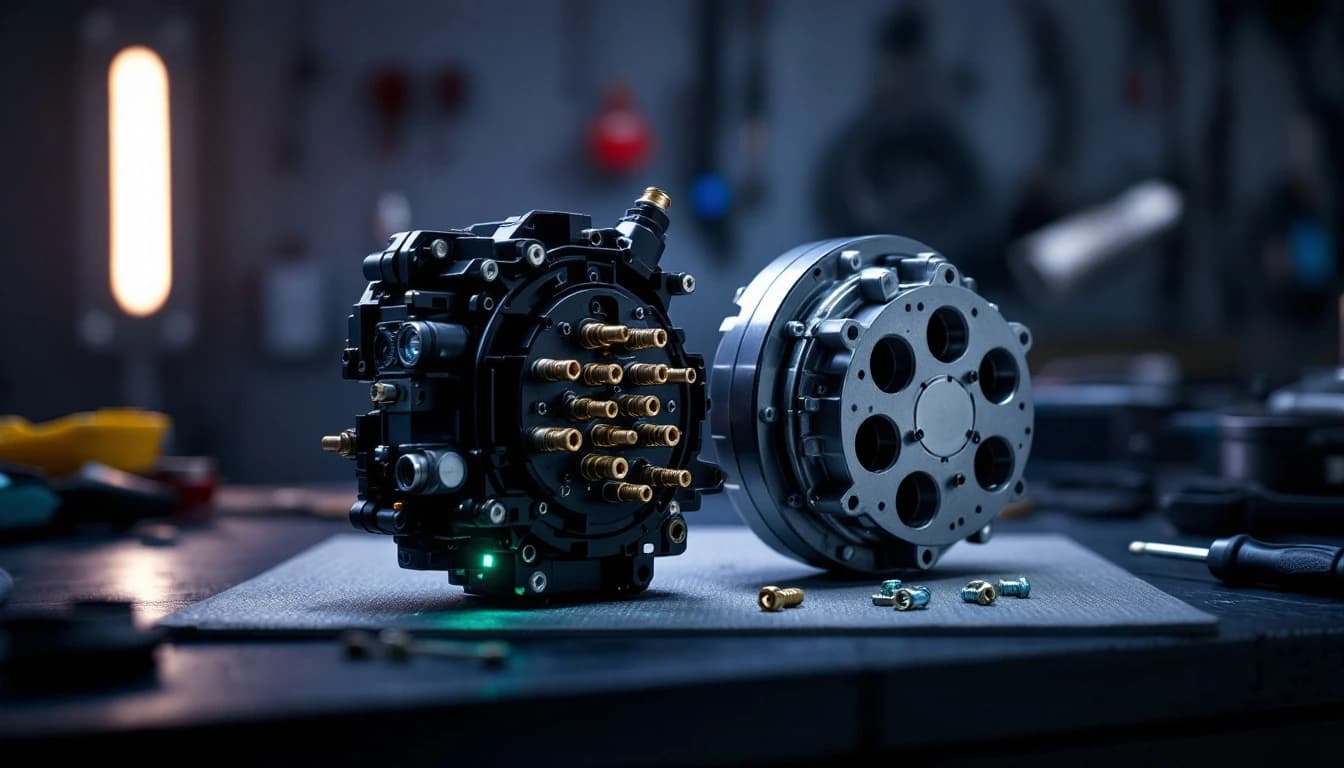
The hydraulic block — a precision-machined aluminum housing containing the brake-fluid passages, the solenoid valves that pulse pressure to each wheel, and the recirculation pump motor. Mechanical, hydraulic, and extraordinarily durable.
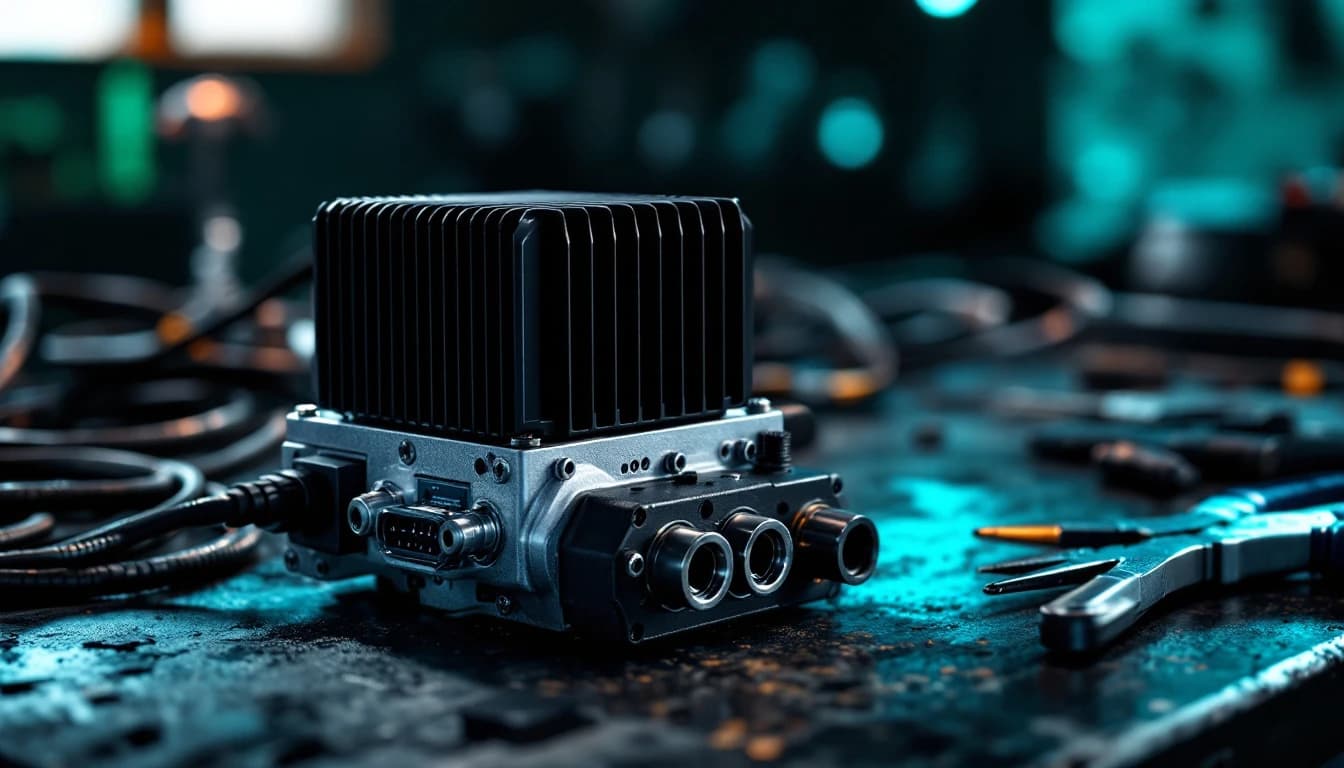
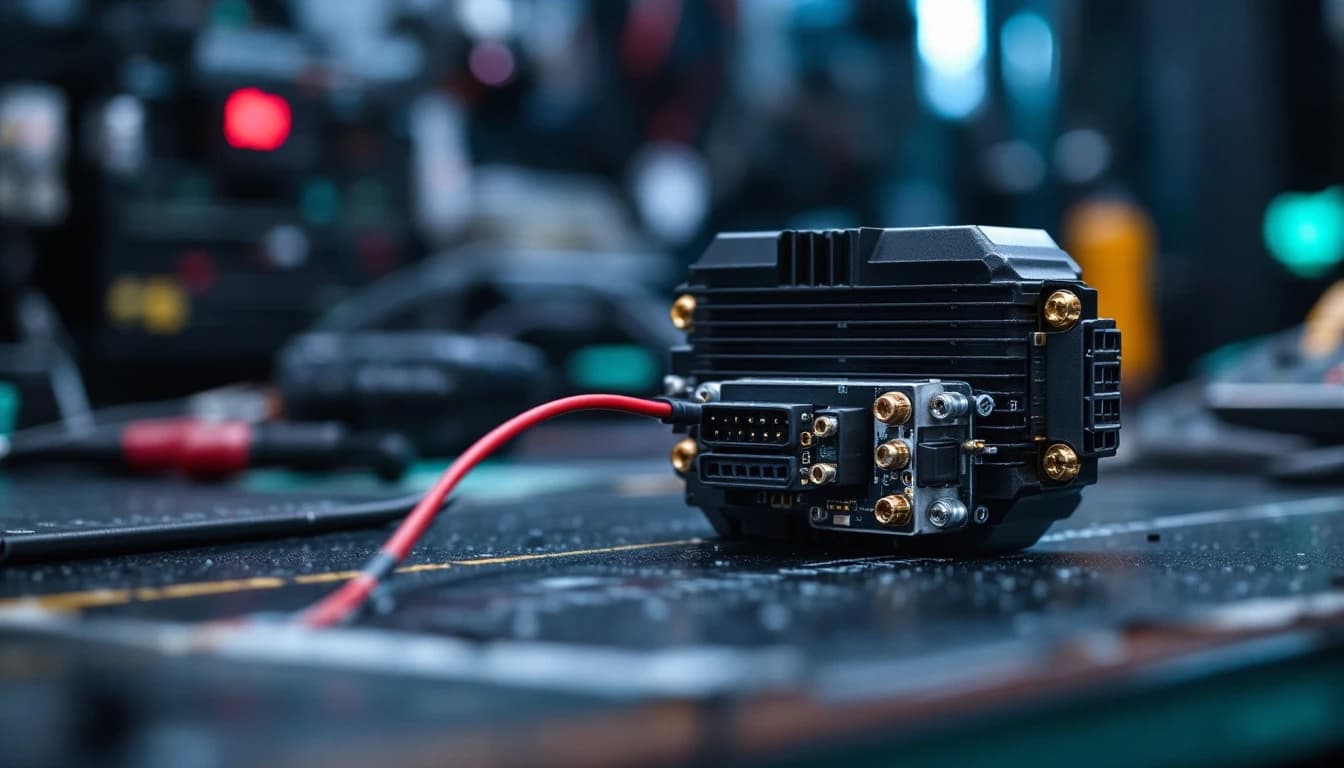
The controller / ECU — a circuit board mounted directly on top of the hydraulic block. The board contains a microcontroller, an EEPROM that holds calibration and adaptation data, solenoid driver ICs (high-side switches rated for 5-20 amps), pump-motor driver MOSFETs, and capacitors handling inrush and decoupling.
When the system works, the controller reads wheel-speed sensors at ~50 Hz and pulses individual solenoids to release-hold-apply brake pressure 10-15 times per second per wheel. When the controller fails, the hydraulic block underneath is still mechanically fine — but the car loses ABS, traction control, stability control, and hill-start assist all at once.
On most designs the controller is a separate assembly held to the block by a handful of screws, and it lifts off without opening a single brake line. The two are sold together as one "ABS module" because that is how the vehicle manufacturer packages the replacement part — not because they fail together. Since Federal Motor Vehicle Safety Standard No. 126 made electronic stability control mandatory on new passenger cars and light trucks up to 10,000 lb built from September 1, 2011, the same controller usually runs traction and stability control too, which is why one failed board can switch all three off at once.
How ABS controllers actually fail
Controller failures fall into four broad categories. Independent specialists describe the same pattern platform by platform — ECU Testing, for example, lists the Jeep Compass and Wrangler ABS fault among the common faults it repairs:
1. Solenoid and pump driver failure
The solenoid drivers are high-side switching chips (typically an integrated high-side driver from a supplier such as Infineon or STMicroelectronics) that connect 12V to each solenoid coil. They run hot and switch hundreds of millions of cycles over a vehicle's life. When a driver fails it usually shorts internally — the result is a stuck solenoid (no ABS modulation on that wheel) or a shutdown of the controller's output stage with a "valve relay" or "solenoid open/short" DTC.
2. EEPROM corruption
The EEPROM stores wheel-speed calibration, brake-pad-wear adaptation, VIN, steering-angle offset, and (on newer cars) the immobilizer link. Voltage spikes during jump-starts, alternator failures, or low-battery cranking can corrupt EEPROM cells. Symptom: a controller that boots, talks to the scanner, but reports an internal-checksum or coding-mismatch fault.
3. Capacitor degradation
Electrolytic and tantalum capacitors dry out, leak, or short over time. The result is power-supply instability, intermittent module reset, or — when a capacitor near the pump-motor driver fails — total loss of pump function. Symptoms are often intermittent at first before progressing to permanent failure.
4. Water ingress and corrosion
Some chassis (Land Rover LR3/Discovery 3 especially, certain Mercedes W211 wagons, early Audi Q7) park the ABS module in a location vulnerable to water intrusion. Corrosion attacks the connector pins, the board, and the solder joints. Caught early this is repairable; caught late the board may be unsalvageable.
The hydraulic-block-swap myth
The typical dealer or independent-shop workflow when an ABS warning light shows up:
- Scanner returns "ABS module internal" or similar fault
- Shop looks up part number for the entire ABS module assembly
- Customer is quoted $800-2,500 for the part plus 2-4 hours labor plus a brake bleed
- Shop swaps the whole assembly and codes the new module to the car
It works. But when the fault is on the controller board it is more than the job needs, and it is not cheap: RepairPal puts an ABS control module replacement on a Ram 1500 at about $785 to $841 installed, and a genuine Mopar module for a Jeep Wrangler lists for roughly $1,000 to $1,800 at Mopar Parts Giant before anyone has programmed it to the vehicle and bled the brakes.
The reason shops still swap the whole unit is simple: most service centers don't bench-repair circuit boards. The skill set for solenoid-driver replacement and EEPROM repair lives at specialty module shops. That's not a criticism; it's just division of labor. But it means the customer pays for parts they didn't need.
Bench repair of the controller board only — leaving the hydraulic block in place — spans a wide market. Older, simpler controllers go for $250-350: Circuit Board Medics lists the 1998-2005 Kelsey-Hayes 325 at $249.99 and the 2006-2012 TRW EBC-440 at $349.99. Modern units run far higher — Automotive Circuit Solutions charges $749.99 for a 2006-2016 Jeep Wrangler EBCM on a 5-15 business day turnaround. At Auto Module Lab the flat rate is $499, with about a week of bench time once the module arrives (2–3 business days with rush repair, +$100). Total downtime is usually about two weeks including shipping.
Diagnosing controller vs hydraulics
Before shipping anything, the diagnostic question is: electrical (controller) or mechanical (hydraulic)?
Step 1: Pull the codes. Use a bidirectional scanner that can see the ABS controller. Generic OBD-II scanners won't — you need one that talks to the chassis bus.
Step 2: Classify the code.
- C0040-C0075 range: wheel-speed sensor faults. Replace the sensor or the tone ring — not a module problem.
- C0245, C0246, C0265: EBCM / ABS controller internal faults. Bench repair candidate.
- C0110, C0121, C0131: valve solenoid faults. Could be the controller's driver IC, or a genuinely stuck solenoid. Bench shop can distinguish.
- U0121, U0122: lost communication with ABS module. Wiring/connector issue or a controller that's not powering up.
- 5DF0 / 5DF1 (BMW), 5710 / 5715 (Mercedes): internal-checksum or EEPROM-corruption codes. Definitive controller fault.
For BMW E46/E39 platforms specifically, see C0040 ABS Module Internal Fault. For Mercedes W211/W219 no-communication cases, see ABS No Comm Mercedes.
Step 3: Inspect the connector seal. Pop the controller cover and look at the back of the connector. Green corrosion = water ingress. White crystalline deposits = brake-fluid intrusion. Either changes the repair plan but is usually salvageable.
Brand-specific failure patterns
After 15 years of bench work the chassis-specific patterns are well-documented. Here's the matrix:
| Chassis / Module | Common failure mode | Bench repair likelihood | Mail-in bench price |
|---|---|---|---|
| BMW E46 ATE Mk60 | Solenoid driver IC + tantalum cap | Very high | $499 flat |
| BMW E39 / E38 Bosch 5.7 | EEPROM + valve relay | Very high | $499 flat |
| BMW E60/E61 Bosch 5.7/8.0 | Driver IC, occasional water | High | $499 flat |
| Mercedes W210 / W211 Bosch SBC | Pump driver MOSFET (notorious) | High | $499 flat |
| Mercedes W203 / W209 Bosch 5.3 | EEPROM + capacitor | Very high | $499 flat |
| Mercedes W164 ML / W251 R | EEPROM coding, water ingress on R | Variable | $499 flat |
| VW / Audi Bosch 5.3 (Mk4 era) | Driver IC | Very high | $499 flat |
| VW / Audi Bosch 5.7 (Mk5 era) | EEPROM + driver | Very high | $499 flat |
| Audi Bosch 8.0 / 8.1 (Mk6+) | Capacitor degradation | High | $499 flat |
| Land Rover Discovery 3 / LR3 Bosch | Water ingress (top of block) | Variable | $499 flat |
| Land Rover RR Sport / LR4 | Driver IC + water | Variable | $499 flat |
| Toyota Camry / Highlander Denso | EEPROM, driver IC | Very high | $499 flat |
| Toyota Tundra / Tacoma Denso | EEPROM | Very high | $499 flat |
| Lexus GS / IS Denso | Driver IC | High | $499 flat |
| GM (most) Delphi DRP | EEPROM, occasional driver | Very high | $499 flat |
| GM Silverado / Sierra Kelsey-Hayes (older) | EBCM relay solder cracks | Very high | $325 flat — dedicated KH325 service |
"Bench repair likelihood" is our qualitative read on how often units of that family arrive in a state we can return to full function, not a published success rate. Every row except the older GM Kelsey-Hayes unit is the same flat $499 ABS module repair service - the price does not change by chassis, because the bench work does not (a failed main processor adds $100, and we ask before doing that work). The variable cases are usually water-damage situations where the board is too far gone — in those rare cases the customer's repair fee is refunded and they fall back to a replacement assembly.
One practical note from how these actually move through the bench: the single thing that most often delays a job is a module we cannot positively identify from the photos supplied. Text us a clear shot of the module label alongside your VIN before you ship and we confirm what you have first, which is also how we catch the cases where the unit in your hand is not the part the parts catalogue said it would be. Bench time on a confirmed ABS module repair is about a week once the module is received — 2–3 business days if you add rush repair at checkout — and return shipping is chosen and paid by you at checkout from 29.95 dollars, so an air option is there when the vehicle is the only one you have.
What bench repair actually fixes
A controller-board bench repair will reliably resolve:
- All four solenoid-driver-fault codes (per-wheel valve faults)
- Pump-motor driver / "pump motor circuit" faults
- EEPROM checksum / coding-mismatch faults
- "ABS module internal" generic faults
- Loss of communication with the ABS module
- ABS / TC / ESC warning lights triggered by any of the above
- Intermittent ABS dropouts during driving (capacitor instability)
After repair the module needs basic re-initialization on the car — wheel-speed calibration, steering-angle reset. Standard scan-tool functions, under 30 minutes at any capable independent shop.
What bench repair does NOT fix
Be honest with the diagnosis before ordering. Out-of-scope for controller bench work:
- Cracked hydraulic body — extremely rare; usually from a freeze event or crash damage
- Contaminated brake fluid damage to solenoids — if improper fluid corroded the coils internally, the hydraulic block needs replacement
- Mechanical pump-motor seizure — distinct from electrical pump-driver failure; requires a pump assembly swap
- Wheel-speed sensor faults — replace the sensor; it's at the wheel, not in the module
- Brake-fluid leaks at block-to-line fittings — sealing issue, fixed with new crush washers
- Wiring-harness damage between module and chassis — bench repair fixes the module, not chassis wiring
A genuinely failed hydraulic unit is the exception rather than the rule: the valve bodies and passages are machined metal sitting in brake fluid, while the board above them carries the heat-cycled electronics. That is why the bench evaluation comes first — it tells you which half actually failed before anyone buys parts.
AML's ABS repair workflow
When your ABS module arrives at the Arlington workshop, here's what happens:
- Intake + photograph — log the chassis and the customer's reported symptoms
- Separation (if needed) — if you shipped the full module, we separate the controller from the hydraulic block in a clean area to avoid contaminating the valve passages
- Visual inspection under magnification — look for the telltale signs (bulged caps, scorched driver ICs, corroded pins, cracked solder joints)
- Bench power-up test — power the controller on a 12V harness and verify the failure mode the scan tool reported
- EEPROM read + archive — dump existing data, archive a binary backup (kept 90 days)
- Component-level repair — replace failed driver ICs, capacitors, or other components. Reflow questionable solder joints. Clean any corrosion.
- EEPROM write + verify — rewrite corrected calibration data, re-read, byte-for-byte verify
- Bench function test — re-run the test that originally failed; confirm the fault is gone
- Reassembly + ship — reseat the controller to the hydraulic block if applicable, ship it back with tracking at the return speed you chose at checkout
Hands-on bench time per module is 2-6 hours depending on failure mode; with testing and the queue, a repaired module typically leaves the bench about a week after it arrives, or in 2–3 business days with rush repair. Both are estimates, not guaranteed dates.
What to ship: controller only vs. whole module
For most chassis, separating the controller at home is straightforward and saves shipping cost (the controller is ~1 lb; the full assembly is 8-15 lb). For BMW, Mercedes, VW/Audi, Toyota, and most GM, separation is 4-6 Torx screws and the controller lifts off cleanly. Step-by-step packing instructions arrive with your order confirmation email.
For Land Rover and some early Mercedes SBC systems, we recommend shipping the whole assembly — the separation is more delicate. If you're not sure, see How It Works for shipping guidance, or text us with the year/make/model.
After-repair brake bleed requirements
If the brake lines were opened to take the whole assembly off, the car needs a brake-system bleed after reinstallation; if only the controller came off the block, the hydraulics were never opened and no bleed is needed. When a bleed is needed: on older systems (pre-2000) a manual gravity bleed at all four wheels is sufficient. On modern systems with high-pressure accumulator or stability-control valving, you need a bidirectional scan tool that can command the ABS pump to cycle each solenoid during bleeding — this purges air trapped in the valve body.
The factory bleed procedure for each platform is in the manufacturer's service information, which shops usually reach through ALLDATA or a similar subscription; skipping it after module work can leave a low or spongy pedal. Any competent independent shop has the scan-tool capability for this; the bleed adds about 30 minutes to the reinstall.
What it costs, side by side
These are published prices, not a customer story, so every number can be checked:
| Path | What you pay | Programming to your car | Brake bleed |
|---|---|---|---|
| New ABS control module, installed (Ram 1500 example) | About $785–$841 per RepairPal | Yes | Yes |
| Genuine Mopar module, part only (Jeep Wrangler example) | Roughly $1,000–$1,800 at Mopar Parts Giant | Yes | Yes |
| Specialist rebuild of a 2006-2016 Jeep Wrangler EBCM | $749.99 at Automotive Circuit Solutions, 5-15 business days | No, it is your unit | Not if only the controller came off |
| Bench repair of your own module at Auto Module Lab | $499 flat plus return shipping from $29.95; about a week on the bench, 2–3 business days with rush repair (+$100) | No, it is your unit | Not if only the controller came off |
The pattern holds across makes: buying new means paying for a hydraulic unit that probably did not fail and then programming the replacement to the car, while repairing the board you already own keeps its original coding.
From the bench
"When an ABS light comes on, the hydraulic unit is usually fine - the board bolted on top of it is what failed. Repair that board and the module keeps its original coding, so it normally goes back in without programming." — Auto Module Lab bench team, Arlington, Texas
Frequently asked questions
Will the car drive while I'm waiting for the module to come back? Yes, mechanically. The brake pedal still works through the master cylinder. You'll lose ABS, traction control, and stability control until the module is reinstalled, so drive conservatively.
Will I need to re-code the module after reinstallation? On most chassis a basic re-initialization (steering-angle reset, wheel-speed calibration) is enough and can be done by any shop with a bidirectional scan tool. Some newer BMW, Mercedes, and Audi platforms require a brief "online coding" step via factory-equivalent tooling.
Is the repair permanent? Yes, when properly executed. We replace the failed parts with new automotive-grade components, and the repair carries a 1-year warranty that you can extend at checkout to 2, 3 or 5 years.
Does this work on hybrids or EVs with regenerative braking? Yes for the friction-brake portion of the ABS. The regenerative braking ECU is a separate module and is not what we repair.
My ABS light came on after a jump-start — is that an EEPROM thing? Very often yes. Voltage transients during jump-starts are a leading cause of EEPROM corruption in ABS controllers — bench-repairable in nearly every case.
What if the bench shop finds the hydraulic block is actually damaged? In the uncommon case where the hydraulic body has cracked or the solenoid internals are mechanically compromised, we refund the repair fee and document the finding so you can source a replacement assembly with confidence.
The bottom line
Most ABS warning lights, no-comm faults, and "module internal" DTCs are caused by failed components on the controller board — not by the hydraulic block. Bench repair of the controller is a fraction of the cost of swapping the assembly, works across nearly every brand and chassis in the table above, and is recoverable work that respects the original part's calibration and VIN coding.
Flat-rate pricing at our ABS Module Repair service page starts at $499 for most chassis, with about a week of bench time once the module arrives (2–3 business days with rush repair, +$100) and a 1-year warranty you can extend at checkout (return shipping is a flat-rate checkout option, from $29.95). The original EEPROM is archived for 90 days as a safety net.
If you're not sure whether your symptoms match a controller fault or a hydraulic fault — or you want a sanity check on a shop quote — text us with the year/make/model, the codes your scanner returned, and a sentence on the symptom. We'll tell you straight whether bench repair is the right path or whether you genuinely need a full assembly replacement.
Ship your module today
Flat-rate pricing, typical 24-hour bench turnaround, return speed your choice at checkout. Most jobs back on your bench within a week.