
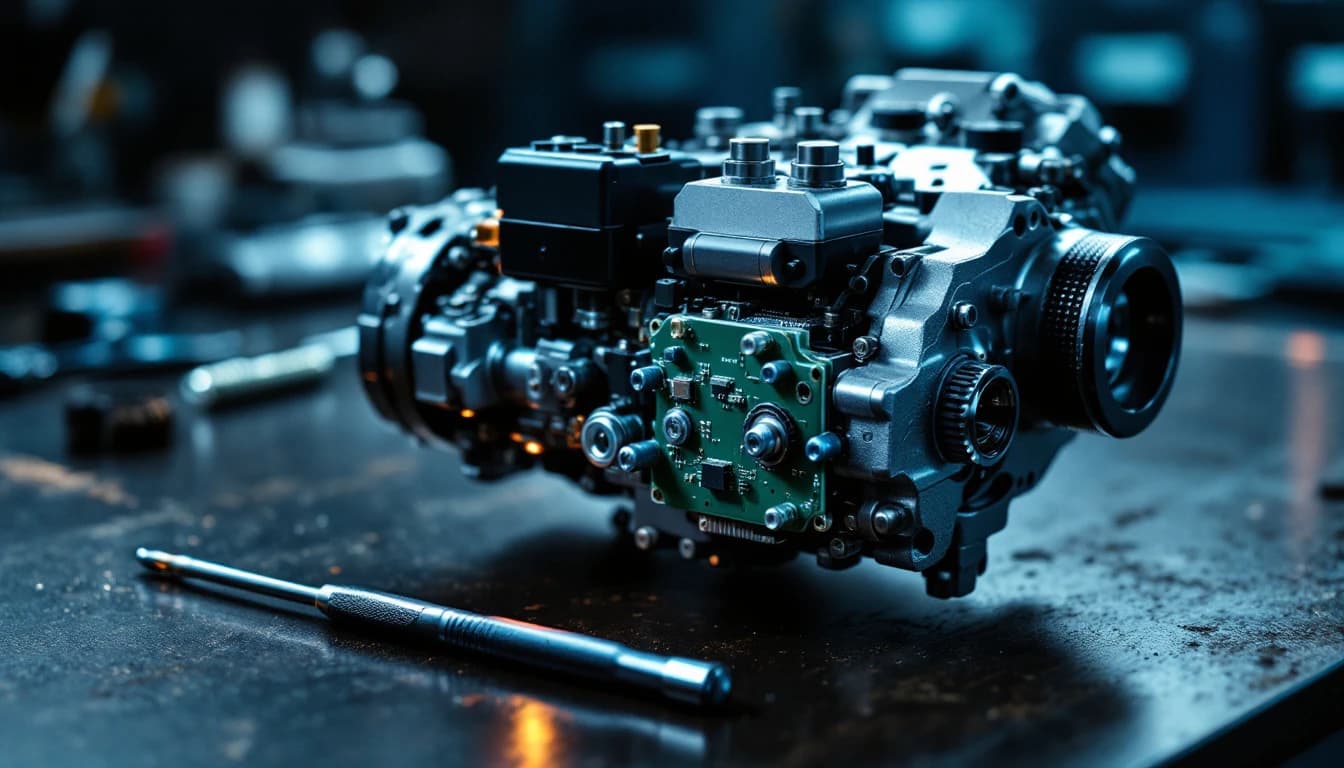
DSG Mechatronic Failure: Symptoms, Fix and the $350 Clone
Who this is for
As of September 2026 this service is $350 flat. The jobs that reach our bench most often are DQ200 dry-clutch units out of 1.4T and 1.8T cars showing the classic no-drive-after-a-cold-start pattern, and DQ250 units arriving after a shop has already replaced the fluid and filter with no change — worth knowing before you spend money on a second fluid service.
You are probably reading this because one of the following is true:
- Your VW, Audi, Skoda, or SEAT is flashing PRNDS at you, has lost reverse, or is stuck in limp-home mode, and the scan points at the mechatronic unit
- A shop quoted you a new mechatronic from the dealer and the number made you sit down
- You already bought a used mechatronic from a breaker and discovered it will not just plug in and drive
- You are a transmission shop or independent garage that pulls mechatronics regularly and wants a reliable bench partner for the data side
The short version: if your original mechatronic's control unit still communicates on the bench, we can clone its data — adaptation data, transmission coding, and component-protection/immobilizer data where applicable — onto a part-number-matched donor unit so the donor behaves like your original. That is a flat $350 mail-in bench job covering DQ250 and DQ200 mechatronics across the VW Group brands, verified by part number before you ship anything. Everything below explains what the mechatronic actually is, how the two common gearboxes differ, what failure looks like, and why the clone path exists at all.
What the DSG mechatronic actually is
DSG stands for Direkt-Schalt-Getriebe — direct-shift gearbox. It is Volkswagen Group's dual-clutch automated manual: two clutches, two input shafts, one clutch handling the odd gears and one handling the even gears, so the next gear is pre-selected and the swap happens in fractions of a second. Dual-clutch transmissions earned their place because they shift faster than a conventional automatic and waste less energy doing it — the efficiency case for advanced transmission designs is well documented by the U.S. Environmental Protection Agency, and the underlying engineering has an extensive technical literature at SAE International.
The brain and the muscle of the whole system live in one component: the mechatronic unit. The name is literal — mechanics plus electronics in a single assembly. Inside one housing you get:
- The transmission control unit (TCU) — the computer that decides when to shift, how to slip the clutches, how much line pressure to run, and how to adapt to wear over time
- The hydraulic valve body — solenoids, valves, pressure sensors, and hydraulic circuits that physically actuate the clutches and gear selectors
- The sensor suite — speed sensors, position sensors, and temperature sensors that tell the TCU what the gearbox is doing in real time
Because the electronics and the hydraulics share a housing bolted inside (or onto) the gearbox, the mechatronic lives in a genuinely hostile environment: heat cycles, vibration, and — on the wet-clutch boxes — immersion in transmission fluid. That environment is exactly why mechatronic failure is one of the best-known weak points in the VW Group driveline, and why a whole aftermarket exists around replacing and repairing them.
DQ200 vs DQ250 — know which one you have
The two mechatronics we clone serve two very different gearboxes, and identifying which one you have is step one of any repair conversation.
DQ250 — the 6-speed wet-clutch DSG. This is the original high-volume DSG, introduced in the early 2000s and fitted behind torquier engines — think GTI, Golf R, Audi A3/TT quattro variants, Passat V6 and TDI applications, and many Skoda and SEAT equivalents. Its two clutches run bathed in oil ("wet"), which cools them well and lets the box take serious torque. Its mechatronic sits inside the gearbox, immersed in fluid, and shares that fluid with the clutch packs.
DQ200 — the 7-speed dry-clutch DSG. Introduced later for smaller, lower-torque engines — 1.2, 1.4, 1.5, and 1.8 litre applications across Golf, Jetta, Polo, Octavia, Leon, and a long list of others. Its clutches run dry, like a manual gearbox clutch, which cuts drag losses and improves economy. Crucially, its mechatronic has its own sealed hydraulic circuit with its own small reservoir of fluid, separate from the gear oil, pressurized by an electric pump into a hydraulic accumulator.
That accumulator design is at the center of the DQ200's reputation. The unit stores hydraulic pressure so clutch and shift actuation is instant; when the pressure system develops a fault — a leaking accumulator, a tired pump, internal leakage — the control unit sees pressure it cannot maintain and takes the gearbox to a safe state. Owners typically experience it as a sudden loss of drive or reverse with a flashing gear display, and scans commonly show hydraulic-pressure fault codes in the P17xx family (the code owners quote most often on DQ200 forums is P17BF). The DQ200's early years were troubled enough that Volkswagen ran recall and extended-warranty campaigns in several markets — coverage at the time, reported by outlets including Car and Driver, described well over a million DSG-equipped vehicles swept up in 2013-era campaigns worldwide, concentrated on the seven-speed box. In the U.S. market you can check whether any campaign ever applied to your VIN through the National Highway Traffic Safety Administration.
The population of these gearboxes is enormous — Volkswagen Group delivers roughly nine million vehicles globally in a typical year, per Volkswagen's own reporting, and DSG variants have been fitted across every brand in the group for two decades. A big installed base plus a known-wear component equals a steady stream of owners searching the exact phrases that probably brought you here.
The classic failure symptoms
Mechatronic failure announces itself in a handful of well-worn patterns. If several of these match your car, you are in the right place:
- Flashing PRNDS display. The whole gear indicator strip flashes on the cluster. This is the DSG's generic "I have a stored fault serious enough to limit operation" signal.
- A single flashing gear letter — often the currently commanded gear blinking — accompanied by refusal to engage drive or reverse.
- No reverse, or no odd/even gears. Because one clutch serves the odd gears and one serves the even gears, a fault on one circuit can take out half the gearbox. Losing reverse plus 1-3-5 (or 2-4-6) while the others still work is a strong dual-clutch fingerprint.
- Limp-home mode. The TCU locks the box into a single gear, typically third, so you can crawl off the highway.
- Harsh, delayed, or shuddering engagement — clunks into drive, flare between shifts, judder pulling away.
- Hydraulic-pressure faults on scan (DQ200 especially): stored codes describing pressure too low, pressure not reached, or pump run-time exceeded.
- Intermittent electrical faults: lost communication with the TCU, implausible sensor signals, gear-position sensor faults — often heat-related at first, appearing when the box is hot and clearing when cold.
One important honesty note: not every one of these symptoms is the mechatronic. Worn clutch packs shudder. Low fluid or the wrong fluid causes harsh shifts. A failing gearbox can mimic a failing controller. That is why diagnosis matters before parts are thrown at the car, and why our hourly bench evaluation exists for units whose condition is unclear — we can power a mechatronic's control unit on the bench and tell you whether the electronics respond before you commit to a path.
"The pattern I see over and over is a car that comes in on a flatbed with PRNDS flashing, and an owner who already bought a used mechatronic off eBay because it was cheap. The used unit goes in, and now the car has two problems: the original fault and a donor unit that's married to somebody else's car. The data transfer is not optional on these — it's the difference between a repair and a paperweight." — European-driveline specialist technician, 15+ years on VW Group dual-clutch gearboxes (anonymized)
A data clone is not a repair — read this twice
Our service is a pure bench 1:1 clone of the failed mechatronic's control-unit data onto a donor unit. Being precise about that matters, because it defines what the service can and cannot fix.
What the clone does:
- Reads the control-unit data from your original mechatronic on the bench
- Transfers the adaptation data — the learned clutch engagement points, pressure adaptations, and synchronizer positions your gearbox has built up over its life
- Transfers the transmission coding — the configuration that matches the TCU to your exact vehicle, engine, and gearbox variant
- Transfers component-protection and immobilizer data where applicable — the security marriage that ties the unit to your car on platforms that enforce it
- Verifies the donor on the bench so it plugs in and drives without a from-scratch adaptation procedure
What the clone does NOT do:
- It does not repair worn or burned clutch packs — that is mechanical wear inside the gearbox
- It does not fix mechanical damage, broken selector forks, or bearing failures
- It does not cure hydraulic wear inside a donor unit — the donor's own pump, accumulator, and valves must be healthy
- It does not resurrect an original control unit whose electronics are completely dead and unreadable — the clone needs a readable source
In other words: the clone solves the data problem that makes used mechatronics useless out of the box. The hardware problem — choosing a healthy donor with a matching part number — is solved by verification before you ship. We check part number and module label first, every time, because a DQ200 unit cannot serve a DQ250 car and even within one family the hardware revisions matter.
Because component-protection and immobilizer data are involved, proof of ownership is required for this service. That is not bureaucracy for its own sake — the same data transfer that makes your repair possible is the kind of operation vehicle-security frameworks exist to control, and a legitimate shop verifies it is working on a legitimately owned vehicle.
Why a used mechatronic doesn't just plug in
This is the question underneath every "used DSG mechatronic" forum thread, so here is the full answer.
1. Adaptation data. A DSG continuously learns. It maps exactly where each clutch begins to bite, how much pressure produces how much torque transfer, and where every synchronizer engages — and it updates those maps as the hardware wears. A donor unit arrives carrying the learned map of a different gearbox with different wear. Run it on your box and, at best, you get harsh engagement and shudder while it slowly relearns; at worst, the mismatch between expected and actual behavior trips plausibility faults and puts you straight back into limp mode. Cloning your original adaptation data onto the donor means it starts life already knowing your gearbox.
2. Transmission coding. The same mechatronic hardware serves many vehicle configurations — different engines, torque limits, final drives, and market variants. Coding tells the TCU which one it lives in. A donor coded for a different variant can shift wrong, report faults, or refuse to play with your engine control unit entirely.
3. Component protection and immobilizer participation. On many VW Group platforms — Audi applications especially — control modules are protected by component protection, the security scheme that marks a module as belonging to a specific vehicle and degrades or disables function when it detects a transplant. On platforms where the transmission controller participates in the immobilizer scheme, an unmarried donor can prevent the car from driving at all. This is precisely the marriage a bench clone resolves: the donor leaves our bench carrying your car's identity, not the donor car's.
This trio is why the plug-and-play fantasy fails, and it is the same story we tell about engine ECUs in our guide to why used ECU swaps fail without cloning. Modern VW Group modules are married to the car. The clone is the wedding.
Clone vs dealer replacement — the honest comparison
There are three realistic paths out of a mechatronic failure. Here is how they stack up:
| Bench clone onto a donor (this service) | Dealer new mechatronic | Bare used unit, no clone | |
|---|---|---|---|
| Parts cost | Donor unit at used-market price | New unit at dealer parts pricing | Donor unit at used-market price |
| Data / programming | Full 1:1 clone — adaptation, coding, security data — $350 flat | Dealer online coding + adaptation session | None — arrives married to another car |
| Adaptation on install | Drives without from-scratch adaptation | From-scratch adaptation required | Wrong data — faults, limp mode, or no-drive likely |
| Typical all-in cost | Donor + $350 + install labor | Commonly well over $1,500-$3,000 with installation | Cheap until it doesn't work |
| Vehicle needed on site | No — pure mail-in bench work | Yes — dealer visit | — |
| Risk profile | Verified part-number match before shipping | Low risk, highest cost | High — the classic forum horror story |
On the dealer number: a new mechatronic assembly plus installation and coding at a franchised dealer commonly runs well over $1,500 and frequently past $3,000 depending on model and market — squarely in the territory of major transmission work, which Kelley Blue Book pegs at roughly $4,000-$7,000 when a full replacement is on the table. Against that backdrop, a healthy used donor plus a $350 clone is the reason this service exists. And the money conversation is not going away: transmission trouble remains one of the persistent problem areas in long-term dependability data — J.D. Power's vehicle dependability studies have measured the industry averaging roughly 190 problems per 100 vehicles in recent years, and driveline complaints are a steady contributor — while the average vehicle on American roads is now roughly 12.5 years old by widely reported industry estimates covered by Car and Driver. Older cars, out of warranty, with known-wear components: that is the exact population DSG owners live in.
One more comparison worth naming: if your transmission controller is a conventional external TCM rather than an integrated mechatronic — common on non-DSG automatics — the equivalent service is our TCM programming and cloning service, which covers the clone-or-configure paths for standalone transmission computers.
The mail-in workflow
This is bench work — no vehicle comes to us, ever. The sequence:
- Verify first. Text us your vehicle details (year, model, engine) and clear photos of your mechatronic's part number and module label. Our technician verifies fitment — DQ250 or DQ200, hardware revision, donor compatibility — before you ship anything. Nothing moves until the match is confirmed.
- Proof of ownership. Because the clone transfers component-protection and immobilizer data, we require proof of ownership for the vehicle before the work is performed.
- Ship both units. Send your original mechatronic and your part-number-matched donor to the workshop at PO Box 120241, Arlington TX 76012 if you ship USPS — or 1009 Oakwood Ln # 120241, Arlington TX 76012 if you ship UPS or FedEx (UPS and FedEx cannot deliver to a PO Box). Drain residual fluid, bag each unit, pack with real padding — these assemblies are heavy and their connectors are brittle when cold.
- Bench read. We power the original's control unit on a regulated bench supply and read its data. If the original's electronics are too far gone to read, we contact you before anything else happens — the clone needs a readable source.
- Clone to donor. Adaptation data, transmission coding, and component-protection/immobilizer data (where the platform applies it) are written to the donor unit and verified.
- Return with tracking. The cloned donor (and your original) ship back via the customer-paid return option you chose at checkout — from $29.95 standard, with faster tiers available. You or your shop install it, and the gearbox drives on your car's own learned data.
The service is $350 flat. No hourly creep, no surprise line items — the only variables are your donor's price and the return-shipping tier you pick.
Frequently asked questions
What does DSG mechatronic failure feel like? The classic presentation is a flashing PRNDS or gear indicator on the cluster, loss of reverse or of alternating gears, harsh or delayed engagement, and limp-home mode locking the box into one gear. On the 7-speed DQ200, sudden loss of drive with hydraulic-pressure fault codes stored is the best-known pattern. Symptoms often start intermittent and heat-related before becoming constant.
Can you repair my original mechatronic instead of cloning it? No — this service is a data clone, not a component repair. We transfer your original unit's adaptation data, coding, and security data onto a healthy part-number-matched donor. Worn clutches, mechanical damage, and hydraulic wear inside a unit are physical problems the clone does not touch, which is why donor health and part-number verification matter so much.
Will a used mechatronic work without cloning? Almost never cleanly. A used unit carries another gearbox's adaptation data, another vehicle's coding, and on many platforms component-protection or immobilizer data married to the donor car. The realistic outcomes are harsh shifting, plausibility faults, limp mode, or a no-start, depending on platform. The clone exists precisely because plug-and-play fails on these units.
Which gearboxes and brands do you cover? We clone DQ250 (6-speed wet-clutch) and DQ200 (7-speed dry-clutch) mechatronics across Volkswagen, Audi, Skoda, and SEAT applications. Every job is verified by part number and module label before you ship, because hardware revisions within each family matter and a mismatched donor cannot be cloned into compatibility.
Do I need to do an adaptation drive after installing the cloned unit? No from-scratch adaptation is required — that is the point of the clone. Because the donor carries your gearbox's own learned adaptation data, it plugs in and drives. Normal fine-tuning continues in the background as you drive, exactly as it did before the failure, but you skip the flat-spot-riddled relearn period an unmatched unit would need.
Why do you require proof of ownership? Because the clone transfers component-protection and immobilizer data — the security layer that ties modules to a specific vehicle. Moving that data is legitimate on your own car and is exactly what vehicle-security frameworks are designed to prevent on anyone else's, so we verify ownership before performing security-related data work. It protects you, us, and the next owner of the car.
How much does the whole repair really cost? Budget three numbers: the used donor unit at market price, the $350 flat clone, and your installation labor, plus customer-paid return shipping from $29.95. Compared with a dealer new-unit path that commonly runs well over $1,500-$3,000 installed, the clone route typically saves a substantial share of the bill while keeping your own gearbox's learned data.
The bottom line
The DSG mechatronic — the TCU and hydraulic valve body living in one housing — is the known weak point of an otherwise brilliant gearbox design, and when it fails it fails loudly: flashing PRNDS, lost reverse, limp mode. The repair trap is the used-parts market: donor mechatronics are plentiful and affordable, but every one of them is carrying the wrong adaptation data, the wrong coding, and on many platforms a security marriage to a car that is not yours.
The bench clone resolves all three at once. $350 flat, DQ250 and DQ200 across VW, Audi, Skoda, and SEAT, verified by part number and module label before you ship, proof of ownership required, and returned with tracking via customer-paid shipping from $29.95. It is a data clone, not a repair — worn clutches and mechanical damage still belong to your transmission shop — but for the enormous population of cars whose problem is the mechatronic itself, it turns a dealer-sized bill into a used donor plus one flat bench fee.
Start at the VW / Audi DSG mechatronic clone service page, then text us your part-number photos. We confirm fitment before anything ships.
Ship it for the vw/audi dsg mechatronic clone — $350 flat
Fast Turnaround, return speed your choice at checkout. Prepaid inbound label by email the minute you order.
More from the Lab
VW & Audi Module Programming Cost by Module (2026)
13 min · October 10, 2026
VW/Audi TDI ECU by Generation: EDC15, EDC16, EDC17
15 min · October 2, 2026
VW & Audi Module Cloning: Which Modules Can Be Cloned
14 min · September 11, 2026
P1570 VW / Audi Code: What It Means and How to Fix It
15 min · July 26, 2026