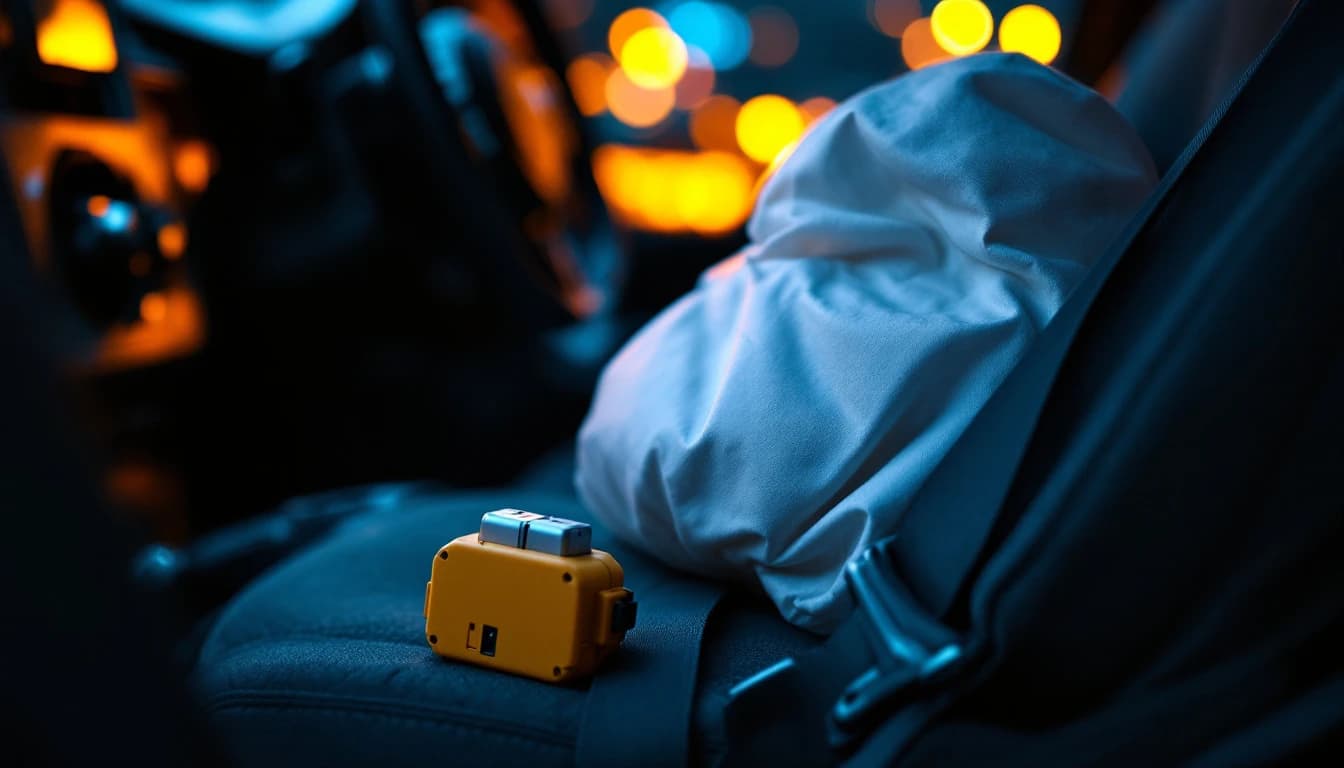
Seatbelt Pretensioners, Airbags, and the SRS Module
The one distinction that matters most
Resetting the SRS module and repairing the car are two different jobs, and confusing them is dangerous. Almost every problem people run into after a collision comes from blurring that line, so it goes first.
When a vehicle is in a crash hard enough to trigger the restraint system, the airbag control module — variously called the SRS module, the ACM, the SDM (Sensing and Diagnostic Module on GM), the RCM (Restraints Control Module on Ford), or the ORC (Occupant Restraint Controller on Chrysler) — makes a decision in milliseconds. It fires the airbags and seatbelt pretensioners it judges necessary, and it writes a permanent record of the event into its own memory. That record is a hard crash code, and once it is written the module locks. It will no longer run its normal self-test, the airbag warning light stays on, and the system is effectively disarmed.
A crash-data reset addresses exactly one part of that: the locked module. It erases the stored crash record and restores the module to a clean, operational, self-testing state, so the warning light goes out and the restraint system can arm again. That is a genuine, necessary step. But it is only the electronics half.
The other half is physical. Airbags and seatbelt pretensioners are pyrotechnic — they contain a small explosive charge that fires exactly once. After they deploy, they are spent. No amount of module work re-inflates an airbag or re-cocks a pretensioner. Those parts have to be physically removed and replaced with new components before the reset means anything. Reset a module in a car that still has a blown airbag hanging off the wheel and you have a car that reports "ready" and cannot protect anyone.
So the honest framing of this entire service is simple: the airbag / SRS module crash-data clear at $75 is the electronics line item in a restraint repair. It is done after the deployed hardware is replaced, not instead of it.
What actually fires in a collision
To understand what a reset can and cannot touch, you have to know what the module set off in the first place. A modern restraint system does far more than pop two airbags.
- Front airbags. The driver and front-passenger bags most people picture. Each is inflated by a pyrotechnic or hybrid inflator that fires once.
- Side and curtain airbags. Thorax bags in the seats or doors and curtain bags along the roof rail, triggered in side impacts and rollovers. Each has its own one-time inflator.
- Seatbelt pretensioners. This is the part our existing airbag guides do not dwell on, and it deserves the spotlight. A pretensioner is a small pyrotechnic device built into the belt buckle or retractor. In a crash it fires and violently retracts the belt, removing slack and pulling the occupant back into the seat a fraction of a second before the airbag arrives. Pretensioners often fire in crashes that are not severe enough to deploy any airbag at all. That is why a car can look barely damaged, have no blown bags, and still have locked, spent belts and an SRS light on.
- Load limiters. Many belts pair the pretensioner with a load limiter that pays a controlled amount of webbing back out once peak force passes, so the belt does not itself injure the chest. On a fired belt, this mechanism is spent along with the pretensioner.
- Battery disconnect and fuel cutoffs. Some modules command a pyrotechnic battery disconnect or fuel-pump shutoff as part of the crash response.
The seatbelt is not a passive strap in a modern car. According to the Insurance Institute for Highway Safety, seat belts combined with airbags are the backbone of occupant protection, and the agency's crash-test protocols evaluate the belt and airbag as a single restraint system rather than separate features. The National Highway Traffic Safety Administration estimates that seat belts save well over 10,000 lives per year in the United States, that they reduce the risk of fatal injury to front-seat occupants by roughly 45%, and that airbags add thousands more lives saved on top of that — but only when both are functioning. A fired pretensioner that was never replaced is a belt that will not do its job the next time.
What a bench crash-data reset does
Here is precisely what the $75 bench service changes, and nothing more.
The module you ship in is powered on a regulated bench supply. Its memory is read and the crash data locking the unit is identified. That stored crash record — the hard codes, the event data, the deployment flags — is erased, and the module's internal state is returned to the operational, pre-crash condition it left the factory in. When it goes back in the car and powers up, it runs its normal start-up self-test, finds a complete and healthy restraint circuit (assuming the hardware has been replaced), and extinguishes the airbag warning light. The system arms.
That is the entire scope. It is real work — a crash-locked module is genuinely locked and cannot simply be cleared with a scan tool, which is why it comes to a bench — but it is bounded. A reset does not:
- Replace a deployed airbag or a fired pretensioner
- Repair damaged wiring, connectors, or crushed clockspring under the wheel
- Replace a physically cracked or water-damaged module housing
- Fix a broken crash sensor at a corner of the car
- Make an improperly repaired vehicle safe
Think of it exactly the way our companion piece on resetting the module versus replacing it frames the money question, and the way our complete crash-data clear guide frames the technical one. This article is the third leg of that set: the part about the belts and the hard line between the electronics and the car.
Single-stage versus dual-stage — why it changes the repair
Not all inflators are the same, and this determines how many parts you are actually buying.
A single-stage inflator fires one charge, full deployment, one time. Older and simpler systems use these.
A dual-stage (multi-stage) inflator has two separate charges. The module decides, based on crash severity, occupant weight sensing, and belt-use status, whether to fire one stage or both, and with what timing. A low-speed impact might fire only the first stage; a severe one fires both. This is why two crashes that look similar can leave very different aftermaths inside the same car.
Two consequences follow for repair:
- A partially deployed dual-stage bag still has a live charge in it. If only one stage fired, the second stage is an undeployed pyrotechnic device sitting in the steering wheel or dash. It cannot be salvaged, and it is hazardous. The entire inflator/airbag assembly is replaced as a unit — you never try to keep a bag because "only one stage went off."
- The module logged which stages fired. Part of the crash record the reset erases includes the deployment pattern. That is diagnostic information for the repair, but it does not change the rule: every deployed or partially deployed component is replaced.
The SAE International standards that govern restraint electronics treat these inflators as safety-critical, non-serviceable pyrotechnic assemblies for exactly this reason. There is no field-refill, no reset of the charge, no reuse. The module can be reset; the inflator cannot be un-fired.
Resetting the MODULE vs repairing the CAR — the comparison
This is the table to keep in front of you. The left column is what a $75 bench crash-data reset handles. The right column is everything else that has to happen for the vehicle to be safe again.
| Item | Bench crash-data reset ($75) | Physical restraint repair (parts + labor, elsewhere) |
|---|---|---|
| Erase stored hard crash code | Yes | No |
| Unlock the module and restore self-test | Yes | No |
| Turn off the airbag warning light | Yes, once hardware is whole | No |
| Replace deployed front / side / curtain airbags | No | Yes, new parts only |
| Replace fired seatbelt pretensioners and limiters | No | Yes, new parts only |
| Replace or repair damaged clockspring, wiring, connectors | No | Yes |
| Replace broken crash sensors | No | Yes |
| Replace a physically damaged module housing | No | Yes |
| Make an improperly repaired car safe | No | Only proper repair does this |
The reset is one inexpensive, necessary line at the bottom of a much longer repair list. When someone asks "can you just reset it so the light goes out," the accurate answer is that we can reset the module, but the light going out on an un-repaired car is a lie the car is telling. The parts come first.
"The pretensioner is the one everybody forgets. I get modules shipped to me from cars where no airbag deployed at all, owner swears it was a fender-bender, and both front belts are locked solid because the pretensioners fired. Resetting the SRS module without pulling and replacing those belts means the next crash, the belts do nothing. I reset the electronics. The shop has to replace the pyrotechnics. Those are not the same job and they were never supposed to be." — Independent restraint-systems technician, 16+ years (anonymized)
Why you must never drive with a bricked SRS module
A crash-locked module is not a nuisance light. It is a disarmed safety system, and driving on it has consequences that go well beyond a failed inspection.
When the SRS module is locked with crash data, the entire restraint system is offline. The airbags will not deploy in a subsequent crash. Any pretensioners that were not fired the first time will not fire either. The car is, for restraint purposes, running with no airbags and no active belts, while looking completely normal from the driver's seat except for a warning lamp most people learn to ignore.
That warning lamp is not decorative. Federal Motor Vehicle Safety Standard 208, administered by the National Highway Traffic Safety Administration, requires the airbag readiness indicator specifically so that a malfunctioning restraint system announces itself. It matters because crashes are not rare events — the agency records well over six million police-reported motor-vehicle crashes in the United States in a typical year, any one of which can be the crash your disarmed restraints fail to answer. A steadily illuminated airbag light means the system has taken itself offline. The Insurance Institute for Highway Safety has documented for decades that occupants in crashes involving disabled or non-functional restraints suffer markedly worse outcomes — the whole reason the modern belt-plus-airbag system exists is that it works, and a disabled one does not. Independent consumer testing organizations such as Consumer Reports reinforce the same point in their vehicle-safety guidance: a lit airbag lamp is a fault to fix, not to ignore.
There is also a data dimension. The crash record inside the module is, in many vehicles, tied to the event data recorder. Erasing and repairing correctly is part of restoring the vehicle to a documented, roadworthy state. Driving indefinitely on a locked module leaves a car that is both unsafe and, in the event of another incident, demonstrably known to have been unsafe.
The correct repair sequence
Put in order, a proper post-deployment restraint repair looks like this, and the module reset sits deliberately near the end.
- Assess the full deployment. Identify every airbag, every pretensioner, the clockspring, sensors, and wiring affected. Read the module's crash data to confirm what fired, including partial dual-stage events.
- Replace all deployed and partially deployed pyrotechnics with new parts. New airbags, new pretensioners and belt assemblies, new inflators. No salvage-yard airbags, no reused belts. This is the non-negotiable core of the repair.
- Repair the surrounding hardware. Clockspring, connectors, brackets, dash structure, and any damaged crash sensors.
- Reset the module. With the hardware whole, the SRS module's crash data is cleared on the bench and the unit restored to operational state. This is where the crash-data clear service fits.
- Reinstall and verify. The module goes back in, the system self-tests, and the light goes out because the system is genuinely ready — not because a code was masked.
Do it in that order and the reset is the honest final confirmation that the car is repaired. Do it out of order — reset first, replace nothing — and you have manufactured a car that lies about its own safety.
Legal and safety framing
This service is for legitimate repair of a vehicle that is being properly restored to safe operating condition after the deployed restraint components have been replaced. That framing is not a disclaimer, it is the actual use case.
A crash-data reset is not a way to make a totaled or improperly repaired car pass inspection with the airbag light off. It is not a substitute for replacing airbags or pretensioners. Anyone offering to "clear the airbag light" on a car with un-replaced deployed hardware is helping create a road hazard, and any owner who accepts that is driving a car that will not protect them or their passengers.
Vehicle restraint systems are regulated safety equipment. Requirements for their function trace to the federal standards enforced by the National Highway Traffic Safety Administration, and improperly repaired restraint systems are a recognized problem — the Insurance Institute for Highway Safety and consumer-protection resources such as those published by the Federal Trade Commission both address the risks of substandard collision repair and salvage-title vehicles. If you are buying a used car, a persistent or recently cleared airbag light is a signal to have the restraint system professionally inspected before you trust it, and vehicle-history resources such as Carfax can flag a reported accident that a cleared light might otherwise hide.
Our position is straightforward. We reset the electronics as part of a real repair. The physical parts must be replaced by a qualified shop first. We will decline work that is framed as hiding a fault rather than completing a repair.
The mail-in workflow
Because this is bench electronics work, you ship the module rather than bring the car anywhere. This is a nationwide mail-in workshop.
- Message the lab first. Send the year, make, model, VIN, and the module part number from its label, plus a note on what deployed — which airbags, and whether the front seatbelt pretensioners fired. Confirm the deployed hardware has been or is being replaced.
- Remove the SRS module. It is usually under the center console or beneath the dash. Disconnect the battery and wait several minutes before unplugging it, and handle it in an anti-static bag.
- Ship it in. Both shipping labels are purchased at checkout — you get a prepaid, pre-addressed inbound label by email, so the module ships to the lab with nothing to print or address by hand. Pack it padded and snug.
- Bench read, archive, and reset. The module is powered on a regulated supply, its crash data is read and archived, and the stored crash record is cleared so the unit returns to operational, self-testing condition.
- Bench verify and return. Function is confirmed before it leaves. Return shipping is a flat-rate tier you choose at checkout, from $29.95, with faster options available. You reinstall the module in a car whose deployed parts are already replaced, and the system arms.
Frequently asked questions
Does an SRS crash-data reset replace my deployed airbags or fired seatbelt pretensioners? No. A crash-data reset only clears the stored crash record and unlocks the module so it can self-test and arm again. Deployed airbags and fired pretensioners are one-time pyrotechnic parts that must be physically replaced with new components before the reset means anything, because the module cannot re-inflate a bag or re-cock a belt.
Can I just clear the airbag light with a scan tool instead of resetting the module? No. After a deployment the module writes a hard crash code to permanent memory and locks, and a scan tool cannot erase that hard code or unlock the unit. That is exactly why the module comes to a bench, where its crash memory is read, archived, and reset to the operational state.
My seatbelts are locked but no airbag went off — what happened? Your seatbelt pretensioners fired without any airbag deploying, which is common in lower-severity crashes. The pretensioners are pyrotechnic devices that retract the belts violently in a crash and fire once, so a car can have locked, spent belts, an SRS light on, and no visible airbag damage. The belts must be replaced and the module reset.
Is it safe to drive with the airbag light on after an accident? No. A steadily lit airbag light after a crash means the SRS module is locked and the entire restraint system is offline, so airbags will not deploy and un-fired pretensioners will not fire in a subsequent crash. The car looks normal but offers no restraint protection, which is why the readiness light is federally required to warn you.
What is the difference between single-stage and dual-stage airbags for the repair? A single-stage inflator fires one charge once, while a dual-stage inflator has two charges the module can fire separately based on crash severity. If only one stage of a dual-stage bag fired, the second charge is still live and hazardous, so the entire inflator assembly is replaced as a unit rather than reused.
Is resetting an SRS module legal? Resetting an SRS module is legal and routine as part of a proper restraint repair performed after the deployed airbags and pretensioners have been replaced with new parts. It is not legal or safe to use a reset to hide a fault or make an un-repaired car appear ready, and reputable shops perform the reset only as the final step of a genuine repair.
How much does the SRS module crash-data reset cost? The bench crash-data clear is a flat $75, which covers erasing the stored crash record and restoring the module to operational, self-testing condition. That price is only the electronics line item — the new airbags, seatbelt pretensioners, clockspring, and any damaged wiring are separate parts and labor handled by your repairing shop.
The bottom line
After a collision, two things happen at once and they must never be treated as one. The seatbelt pretensioners and any airbags fire — spent, one-time pyrotechnic hardware — and the SRS module writes a hard crash code and locks itself. A bench crash-data reset at $75 handles the second thing completely and the first thing not at all. It erases the crash record, unlocks the module, restores the self-test, and lets the warning light go out — but only on a car whose deployed parts have already been replaced.
The rule that ties it together: replace the physical restraint components first, reset the module last, and the light going out is the truth. Reset first and replace nothing, and the light going out is a lie that will cost someone in the next crash. If you want the technical detail on the reset itself, read our complete crash-data clear guide; if you are weighing reset against a replacement module, read the reset-versus-replacement cost comparison; and if your airbag light just came on after an incident, start with what to do when the airbag light is on after an accident. When your shop has replaced the deployed parts and you are ready for the electronics, message the lab with your VIN and module part number, and ship it in.
Ship your module today
Flat-rate pricing, typical 24-hour bench turnaround, return speed your choice at checkout. Most jobs back on your bench within a week.