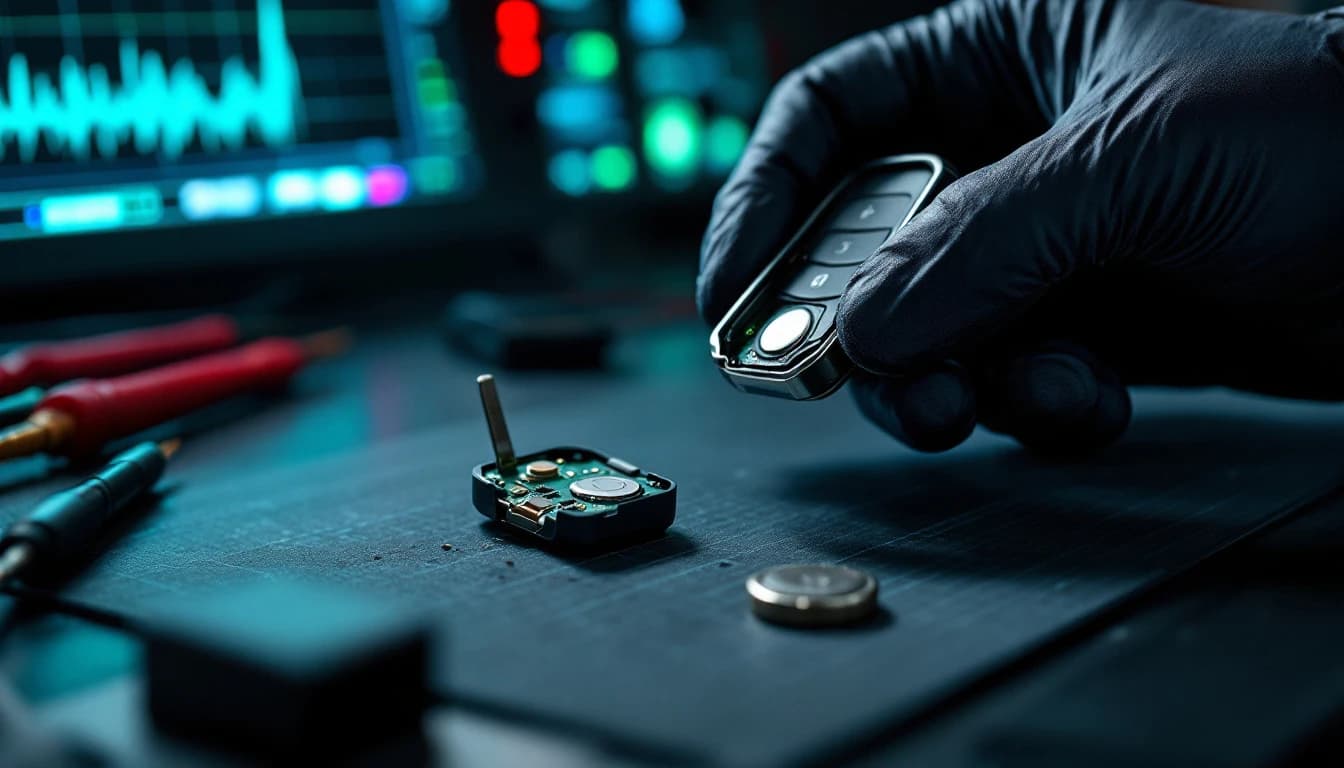
RKE System Test: Prove the Receiver Is Bad First
Start here: a receiver is guilty last, not first
A keyless entry receiver module is one of the least likely parts in the chain to have actually failed, and it is one of the most commonly replaced. That is the whole reason this article exists. The receiver is a sealed, low-power, low-heat, low-current device that sits in a dry part of the car and listens. It is not doing anything strenuous. Meanwhile the two components on either side of it, the fob and the antenna path, live hard lives.
The test order below is deliberate. It runs from free to expensive, and from likely to unlikely. If you follow it, roughly nine out of ten no-remote-function complaints resolve before you get to the last step, and the tenth one ships with real evidence behind it instead of a guess.
Before any of it, understand the architecture you are testing. A remote keyless entry system has four parts:
- The fob, a battery-powered UHF transmitter. In North America it almost always sits near 315 MHz; many European-market vehicles use 433.92 MHz. These are unlicensed low-power devices operating under the Federal Communications Commission Part 15 rules, which is exactly why their usable range is commonly well under 100 feet and why they are legally required to tolerate interference from other devices rather than being protected from it. That last point matters more than people expect.
- The antenna path, which on most cars is a coax lead or a bare wire whip routed to a pillar, the rear glass, or the headliner.
- The receiver, which demodulates the burst, checks the rolling code, and passes a validated command onto the vehicle network.
- The output side: the body controller, the door lock driver circuits, and the lock actuators themselves.
A "remote does not work" complaint can come from any of the four. The tests separate them.
Test 1 — The fob battery, under load, not at rest
Start with the coin cell, and do not trust a resting voltage reading. A CR2032 is nominally 3.0 volts. A tired cell will still show 2.9 or 3.0 volts on a meter with no load on it, then collapse to 2.2 volts the instant the transmitter draws its burst current. That is the single most common false pass in this entire sequence.
Two ways to do it properly:
- Meter under load. Hold the meter leads on the cell, in circuit, while somebody presses a button. If the reading dives below roughly 2.6 volts during the press, the cell is done regardless of what it read at rest.
- Just replace it. A fresh brand-name cell costs a couple of dollars and takes ninety seconds. For a diagnostic that expensive to get wrong, buying certainty is the cheaper move.
While the fob is open, look at four things people skip:
- The battery clip spring tension. Clips relax with age and with repeated battery changes. A clip that no longer presses hard on the cell gives you an intermittent that gets worse when the car is cold or when the fob is jostled in a pocket. Bend it back gently.
- Green or white crust on the clip or the cell. That is electrolyte, and it means the cell leaked. Clean it with isopropyl alcohol and a fiberglass pen, not with a file.
- Water staining on the board. A fob that went through a wash cycle or sat in a wet coat pocket will show tide marks and dull, dark solder. Corrosion under a crystal or an antenna trace kills range long before it kills the fob entirely.
- Cracked solder around the buttons or a delaminated carbon pad. A fob that lived in a back pocket has been sat on thousands of times. The board flexes, the button pad wears through, and the crystal or its solder joints crack. A fob that works when you squeeze the case in a certain way has cracked joints, full stop.
Test 2 — Prove the fob is actually transmitting
This is the step that turns a guess into a fact, and it is what most people mean when they search for an RKE system test.
A fob tester or RF field probe is the correct tool. These are inexpensive handheld units that light up or beep when they detect a burst in the 315 MHz or 433 MHz band. Many key-programming machines and quite a few TPMS tools include the same function. It tells you one thing and tells it reliably: energy is leaving this fob when the button is pressed.
Two important limits, stated honestly so you do not over-read the result:
- A tester proves transmission, not correctness. A fob can radiate a perfectly healthy burst that carries a rolling code the car has desynchronized from or never learned. Transmit-good does not mean will-work.
- The AM radio trick is unreliable. You will find advice to tune an AM radio to a quiet spot and listen for a buzz when you press the fob. It sometimes works on older transmitters and it fails silently on plenty of good ones. It is not a test you should condemn a two-hundred-dollar part on.
If you have no tester at all, the second-fob test in the next section gives you most of the same information for free.
Test 3 — The second-fob test, the highest-value sixty seconds in the job
If a second, independently programmed fob behaves exactly the same way, the problem is on the vehicle side. If the second fob works normally, the first fob is the problem. That is the whole test, and it settles more of these complaints than every other step combined.
Do it properly:
- Use a fob that was already working on this car, not a spare from a drawer that has never been programmed. An unprogrammed fob failing tells you nothing.
- Test from the same distance and the same position relative to the car. Range results are meaningless if one fob was tested at the driver door and the other from across the lot.
- Test all buttons, not just unlock. A fob with one dead button and three good ones is a fob problem by definition.
The interpretation is clean:
| Fob 1 | Fob 2 | What it means | Next step |
|---|---|---|---|
| Fails | Works normally | Fob 1 is bad or unlearned | Replace or reprogram fob 1. Stop here. |
| Fails | Fails identically | Vehicle side: antenna, receiver, power, or environment | Continue to Test 4 |
| Short range | Short range | Antenna path or receiver sensitivity | Tests 5 and 8 |
| Works at 3 feet only | Works at 3 feet only | Almost always antenna or coax, not the receiver | Test 8 before shipping anything |
| Works intermittently | Works normally | Fob 1 board or battery clip | Open fob 1 and inspect |
| Both dead, no interior lock either | Both dead, no interior lock either | Not RKE at all: lock driver or actuator | Test 4 |
That last row is the one that saves the most money, and it is what Test 4 is for.
Test 4 — Make the doors lock without the fob
Before you spend one more minute on radio, prove that the car can lock and unlock its own doors when you take the remote out of the equation. Use the interior door lock switch on the driver door panel. Use the mechanical key in the driver door cylinder if the car still has one.
- Interior switch works, key works, remote does not. Good. The output side is healthy, the lock actuators are healthy, the driver circuits in the body controller are healthy. Your fault is genuinely in the RF path. Continue.
- Interior switch also does nothing. Stop. You do not have a keyless entry problem. You have a lock actuator, a lock driver circuit, a blown fuse, or a body-controller output fault, and replacing a receiver module will not touch any of those.
- One door does not respond but the rest do. That is a single actuator or its wiring, most commonly in the door jamb harness boot where the wires flex every time the door opens. Not a receiver.
Do the same discrimination on the start side if the complaint includes starting. Keyless entry and the immobilizer are separate systems that happen to share a fob housing on most modern cars. If the engine cranks and will not start, that is an immobilizer or engine-controller question, not an RKE question, and our guide on why a car still will not start after a module was programmed walks that branch instead. Comfort functions and authorization to run are different circuits with different failure modes, and conflating them sends people down expensive dead ends.
Test 5 — Eliminate the RF environment before you blame the hardware
Radio interference produces symptoms that look exactly like a failed receiver, and it is far more common than most owners believe. Because RKE transmitters are unlicensed Part 15 devices, they have no protection from anything else radiating in the same band, and plenty of cheap consumer electronics radiate badly.
Run this test, in this order:
- Move the car. Drive it one to two miles away from where the problem occurs and try the fob. This is the single most diagnostic thing you can do. A dead zone that stays behind at the parking spot is environmental. A dead zone that follows the car is the car.
- Unplug everything aftermarket in the cabin. Dash cameras are the worst offenders by a wide margin, especially inexpensive ones with poorly filtered switching power supplies. Wireless phone chargers, cell signal boosters, LED interior and headlight conversions with cheap drivers, aftermarket remote starters, GPS trackers, and OBD-port dongles all belong on this list. Unplug them, wait thirty seconds, and retest.
- Try it with the engine off and the ignition fully off. A noise source that only runs with the key on is a strong hint.
- Note whether it started after something changed. New dashcam, new LED bulbs, a new charger, a new neighbor, a new building, a new light fixture in the garage. Timing is evidence.
Local interference from nearby commercial equipment, security systems, and industrial sites is a real and documented phenomenon, and it can knock out fobs across an entire parking lot. If all of the cars in one row have flaky remotes, nobody's receiver is bad.
Test 6 — Find out which module on your car is actually the receiver
On some vehicles the receiver is its own separate box. On others there is no separate receiver at all and the function lives inside the body control module. Getting this wrong is how people order and install a part that was never in the circuit.
The common architectures:
- Standalone RF receiver. A small, light module, often behind the dash, under a seat, in the headliner, or near a rear pillar, with a short pigtail and a coax antenna lead. This is the classic repairable unit, and it is what our key fob module repair guide covers in detail as a bench service.
- Integrated into the body control module. The BCM handles the RF plus dozens of other body functions. Replacing it is a much larger job with real programming consequences, because the BCM also holds configuration for lighting, wipers, chimes, and often security data. Our explainer on what a body control module does and when it needs programming covers that path.
- Combined remote-function or keyless-access module. Later vehicles frequently combine RKE reception, passive entry low-frequency antenna drive, and push-button start authorization in a single module. On these the same box handles both comfort and security, so the diagnostic and the programming requirements both get more serious.
- Handled by an existing security module. Many platforms fold RF reception into whatever module already holds the immobilizer data.
Find out which one you have before you order anything. The service information for your specific year, model, and trim will name the component and give the location. If you are unsure how to separate a receiver complaint from a body-module complaint, our checklist on how to know which module failed before you ship it is written exactly for this decision.
Test 7 — Codes and live data, which is where a scan tool earns its keep
Pull codes from the body and network modules, not just the engine controller. A generic code reader that only talks to the powertrain will show a clean scan on a car with a dead receiver, because nothing about RKE lives in engine-side memory.
What to look for:
- Body-side B-codes referencing the receiver, remote functions, or antenna circuits. These are manufacturer-defined, so you need a tool that speaks your brand properly rather than a universal reader guessing at descriptions.
- Network U-codes showing lost communication with the receiver or remote-function module. A lost-communication code on the receiver is a genuinely strong signal, because it means the module is not answering the bus at all. That is the one code pattern that points hard at the hardware rather than at the radio path.
- Live data parameters. Many platforms expose a data value that shows whether a valid transmitter signal was received and, on some, which transmitter number sent it. Watch that parameter while somebody presses the fob. If the counter or status flips, the receiver heard the fob and the problem is downstream. If it never moves with two known-good fobs at arm's length, the RF path or the module is at fault.
- Programmed transmitter count. If the module reports zero learned transmitters, nothing is wrong with the hardware. The fobs need to be learned.
That last case is worth pausing on. Battery disconnects, module resets, and low-voltage events can occasionally leave a module with its transmitter table cleared. The car behaves exactly like a dead receiver and needs nothing but a relearn.
"I keep a cheap RF probe and a known-good fob in the top drawer, and between those two things I turn away most of the receiver modules people bring me. The ones that are genuinely bad almost always show up as no communication on the bus, or they come out of a car that had water somewhere it should not have been. A module that answers the scan tool, has clean power and ground, and still hears nothing with a good fob three feet away is the one I actually open." — Independent automotive electronics technician, 19+ years in body and network diagnostics (anonymized)
Test 8 — Power, ground, and the antenna at the connector
This is the last test before the module is genuinely a suspect, and it is entirely doable with a decent multimeter.
Check the fuse first. Keyless entry receivers are normally fed from a constant battery-voltage circuit, because the remote has to work with the ignition off. A blown fuse on that circuit gives you a totally dead remote and a perfect scan on everything else.
Measure at the module connector, mated, by back-probing. Never pierce insulation. Piercing a wire in a body harness creates a corrosion site that will come back as an intermittent in two years.
- Supply voltage. You want battery voltage present at the supply pin, within a few tenths of what the battery reads. A supply pin sitting two volts low means resistance upstream, not a bad module.
- Ground quality, measured properly. Do not just check continuity. Run a voltage drop test: meter between the module's ground pin and the battery negative post with the circuit live. Under 0.1 volt is good. Anything approaching 0.3 volts is a bad ground and is enough to make a low-power receiver behave erratically. A corroded body ground under a seat or behind a kick panel is a common and entirely fixable cause of a flaky remote.
- The antenna lead. Inspect the coax or wire whip along its whole visible run. The failure points are exactly where you would guess: behind pillar trim that has been off for a stereo or airbag job, along the headliner edge, near the rear glass on cars where the antenna is bonded to or routed near the defroster grid, and anywhere a body shop has worked. A crushed, pinched, or disconnected antenna is the number one cause of range collapsing to a few feet while the remote still technically works. A receiver that hears a fob at three feet and nothing at fifteen is far more likely to have an antenna problem than an electronic one.
Go or no-go: when the module actually earns a trip to the bench
Ship the module when all of the following are true:
- Two known-good, previously programmed fobs fail identically, with fresh batteries.
- The doors lock and unlock normally from the interior switch, so the output side is proven.
- The car behaves the same at a completely different location, so the environment is eliminated.
- All aftermarket cabin electronics have been unplugged and retested.
- The supply pin has battery voltage and the ground drop is under 0.1 volt.
- The antenna lead is visually intact and connected.
- Either the module is not answering the bus, or its live data shows no transmitter signal received with a good fob held right against it.
Do not ship the module when the interior lock switch is also dead, when only one fob is affected, when the range problem is confined to one location, when a lost-communication code appeared right after a battery or alternator problem, or when the module reports zero learned transmitters. Those are all different repairs.
What an owner can safely do, and what needs a shop
Safe with basic hand tools and a multimeter: replacing the coin cell, inspecting and cleaning the fob board, the second-fob comparison, the interior-lock-switch check, the drive-somewhere-else interference test, unplugging aftermarket accessories, checking the fuse, visually tracing the antenna lead, and measuring supply voltage and ground drop at a mated connector by back-probing.
Needs a proper scan tool and someone who knows the platform: reading body-side and network codes, watching RKE live data, checking the learned-transmitter count, running any factory RF self-test the platform offers, and performing the relearn procedure afterward.
Needs a bench: anything that involves opening the module. That includes reflowing cracked solder joints, replacing a corroded connector, or recovering a module that has taken water. Board-level receiver repair is a flat $125 service through our keyless entry module repair bench job. If the diagnosis genuinely will not settle, and you need a technician to power the module up, exercise it, and tell you honestly whether it is repairable, that is what the bench evaluation service at $150 exists for.
Some perspective on why this stuff is worth testing carefully. The National Highway Traffic Safety Administration has documented the steady growth of networked control units in mainstream vehicles, with a modern car commonly carrying well over 50 of them. Industry reporting from Car and Driver has put electronics and software at an increasing share of a new vehicle's value, by some estimates approaching 40%. Owner surveys from Consumer Reports and dependability studies from J.D. Power have for several years running placed in-car electronics among the most-reported problem categories, with overall dependability scores on the order of 190 problems per 100 three-year-old vehicles. And the reason keyless systems keep getting more complex rather than simpler is theft pressure: the National Insurance Crime Bureau reports vehicle theft in the United States running into the hundreds of thousands of vehicles per year. Rolling codes, encrypted transmitters, and security-linked modules are the response to that.
The mail-in workflow
This is a nationwide mail-in bench workshop. There is no on-site or mobile service.
- Message the lab before you remove anything. Send the VIN, year, make, model, the module part number from its label, a photo of the label, exactly which of the tests above you ran, and what each one showed. That evidence is what determines whether the module is worth shipping.
- Provide proof of ownership. Keyless entry receivers touch vehicle security, and proof of ownership is required for any key, immobilizer, or security-linked work, without exception.
- Ship the module. Anti-static bag inside a padded box, with the connector protected. USPS goes to PO Box 120241, Arlington, TX 76012. UPS and FedEx cannot deliver to a PO Box, so couriers go to 1009 Oakwood Ln # 120241, Arlington, TX 76012. Our remove, package, and ship guide covers the packing details.
- Bench power-up and evaluation. The module is run on a regulated bench supply and exercised with a known-good transmitter, so the receiver is tested in a controlled environment instead of a car with unknown grounds.
- Board-level repair. Cracked joints get reflowed properly with flux and a controlled profile, corroded connector pins get cleaned or replaced, and damaged traces get repaired.
- Verification, then return. The module is retested before it leaves. Return shipping is a flat-rate tier you choose at checkout, from $29.95, with faster options available.
Expect to relearn your transmitters after reinstallation on most platforms. That is normal and it is part of the job, not a sign that something went wrong.
Frequently asked questions
How do I test if my key fob receiver is bad? Prove that two known-good, previously programmed fobs with fresh batteries both fail identically, that the doors still lock from the interior switch, that the fault follows the car to a different location, and that the module has battery voltage and a ground drop under 0.1 volt at its connector. Only when all four are true is the receiver a real suspect.
Why does my remote only work from a few feet away? Short range with both fobs is far more often an antenna problem than a receiver problem. The antenna lead is a thin coax or wire whip routed behind trim, and it gets pinched, crushed, or unplugged during stereo installs, glass replacement, headliner work, and body repair. Inspect the entire visible run before condemning the module.
Can a dash camera stop my key fob from working? Yes, and it is one of the most common causes we see. Inexpensive dash cameras, wireless chargers, cell boosters, LED bulb conversions, and OBD dongles can all radiate noise in the same band the fob transmits on. Unplug every aftermarket accessory, wait thirty seconds, and retest before spending money.
My fob transmits on an RF tester but the car does not respond. What now? A tester proves the fob is radiating energy, not that the car will accept the code. Move to the second-fob comparison, then check the module's learned-transmitter count with a scan tool. A module reporting zero learned transmitters needs a relearn, not replacement, and a fob that has lost sync needs reprogramming.
Is the keyless entry receiver the same as the immobilizer? No. Keyless entry is a comfort function that unlocks doors, and the immobilizer is a security function that authorizes the engine to run. They often share a fob housing and on some vehicles share a module, but they are separate circuits with separate failure modes. A crank-no-start is an immobilizer question, not an RKE question.
Do I need to reprogram my fobs after the module is repaired? Usually yes. Most platforms require the transmitters to be relearned to the module after any repair, replacement, or reset, and that is a normal part of reinstallation rather than a sign of a problem. Some platforms allow an owner-performed relearn sequence, others require a scan tool.
Is it cheaper to repair the receiver or buy a used one? Board-level repair of your original module is $125 and returns the unit the car already knows, which avoids donor-VIN and configuration issues entirely. A used module is a gamble on an unknown board with the same age-related solder and corrosion exposure, and on many platforms it still needs programming and a transmitter relearn afterward.
The bottom line
Test the cheap things first, and make the car prove which half of the system is broken before you buy a part. A fresh coin cell, a second known-good fob, and the interior lock switch will resolve the large majority of remote-not-working complaints for free. The drive-somewhere-else interference test and the antenna inspection catch most of the rest. What is left after all of that is a small number of genuinely failed receivers, and those almost always announce themselves either by refusing to answer the network at all or by carrying visible evidence of water.
When you get to that point, board-level repair of your original module is a flat $125 through the keyless entry module repair service, and a stubborn, undiagnosable unit can go through bench evaluation at $150 so a technician can tell you honestly whether it is worth fixing. Return shipping is chosen at checkout from $29.95. Proof of ownership is required for security-linked work.
If you have run the sequence and you are not sure how to read the result, message the lab with your VIN, the module part number, and what each test showed. A ten-minute conversation before a part goes in a box has saved a lot of people from replacing a perfectly good receiver.
Ship your module today
Flat-rate pricing, typical 24-hour bench turnaround, return speed your choice at checkout. Most jobs back on your bench within a week.