
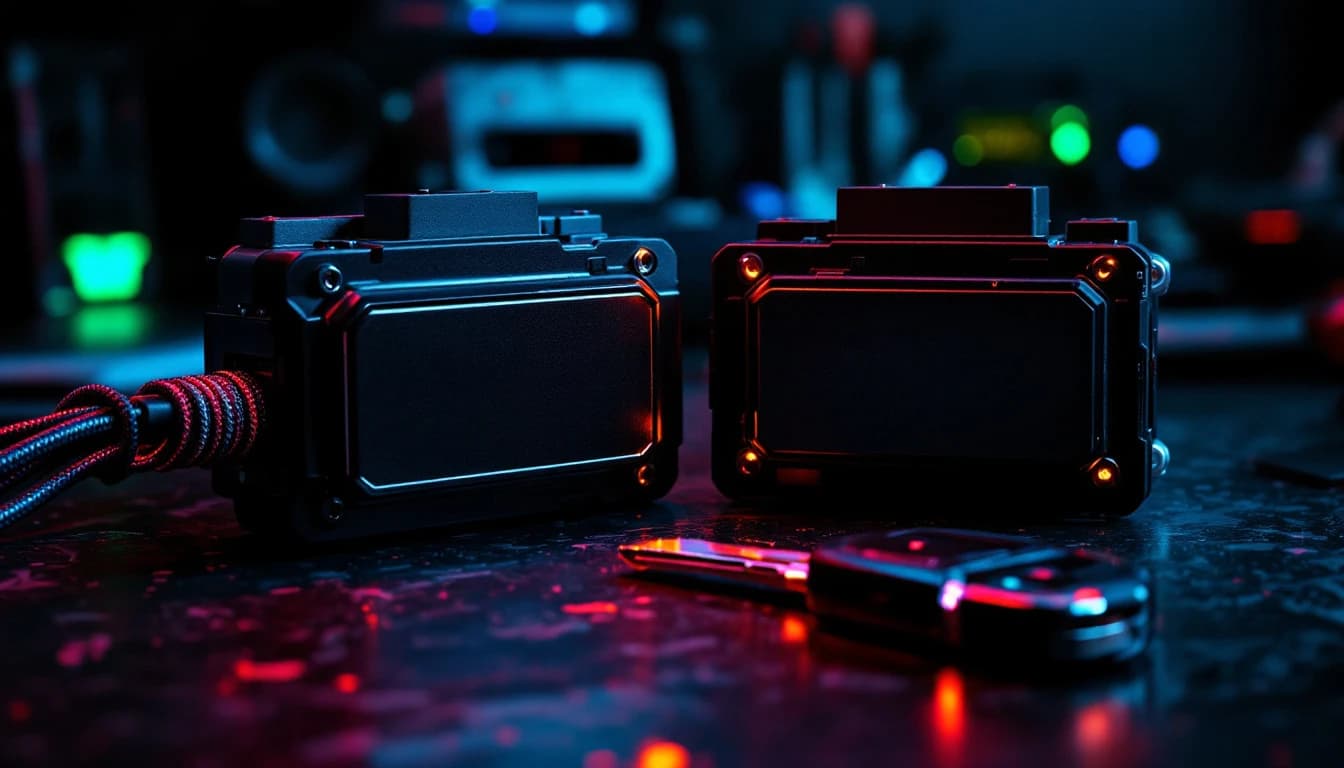
Porsche BCM / Kessy Cloning: Why Used Won't Just Work
The short answer: the donor is married to a different car
A used Porsche BCM or Kessy module refuses to run your car because it is still cryptographically married to the car it came out of. It carries that car's immobilizer relationship, that car's learned keys, and that car's option coding. Bolt it into your Porsche and it does exactly what it was designed to do in a theft scenario: it declines to cooperate. Depending on platform and module, that shows up as a crank-no-start, keys that will not authorize, a dead keyless-entry system, remote functions that ignore you, or a dashboard lit up with implausible faults from systems that are physically fine.
Nothing is wrong with the donor. Nothing went wrong with your installation. The part is simply loyal to another vehicle, and no amount of clearing codes, disconnecting the battery, or reseating connectors changes its mind.
The fix is cloning: your original module's identity is read out on a bench and written onto the donor, so the donor becomes — at the data level — your original. The Porsche BCM / Kessy clone service does exactly that as a $150 flat mail-in job with a typical 24-hour bench turnaround. You ship both units, the identity moves across, your existing keys keep working, and both modules come back to you. The rest of this guide explains why the marriage exists, what actually lives in these modules, how they fail, what cloning transfers, and how to source a donor that will actually accept the transplant.
What a Porsche BCM does — and what the Kessy module is
The two names cover two eras of the same idea, and knowing which one your car uses is the first sorting question.
On 2010-and-later platforms, body electronics consolidate into BCM architecture. The body control module is the housekeeping computer for everything that is not engine or transmission: exterior and interior lighting, wipers, central locking, windows, alarm monitoring, and — critically for this article — a role in the vehicle's access and authorization chain. Covered platforms for cloning are the Cayenne (958), Panamera (970), Macan (95B), Cayman and Boxster (981/982), and the 911 (991/992). On these cars the BCM is not a dumb relay box; it is a networked node that other modules expect to recognize, and that expects to recognize the car around it.
On 2003-2010 Kessy-based cars — the 9PA/957 Cayenne and older Kessy-equipped Porsches — the security-critical unit is the Kessy module. Kessy is the keyless entry and start authorization module, and the first-generation Cayenne inherited it from shared VW Group platform engineering — the 9PA Cayenne, the VW Touareg, and their relatives were developed on common electrical architecture, which is why the Kessy concept, its connectors, and even its failure patterns look so familiar to anyone who works on Touaregs. The Kessy is the gatekeeper: it reads the key's transponder or radio credential, decides whether that key is authorized, releases the electric steering-column lock, and tells the rest of the car it may wake up and start. When a first-generation Cayenne cranks endlessly with good fuel and spark, or the key turns but nothing wakes, the Kessy is the prime suspect — our companion guide to Porsche Kessy immobilizer no-start diagnosis walks that symptom tree in detail, so this article will not repeat it.
The through-line for both eras: these are security parts, not accessories. Swapping one is immobilizer surgery whether you intended it to be or not.
Component protection: why Porsche marries electronics to the car
Porsche sits inside the Volkswagen Group engineering world, and VAG's answer to module theft and gray-market parts swapping is the concept usually called component protection. The principle is simple: a control unit is bound to one specific vehicle at the data level. Its serial identity, its immobilizer secrets, and its learned relationships are written for that VIN and that set of peer modules. Move it to another car and it does not merely fail to help — it actively withholds its security-relevant functions until it is properly authorized or re-identified for the new vehicle.
This is deliberate anti-theft engineering, and the pressure that produced it is real. The National Insurance Crime Bureau has tracked US vehicle theft running on the order of a million vehicles in recent peak years, and the Federal Bureau of Investigation consistently ranks motor-vehicle theft among the most common property crimes in the country. A stolen car that can be parted out into freely interchangeable computers is worth far more to a thief than one whose modules brick themselves in any other vehicle. Marrying electronics to the VIN attacks the economics of theft directly.
It also, as a side effect, attacks the economics of honest repair. A modern vehicle commonly carries well over 50 electronic control units by counts documented in work published through the National Highway Traffic Safety Administration, and industry reporting from Car and Driver has put electronics and software at a large and rising share of a new vehicle's value — by some estimates approaching 40%. On a Porsche, where the manufacturer delivers on the order of 300,000 vehicles per year globally and new-module pricing reflects the badge, a dealer-sourced replacement BCM plus dealer programming can run to four figures before labor. That is precisely why the used-module market exists — and why the used-module market keeps producing no-start Porsches in driveways: the part is affordable, but the marriage travels with it.
Cloning threads the needle. It does not weaken or bypass component protection; it relocates your car's own legitimate identity onto healthier hardware. The security architecture stays fully intact — the car ends up exactly as married as it was before, just to a module that works.
How Porsche BCMs and Kessy modules actually die
Understanding the failure mode matters, because it determines whether your original can still be read — and readability is the whole ballgame for cloning.
Water ingress is the classic killer. Body and access modules live low in the cabin and near the firewall, downstream of every drain the car has. Blocked cowl and plenum drains, clogged sunroof drains, and door membranes that have given up all route water toward footwells and the under-dash area where these modules mount. The damage is rarely instant: moisture creeps into the connector, tracks along the pins, and sets up electrolytic corrosion on the board. The car develops ghosts first — intermittent locking faults, a wiper that self-starts, keyless entry that works on dry days — and then one morning it does not start. Caught early, a water-exposed module often still reads perfectly on the bench even though it can no longer be trusted in service, which makes it an ideal cloning candidate.
Electrical abuse is the second path. Jump starts done backwards or carelessly, welding on the car without disconnecting the battery, a failing alternator spiking the bus, or damage cascading from a stuck relay circuit that cooked a driver stage inside the module. These failures tend to kill specific output sections — one lighting channel, the lock actuator driver — while leaving the processor and the memory that holds the identity untouched. Again: frequently still readable, therefore frequently cloneable.
Age and corrosion do the rest. Twenty-year-old Kessy modules from the 9PA era are now simply old electronics. Solder joints fatigue, electrolytic capacitors drift, and connectors that have seen two decades of thermal cycling stop making dependable contact.
The one failure class that closes the cloning door is catastrophic damage to the memory itself — a board that was submerged long-term, burned, or physically shattered through the storage devices. If the original cannot be read, there is nothing to clone. That is checked first on the bench, and you are told before any further charge. It is the honest limit of the service, and it is why the intake conversation asks how the module died before anything ships.
"The Cayennes that break my heart are the ones where somebody threw the original module away because it was 'bad.' Bad in the car and dead to the world are not the same thing. Nine times out of ten that water-stained board still reads fine on the bench, and reading it is the difference between a fifteen-minute identity transfer and re-keying the whole car from scratch." — Independent European-vehicle electronics technician, 20+ years (anonymized)
What cloning actually transfers at the data level
Cloning is not a settings copy or a code-clearing trick. On the bench, the original module is powered on a regulated supply and its non-volatile memory is read out — the storage that holds who the module is, not just what it does. Three categories of data matter:
- The immobilizer marriage. The secret material that binds this module into the car's authorization chain — the data the rest of the vehicle's security network checks when it decides whether to allow a start. This is the part that makes a raw donor useless and a cloned donor indistinguishable from your original.
- The learned keys. Your working keys were taught to your original module. Cloning carries that key data across, which is why a cloned donor accepts your existing keys immediately — no re-keying, no new keys to buy, no dealer visit.
- The coding. The configuration that tells the module what car it lives in: options fitted, market settings, feature enables. Carrying the coding across is why a cloned module behaves correctly on day one instead of needing a configuration session.
The donor's own identity is overwritten in the process. When the pair leaves the bench, the donor believes — completely and verifiably — that it is your original module, and both units are returned to you: the cloned donor to install, and the original to keep as the archival copy of your car's data. For the general engineering background on where module identity physically lives and why it survives the module's functional death, our explainer on module part numbers and hardware/software compatibility goes deeper than this article needs to.
Clone or key programming? The decision tree
There are two Porsche services on the menu, and they solve different problems. The sorting question is one sentence: can your original module still be read?
| BCM / Kessy clone — $150 | BCM / Kessy key programming — $250 | |
|---|---|---|
| The situation | Original failed but readable; you have a used donor | Original dead or missing; donor must be married fresh — or a working module needs keys added |
| What you ship | BOTH the original and a matching donor | The module being put into service, plus what intake specifies |
| Your existing keys | Keep working — identity carries them across | New key programming; existing keys re-handled as needed |
| Immobilizer marriage | Your original marriage, relocated intact | Established fresh for the vehicle |
| Coding | Carried over from the original | Configured as part of the job |
| Turnaround | typical 24-hour bench turnaround | Bench job — see the service page |
If the original reads, clone. It is cheaper, it preserves your keys untouched, and the car cannot tell anything changed. If the original is unrecoverable — memory destroyed, module lost, or a previous shop's attempt overwrote it — cloning is off the table by definition, and the path is the Porsche BCM / Kessy key programming service at $250, where the replacement module is brought onto the car and keys are established for it. And if you genuinely do not know what state your module is in — it came to you dead, or the car has a tangle of prior repair attempts — the hourly bench evaluation at $150 answers the readability question definitively before you commit to either path.
One more boundary worth stating plainly: cloning is module-identity work, not mechanical repair. A worn mechanical ignition switch or a seized electric steering-column lock is a hardware fault outside the module, and no data transfer fixes it. If the column lock grinds or the key physically binds, solve that separately — a freshly cloned module wired to a jammed lock is still a car that will not start.
Sourcing the donor: the checklist that prevents a wasted round trip
The donor is the half of this job you control, and donor quality decides whether the clone is routine or impossible. Work the list in order:
- Match the part number. The full part number off your original module's case label is the specification. A donor should match it — the same hardware family and variant — wherever possible. Porsche revised these modules across model years, and a donor from the wrong revision can differ in connectors, hardware generation, or internal layout in ways that make a clean transfer impossible.
- Match the hardware variant, not just the family. Two modules with near-identical numbers can still differ by suffix or index — different market, different option support, different board revision. Closer is always safer. Text photos of BOTH case labels — your original and the candidate donor — before you buy or ship, and the pairing gets confirmed for you in advance.
- Ask the dismantler the right questions. What car did it come out of — year, model, and ideally VIN? Did that car run and drive before dismantling, or is this module from a flood or electrical-fire car? A donor from a burned or submerged parts car may carry the exact damage you are trying to escape. A donor pulled from a running, driving, rear-ended car is the gold standard.
- Insist on the actual label photo, not the listing's stock photo. Online listings routinely show a representative image while shipping whatever is on the shelf. The label photo of the physical unit you will receive is the only one that counts.
- Do not worry about the donor's old identity. Some sellers advertise modules as virgin or reset at a premium. For cloning it is irrelevant — the donor's existing data is overwritten regardless. Condition and part-number match are what you are paying for; the donor car's history of keys and coding is not.
The general version of this checklist — escrow, return policies, dismantler grading, and the questions that expose a flood-car part — is covered at length in our guide to buying a used donor module and what to check before you buy.
The mail-in workflow, start to finish
This is a nationwide mail-in bench service — the car never moves, the modules do.
- Text the lab before anything ships. Send the VIN, year and model, the part number off your original's label, a photo of that label, how the module failed, and the donor's label photo if you have already sourced one. This confirms the platform is covered, the pair is compatible, and cloning is the right service rather than key programming.
- Proof of ownership. This is immobilizer-linked security work, and proof of ownership is required without exception — documentation tying you to the vehicle, such as registration or title.
- Order and pull the modules. Disconnect the battery before unplugging anything. Photograph connectors before removal, and pack both units in anti-static bags inside a padded box — our packing and shipping guide by job type covers the details, including the label photos and paperwork to include.
- Ship both units. USPS: PO Box 120241, Arlington, TX 76012. UPS or FedEx: 1009 Oakwood Ln # 120241, Arlington, TX 76012 — couriers cannot deliver to a PO Box, so use the street address for anything that is not USPS.
- Bench read — the go/no-go gate. The original is powered and read first. If it reads, the clone proceeds. If it cannot be read, you are told before any further charge, and the conversation moves to the key-programming path instead.
- Clone and verify. The identity, key data, and coding are written to the donor and the result is verified on the bench before anything leaves.
- Both modules return with tracking. Return shipping is chosen and paid at checkout, from $29.95, with faster tiers available. Install the cloned donor, keep the original as your data backup, and drive.
The bench turnaround is typically 24 hours from arrival. For diagnostic standards context on why bench-level work reads what a scan tool cannot, SAE International publishes the protocols that govern on-car diagnostics — and the short version is that vehicle-level diagnostics talk to a module's front door, while identity lives behind it.
Frequently asked questions
Why does a used Porsche BCM cause a no-start when the part number matches? Because a matching part number proves hardware compatibility, not identity. The used module still carries its donor car's immobilizer marriage, keys, and coding, so your Porsche's security chain rejects it and blocks the start. Cloning your original's identity onto it is what makes it behave as your module.
What does the $150 Porsche BCM / Kessy clone service include? It includes reading your original module, cloning its identity — immobilizer marriage, learned keys, and coding — onto the matching donor you supply, bench verification, and the return of BOTH modules, on a typical 24-hour bench turnaround. Return shipping is selected and paid at checkout, from $29.95.
Will my existing Porsche keys still work after cloning? Yes — that is the core benefit. Because the donor takes on your original module's identity and key data, the keys already matched to your car keep working with no re-keying and no dealer involvement. If your original cannot be read, that guarantee no longer applies and the key-programming path takes over.
Which Porsches are covered for BCM / Kessy cloning? BCM-based coverage is 2010-and-later: Cayenne (958), Panamera (970), Macan (95B), Cayman and Boxster (981/982), and 911 (991/992). Kessy-based coverage is the 2003-2010 era: Cayenne (9PA/957) and older Kessy-equipped Porsches. Anything outside those platforms is quoted case-by-case after bench evaluation.
What if my original module is too damaged to read? Then there is nothing to clone — cloning requires a readable original, full stop. That readability check happens first on the bench, and you are told the result before any further charge. From there the usual route is the $250 key programming service, where the donor is married to your car fresh instead of inheriting the old identity.
Does cloning fix a jammed steering lock or a worn ignition? No. Cloning transfers data between modules; it does not repair mechanical ignition or steering-column-lock hardware. If the lock physically binds or the switch is worn out, that is a separate mechanical repair — and it is worth confirming before shipping modules, because a mechanical fault will still prevent starting after a perfect clone.
The bottom line
A failed Porsche BCM or Kessy module puts you in front of an ugly-looking choice: dealer-priced new hardware with dealer programming, or a used module that seems like a bargain until it strands the car in the driveway. Cloning removes the ugliness. Because Porsche marries these modules to the vehicle by design, the used part was never going to just work — but your original's identity, read on a bench and written onto a healthy donor, makes the donor into your original as far as the car can tell. Existing keys keep working, the coding carries over, the immobilizer stays exactly as secure as the factory built it, and both modules come back to you.
The decision tree is short. Original readable plus matching donor: the $150 BCM / Kessy clone. Original unrecoverable: the $250 key programming service marries the replacement fresh. Not sure which side you are on: the $150 hourly bench evaluation settles it before you spend another dollar on parts. Text the lab with your VIN and both module label photos, and the pairing gets confirmed before anything goes in a box — proof of ownership in hand, because that is non-negotiable for immobilizer work.
Ship your module today
Flat-rate pricing, typical 24-hour bench turnaround, return speed your choice at checkout. Most jobs back on your bench within a week.
More from the Lab
Porsche BCM & Kessy Key Programming Mail-In Guide 2026
12 min · June 18, 2026
Porsche Module Cloning Cost: DME, Alarm Box, BCM (2026)
13 min · September 23, 2026
Porsche Won't Start? Kessy Immobilizer and Key Options
12 min · July 13, 2026

MINI R50/R53 Body Control Module Failure: Diagnosis
15 min · October 2, 2026