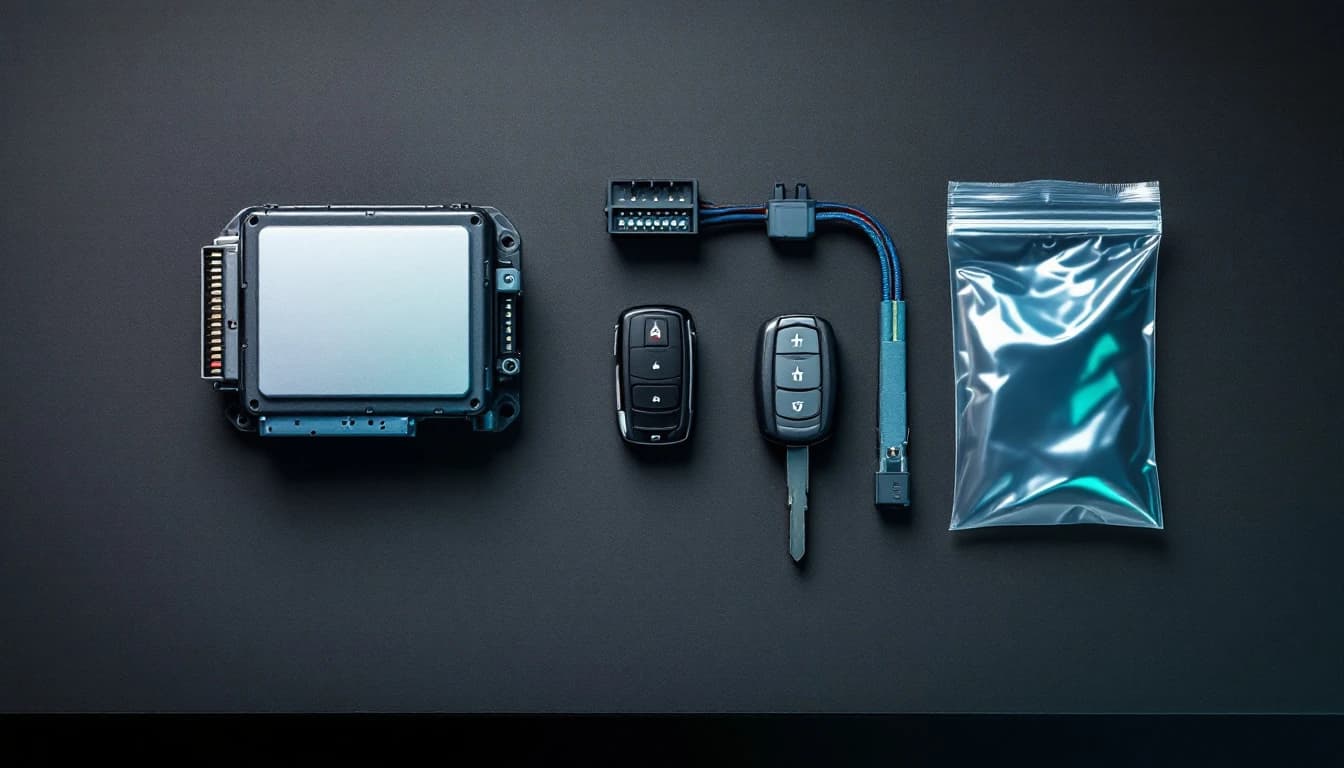
What to Ship With Your Module, by Job Type
Start here: the module alone is only right for repair
If the job is a physical repair, the module travels alone. If the job touches security, identity, or mileage, it almost never does. That one sentence resolves most of the confusion, and it is worth understanding why before you pack anything.
A repair job acts on the hardware in front of it. A cold solder joint, a corroded connector pin, a swollen electrolytic capacitor, a burned-out driver transistor, a cracked board trace from years of underhood vibration - all of that is fixable by looking at the board, and none of it requires anything else from the car.
Security, identity, and mileage work is different in kind. It acts on data, and that data was intentionally designed not to live in one place. Manufacturers split it deliberately, and they did it because a security secret sitting in one removable box is a security secret a thief can carry away. The result is that when you unbolt a single module and put it in a box, you have often shipped half of a matched pair.
Before you decide what to send, it helps to be sure you are sending the right part at all. Our guide on how to work out which module actually failed before you ship it walks the diagnostic order, and it will save you a round trip if the symptom is pointing somewhere other than where you assumed.
Why security data is deliberately split
Modern vehicles carry an enormous amount of networked electronics. The National Highway Traffic Safety Administration has documented for years that a mainstream vehicle now commonly runs well over 50 electronic control units talking to each other on multiple buses, and coverage from Car and Driver has put electronics and software at roughly 40% of the value of a new vehicle. Security functions have been distributed across that network on purpose.
The pressure driving that design has never let up. The National Insurance Crime Bureau reports vehicle theft in the United States running into the hundreds of thousands of vehicles per year, and the Federal Bureau of Investigation tracks motor-vehicle theft as one of the most common property crimes in the country. Every generation of immobilizer has been an answer to that, and every generation has spread the secret a little wider.
For an owner or a shop, the practical consequence is simple. The module you unbolted holds one half of a conversation. The other half is still bolted to the car - in the ignition switch, in the cluster, in a body module, or encoded in a key in your pocket. A bench can only verify a handshake if both sides of it are on the bench.
Job class 1: immobilizer and key programming, where the data is split
This is the class where the wrong box contents cause the most delay, because the missing part is different on every platform.
Mercedes EIS and ESL work
On Mercedes, the EIS or EZS - the electronic ignition switch - is the security brain, not a switch in the ordinary sense. It holds the drive authorization data, it knows which keys are allowed, and it exchanges rolling secrets with the engine controller and the steering lock. Cloning an EIS onto a replacement unit means the original has to be present so its identity can be read and carried across, which is why Mercedes EIS cloning at $250 is an original-plus-donor job rather than a single-unit job.
On many Mercedes jobs a working key should travel with the EIS. The key is not an accessory here - it is a cryptographic participant, and having a known-good one on the bench is often the difference between verifying the job in an hour and guessing at it. Where the requirement is adding or replacing keys against an EIS that is otherwise healthy, Mercedes EIS key programming at $150 is the correct service, and the intake conversation decides which of the two you actually need.
BMW CAS and FEM/BDC work
BMW splits security across the CAS (Car Access System) on older chassis and the FEM or BDC on later ones, with the engine controller holding a matching identity number. BMW CAS key programming at $150 is bench work on the CAS itself, and for most key jobs the CAS is what ships. Where the car is an all-keys-lost case, sending a dead or non-working key along is still useful, because the key shell and its transponder tell the bench what family it is dealing with.
The reason BMW work often expands beyond one module is the ISN, the internal serial number that ties the DME to the CAS or FEM. If a DME has been swapped, the pair no longer agree, and the fix involves both halves. That is also the situation where owners start reading about BMW EWS delete work on older chassis - our BMW DME EWS delete bench programming guide explains where that path is appropriate and where matching the units is the better answer. On the later chassis the equivalent job is BMW FEM/BDC key programming at $150, and on those cars the FEM module is what goes in the box.
VW / Audi cluster-based immobilizer work
On a large family of Volkswagen and Audi cars, the instrument cluster is the security part. It stores the immobilizer secret, it learns the transponder keys, and it challenges the engine controller at every start. That makes the cluster a security component and not a gauge assembly, which is exactly why VW and Audi cluster key programming at $250 exists as its own dedicated bench job.
On these cars, sending only the engine controller for a key or no-start complaint sends the wrong half. On the later distributed platforms, the data is spread wider still - cluster, engine controller, comfort module, and on keyless cars the access-and-start module - and it is common to need two of those on the bench at the same time.
Proof of ownership is required for every key, immobilizer, and security-linked job, without exception. That means documentation tying your name to the vehicle, such as a registration or a title. A shop that does not ask for it should worry you.
Job class 2: clone jobs, where both units must ship
A clone is a data transfer, and a transfer needs a source and a destination. Send both.
The mistake here is understandable: the original module is dead, the car has been down for two weeks, and it feels pointless to pay postage on a brick. It is not pointless. A module that will not run a car is very often still readable on a bench.
The reason is that the failure and the data are usually in different places. A module dies because a power stage shorted, because a voltage regulator failed, because water got into a connector and corroded a track, or because a driver output blew when a solenoid shorted. None of those necessarily damage the memory device holding the identity, the calibration, and the immobilizer data. On a bench, that memory can frequently be read directly - powered from a regulated supply, or in stubborn cases read at the chip - even when the module is functionally dead in the vehicle.
That is the whole argument for shipping the dead original:
- If the original reads, your car keeps its own identity. The donor becomes your module. Your keys keep working, your VIN stays correct, and the security chain is undisturbed.
- If the original does not read, you have lost only postage. The job falls back to programming the donor to the vehicle, which is a different and often longer path.
- If you scrapped the original, you removed an option that cannot be recovered. Nobody can read a unit that is in a skip.
The donor matters too, and it has to be the right donor. Hardware family, part number lineage, and revision all decide whether a transfer is even possible. Before you buy one, read what to check before you buy a used module donor - donor mismatch is the single most common reason a clone job cannot proceed, and it is entirely avoidable at the purchase stage.
"The customers who ship me the dead one along with the donor get their own car back. The ones who binned the original because it was scrap get a longer job, a bigger bill, and sometimes a set of keys they have to replace. I have read identity data off units with a hole burned through the power section. Send it. It weighs nothing." — Independent European module technician, 17+ years (anonymized)
Job class 3: repair-only jobs, where the module travels alone
This is the easy class. If the job is a board-level repair - resoldering, component replacement, connector repair, corrosion cleanup, a failed driver stage - the module is all that ships.
Typical examples are footwell and lighting modules with failed outputs, keyless entry receivers that have stopped hearing the fob, body modules with water damage from a plugged drain, and clusters with failed backlighting, dead stepper motors, or a specific gauge that has stopped sweeping.
Electronic faults of this kind are not a niche category. J.D. Power has for years found electronics, infotainment, and driver-assistance complaints sitting at or near the top of all reported vehicle problem categories in its quality studies, and Consumer Reports reliability survey work consistently ranks in-car electronics among the most-reported trouble spots across brands. Standardized diagnostics have been mandatory since the Environmental Protection Agency required OBD-II on light vehicles sold in the United States beginning with the 1996 model year, and the diagnostic and network standards those modules speak are maintained by SAE International. The upside of all that standardization is that a module can be powered, addressed, and tested on a bench rather than only in a vehicle.
The one caveat worth naming: a repair does not become a repair just because you hope it is one. If a cluster is dead because its processor is gone, mileage recovery becomes part of the job and the rules in the cluster section below apply instead. If a body module is being replaced rather than repaired, the job just moved into the programming class. The intake conversation is where that gets settled, and it is faster to have it before the box ships than after.
Job class 4: cluster jobs, and the mileage question
If mileage has to carry over, the original cluster has to ship. That is not a policy, it is arithmetic. The true mileage lives in the original cluster's memory. If it is not on the bench, there is no authoritative source for the number, and no honest technician will simply type in a figure you told them over a message.
That is why instrument cluster repair and mileage sync at $200 is a job where the original unit is the whole point. When a cluster is being replaced with a used one, both go in the box: the original as the source of truth for the mileage and configuration, the replacement as the destination.
The framing here matters and it is not negotiable. Mileage is synchronized to the vehicle's true mileage only. Under federal law - 49 U.S.C. Chapter 327, administered by NHTSA - misrepresenting a vehicle's odometer reading is a federal offense, and vehicle history services such as Carfax exist in part because odometer fraud has been a persistent problem in the used market for decades. Carrying a true reading across a hardware replacement is the legitimate repair. Anything else is not a service we offer.
Practical extras for cluster jobs: photograph the odometer before you pull the cluster, and note the reading in writing with the job. If the display is dead and the number cannot be photographed, say so at intake - there are other places on the vehicle where mileage is recorded, and that changes the approach.
Job class 5: ABS, EBCM, and powertrain - the module usually separates
Good news on this class: on most vehicles you do not ship the whole assembly.
An ABS or EBCM unit is normally an electronic control module bolted to a hydraulic modulator block. The electronics are what fail - internal relay contacts, motor driver stages, solder joints under the pump connector that crack from vibration and thermal cycling. The hydraulics rarely are. On the great majority of applications the control module unbolts from the hydraulic block with a handful of fasteners, and only the electronic half needs to travel. That is what ABS module repair at $499 is built around, and it is why you are not being asked to drain a brake system and ship a heavy casting across the country.
Two honest exceptions:
- Some units are not designed to separate. A minority of applications have the electronics potted, riveted, or otherwise integrated with the hydraulic body in a way that does not come apart without destroying it. Ask before you start unbolting.
- Some faults are not in the module. A pump motor that has seized, or a hydraulic valve that has stuck, will not be fixed by anything done to the electronics. If your symptom is a pump that runs continuously or a pedal that behaves strangely under braking, the electronic half may not be the culprit.
The same separation logic applies on the powertrain side. A transmission control module that is bolted to or built into a valve body assembly sometimes separates and sometimes does not - it varies by platform and generation. Engine controllers are almost always standalone units in their own housing, and they ship on their own unless the job is a clone, in which case the donor goes with them.
Do not drain, cut, or force anything to make a part separate. If it is not obvious, ask first.
The comparison table: what goes in the box
| Job class | What ships | Why |
|---|---|---|
| Board-level repair | The failed module only | The fault is in the hardware in front of us; no external data is needed |
| Immobilizer / key programming | The security module, often plus the ignition switch or cluster, and where asked a working key | The secret is split across components and the handshake has to be verifiable |
| Clone or data transfer | The original (even if dead) AND the donor | A transfer needs a readable source and a compatible destination |
| Cluster with mileage carry-over | The original cluster AND the replacement | True mileage lives in the original memory and must be read, not typed in |
| ABS / EBCM | The electronic control module, usually separated from the hydraulic block | The electronics fail; the hydraulics rarely do and are heavy to ship |
| TCM / powertrain | The control module; on some platforms the valve body assembly it is built into | Separability varies by platform, so this one is confirmed at intake |
| Replacement module needing VIN or configuration | The replacement unit, and the original where it is still available | Configuration is copied from the original wherever it can still be read |
The extras that travel with a job
Beyond the module itself, four items come up repeatedly.
A working key. On Mercedes, some BMW, and several other security jobs, a key is a participant in the handshake and not a spare part. If a key is asked for, ship the one that works, not the one in the drawer that has never opened the car.
The ignition lock or switch assembly. Mercedes work is the common case, but any platform where the ignition assembly holds security or steering-lock data may need it. Steering lock and ELV faults in particular usually involve the ignition side, not the engine side.
A wiring pigtail. A short cut length of harness with the mating connector still attached is genuinely useful on unusual or low-volume modules, because it lets the bench power and communicate with the unit without improvising a connection. It is optional for common platforms and welcome on rare ones. Cut it with generous wire tails, and only from a harness you are willing to sacrifice.
Build and option information. The VIN is essential. Beyond that, the module part number from the label, a clear photo of that label, the engine, the market the car was built for, and any known option content all shorten the job. If a previous shop has already tried something, say what and when - that history is diagnostic in itself.
Universal rules for every shipment
These apply regardless of job class.
- Include the VIN and a written description of the fault. Not "does not work." What it does, when it started, what changed immediately before, and whether anything has already been attempted.
- Do not write personal information on the outside of the box. Your name and return address are necessary. Nothing else is. Do not label the package with your address plus the VIN plus a key in the same visible place - that combination is exactly what you do not want visible in transit.
- Anti-static bag first, padding second. Board-level electronics are static-sensitive. Use a proper anti-static bag rather than a household plastic bag, then pad it so the module cannot move inside the carton.
- Do not send loose hardware you want back. Brackets, fasteners, and covers that are not needed for the work should stay with you.
- Include only what identifies the vehicle, not you. The VIN and the fault description do the whole job. There is no reason to send documents that are not required.
Our full step-by-step on removing, packaging, and shipping a module covers the mechanics of getting the part out of the car safely and packing it so it survives the trip.
The two ship-to addresses - use the right one
This trips people up more often than anything else on this page, so it gets its own section.
USPS shipments go to the PO Box: PO Box 120241, Arlington, TX 76012
UPS and FedEx shipments go to the street address: 1009 Oakwood Ln # 120241, Arlington, TX 76012
Couriers cannot deliver to a USPS PO Box. UPS and FedEx will not accept a PO Box as a destination, and a label created with one will either be rejected at drop-off or bounce back to you after a delay. If you are shipping with either carrier, use the street address. If you are shipping USPS, use the PO Box. The work itself is performed at the Arlington workshop either way.
Return shipping is selected and paid by you at checkout, starting from $29.95, with faster tiers available if you need the part back quickly.
Frequently asked questions
Do I really need to send the dead original module for a clone job? Yes, and it is worth the postage almost every time. A module that will not run a car is frequently still readable on a bench, because the failure is usually in a power stage or driver output while the identity and calibration data sit untouched in a separate memory device. If it reads, your vehicle keeps its own identity and your keys keep working.
What happens if I only send the module and the job needed a companion part? The job pauses until the missing part arrives, which is the single most common cause of a delayed bench job. Nothing is lost, but you have added a shipping cycle in each direction. The way to avoid it is to message the lab with your VIN and the symptom before you remove anything, so the box is packed correctly the first time.
Do I have to ship a key with my module? Only on the jobs where the key is part of the security handshake, which most often means Mercedes EIS work and certain BMW cases. It is confirmed at intake rather than guessed at. When a key is requested, send the one that actually works, and note that proof of ownership is required for every key and immobilizer job.
Can I unbolt just the electronic part of my ABS unit and send that? On the large majority of vehicles, yes - the control module separates from the hydraulic block with a few fasteners and only the electronics need to travel. A minority of applications have the two integrated in a way that does not come apart, so confirm your specific unit before you start, and never drain or cut anything to force a separation.
Does the original cluster have to come along if I bought a used replacement? Yes, whenever the true mileage has to carry over to the replacement, because that figure lives in the original cluster's memory and is read from it rather than typed in from a message. Mileage is only ever synchronized to the vehicle's true reading; federal law forbids misrepresenting an odometer.
Which address do I ship to? Your carrier decides the address: USPS shipments go to PO Box 120241, Arlington, TX 76012, and UPS or FedEx shipments must go to 1009 Oakwood Ln # 120241, Arlington, TX 76012. The split exists because couriers are not able to deliver to a USPS PO Box. Using the wrong one is the most common avoidable delay in the whole process.
What information should I include in the box? The VIN, the module part number, and a written description of the fault including when it started and what changed immediately before. Skip anything that identifies you beyond the return address, and never label a package with a VIN, an address, and a key all visible together.
The bottom line
The box contents follow the job class, and the job class follows what the work actually touches. Hardware repairs travel alone. Security work usually travels in pairs, because manufacturers split the immobilizer secret across the ignition switch, the cluster, the body module, and the key on purpose. Clone jobs always need both units, and a dead original is still worth its postage because the data on it is often perfectly readable even when the module is not. Cluster jobs that carry true mileage need the original cluster, without exception. ABS, EBCM, and most powertrain jobs need only the electronic half, which keeps the shipment small and the cost down.
Flat bench pricing on the services in this guide is public: $250 for Mercedes EIS cloning, $150 for BMW CAS key programming, $200 for instrument cluster repair and mileage sync, and $499 for ABS module repair, with return shipping chosen and paid at checkout from $29.95.
The cheapest possible move is also the simplest one. Before you pull a single bolt, message the lab with your VIN, the module part number, a photo of the label, and a plain description of what the car is doing. Two minutes at that end routinely saves a week at the other.
Ship your module today
Flat-rate pricing, typical 24-hour bench turnaround, return speed your choice at checkout. Most jobs back on your bench within a week.