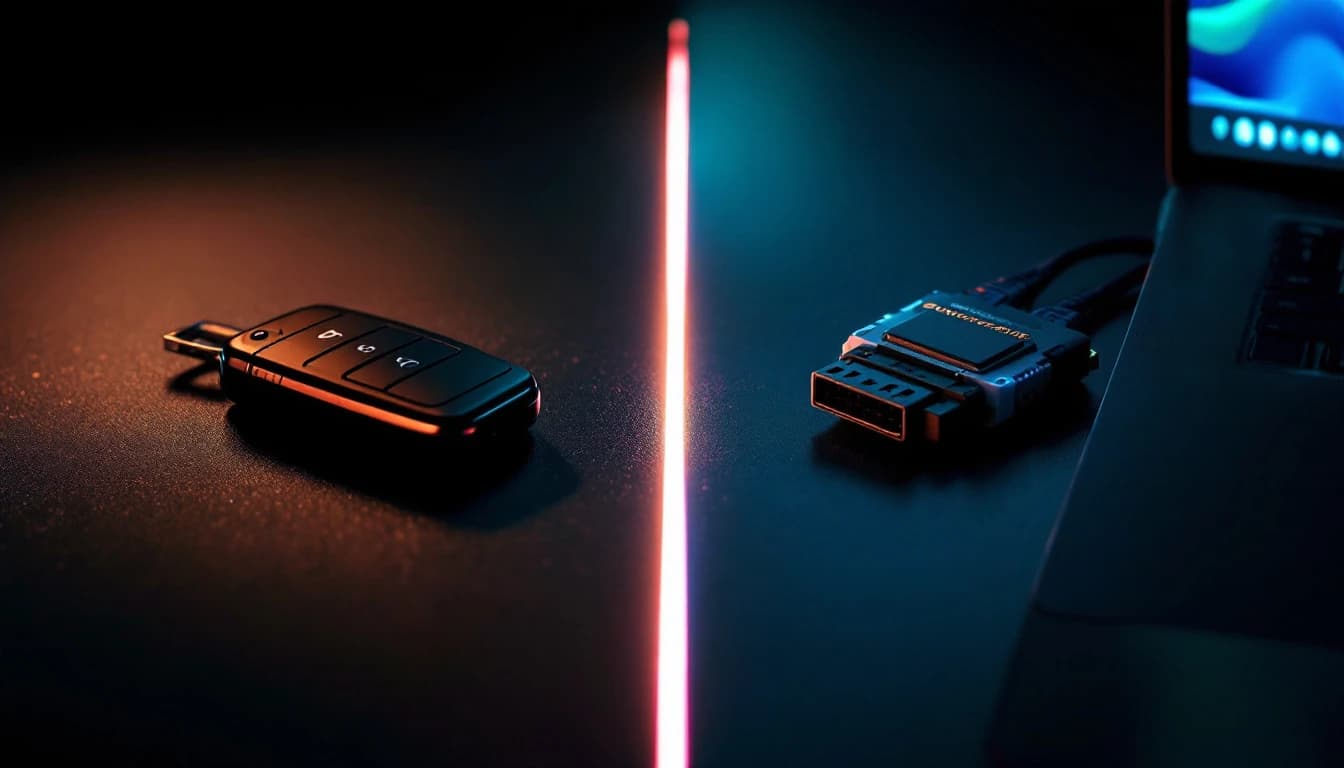
Ford PATS Delete vs Key Programming
Two fixes that sound similar and are not
If your Ford will crank but not start, a flashing security light, PATS — Ford's Passive Anti-Theft System — is a prime suspect, and you will quickly run into two options that people constantly confuse: program a key, or delete PATS. They sound like alternatives to the same problem. They are not. One keeps the factory immobilizer and adds a working key to it. The other turns the immobilizer off inside the PCM so the engine starts with no transponder at all. Choosing the wrong one wastes money and, in the delete case, removes a security feature you may actually want to keep.
This guide lays out exactly when each path is correct, the legitimate reasons a PATS delete exists, the proof-of-ownership and legality rules that govern this work, and a clear side-by-side so you can tell a technician which situation you are in. The two services involved are a Ford PATS delete at $199 and a Ford PCM clone / VIN transfer at $250, both mail-in bench jobs. A technician confirms your exact setup before you ship anything.
What PATS is and how it decides to start your engine
PATS is the anti-theft immobilizer Ford has fitted to the vast majority of its vehicles for decades. Each key contains a transponder chip with a unique code. When you turn the key or press start, the immobilizer antenna around the ignition reads that chip and checks it against the list of keys programmed to the vehicle. Only if the chip is on the list does the PCM enable fuel and spark. No valid key, no start — the engine may fire for half a second and die, or never catch at all, usually with the security light flashing.
The reason this system exists is simple: it works. Electronic immobilizers are one of the most effective anti-theft technologies ever deployed. Insurers and safety researchers have credited immobilizers with large reductions in theft of the vehicles that have them, and organizations that study vehicle crime such as the National Insurance Crime Bureau and the Insurance Institute for Highway Safety track how theft patterns shift toward the models that lack strong immobilization. With hundreds of thousands of vehicles stolen in the United States every year according to figures compiled by federal agencies including the FBI, the immobilizer is doing real work every time it refuses a stranger's key. That is worth remembering before you decide to turn it off.
Path 1 — Key programming (keep PATS, add a working key)
Key programming is the answer for the ordinary situations, and it is what most people actually need. PATS stays fully active. The module simply learns a new key, or relearns a set of keys, so that key is authorized to start the engine. Nothing about the security architecture changes — you still have a working immobilizer afterward, now with the key you want it to accept.
Key programming is the right call when:
- You lost one key but still have a working one. The spare gets you into a key-add procedure to program a replacement, restoring you to two keys.
- You want a spare cut and programmed. Prudent for any single-key vehicle — a second programmed key is cheap insurance against a lockout later.
- A key is worn, damaged, or intermittent. Replace and program a fresh key.
- All keys are lost but keys and key data are obtainable for your vehicle. Where the immobilizer can be relearned and a new key programmed, this restores normal operation with PATS intact — the preferred outcome whenever it is possible.
The guiding principle: if you can keep the immobilizer and simply have a valid key, do that. You keep the theft protection, and it is usually the least invasive fix.
Path 2 — PATS delete (disable the immobilizer in the PCM)
A PATS delete is a different animal. It reprograms the PCM so the immobilizer function is disabled — the engine no longer requires a transponder handshake to start. After a delete, the vehicle starts without PATS checking any key against any list. This is a legitimate and sometimes necessary service, but only for specific situations, and it removes a security feature by design.
A PATS delete is appropriate for legitimate cases such as:
- Engine swaps and standalone setups. When a Ford engine and PCM are transplanted into another chassis, a kit car, a marine or industrial application, or run on a standalone harness, the original immobilizer hardware and key data often are not present. Disabling PATS lets the powertrain run in its new home.
- Off-road, racing, and competition builds. Purpose-built vehicles that are not registered for road use, where a factory immobilizer serves no purpose and complicates the build.
- Orphaned or incomplete platforms. A powertrain removed from a donor where the matching immobilizer or keys cannot be reunited with it.
- Genuine all-keys-lost where keys or key data are unobtainable. On some older or unusual configurations, when every key is gone and a normal relearn or new key simply is not achievable, disabling the immobilizer is the remaining way to make the vehicle drivable — for the legitimate owner, with proof of ownership.
The Ford PATS delete service is $199 on the bench. Note carefully what a delete is not for: it is never a means of starting a vehicle you cannot prove you own, and it is never a bypass for a stolen or recovered-stolen vehicle. Disabling an immobilizer removes theft protection, and that is precisely why proof of ownership is mandatory and why this work is offered only for legitimate purposes.
"People hear 'PATS delete' and think it's the easy button for any no-start. It isn't. Ninety percent of the time the right answer is programming a key and keeping the immobilizer. Delete is for the swap, the race car, the orphaned engine, or the genuine all-keys-lost where there's simply no key path left — and only ever for the person who can prove the vehicle is theirs. I turn away anyone who can't." — Independent locksmith and ECU programmer, 16+ years in immobilizer work (anonymized)
The clear comparison
| Key programming | PATS delete | |
|---|---|---|
| What happens to PATS | Stays fully active | Disabled in the PCM |
| Engine starts with | A valid programmed key | No transponder needed |
| Theft protection after | Retained | Removed by design |
| Typical use case | Lost key, spare key, worn key, relearnable all-keys-lost | Engine swap, off-road/racing, orphaned platform, unrecoverable all-keys-lost |
| Keeps factory security | Yes | No |
| Proof of ownership | Required | Required |
| Reversible intent | N/A — nothing removed | Restores drivability, not security |
| Right default choice | Yes, whenever a key path exists | Only when no key path is appropriate |
The table makes the decision rule obvious: if a key can solve it, program a key. Reserve the delete for the cases where keeping the immobilizer is genuinely impractical — a swap, a race build, an orphaned engine, or an all-keys-lost with no achievable key path — and always with ownership verified.
How PATS interacts with PCM replacement
PATS and the PCM are tied together, so immobilizer decisions often come up during a module replacement. If your PCM has failed and you are replacing it, the immobilizer data lives partly in that module, which shapes your options.
- Cloning your original PCM keeps PATS and your keys intact. If your failing module can still be read, a Ford PCM clone / VIN transfer copies your VIN and PATS key data onto a donor, so your existing keys keep working and the immobilizer stays functional — no delete, no relearn. This is usually the cleanest route when a module has failed but its data is recoverable.
- A delete is a separate decision from replacement. Choosing to disable PATS is about the four legitimate use cases above, not merely because a module was swapped. If you are swapping a PCM into a road car with keys available, you want the immobilizer working, not deleted.
If your no-start might be an immobilizer fault rather than a failed module or a mechanical problem, it is worth confirming before you spend on parts. And if you are facing a true all-keys-lost, our mail-in guide on that scenario walks through the options in detail.
All-keys-lost: which path applies?
All-keys-lost is the situation that most often forces the key-versus-delete question, so it deserves its own treatment. Losing every key to a vehicle is not rare — with tens of millions of vehicles on U.S. roads and keys that are easy to misplace or lock away, it happens constantly, and outlets that cover ownership costs like Kelley Blue Book regularly note how expensive dealer key replacement has become. When every key is gone, the decision follows the vehicle:
- If a new key can be cut and programmed and the immobilizer relearned, that is the preferred path — you end up with a working key and an intact PATS system. This is the normal outcome for most vehicles.
- If, for that specific configuration, no achievable key path exists — the key data or key type is genuinely unobtainable and a relearn is not possible — a PATS delete becomes the practical way to make the vehicle drivable again for its legitimate owner.
You do not have to diagnose which case you are in on your own. Describe the vehicle and the situation, send your details and proof of ownership, and a technician determines whether a key path is viable or whether a delete is the appropriate remedy. Our companion guide, an all-keys-lost mail-in module programming walkthrough, goes deeper on how these cases are worked. For understanding whether your no-start is even PATS-related in the first place, see our breakdown of diagnosing an immobilizer no-start versus a module fault.
Proof of ownership and legality — read this before ordering
This work sits squarely in security territory, so the rules are strict and non-negotiable.
Proof of ownership is required for both key programming and PATS delete. No legitimate shop performs immobilizer or key work without verifying that the vehicle belongs to the person requesting it. Title, registration, and matching identification are the standard. This protects owners and keeps this trade legitimate.
A PATS delete is offered only for lawful, legitimate purposes — engine swaps, off-road and racing applications, orphaned or standalone platforms, and genuine all-keys-lost cases where legally permitted. It is never provided to defeat the security of a vehicle the requester cannot prove they own, and it is never a tool for stolen-vehicle recovery bypass.
The customer is responsible for legal compliance. Disabling an immobilizer, like any modification, may carry legal and insurance implications depending on your jurisdiction and how the vehicle is used. What is appropriate for a dedicated off-road or competition vehicle may not be appropriate for a road-registered one. The customer is solely responsible for ensuring the work complies with applicable local, state, and federal law for their vehicle and intended use. A technician confirms controller support and fitment; you confirm legality for your situation.
Software does not repair mechanical faults. If your no-start is fuel, spark, compression, wiring, or a bad ground rather than PATS, neither key programming nor a delete will fix it. Confirm the diagnosis first.
The mail-in workflow
Both services are bench jobs — you ship the module, not the vehicle:
- Confirm fitment and ownership first. Text us your VIN, the PCM part numbers off the module label, a photo of that label, and your proof of ownership. Describe your situation — lost key, spare, engine swap, all-keys-lost — so a technician can confirm whether key programming, a PATS delete, or a clone fits. Nothing ships until it is confirmed.
- Remove the module. Unplug and remove the PCM, pack it in an anti-static bag inside a padded box.
- Ship to the workshop. Send it to PO Box 120241, Arlington TX 76012 if you ship USPS — or 1009 Oakwood Ln # 120241, Arlington TX 76012 if you ship UPS or FedEx (UPS and FedEx cannot deliver to a PO Box).
- Bench read and program. The module is read and archived on a regulated bench supply, then programmed or deleted as appropriate for your confirmed case.
- Verify and return. The module is tested to communicate, then shipped back with tracking via the return option you choose at checkout, from $29.95. Return shipping is paid by the customer.
The bench approach is also safer than in-vehicle flashing because a regulated power supply removes the voltage-sag risk that can corrupt a module mid-write. Ford's factory service definitions, accessible through resources like Ford, define what applies to which vehicle, and the work stays within those definitions for your exact configuration.
Frequently asked questions
Should I delete PATS or just program a key? Program a key whenever a valid key path exists — a lost key with a spare, a new key you can cut and relearn, or an all-keys-lost that can still be relearned. That keeps the immobilizer and its theft protection. Reserve a PATS delete for engine swaps, off-road or racing builds, orphaned platforms, and all-keys-lost cases where no achievable key path remains.
Does a PATS delete remove my car's anti-theft protection? Yes. A PATS delete disables the immobilizer inside the PCM, so the engine starts without any transponder handshake and the factory anti-theft function is gone by design. That is exactly why it is reserved for legitimate use cases and why keeping PATS with a programmed key is the default whenever it is possible.
Is a PATS delete legal? It is offered only for legitimate purposes such as engine swaps, off-road and racing use, orphaned platforms, and genuine all-keys-lost where legally permitted, and always with proof of ownership. The customer is solely responsible for ensuring the work complies with local, state, and federal law for their vehicle and intended use.
Do I need proof of ownership for key or PATS work? Yes, always, for both key programming and PATS delete. No legitimate shop performs immobilizer or key work without verifying the vehicle belongs to the requester, using title, registration, and matching identification. This is a firm, non-negotiable requirement designed to protect owners.
Can PATS be deleted for a stolen or unrecoverable vehicle? No. A PATS delete is never provided to defeat the security of a vehicle the requester cannot prove they own, and it is never a stolen-vehicle bypass. Proof of ownership is mandatory precisely to prevent this, and requests that cannot verify ownership are declined.
What if all my keys are lost? If a new key can be cut, programmed, and the immobilizer relearned for your vehicle, that is the preferred fix and keeps PATS intact. Only when no achievable key path exists for that specific configuration does a PATS delete become the practical way to make the vehicle drivable again — decided after a technician reviews your setup and ownership.
When you are weighing the two paths, remember that both keep you within a legitimate repair framework as long as ownership is proven. Broad reliability reporting from J.D. Power underscores how central electronic security has become to modern vehicles, which is exactly why the PATS handshake exists in the first place and why the right fix depends on whether you are keeping the immobilizer or removing it for a legitimate build.
The bottom line
Ford PATS gives you two very different tools, and the right choice comes down to whether a valid key path exists. Key programming keeps the immobilizer and simply authorizes a new or replacement key — the correct answer for ordinary lost-key, spare-key, worn-key, and relearnable all-keys-lost situations, and the default whenever it is possible because you keep the theft protection.
A Ford PATS delete disables the immobilizer in the PCM entirely at $199, appropriate only for legitimate engine swaps, off-road and racing builds, orphaned or standalone platforms, and genuine all-keys-lost cases where no key path remains — never as a workaround for a vehicle you cannot prove you own. When a failed module is the real issue, a Ford PCM clone / VIN transfer at $250 keeps your VIN and keys intact. Both require proof of ownership, both are mail-in bench jobs returned with tracking and return shipping from $29.95, and the customer is responsible for legal compliance. Text us your VIN, your situation, and your proof of ownership, and a technician confirms the right path and your exact setup before anything ships.
Ship your module today
Flat-rate pricing, typical 24-hour bench turnaround, return speed your choice at checkout. Most jobs back on your bench within a week.