
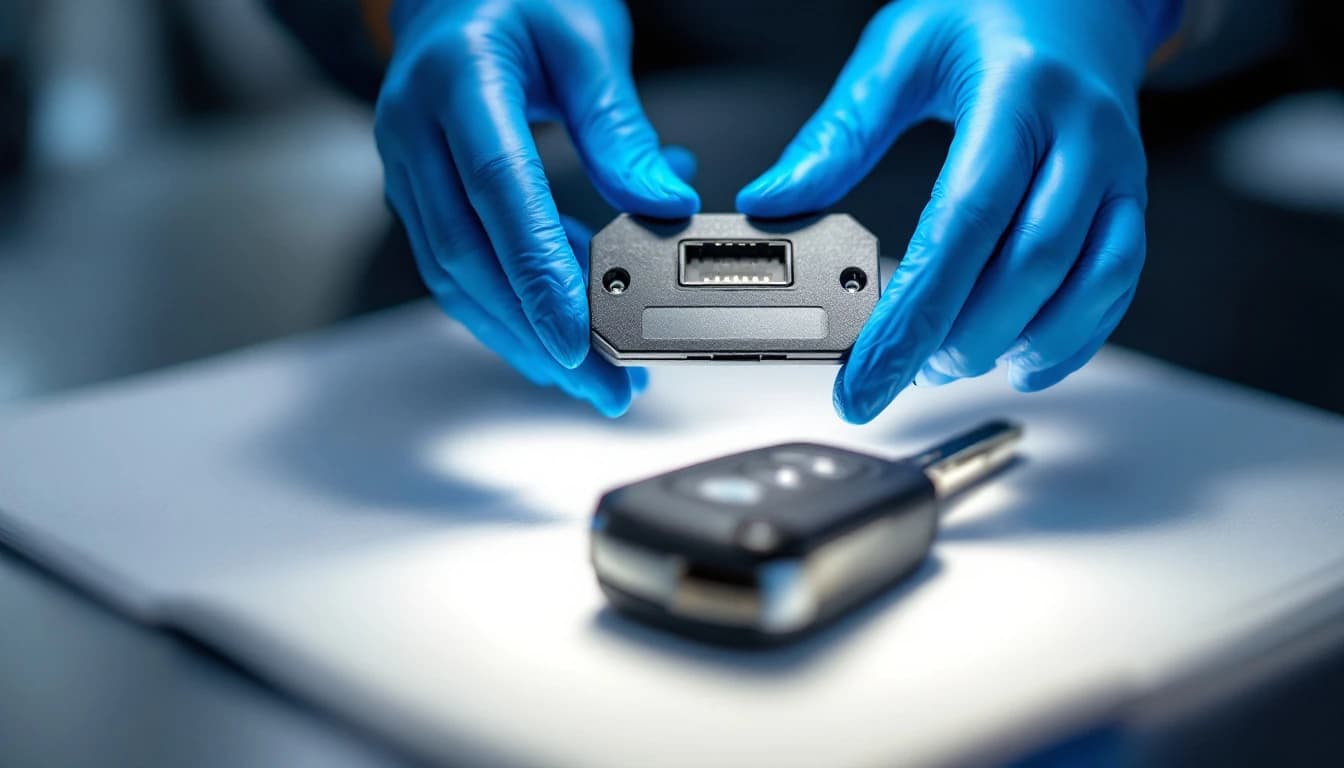
Proof of Ownership for Immobilizer and Key Module Work
The question behind the question
When you send a control module to a bench lab for immobilizer, key, or security-access work, somewhere in the intake you will be asked to prove the vehicle is yours to work on. Owners sometimes read that as friction — one more hoop between a dead car and a running one, added by a shop being difficult.
It is worth understanding what the request is actually for, because once you see the shape of the problem, the paperwork stops feeling arbitrary and starts looking like the reason the service is worth trusting at all.
Every job in this category has a dual nature. Reading an immobilizer secret out of an engine controller so a new key can be programmed is, for the titled owner of a car with no working keys, the difference between a modest bench service and a four-figure dealer tow-and-replace. The exact same read, done for somebody who found the car in a parking lot and pulled the module out with a screwdriver, is a theft tool. The bench work is identical. The soldering is identical. The dump is identical. The only thing that separates the two situations is who is asking, and the only way a lab can tell the difference is to ask.
That is the whole logic. It is not a legal formality bolted on by a lawyer. It is the single control that keeps a legitimate repair capability from being a service that helps steal cars.
Why this matters more than it used to
Modern vehicle security is genuinely good, and that is precisely why the module lane became attractive to the wrong people. The National Highway Traffic Safety Administration has required theft-protection and starting-system safeguards on passenger vehicles for decades, and oversees a national fleet of well over 250 million registered light vehicles. The practical result is that essentially every car built in the last twenty-five years refuses to start unless a control module recognizes an authenticated key. You cannot hot-wire a modern car in any meaningful sense. The engine controller simply will not fuel and spark without a conversation it trusts.
Insurance loss data has repeatedly shown how effective that has been. Research published by the Insurance Institute for Highway Safety and its affiliated loss-data arm has found that vehicle lines built without engine immobilizers ran theft-claim frequencies on the order of 2 times those of otherwise comparable vehicles that had them — one of the clearest safety-technology effects in the entire loss database.
But theft did not stop. It moved. The National Insurance Crime Bureau has reported roughly 1 million or more vehicles stolen in the United States in recent high years, and the Federal Bureau of Investigation has long ranked motor vehicle theft among the highest-volume property crimes it tracks, with aggregate annual losses running well over $7 billion in a single year. When the front door is locked, attention shifts to the locksmith. Thieves increasingly work through the security system rather than around it — plugging into a diagnostic port, or pulling a module and having someone else read its secrets.
That is the environment a bench lab operates in. Refusing to be the someone else is not optional.
"The uncomfortable truth is that the skills are neutral. I can read a secret out of a body module in twenty minutes and I genuinely cannot tell from the part whether the car is in the customer's driveway or somebody else's. The paperwork is the only sensor I have. So I treat a clean document package as part of the job, not as an obstacle to it — and the customers who are actually owners have never once had a problem producing it." — Independent automotive security technician, 17+ years in immobilizer and bench module work (anonymized)
What proof of ownership is actually proving
It helps to be precise, because "proof of ownership" is doing three separate jobs at once.
First, it links a person to a vehicle. A title, a registration, or a bill of sale ties a named human or business to a specific VIN. That is the core claim.
Second, it links that vehicle to the part in the box. A module arriving by mail is an anonymous grey plastic brick. The lab needs a reason to believe it came out of the vehicle on the paperwork — which is why the VIN, the part number, and often a photo of the module in the car matter as much as the title itself.
Third, it creates a record. If a job is later questioned — by an owner, an insurer, or law enforcement — the lab can show who asked, what was claimed, and what was supplied. A shop with no record has no answer. A shop with a record has an ordinary business file.
All three are needed. A title with no part linkage proves you own a car, not that you own this module. A module photo with no title proves the part came from a car, not that the car is yours.
What counts, by who you are
Most people reading this are not edge cases. They are the titled owner of a car that will not start, and they will satisfy the requirement in about four minutes with a phone camera. But real intake covers a wider set of requesters, and each one has a realistic document set.
| Who you are | Primary document | Supporting document | Typical gap and how to close it |
|---|---|---|---|
| Titled owner | Title or current registration in your name, VIN visible | Photo ID matching the name | Almost none — this is the clean case |
| Recent buyer, title not yet transferred | Signed bill of sale naming you, the seller, and the VIN | Prior title or its assignment section, insurance card in your name | Name mismatch on the registration — send the bill of sale plus the seller-signed title so the chain is visible |
| Salvage or rebuilt-title buyer | Salvage certificate or rebuilt title with matching VIN | Auction sale receipt or dealer invoice | Auction paperwork alone is weak — pair the receipt with the certificate |
| Independent shop working a customer car | Repair order naming the customer and VIN | Shop business license or credentials, plus the customer's ownership document | Shops often send an RO alone — include the customer's title or registration too |
| Licensed locksmith or security professional | Locksmith or security license or registry credential | Customer work order and the customer's ownership document | Credential proves who you are, not who owns the car — both are needed |
| Fleet or company vehicle | Title or registration in the company name | Letter or work order on company identification from an authorized person | Employee name will not match the title — the authorization letter closes it |
| Estate or inherited vehicle | Title plus letters testamentary, small-estate affidavit, or equivalent | Death certificate copy where required by the state | Title still in the decedent's name — the estate document is what bridges it |
| Lienholder, repossession, or insurer | Lien instrument, repossession assignment, or total-loss transfer | Company credentials and the VIN-matched assignment | Assignment must name the same VIN as the part — mismatch is the usual stall |
Two things are worth pulling out of that table.
Credentials and ownership are different claims. A locksmith license is excellent evidence that you are a trained professional operating a real business. It says nothing about whether the specific vehicle belongs to your customer. Serious labs ask for both, and serious locksmiths already collect the customer's paperwork as a matter of routine — it protects them far more than it protects us.
Chains are acceptable, gaps are not. A car bought last week will not have a title in your name yet, and nobody expects it to. What is expected is a visible chain: the seller's title, the assignment signed over, and a bill of sale naming you and the VIN. A chain with all its links is fine. A chain missing the middle is where a job stalls.
Salvage, rebuilt, and auction cars
This is the category that generates the most intake conversation, so it deserves its own note.
Buying a salvage or rebuilt-title car is completely legitimate, and a large share of module programming work exists precisely because these vehicles need control units replaced, cloned, or reconciled to the car. This is a mainstream population, not a fringe one: roughly 36 million used vehicles change hands in the United States in a typical year according to Kelley Blue Book, and vehicle-history data providers such as Carfax report that well over 1 million vehicles on U.S. roads carry a branded title of some kind.
What changes is the documentation. A salvage buyer often does not have a conventional title in hand — they have a salvage certificate, a rebuilt title, or an auction sale receipt. Those are acceptable, but the VIN has to match cleanly and the sale document should name you. If you are working through the full rebuild sequence, the salvage and rebuilt-title module programming guide walks through what to expect module by module.
The place labs get cautious is auction paperwork with no accompanying certificate, on a vehicle whose modules were removed by someone other than the buyer. That is not an accusation — it is simply a thin file, and thin files get one more question.
All-keys-lost and theft-recovery jobs
The two highest-scrutiny situations are the ones where the vehicle has no working key at all, and the ones where the vehicle has just been recovered after a theft.
An all keys lost job is the classic legitimate emergency: the owner has a car, no keys, and a module that has to give up a secret so a new key can be made. It is also, structurally, exactly what a thief needs. So it draws the fullest document set — ownership document, photo ID, and usually a photo of the vehicle with the VIN plate visible.
Theft-recovery jobs are similar but with an added element. A recovered vehicle frequently comes back with damaged or replaced security modules, and the owner may be working with an insurer. In that situation the police report number and the insurer's claim documentation are genuinely useful additions to the file, not extra hurdles. They make the story coherent, and coherent stories move fast.
The VIN on the part versus the VIN on the paperwork
Once ownership is established, a second and more technical check begins: does the module match the car?
Many control modules carry the VIN written into their memory, and many carry a manufacturer part number and hardware or software revision on the case label. A bench read will surface both. When a lab compares the VIN stored in a module against the VIN on the paperwork, three outcomes are possible.
They match. This is the ordinary case, and it is quietly reassuring for everyone.
The module is virgin or has no VIN stored. Perfectly normal on a new replacement unit or a module that has been reset. The paperwork is then the only linkage, so the ownership document carries the full weight.
They do not match. This happens constantly for innocent reasons — you bought a used donor module from a scrapyard, and it still holds the donor car's identity. That is precisely what a cloning or VIN-write service is for, and the mismatch is expected. If you are buying donors, the used module donor checklist covers what to verify before you spend money.
A mismatch is a question, not a verdict. The question is simply: which VIN is the customer's car? If your paperwork says one VIN and the module says another, tell the lab that up front and explain why. A pre-declared mismatch is a routine donor job. An undeclared mismatch discovered on the bench is the one that slows everything down.
Why a lab may still decline a job that looks fine on paper
Documentation is necessary. It is not always sufficient, and it would be dishonest to imply otherwise.
A bench lab retains discretion, and reasonable ones use it sparingly. The situations that trigger a decline despite an apparently complete file tend to share a pattern: something in the story does not fit the physics of the job.
- The module shows fresh pry marks or cut harness pigtails consistent with rapid removal rather than a service removal.
- The requested operation does not match the stated symptom — a request to strip identity from a module on a car described as running fine.
- The vehicle is described in one way and the part is unmistakably from another platform or model year.
- The requester will not answer basic vehicle questions an owner would answer instantly.
- The documents are internally inconsistent — VIN digits that do not check out, or a name that changes between documents without explanation.
When a lab declines on those grounds it is usually not accusing anyone of anything. It is recognizing that its own confidence is below the threshold it holds itself to, and the honest response to low confidence on a security job is to stop. A lab that will not decline anything is a lab whose approval means nothing.
The practical implication for a legitimate customer is simple and encouraging: explain the situation in plain language up front. Nearly every borderline-looking file resolves in one message once the customer says what actually happened.
Where the wider industry framework fits
None of this is one lab's invention. The automotive service industry built formal infrastructure around exactly this problem.
The National Automotive Service Task Force exists in large part to solve the tension between two legitimate goals: independent shops and locksmiths need access to security-related data and parts to repair vehicles, and manufacturers need assurance that access is not handed to thieves. Its Vehicle Security Professional registry and Secure Data Release framework create a vetted channel — background-checked, credentialed professionals who can request theft-relevant information and order theft-relevant parts through documented processes, with records kept at every step. More than 2,000 credentialed professionals participate in the NASTF registry.
The design principle is worth noticing, because it is the same one behind a bench lab's intake: identity of the requester, evidence of the vehicle relationship, and a durable record. If you are ordering a theft-relevant part through that channel, the NASTF theft-relevant part order guide explains the sequence and what documentation the process expects.
Standards bodies reinforce it from the engineering side. SAE International publishes the diagnostic and security-access standards that define how a tool authenticates itself to a module before it is allowed to write anything, and industry certification bodies such as ASE formalize the competence side. Meanwhile the Federal Trade Commission receives well over 1 million identity-theft reports in a typical year, which is the broader context in which any business handling identity-linked property keeps records.
Layered together, the picture is consistent: the industry decided long ago that security-relevant work happens through documented channels, and a mail-in bench lab is simply one node in that structure.
What to send with your module — the checklist
Here is the short version. Text us before you ship if anything on this list is complicated in your situation, and we will tell you exactly what will satisfy it before you spend money on postage.
Always include:
- Your ownership document — title, current registration, salvage or rebuilt certificate, or a signed bill of sale naming you and the VIN.
- Photo identification matching the name on that document.
- The full 17-character VIN, typed out, plus a photo of the VIN plate or door-jamb sticker.
- A photo of the module including its part-number label, and where possible a photo of it installed in the vehicle before removal.
- A plain description of what the car is doing — no keys, no crank, replaced module, donor unit purchased, and so on.
Include when applicable:
- A repair order if you are a shop, naming your customer and the VIN, alongside your customer's ownership document.
- Your professional credential if you are a locksmith or security professional.
- A company authorization letter for fleet vehicles where the requester's name will not match the title.
- Estate documentation — letters testamentary or a small-estate affidavit — for an inherited vehicle whose title is still in the decedent's name.
- A police report number and insurer claim reference for theft-recovery vehicles.
- A note declaring any known VIN mismatch, if the module came from a donor car.
Everything ships to our workshop, and the physical mail-in addresses differ by carrier: USPS goes to PO Box 120241, Arlington, TX 76012, while UPS and FedEx cannot deliver to a USPS PO Box and must be addressed to 1009 Oakwood Ln # 120241, Arlington, TX 76012. Work is performed at our Arlington workshop at 1168 W Pioneer Parkway, Arlington, TX 76013. We buy and email you a prepaid inbound label so the module reaches us correctly, and you choose your return shipping tier at checkout starting at $29.95 for standard service, with UPS 2nd Day Air at $54.95 and UPS Next Day Air at $94.95.
Security-relevant services where this documentation applies include Range Rover and Jaguar key programming, Mercedes EIS key programming, and BMW CAS key programming. The full catalog is on the services hub, and any service touching keys, immobilizers, immobilizer deletion, or security access carries the same requirement.
Frequently asked questions
Why do you need proof of ownership if I am paying you and shipping the part myself? Because payment and possession do not establish ownership, and the operations involved — reading an immobilizer secret, generating a key, or granting security access — are the exact operations a vehicle thief needs. The document requirement is the only mechanism a mail-in lab has to separate a legitimate repair from a theft-enabling service, so it applies to every requester without exception.
I just bought the car and the title is not in my name yet. Can you still help? Yes, and this is one of the most common situations we see. Send the signed bill of sale naming you, the seller, and the VIN, together with the prior title showing the seller's assignment to you. A visible ownership chain is fully acceptable even when the state transfer has not completed — what stalls a job is a missing link in that chain, not the pending transfer itself.
I run an independent shop. Is my repair order enough on its own? A repair order establishes that you are performing legitimate work for a named customer, which is valuable, but it does not establish that your customer owns the vehicle. Send the repair order together with your customer's title or registration and your shop credentials. Shops that collect that document at intake almost never have a job delayed, and the practice protects your business at least as much as it protects ours.
The module I bought used has a different VIN stored in it than my car. Is that a problem? No, that is normal and expected on a donor unit, and reconciling it is exactly what a cloning or VIN-write service does. Just declare the mismatch when you send the job in and explain which VIN belongs to your vehicle. A pre-declared mismatch is a routine donor job; an undeclared one discovered on the bench is what causes delays while we sort out which car is yours.
What if the vehicle was inherited and the title is still in my relative's name? Send the title as it stands plus the estate document your state issued — letters testamentary, a small-estate affidavit, or the equivalent short-form authority. That estate document is what legally bridges the gap between the name on the title and your authority to act, and with both in hand an inherited-vehicle job proceeds normally.
Can a job be refused even if I send every document you asked for? Yes, though it is uncommon. A lab retains discretion and will stop when the physical evidence contradicts the paperwork — fresh pry marks on a module described as a clean service removal, or a requested operation that does not match the stated symptom. If that happens on a genuine job, a short explanation of what actually occurred resolves nearly every case, and you will not be charged for work that is not performed.
Do you keep copies of my documents, and for how long? Yes. Documentation supplied for a security-relevant job is retained as part of the ordinary business record for that order, which is the entire point of collecting it — a job with no record cannot be defended later if an owner, insurer, or investigator ever asks. It is treated as confidential business information and is not used for anything other than establishing and recording authorization for the work you ordered.
The bottom line
Proof of ownership is not bureaucracy for its own sake. Immobilizer, key, and security-access work sits on a knife edge where the identical technical operation is either an owner's cheapest route back to a running car or a thief's shortcut, and documentation is the only instrument that tells a mail-in lab which one it is looking at.
For the overwhelming majority of customers this is a four-minute task: photograph your title or registration, photograph your ID, type out the VIN, photograph the module label, and describe what the car is doing. Buyers mid-transfer, salvage purchasers, shops, locksmiths, fleets, estates, and lienholders each have a realistic document set, and none of them are unusual — they simply need the chain to be visible rather than assumed.
The industry built formal infrastructure around this exact tension for the same reason we ask: access to vehicle security data has to be real enough to repair cars and controlled enough not to steal them. A lab that never declines anything is a lab whose authorization means nothing.
Get the paperwork ready before you pack the box, declare anything unusual up front, and the rest of the process is ordinary. Text us with your VIN, a photo of the module label, and a description of your situation, and we will confirm exactly what your case needs before you ship anything.
Ship your module today
Flat-rate pricing, typical 24-hour bench turnaround, return speed your choice at checkout. Most jobs back on your bench within a week.
More from the Lab
Porsche Module Cloning Cost: DME, Alarm Box, BCM (2026)
13 min · September 23, 2026
Fiat 500 Cranks, No Start After ECU Swap: Diagnosis
12 min · September 23, 2026
How to Reset EWS on a BMW: DME Re-Sync Guide
13 min · September 23, 2026
BMW EWS2 vs EWS3 vs EWS4 — Which One Do You Have?
13 min · August 31, 2026