Swapping In a Used Cluster: VIN and True Mileage
Why a used cluster does not just drop in
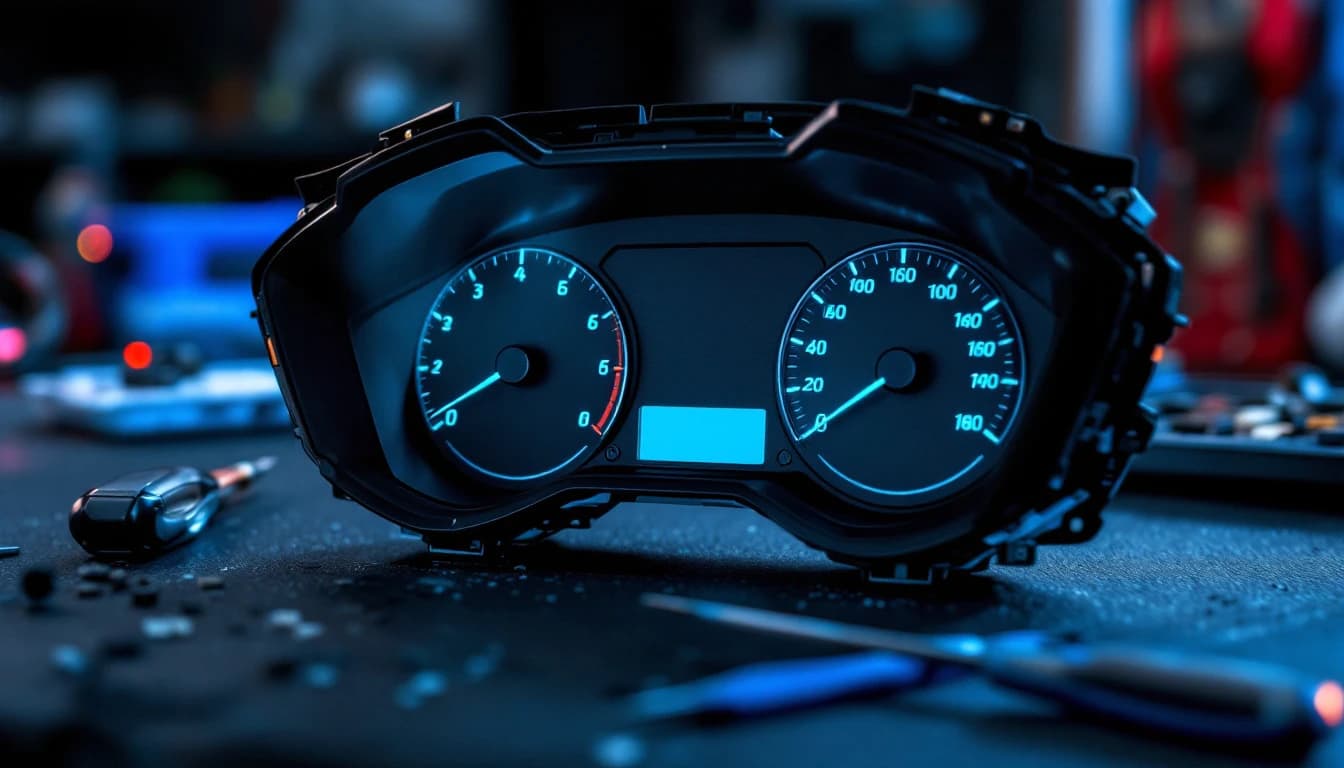
A donor instrument cluster is not a gauge assembly. It is a small computer with a memory, an identity, and often a role in the immobilizer. That is why the junkyard cluster with the correct part number cranks up showing the wrong mileage and, on a lot of cars, throws a fault the moment it wakes up.
Three things are baked into that donor cluster from the car it came out of:
- The stored odometer value. Modern clusters keep mileage in non-volatile memory, usually an EEPROM or the flash inside the cluster microcontroller, not on a mechanical drum. The donor remembers the miles the wrecked car had.
- The VIN. Most clusters store the vehicle identification number and expect it to match the rest of the car. A mismatch is something the network can see and, on many platforms, refuse to accept.
- A piece of the security system. On a large number of vehicles the cluster participates in the immobilizer handshake. It holds a component security code or key data and cross-checks with the engine controller and body module at every start.
Plug that into your car and you have three conflicts at once: the odometer is wrong, the VIN does not match, and the security data belongs to a different vehicle. The dash may light up and the gauges may sweep, but the numbers are somebody else's and the car may not start. This is exactly the situation our guide to what is actually fixable when a cluster is replaced and how VIN and mileage carry over covers from the replacement-part angle, and it pairs directly with everything here about used donors specifically.
The wrong-mileage problem, and the law that governs it
Start with the part that has legal weight, because it shapes every honest answer that follows.
When a donor cluster shows, say, 47,000 miles and your car has actually traveled 138,000, the odometer is now misrepresenting the vehicle. The only lawful and correct fix is to make the cluster display your vehicle's true accumulated mileage, the real 138,000, not the donor's 47,000 and never a number chosen to look better.
This is not a shop policy. It is federal law. The odometer statutes at 49 U.S.C. Chapter 327 make it illegal to disconnect, reset, or alter an odometer with intent to change the mileage reading, and to operate a vehicle knowing the odometer is disconnected or non-functional. The enforcement and rulemaking sit with the National Highway Traffic Safety Administration, which treats odometer fraud as a serious consumer-protection matter. NHTSA has estimated that odometer fraud affects on the order of hundreds of thousands of vehicles sold each year in the United States and costs American car buyers well into the hundreds of millions of dollars annually. Vehicle-history provider Carfax has put the number of vehicles on U.S. roads with rolled-back odometers at well over a million. The scale is exactly why the law is strict and why a legitimate bench refuses to touch a number in the wrong direction.
So the rule a reputable service follows is simple and absolute: the transferred mileage is the vehicle's true accumulated mileage, established from your original cluster or your documentation. We never roll mileage back, and we never invent a figure. If the true mileage cannot be established honestly, the correct outcome is to say so, not to guess. For the full treatment of where the line sits between legitimate sync and illegal rollback, our explainer on whether odometer and mileage correction is legal during a cluster sync is the companion read, and it is worth reading in full before you commit to any cluster swap.
The two clean paths
There are two honest ways to make a donor cluster work in your car, and which one applies is decided by the platform, not by preference.
Path one: transfer your true mileage and VIN onto the donor. Your original cluster is read, your genuine accumulated mileage and your VIN are pulled from it, and those values are written into the donor. The donor stops being the wrecked car's cluster and becomes yours, carrying your real mileage and your VIN. This is the usual path when your original cluster can still be read, even if its display or a stepper motor is failing, because the data can still be recovered from the memory.
Path two: virginize the donor, then code it to your car. On platforms that support it, the donor is returned to a clean, unpaired state as if it were a fresh service part, and then it is coded to your vehicle and set to your true mileage. This is the path when your original cluster is truly dead and unreadable, or when the platform's tooling favors a clean coding procedure over a direct data transfer.
The critical difference between them is whether your original cluster still reads. That single fact usually decides the route, which is why intake starts with the condition of your old cluster rather than with what you would prefer.
| Transfer mileage and VIN onto the donor | Virginize the donor, then code it | |
|---|---|---|
| Starting point | Your original cluster still reads | Original cluster dead or unreadable |
| What moves across | Your true mileage and VIN, written into the donor | Donor cleared, then set to your true mileage and VIN |
| Immobilizer handling | Security data aligned or keys re-learned as needed | Donor re-paired to your car, keys re-learned as needed |
| Best for | Most swaps where the old cluster memory survives | Genuinely dead originals, or platforms favoring clean coding |
| Original cluster needed | Yes, to source the true data | Helpful for proof, not always required to read |
| Legal constraint | True accumulated mileage only, never a rollback | True accumulated mileage only, never a rollback |
Notice what is identical in the last row of both columns. No matter which path a platform takes, the mileage written is the vehicle's true accumulated mileage. That never changes.
The immobilizer trap that catches people out
Here is the part that turns a simple gauge swap into a no-start, and it catches a lot of people who assumed a cluster was just gauges.
On a large share of vehicles, the instrument cluster is part of the immobilizer chain. It stores a component security code, or it holds transponder key data, or it is one of the modules that must agree during the start-authorization handshake with the engine controller and the body module. When any of those is true, swapping the cluster means swapping a piece of the security system.
The symptom is predictable. The car cranks and will not start, an immobilizer or key symbol flashes on the new dash, or you get a module-mismatch or component-protection fault that will not clear with a scan tool. The gauges might work perfectly and the car still will not run, because the security handshake is now failing.
This is why cluster work on these platforms is often key-programming work at the same time. If the donor's security data does not match your car, either the security data has to be aligned or the keys have to be re-learned to the new-to-you cluster. And that pulls in a hard requirement: proof of ownership is required for any key or immobilizer-linked work, without exception. A reputable bench verifies that the vehicle is yours before touching security data, and a shop that skips that step should worry you.
The direction of the industry has only made this more common. The National Highway Traffic Safety Administration has documented that a mainstream modern vehicle commonly carries well over 50 networked electronic control units, and the cluster is squarely one of them, cross-checking its neighbors rather than sitting alone. The diagnostic and security protocols those modules use to talk are defined by SAE International, which is why a bench can even read and align them in the first place. And immobilizers themselves exist because theft pressure never eased. The National Insurance Crime Bureau reports vehicle theft in the United States running into the hundreds of thousands of vehicles a year, and tighter, distributed security is the industry's answer, which is also why a single swapped module so often triggers a block.
"The call I get is always the same. The gauges work great, the mileage is wrong, and the car will not start. People think a cluster is a speedometer. On half the cars I see it is also a key. Send me the old cluster and the new one together and I can pull your real miles and your VIN, set the donor to your true number, and sort the immobilizer in one pass. Send me only the donor and we are already fighting with one hand tied." — Independent instrument-cluster technician, 17+ years (anonymized)
What has to ship, and why both clusters usually go
The single most common intake mistake is shipping only the donor cluster. On most jobs, both clusters need to be on the bench, and the reason is the mileage.
Your true accumulated mileage lives in your original cluster's memory. To transfer it honestly, the bench has to read it from the source. If only the donor arrives, there is no lawful way to establish your real mileage from the part, and the job stalls on the exact legal requirement that matters most. So the default for a used-cluster swap where mileage must carry over is: send both.
Here is the practical shipping checklist for a used-cluster job:
- Both clusters. Your original, even if the display or a gauge is dead, because its memory is the source of your true mileage and VIN. Plus the donor you intend to fit.
- Proof of ownership. Registration or title tying your name to the VIN, required before any immobilizer or key work proceeds.
- Documentation of your true mileage. A photo of your dash reading before removal, and any service records or an inspection report that corroborate it. This backs up the number read from the cluster.
- A working key, if the platform needs it. For cars where the cluster holds key data, a key may be needed to complete the security alignment. This gets confirmed at intake.
- The part numbers. Photograph both cluster labels so compatibility is confirmed before anything is written.
If your original cluster is genuinely gone, destroyed in the crash or already discarded, say so up front. The path changes, the documentation of true mileage becomes more important, and honesty about what you can and cannot prove drives the whole approach. What a bench cannot do is manufacture a mileage figure to fill the gap.
GM cluster upgrades are a related but distinct job
There is a specific and popular case worth separating out, because people conflate it with a plain swap: fitting a higher-trim GM cluster, such as a Denali-style or upgraded gauge package, into a lower-trim truck or SUV.
This is still a cluster swap, so it still carries all the same rules. The upgraded cluster is a donor. It arrives with the other vehicle's stored mileage and VIN, and on these platforms the cluster is on the data network and cross-checks the BCM and other modules, so a mismatch is visible and can throw faults. Making it work means the same two-path logic: your true mileage and VIN go onto the upgraded cluster, and it is coded to your truck so the network accepts it.
The difference is that the target part is chosen for its features rather than because your original failed, but the mileage law is exactly the same. The upgraded cluster must display your vehicle's true accumulated mileage, never the donor truck's lower number. This is a dedicated bench job, the GM instrument cluster upgrade service at $300, precisely because getting the VIN, the true mileage, and the network coding right on a trim-up swap is more involved than a like-for-like replacement. If your job is a straightforward same-trim swap or a mileage-sync onto a repaired original, that is the instrument cluster repair and mileage sync service at $200 instead.
How the sync actually happens on the bench
Understanding the bench sequence makes it obvious why the controlled setting matters and why both parts usually travel.
- Read the original. Your old cluster goes on a regulated bench supply and its memory is read. Your true accumulated mileage and your VIN come off it, and everything is archived before a single value is written anywhere.
- Confirm the true number. The mileage read from the cluster is cross-checked against your dash photo and any records you supplied. The goal is one defensible true figure.
- Prepare the donor. The donor is read and archived too, then either written with your data directly or virginized first, depending on the platform.
- Write your true data. Your genuine mileage and your VIN are written into the donor so it becomes your cluster.
- Align the security chain. Where the cluster is part of the immobilizer, the security data is aligned or keys are re-learned so the start handshake succeeds. Proof of ownership gates this step.
- Verify. The donor is read back and confirmed to show your true mileage and your VIN, and to communicate correctly, before it ships.
The reason this belongs on a bench rather than in a driveway is the same reason all module work does: a regulated supply holds a steady voltage no starter can pull down, so a write cannot be corrupted mid-operation by a sagging battery. On a memory-write to a cluster, that stability is not a luxury. A half-completed write to an EEPROM can leave a cluster in a worse state than it started, and the bench exists specifically to prevent that. For the underlying detail of how a cluster's mileage and VIN live in memory and move between units, our instrument cluster repair and mileage sync explainer goes deeper into the electronics than there is room for here.
Why value and honesty are linked here
There is a self-interested reason to insist on true mileage beyond the legal one, and it is worth being clear-eyed about.
A vehicle's stated mileage is one of the largest single inputs into its value. Valuation guides such as Kelley Blue Book build mileage directly into every figure they publish, and a discrepancy between a car's odometer and its documented history is a red flag that follows the vehicle forever. Vehicle-history reporting from providers like Carfax records odometer readings at every service and title event, so a cluster showing a number lower than a previously recorded reading does not hide anything. It flags the car as a possible rollback and damages its value and salability far more than the honest higher number ever would.
So the honest path is also the smart one. A cluster set to your true mileage keeps the car's history consistent, keeps it lawful, and keeps its value intact. A cluster set to a donor's lower number does the opposite on all three counts, and it exposes the owner to real legal risk. The standardization that lets any of this be read and verified in the first place traces back to the Environmental Protection Agency requiring standardized on-board diagnostics on light vehicles from the 1996 model year onward, which is what made the electronic odometer a networked, readable, verifiable value rather than a mechanical drum nobody could audit.
Frequently asked questions
Why does a used instrument cluster show the wrong mileage? Because a modern cluster stores the odometer value in its own memory, not on a mechanical drum, so a donor cluster carries the mileage of the car it came out of. Making it correct means writing your vehicle's true accumulated mileage into the donor, which is a bench memory operation, not a mechanical adjustment.
Can you set the cluster to whatever mileage I want? No. The odometer must reflect the vehicle's true accumulated mileage only. Federal law under 49 U.S.C. Chapter 327 forbids disconnecting, resetting, or altering an odometer to misrepresent the reading, and a reputable bench never rolls mileage back or invents a number. The transferred figure is your genuine mileage, established from your original cluster or documentation.
Do I need to send my old cluster too, or just the donor? On most jobs both clusters ship. Your true accumulated mileage lives in your original cluster's memory, so the bench has to read it from the source to transfer it honestly. If only the donor arrives, there is no lawful way to establish your real mileage from the part, and the job stalls on that exact requirement.
Why does the car not start after I swap the cluster? On many platforms the cluster is part of the immobilizer chain, holding a security code or key data and cross-checking the engine and body modules at start. A donor cluster carries the wrong security data, so the start handshake fails and you get a crank-no-start with a flashing immobilizer light. The security data has to be aligned or the keys re-learned to the new cluster.
Is proof of ownership really required for a cluster swap? Yes, whenever the cluster is linked to the immobilizer or keys, which is common. Proof of ownership such as a registration or title is required before any security-linked work proceeds, without exception. A shop that does not ask for it is a warning sign, not a convenience.
What is the difference between a plain cluster swap and a GM cluster upgrade? A plain swap replaces a failed cluster with a like-for-like unit and syncs your true mileage and VIN. A GM cluster upgrade fits a higher-trim gauge package, such as a Denali-style cluster, into a lower-trim vehicle, which adds trim-up network coding on top of the same VIN and true-mileage requirements. It is a distinct bench job at $300 because the coding is more involved.
What if my original cluster is destroyed and cannot be read? Then the transfer path is off the table and the donor is virginized and coded to your car instead, with your true mileage set from your documentation. This is exactly why documenting your real mileage before removal matters, and why an honest bench will decline to proceed rather than guess if the true figure cannot be established.
The bottom line
A used instrument cluster is a computer with someone else's memory, someone else's VIN, and often a piece of someone else's immobilizer, which is why it shows the wrong mileage and frequently will not let the car start. Making it yours takes one of two clean bench paths: transfer your true mileage and VIN onto the donor when your original still reads, or virginize the donor and code it to your car when the original is dead. On any platform where the cluster is part of the security chain, keys and proof of ownership come into it, and that requirement is not optional.
The rule that sits above all of it is legal and absolute. The odometer must show the vehicle's true accumulated mileage only. Federal law under 49 U.S.C. Chapter 327 forbids misrepresenting an odometer, and a reputable bench never rolls a number back or invents one. That is why most swaps ship both clusters, the true figure gets cross-checked against your documentation, and the whole thing happens on a regulated bench where a memory write cannot be corrupted by a sagging battery. Bench pricing is flat: $200 for instrument cluster repair and mileage sync, $300 for a GM instrument cluster upgrade, with return shipping chosen at checkout from $29.95. Send both clusters, your proof of ownership, and a photo of your true mileage, and the swap becomes a clean, lawful, one-pass job.
Ship your module today
Flat-rate pricing, typical 24-hour bench turnaround, return speed your choice at checkout. Most jobs back on your bench within a week.