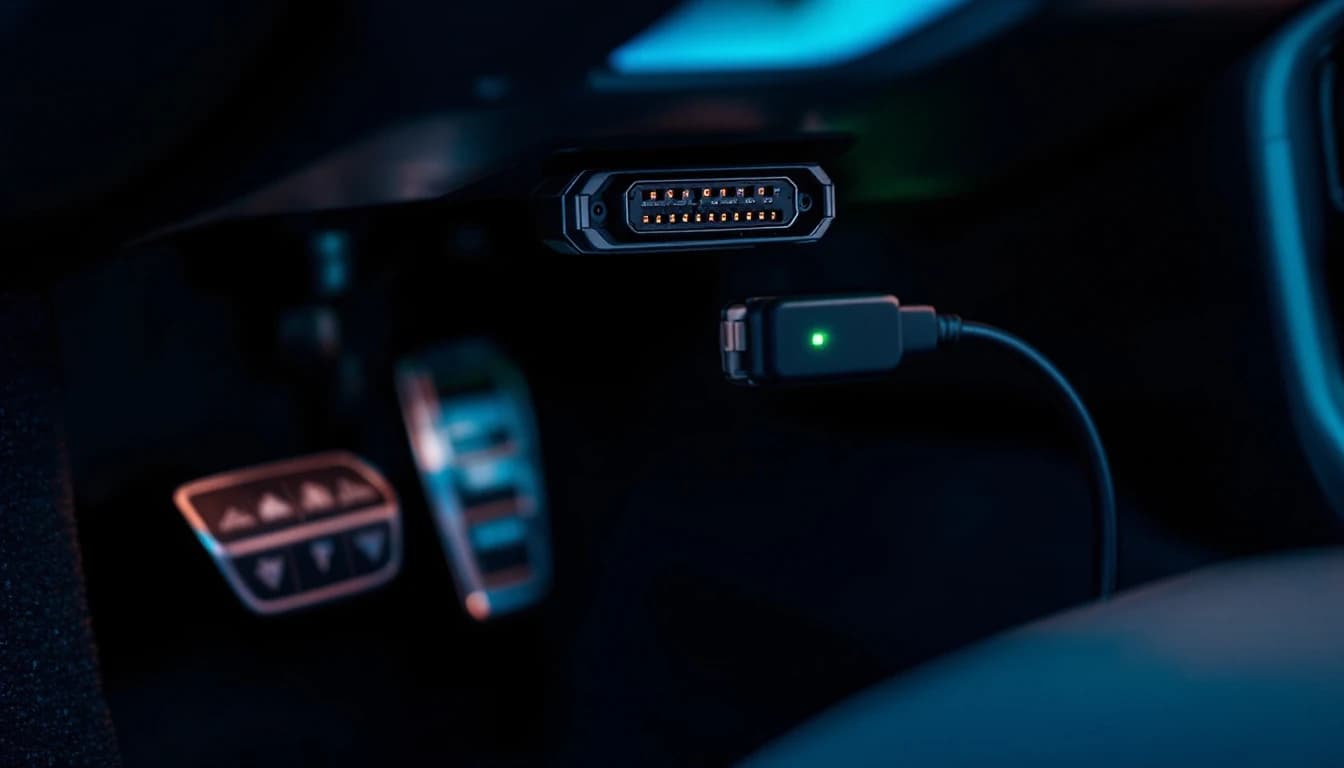
OBD-II Readiness and Drive Cycles After Programming
Who this is for
Read this if:
- You had an ECM/PCM replaced, cloned, unlocked or reflashed and the car now drives fine but will not pass an emissions test
- Your inspection station told you the vehicle is "not ready" and sent you away without testing it
- You cleared a code, the light stayed off, and then something came back that your scan tool refuses to erase
- You did an engine swap or a used-controller install and are trying to work out which of the resulting oddities are normal
- You are a shop that sends controller work out and wants a clear explanation to hand customers
If your car does not run — cranks and will not start, or starts and dies — you are in the wrong article. That is a different problem with a different diagnostic path, covered in module programmed and the car still will not start. Everything below assumes the vehicle runs and drives correctly.
The short answer
After a powertrain controller is programmed, replaced or reflashed — or after the battery is simply disconnected long enough to lose keep-alive memory — the OBD-II readiness monitors reset to "not ready." This is normal, expected, and designed behavior. The vehicle must then complete its own self-tests through ordinary driving before it can report readiness to an inspection station.
Nothing is broken. The controller has no history yet. Every emissions self-test the vehicle runs needs a set of operating conditions to occur before it can even start, and the controller has to observe those conditions after the reset. Some monitors set within a few minutes of driving. Others can take days of mixed driving, and a couple can take a week or more if your commute happens to never satisfy the enabling criteria.
The rest of this article is the detail — because "just drive it" is true, unhelpful, and hides several situations where the problem genuinely is the programming.
What readiness monitors actually are
On-board diagnostics as we know it has been federally required on light-duty vehicles sold in the United States since the 1996 model year, under rules administered by the Environmental Protection Agency. The standardization that makes any generic scan tool work on any car — the trapezoidal connector, the diagnostic services, the standardized parameter identifiers — comes from SAE International standards work, principally the J1962 connector and the J1979 diagnostic-services documents.
Part of that standard is a set of readiness monitors: self-tests the powertrain controller runs on the emissions-related systems it is responsible for. Each monitor reports one of two states to a scan tool or an inspection station: complete (ready) or incomplete (not ready).
An inspection station is not primarily reading your engine's health. It is asking the controller three things: is the malfunction indicator lamp commanded on, are there stored emissions DTCs, and have the monitors run. If the monitors have not run, the station cannot certify anything — the vehicle has not yet tested itself — so most programs reject the vehicle rather than pass or fail it.
That distinction matters emotionally as much as technically. "Not ready" is not a failure. It is the machine saying ask me again later.
Continuous vs non-continuous monitors — and why evap and catalyst are the stubborn ones
Monitors fall into two families, and the difference explains almost everything about why some set immediately and some refuse for a week.
Continuous monitors run constantly whenever the engine is running. There are three: misfire, fuel system, and comprehensive components (the broad circuit-and-rationality checks on sensors and actuators). Because they are always running, they typically report ready almost immediately after a reset — often within minutes.
Non-continuous monitors only run when a specific set of enabling criteria is satisfied. The controller will not even attempt the test until the conditions are right, because running it outside those conditions would produce a false result. These are the ones that keep people out of inspection lanes.
| Monitor | Family | Typically sets | Why it stalls |
|---|---|---|---|
| Misfire | Continuous | Minutes of running | Rarely an issue after a reset |
| Fuel system | Continuous | Minutes of running | Rarely an issue after a reset |
| Comprehensive components | Continuous | Minutes of running | Rarely an issue after a reset |
| Oxygen sensor | Non-continuous | Within a drive cycle or two | Needs closed-loop operation and steady cruise |
| Oxygen sensor heater | Non-continuous | Usually early, on a cold start | Needs a genuine cold start |
| EGR / VVT | Non-continuous | Within a few drive cycles | Needs specific load and steady-state segments |
| Secondary air (where fitted) | Non-continuous | Cold start dependent | Only runs briefly after a cold start |
| Catalyst efficiency | Non-continuous | Often several drive cycles | Requires the O2 monitor to pass first and a long steady cruise |
| Evaporative system | Non-continuous | Often the last to set, sometimes days | Narrow fuel level, ambient temperature and cold-soak criteria |
Evaporative emissions is the classic holdout. The evap monitor tests for leaks in the fuel-vapor system, and to do that meaningfully the controller wants a fuel level in a middle band — commonly described as roughly a quarter to three quarters of a tank, though the exact window is manufacturer-specific — plus a genuine cold soak, an ambient temperature inside a defined range, and a stable period after startup. Park with a nearly full tank in a heat wave and drive short trips, and the evap monitor may never attempt its test at all.
Catalyst efficiency is the other one. It compares upstream and downstream oxygen sensor behavior to infer how much oxygen storage the converter still has. It generally will not run until the oxygen sensor monitor has already completed, and it wants a sustained steady cruise at moderate load. A commute of six stoplights and a parking garage does not provide that.
There is a hierarchy hiding in there worth naming explicitly: some monitors gate others. The O2 heater monitor tends to run first, the O2 sensor monitor next, catalyst after that. If something upstream never completes, everything downstream of it sits at not-ready no matter how far you drive.
What a drive cycle actually is
A drive cycle is a specific sequence of operating conditions designed to satisfy the enabling criteria for the non-continuous monitors. It is manufacturer-specific. There is no single universal drive cycle that works on every vehicle, and the generic ones you find online are approximations of the real published procedures.
A representative pattern, which most manufacturer procedures resemble in outline:
- Cold soak. The vehicle sits, typically overnight or at least eight hours, so coolant and intake air temperatures are close to ambient. Many monitors require a genuine cold start and will not run on a warm restart.
- Fuel level in the middle band. Roughly a quarter to three quarters of a tank is the common guidance for evap-related testing. Not nearly empty, not brim full.
- Idle after start. A couple of minutes at idle, often with accessories in a defined state.
- Gentle acceleration to a moderate cruise. Steady throttle, no hard acceleration, typically to a suburban speed.
- Sustained steady cruise. The important one. A stretch of highway at constant speed with minimal throttle movement, often several minutes, which is what the catalyst and O2 monitors want.
- Deceleration without braking. A closed-throttle coast-down segment, which some monitors use.
- Return to idle, then shut down. Then repeat over the next several days.
Ambient temperature and altitude also gate things. Very cold weather blocks several monitors outright, which is why people in northern states have more trouble getting a car ready in January than in May.
Practically: mixed driving over several days beats any attempt to nail a procedure in one trip. Some highway, some surface streets, some cold starts, and a middle-of-the-tank fuel level. Most vehicles get everything except evap within a hundred miles or so of varied driving. Evap sets when it sets.
How many incomplete monitors are allowed at inspection
This one has to be phrased carefully, because it varies by state and by model year and there is no single national number.
Inspection and maintenance programs are run at the state or regional level under EPA oversight, and roughly thirty states operate some form of vehicle emissions inspection in at least part of their territory. Program rules — including how many incomplete monitors a vehicle may present and still be tested — are set by the individual program, published by that state's environmental or motor vehicle agency, and are not uniform.
What is broadly true across many programs is that a small number of incomplete monitors is tolerated, commonly one or two depending on model year, with newer vehicles typically allowed fewer. Some programs specifically exempt the evap monitor from the count. Others do not. Several allow more leniency on older OBD-II vehicles than on recent ones.
Check your own state's program before you assume anything. The rule that applies to you is published by your state, not by a forum. If you are close — one monitor short and it is evap — many people simply need a tank of fuel drawn down to the middle band and a couple more days of mixed driving.
The federal framework these programs sit inside, including the emissions warranty provisions discussed below, lives in the Code of Federal Regulations and is publicly readable at ecfr.gov.
Pending, stored and permanent DTCs — the part nobody explains
This is the single most useful section here, and it is the one most people have never had explained. There are three distinct fault-code states and they behave completely differently.
Pending codes are a fault the controller has seen once but not yet confirmed. Most emissions faults have to occur on two consecutive qualifying drive cycles before the controller commits to them. A pending code usually does not illuminate the malfunction indicator lamp. If the fault does not recur, it ages out on its own.
Stored (confirmed) codes are faults the controller has confirmed. These typically illuminate the check-engine light. A scan tool can clear them — and clearing them also resets your readiness monitors, which is exactly how people accidentally send themselves back to square one the day before an inspection.
Permanent codes (PDTCs) are the ones that surprise people. A permanent code is written when a confirmed fault illuminates the lamp, and it cannot be erased by any scan tool, by any shop, by disconnecting the battery, or by any other means available to a technician or an owner. There is no back door. The controller clears a permanent code itself, only after the underlying fault has been repaired and the relevant monitor has run and passed the required number of times.
This behavior exists deliberately, as an anti-tampering measure — it closed the loophole where somebody cleared codes in the parking lot outside the inspection station and drove straight in with a dark dash and no history. Permanent codes became a broad requirement on light-duty vehicles beginning roughly with the 2010 model year, and essentially all newer vehicles support them.
The practical consequences are worth stating in plain terms:
- If a permanent code is present, fix the actual fault. There is no shortcut.
- After the repair, the vehicle must be driven until the relevant monitor completes and passes. The code then self-clears.
- A shop that tells you they can erase a permanent code is either confused about what they are looking at or is not being straight with you.
- Many inspection programs check for permanent codes explicitly, which means a car with a dark dash and no stored codes can still be rejected.
The permanent code conversation is the one I have three times a week. Customer comes in, light is off, scan tool shows no stored codes, and they still got turned away. I show them the permanent code on the screen and explain that the car is holding a grudge until it re-tests itself and passes. Half of them do not believe me until I show them the same screen on a different tool.
— Independent driveability technician, 18+ years emissions and inspection work (anonymized)
When a stuck monitor really is a programming problem
Most of the time, "not ready" after programming means "drive it more." But there are specific, identifiable cases where the monitor is stuck because the calibration or identity written to the controller is wrong for the vehicle. These are worth knowing so you can tell the difference instead of driving in circles for two weeks.
Wrong calibration for the emissions family
Manufacturers publish calibrations by application, and within one engine and model year there can be multiple variants covering different emissions certifications, transmission combinations, axle ratios, and market destinations. A controller programmed with a calibration from a near-miss variant may run fine — but the monitor set it expects, the sensor configuration it looks for, or the thresholds it tests against will not match the hardware on your car.
The tell: a monitor that has had abundant opportunity to run and simply never attempts, or a code for a component your vehicle does not physically have (secondary air injection is the classic example, where a calibration for a variant with an air pump lands in a car with no pump).
Mismatched VIN or build data
Identity matters. If the VIN written to the controller does not match the vehicle, or the build/configuration data was not correctly transferred, several things break in ways that look like unrelated faults. Inspection programs frequently compare the VIN reported by the controller against the registration — a mismatch there is an instant rejection regardless of monitor state, and it is a genuinely common finding on cars where a used controller was installed without proper programming.
This is why the identity side of programming is not optional busywork. We cover the mechanics of it in how module programming actually works — the VIN write, the seed-key security access, and the checksum correction that makes the write valid.
Aftermarket or performance calibration
A tune that alters fueling, spark, or diagnostic thresholds can disable or perpetually fail monitors. Some performance calibrations turn monitors off outright. If the vehicle is on an aftermarket tune and a monitor will not set, returning to a correct stock OEM calibration at $250 is the diagnostic step that removes the variable entirely.
An actual hardware fault masquerading as a stuck monitor
Sometimes the monitor is not stuck — it ran, it failed, and the controller will not report ready because the system it tested is genuinely broken. A small evap leak, a lazy downstream oxygen sensor, a converter at the end of its life. Look at the freeze-frame data and any pending codes before assuming the programming is at fault.
A useful sanity check on that last one: major emission-control components including the catalytic converter and the powertrain controller itself carry a federal emissions warranty of 8 years or 80,000 miles on light-duty vehicles under the Clean Air Act framework described by the EPA and codified in the Code of Federal Regulations. If your vehicle is inside that window, a failing converter may not be your bill to pay.
Engine swaps are their own category
If the controller is in a vehicle it did not originate in, expect monitor and configuration problems as the default rather than the exception. That whole territory has its own guide: engine swap ECU/PCM programming.
What the bench controls, and what it does not
Be precise about the boundary, because it is where expectations go wrong.
What bench programming controls:
- The calibration written to the controller — correct part number, correct application, correct emissions variant where that information is supplied and verifiable
- The vehicle identity written into the module: VIN, and the configuration and build data the platform requires
- Security access and checksum correction so the write is valid and the module accepts it
- A stable, regulated bench power supply during the flash, which removes the voltage-sag risk that bricks controllers during in-vehicle programming
- A communication test before the module ships back
What bench programming cannot control:
- Whether the monitors run. That happens in your hands, over days of driving, on the road.
- Weather, altitude, your fuel level, and whether your commute includes a sustained highway cruise
- Whether the catalytic converter, oxygen sensors, purge valve or vent valve on the car are actually healthy
- Your state's specific inspection rules
- A permanent code, which no tool anywhere can erase
Programming sets the correct identity and calibration. The drive cycle happens in the customer's hands. That is not a disclaimer, it is a description of how OBD-II was designed — the controller is required to verify the systems itself, in the real world, before it will certify them.
Practically, that means: after you get your module back and install it, budget a week of ordinary mixed driving before you go anywhere near an inspection station. Do not clear codes on the way there. Keep the tank between roughly a quarter and three quarters. Take at least one genuine cold start each day.
Cost and turnaround framing
All of this work is mail-in bench programming from the Arlington, Texas workshop, with flat pricing:
- GM ECM/PCM programmed replacement — $399. You send nothing; the correct controller arrives programmed to your VIN.
- Ford PCM programmed replacement — $379. Same model.
- Stock / OEM reprogramming — $250. Returning a controller to a correct factory calibration, which is also the cleanest way to eliminate an aftermarket tune as a variable in a stuck-monitor investigation.
- PCM unlocking service — $250. For locked controllers that need to be opened up for read/write access.
Modules ship to PO Box 120241, Arlington, TX 76012 if you send USPS, or 1009 Oakwood Ln # 120241, Arlington, TX 76012 if you send UPS or FedEx — couriers cannot deliver to a PO Box. Return shipping is selected and paid at checkout, from $29.95, with faster tiers available. Broader pricing context across module types is in our module programming cost guide.
One more piece of framing worth having. The vehicle fleet is old — average vehicle age in the United States has been climbing for years and now sits well above eleven years according to federal transportation statistics published at bts.gov — which means an enormous number of the cars going through inspection lanes have aging converters, aging oxygen sensors and aging evap components. Survey work from organizations including AAA and Consumer Reports has repeatedly found that a large share of drivers defer recommended repairs. If your monitor will not set after a genuinely correct programming job, the age of the emissions hardware on the car is a very reasonable next place to look. Vehicle valuation and ownership-cost context from outlets like Edmunds is worth weighing before sinking converter money into an older vehicle.
Frequently asked questions
Why did my readiness monitors reset after the PCM was programmed? Programming, reflashing or replacing a powertrain controller clears the OBD-II system memory, so every monitor returns to not-ready. This is designed behavior, not a fault — the controller has no test history yet and must re-run each emissions self-test through normal driving before it can report readiness.
How long until my car is ready for an emissions test? Most vehicles set the continuous monitors within minutes and the majority of the non-continuous ones within roughly a hundred miles of varied driving over several days. Evaporative emissions is commonly the last to set and can take longer, because it needs a middle fuel level, a cold soak and a suitable ambient temperature.
Why will the evap monitor not set? The evaporative monitor has the narrowest enabling criteria of any monitor. It typically needs the fuel level in a middle band — often described as roughly a quarter to three quarters of a tank — plus a genuine cold soak and an ambient temperature inside a defined window. Fill the tank to the brim or drive only short warm trips and it may never attempt the test.
Can a shop clear a permanent code for me? No. Permanent diagnostic trouble codes cannot be erased by any scan tool, by disconnecting the battery, or by any other means available to a shop or an owner. The controller clears them itself once the underlying fault is repaired and the relevant monitor has run and passed, which is exactly what the design intends.
How many incomplete monitors can I have and still pass inspection? It varies by state and by model year — there is no single national number. Many programs tolerate one or two incomplete monitors, with newer vehicles generally allowed fewer, and some exempt evap from the count. Check the published rules for your own state program rather than relying on a general figure.
My car runs perfectly. Does a stuck monitor mean the programming was wrong? Usually not — it most often means the vehicle has not yet met the enabling criteria for that specific test. Programming is genuinely implicated when the calibration is for the wrong emissions variant, when the VIN or build data does not match, or when an aftermarket tune has disabled the monitor.
Should I disconnect the battery before an inspection to reset the light? No — that is the worst possible move. Disconnecting the battery or clearing codes resets every readiness monitor to not-ready, which guarantees rejection, and it does nothing to a permanent code. If a light is on, diagnose and repair the fault, then drive until the monitors complete on their own.
The bottom line
A car that runs perfectly and will not pass inspection after controller programming is almost always a car doing exactly what OBD-II was designed to make it do. Programming or a battery disconnect wipes the monitor history; the vehicle then re-tests itself in the real world before it will certify anything. The continuous monitors return within minutes. Evaporative and catalyst are the two that make people wait, because their enabling criteria are narrow and manufacturer-specific.
Three things are worth carrying away. Do not clear codes before an inspection — you are resetting the clock. A permanent code cannot be erased by anyone, so the only path is repair the fault and drive until the monitor passes and the controller clears it itself. And check your own state's rule on incomplete monitors rather than a general one, because those rules genuinely differ.
When a monitor is truly stuck and the driving has been varied and patient, the programming-side suspects are specific and checkable: a calibration for the wrong emissions variant, a VIN or build-data mismatch, or an aftermarket tune. Returning to a verified stock OEM calibration at $250 removes the last of those cleanly. For a controller that needs replacing outright, a GM ECM/PCM programmed replacement is $399 and a Ford PCM programmed replacement is $379, programmed to your VIN before it ships.
The bench sets the correct calibration and the correct identity. The drive cycle happens in your hands. Give it a week of ordinary mixed driving with a half tank of fuel before you go stand in an inspection line.
Ship your module today
Flat-rate pricing, typical 24-hour bench turnaround, return speed your choice at checkout. Most jobs back on your bench within a week.