
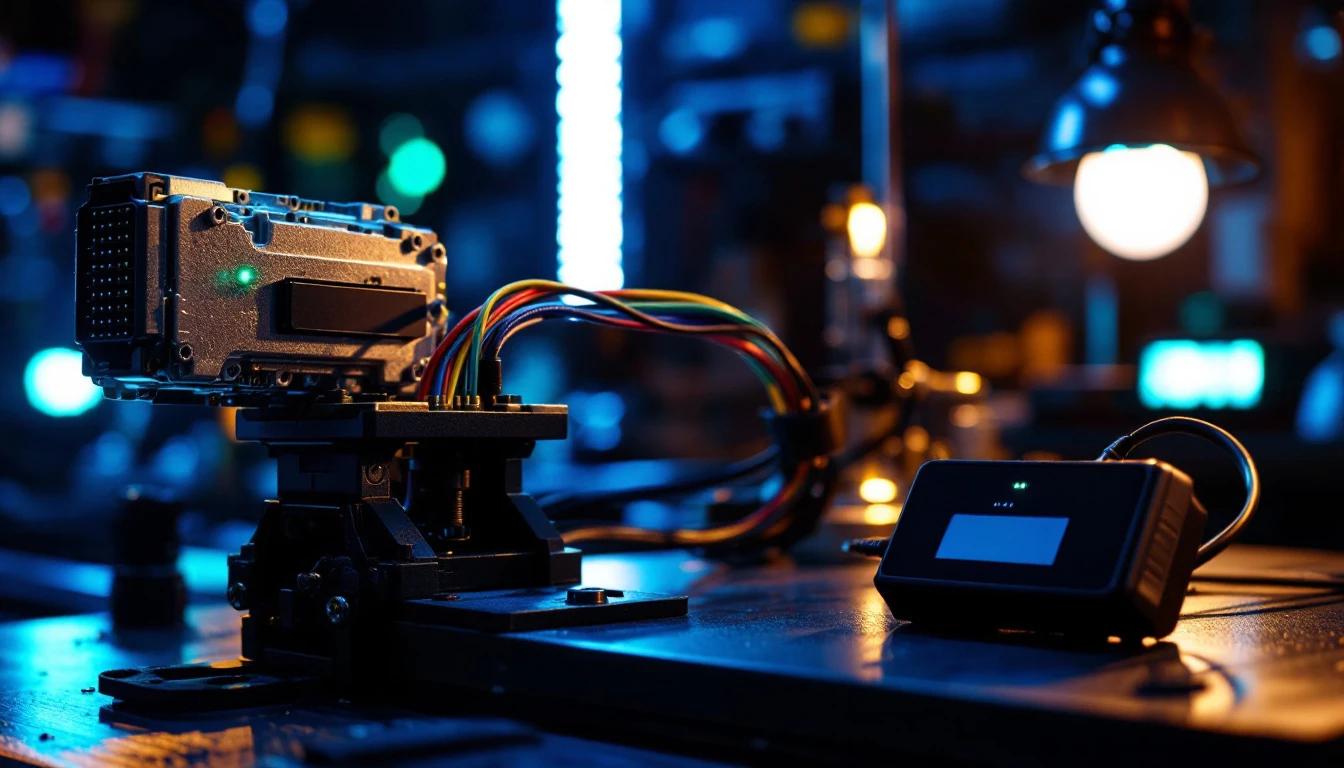
Stock ECM Reflash Cost — Mail-In Bench Programming (2026)
The short answer: what a return-to-stock reflash costs
As of November 2026, a mail-in return-to-stock reflash costs $250 flat per Ford or GM module and $350 flat per Chrysler, Dodge, Jeep or Ram module. Both are bench services: you remove the powertrain control module, ship it on a prepaid inbound label, we flash the factory calibration that matches your VIN, and we return it. Typical bench turnaround is about 24 hours after the module arrives. Return shipping is paid by you at checkout, starting from $29.95.
So a standard-return Ford or GM job totals $279.95, and a standard-return Mopar job totals $379.95. Those are the numbers most owners need, and the rest of this guide explains where they come from and what can change them.
Pricing note: every dollar figure for our services below is read from our own service catalog, not estimated. We do not print dealer or competitor figures here because we have no linked source for them.
Why people need a return-to-stock flash
Nobody orders this service for fun. The reasons are practical, and they are worth naming because they decide whether the service fits your situation:
- Selling the vehicle. A buyer's pre-purchase scan, or an emissions inspection, goes more smoothly when the module carries the factory calibration.
- Returning a lease. Lease-end inspections look at the whole vehicle, and an unrestored tune is a risk you carry.
- Preparing for service work. Some owners restore the factory calibration before taking a vehicle to a shop for unrelated work.
- Recovering from a failed tune flash. A flash that was interrupted, or a tune that did not suit the hardware, can leave a module in a confusing state. Restoring a known-good factory calibration is the cleanest reset.
- Putting a street vehicle back into compliance. Modifying the calibration of an emissions-regulated vehicle for street use is a legal problem under the Clean Air Act, as the Environmental Protection Agency explains on its site. Returning the module to its factory calibration is the straightforward way to correct that.
One boundary is worth stating plainly. We restore software; we do not restore hardware. If the engine has headers, cams or other physical modifications, the stock calibration still expects stock parts, and the vehicle can behave accordingly. We also do not tune: our service is to put the module back to the factory file, not to write a performance calibration.
The price table: every route in one view
The table below puts our three related services side by side with the all-in total for the standard return tier. Add $25 for UPS 2-Day ($54.95) or $65 for UPS overnight ($94.95); exactly one return tier is charged per order.
| Service | Modules covered | Service price | With standard return ($29.95) |
|---|---|---|---|
| Stock OEM reprogramming, Ford and GM | GM E38, E40, E41, E78, E90, E92, E93 and T43, T87, T87A, T93 TCMs; Ford EEC-V through Spanish Oak | $250 | $279.95 |
| Stock OEM reprogramming, Mopar | GPEC2 and GPEC2A (2015+), NGC4 and NGC5, JTEC+, SBEC III | $350 | $379.95 |
| GPEC PCM unlocking, Mopar | GPEC2, GPEC2A, GPEC3, GPEC4 and GPEC4LM on 2015+ vehicles | $250 | $279.95 |
The unlock row sits in this table because the two services are partners: unlock comes before a tune, stock reflash comes after one. They are different products with different goals, and confusing them is the most common ordering mistake.
What changes the price: the variables that matter
The service prices are flat. These are the variables around them.
1. Which brand your module belongs to. The Ford and GM price is $250 and the Mopar price is $350. The $100 gap is explained on our service page: modern Chrysler, Dodge, Jeep and Ram modules, GPEC2 and GPEC2A especially, need extra security handling and a longer bench process than Ford and GM controllers. The price follows the work.
2. Whether the module is locked. A GPEC module that has never been unlocked cannot be tuned, so it is likely already at factory calibration and may not need a reflash at all. A module that was unlocked and tuned is the one that needs restoring. If you want to tune it again afterward, a fresh unlock is a separate $250 service.
3. The return-shipping tier. This is the largest swing on a normal job: $29.95 for standard, $54.95 for UPS 2-Day and $94.95 for UPS overnight. If the vehicle is parked while you wait, standard is the rational choice.
4. How many modules are in the order. A cart is one physical shipment, so one return tier is charged per order, not per module. If a truck needs both its ECM and its TCM restored, the two service prices add, but the shipping tier is charged once. Check the cart at checkout to see the exact total.
5. Whether the factory calibration exists for your VIN. We carry the current Ford, GM and Mopar factory calibration archives. If the calibration for your exact VIN is not available, which our service pages describe as very rare and typically limited to brand-new model years, we tell you up front and refund.
6. Whether the module is mechanically healthy. A reflash changes software. If the board has failed, no calibration will bring it back. That is a repair job, and the price is different; our cross-module repair price menu and our ABS module repair cost guide show how repair pricing differs from reflash pricing.
What the service includes and what it leaves out
On a return-to-stock job, the module comes back flashed to the factory OEM calibration matching your VIN, with the aftermarket tune wiped. We capture the pre-flash dataset automatically and email both the pre-flash and post-flash datasets. After the reflash the module is unrestricted, so your tuner can read and write normally if you later want to tune again.
What it leaves out is just as important:
- No physical restoration. Only the calibration is restored, not the headers, cams or other hardware.
- No repair. If the module itself is damaged, the reflash does not fix it.
- No tuning. We deliberately do not write calibrations or offer dyno tuning.
- No concealment advice. A reflash puts the factory file back; it does not change what happened to the engine. If a modification caused a failure, restoring the software does not change who is responsible for it.
Our service page notes that a restored module reports factory calibration values to dealer scan tools and during OBD-II and emissions checks, and that the check engine light should not come on afterward as long as the engine is in OEM-spec hardware condition. For the drive-cycle side of that, see our guide to readiness monitors after module programming, because a freshly flashed module needs its monitors to run before an inspection.
Worked example 1: a tuned Hellcat that must go back to stock
A 2018 Dodge Challenger Hellcat has a GPEC2A module that was unlocked and tuned. The owner is selling and wants it returned to factory calibration.
- Mopar stock reprogramming: $350
- Standard return shipping: $29.95
- Total: $379.95
The unlock service is not needed, because the goal is the factory file, and the module is unrestricted after the reflash. If the buyer, or the owner, later wants the module tuned again, a new unlock at $250 is the next step. Our GPEC2 and GPEC2A unlock guide explains how that process works, and our Mopar stock reprogramming guide covers the reflash side in more detail.
Worked example 2: a failed flash on a GM truck
A GM truck's E38 ECM was flashed by a tuner, the flash was interrupted, and now the truck starts badly and sets codes. The owner wants a clean factory file.
- Ford and GM stock reprogramming: $250
- Standard return shipping: $29.95
- Total: $279.95
If the board itself was damaged during the failed flash, the module may need a repair or a donor clone instead. Our tuned and flashed ECU cloning and replacement guide and our GM E38, E67 and E92 ECM clone guide cover the path when a restore alone is not enough. You will not know which case you have until the module is on the bench, and that is what the pre-flash dataset capture is for.
Worked example 3: an ECM and a TCM restored together
A Silverado owner is returning a lease and wants the engine controller and the transmission controller put back to the factory calibration.
- Ford and GM stock reprogramming for the ECM: $250
- Ford and GM stock reprogramming for the TCM: $250
- Standard return shipping, one tier for the order: $29.95
- Total: $529.95
The shipping line appears once because a cart is a single shipment. If you are weighing the cost of more modules, our worked examples of total mail-in cost with shipping shows how service prices and return tiers combine.
Why a vehicle's age and market value belong in the decision
A return-to-stock reflash is usually a small bill against a vehicle's value, but it is worth checking the proportion. S&P Global Mobility reports that the average US light vehicle reached 12.8 years old in 2025, with about 289 million light vehicles in operation. A 2008 truck with a failed flash is squarely in the typical age band, and the $279.95 all-in total is a sensible number against what a replacement controller and dealer programming would involve.
For a newer, higher-value vehicle such as a late-model Hellcat or Trackhawk, the calculation is different: the reflash cost is trivial next to the resale value, and a clean factory calibration can matter to a buyer. For valuation context before you decide, Kelley Blue Book is the standard reference, and MotorTrend and Car and Driver publish model-specific ownership material.
"The cleanest reflash jobs are the ones where the owner knows what was on the module and ships it before the car gets driven again. A half-failed flash left to sit is the only thing that makes this harder than a plain restore." — Independent powertrain calibration technician, 15+ years on Ford, GM and Mopar controllers (anonymized)
Why not do it yourself with a pass-thru tool
Many owners wonder whether they can restore stock with a pass-thru device and tuner software. Sometimes they can. The honest caveat is that the restore is only as good as the factory file you have and the stability of the flash. A pass-thru flash depends on a steady supply voltage, a stable laptop connection and the right calibration for your exact VIN. Our Tactrix OpenPort 2.0 review explains what that tool does well and where a bench service makes more sense, and our explanation of J2534 pass-thru programming covers the technology behind it.
The bench route does not depend on the car's electrical system staying stable during the write, and that is its main advantage when a module is already in a questionable state. For the broader reasons DIY module work goes wrong, see our guide on why DIY ECU programming fails.
How to remove, pack and ship the module
The process is the same for Ford, GM and Mopar modules.
- Disconnect the battery before touching any connector.
- Remove the module and do not open the case.
- Note the part number off the case label and the VIN of the vehicle.
- Pack it static-safe with padding, and no harness or connectors are needed.
- Include a note describing the current tune, the vendor and the approximate power level if you know them, which helps us confirm the overwrite worked.
- Include your order confirmation and your return address.
We buy and email the prepaid inbound label, so shipping to us does not add to your bill. For the packing details, our guide to removing and shipping a car module covers static protection, and what to ship by job type lists the box contents.
When the reflash is the wrong purchase
- The module is physically dead. That needs a repair, not a reflash.
- The issue is a no-start with a security light. That may be an immobilizer problem, and our guide to telling an immobilizer fault from a module fault comes first.
- You want a performance tune. We do not tune. We unlock modules and restore them.
- The vehicle has physical modifications. The stock calibration will not hide them, and the vehicle may not run as the factory intended.
- You want to disguise a failure for a claim. We restore software; we do not offer advice on concealing a condition from anyone.
If you are not sure which situation you are in, a bench evaluation reads the module and tells you what it holds before you decide.
Sources and further reading
For emissions rules and the Clean Air Act, see the EPA. For recall lookups, use NHTSA. For standards on vehicle electronics and diagnostics, SAE International is the reference body, and the Insurance Institute for Highway Safety publishes vehicle safety research. For older vehicles specifically, Hagerty is a useful source.
Frequently asked questions
How much does a return-to-stock ECM reflash cost by mail?
A return-to-stock reflash costs $250 for a Ford or GM module and $350 for a Chrysler, Dodge, Jeep or Ram module as of November 2026, both flat per module. Return shipping is extra, starting from $29.95, so standard-return totals are $279.95 and $379.95.
Why does the Mopar service cost $100 more?
Modern Chrysler, Dodge, Jeep and Ram modules, GPEC2 and GPEC2A especially, need extra security handling and a longer bench process than Ford and GM PCMs. The $350 price reflects the added work, and it covers GPEC2 and GPEC2A, NGC4 and NGC5, JTEC+ and SBEC III controllers.
What is the difference between unlocking and reflashing to stock?
Unlocking removes the security so a module can be tuned, and stock reprogramming flashes the module back to factory calibration. You unlock before tuning and restore after, for example before selling, before service work or after a failed tune. The unlock is $250 and the stock reflash is $250 or $350.
Do I need to tell you what tune was on the module?
It is helpful but not required. We capture the pre-flash data automatically, and knowing the tune vendor and approximate power level helps us verify that the reflash overwrote everything correctly. We email you both the pre-flash and post-flash datasets.
Can I tune the module again after the reflash?
Yes. The module is unrestricted after the reflash, so your tuner can read and write normally. If a Mopar GPEC2 or GPEC2A needs to be unlocked again for tuning, that is the separate $250 unlock service.
What if the factory calibration is not available for my VIN?
We tell you up front and refund. Our service pages describe this as very rare and typically limited to brand-new model years. We carry the current Ford, GM and Mopar calibration archives, so most VINs are covered.
Does a reflash fix a dead or damaged module?
No. A reflash changes software, and it cannot repair a failed board. If the module is physically damaged, the right product is a repair or a donor clone, and a bench evaluation tells you which one applies before you spend more.
The bottom line
A mail-in return-to-stock reflash is $250 for Ford and GM modules and $350 for Mopar modules as of November 2026, which makes the standard-return totals $279.95 and $379.95. The price is flat per module, and the variables around it are the return tier, the number of modules in the order, whether a GPEC unlock is also needed and whether the module is healthy enough for software to matter. Use it to sell cleanly, return a lease, recover from a failed flash or bring a street vehicle back to its factory calibration. Do not use it to hide hardware changes or to fix a board that has failed. Photograph the label, note what tune was on the module, and ship it with your order confirmation.
Ship it for the stock oem re-programming (ford / gm) — $250 flat
Typical 24-Hour Turnaround, return speed your choice at checkout. Prepaid inbound label by email the minute you order.
More from the Lab
Car Key Programming Cost — Mail-In Bench Programming (2026)
15 min · November 16, 2026
TIPM Repair Cost — Mail-In Bench Programming (2026)
11 min · November 9, 2026
BMW FRM Repair Cost — Mail-In Bench Programming (2026)
11 min · November 9, 2026
Can a Mail-In Service Program to My VIN, No Dealer?
13 min · July 26, 2026