
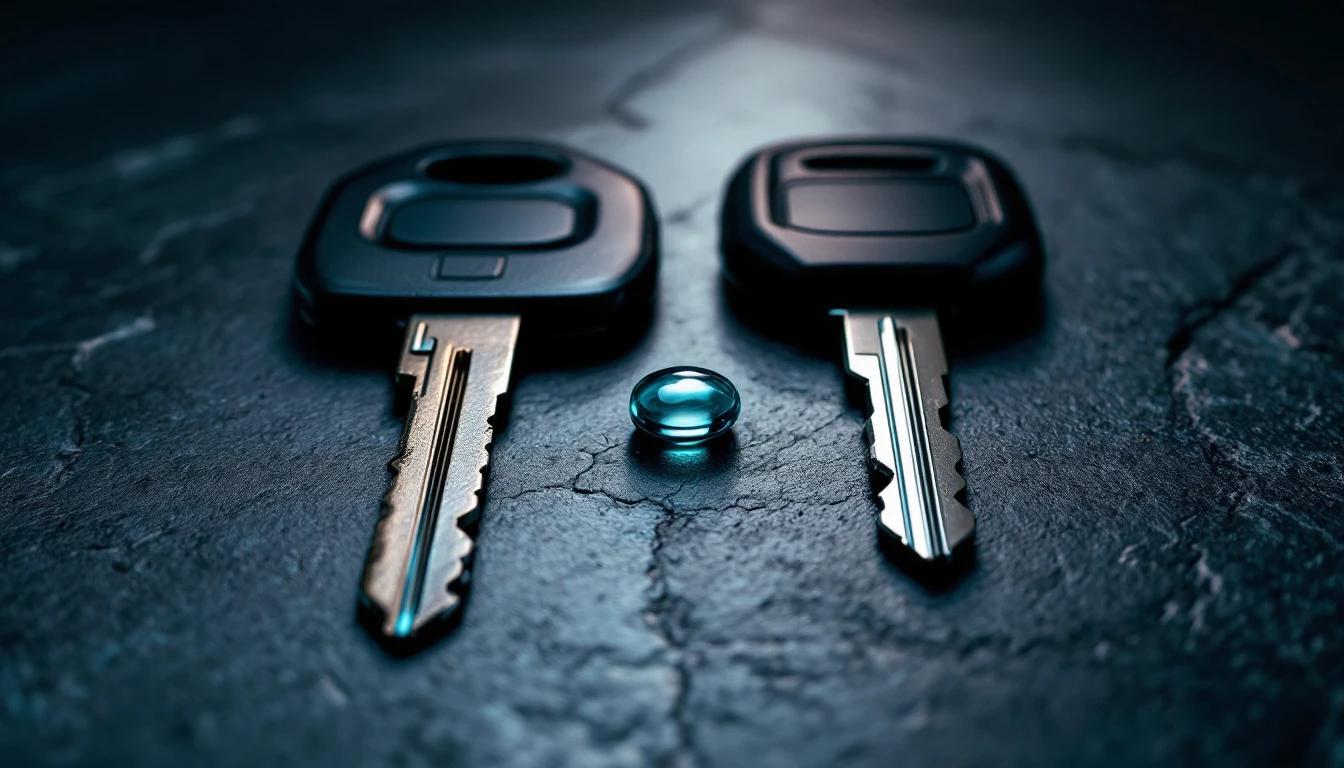
Car Starts With Spare Key, Not Main Key: Key or Module?
The short answer: the spare key just did your diagnosis for you
When a spare key starts the car and the main key does not, you have already ruled out most of the expensive possibilities. The vehicle's immobilizer antenna, its security module, its engine computer and its starter circuit all worked with the spare. A module fault is possible but unusual in this pattern, because a failing module normally rejects every key, or behaves randomly rather than consistently refusing one.
That leaves four realistic suspects, in rough order of how often they turn out to be the answer:
- The main key's blade or ignition fit. The key no longer turns the cylinder properly, or turns with force.
- The main key's transponder chip. It was cracked, soaked, or simply worn out, and it no longer answers the car.
- The fob battery or fob electronics on a push-button or proximity-key car.
- The key's registration in the module. The key is physically fine but the car no longer recognizes it, for example after a module replacement or an interrupted programming session.
The rest of this guide shows how to tell them apart without spending anything, and what each outcome costs.
Start here: what exactly does the main key do?
Describe the behavior precisely, because the exact symptom narrows the cause faster than any tool. Run through these before you read further.
- The main key will not go into the ignition, or will not turn. That is a mechanical problem: the blade, the lock cylinder or debris.
- The key turns, the dash lights up, the starter spins, but the engine will not run. That points at the immobilizer, because the starter works and something is blocking fuel or spark.
- The key turns, the starter does not spin and a security light is on or flashing. The car is refusing the key before it ever tries to start.
- The engine starts and dies within about two seconds. This is the classic immobilizer pattern on many Chrysler, Dodge and Jeep vehicles from the late 1990s and 2000s, where the engine computer starts the engine and then shuts it down when the key's answer fails. Our identification clues for the Sentry Key system are in that guide.
- Nothing happens at all, including no dash lights. That is a battery, ground or switch issue, and the spare key starting the car makes it unlikely. Re-test with the spare to be sure.
- A keyless car shows a "key not detected" message with the main fob. That is a fob or antenna pattern, not a blade pattern.
The ten-minute driveway test sequence
You need only the two keys and a few minutes. Do these in order.
Step 1. Repeat the test with both keys back to back. Try the main key, then the spare, then the main key again. An intermittent key can fail once and work once; a consistent failure is more informative. Wait about a minute between attempts, because some systems lock out briefly after a failed challenge.
Step 2. Look at the main key closely. Check the plastic head for cracks, especially around the point where the blade meets the head, which is where chips often break after drops. Look for corrosion, signs of water entry, or a head that has been glued. A key that went through a washing machine is a common culprit.
Step 3. Compare the two blades side by side. Hold the keys flat against each other. A main key that has been used for ten or fifteen years can be visibly rounded on its cuts compared with a spare that has barely been used. A worn main key can enter the lock and even turn it, yet not seat the tumblers cleanly enough to complete the ignition circuit. If the blades are visibly different, you may have a mechanical wear problem, not an electronic one.
Step 4. Try the main key in the driver's door lock. If it will not unlock the door either, the key is physically worn. If it unlocks the door perfectly, the blade is probably fine and the issue is electronic.
Step 5. Watch the security light with each key. With the spare, note what the light does at key-on: many cars show the light for a few seconds and then turn it off. With the main key, see whether it stays on, flashes or behaves differently. A different light behavior with one key is strong evidence the car sees that key and rejects it.
Step 6. For a push-button car, replace the fob battery first. A weak coin cell is the cheapest and most common fix on proximity keys. Use the correct cell for your fob, and mind the polarity. After replacing it, hold the fob against the start button or the position your owner's manual shows for a dead fob, which uses a short-range antenna and works even with a flat battery.
Step 7. Try the main key on a different day. Weather matters. A cracked chip can fail in the cold or damp and work in warm dry air, so intermittent behavior is itself a clue.
If after these seven steps the main key still fails and the spare still works, you can be confident the problem is specific to that key or to that key's registration. If the main key works on some attempts, treat it as a failing chip and plan a replacement soon, because it will fail permanently at the worst moment.
What the symptom looks like: matching cause to evidence
The table below maps what you saw to the likely cause and the route that fixes it.
| What you observe | Most likely cause | Who fixes it |
|---|---|---|
| Main key will not turn, or turns with force; spare is smooth | Worn key blade or worn lock tumblers | Locksmith cuts a new blade from the code or the lock |
| Main key turns and dash lights up, but security light flashes and engine will not run; spare works | Dead or cracked transponder chip, or key not registered | Replace or reprogram the key |
| Main key starts and engine dies within about two seconds; spare works | Key not matched to the immobilizer module | Key programming at the module |
| Push-button car says no key detected with main fob; spare fob works | Weak fob battery or damaged fob electronics | Fob battery first, then fob replacement |
| Main key worked until a module was replaced; spare also never worked after | Module needs keys re-registered | Module-level key programming |
| Both keys work some days and fail others | Failing antenna, ground or module | Diagnose the vehicle, not the key |
The last row matters for honesty. If both keys fail in the same way, you are no longer in this guide's pattern. That is a vehicle fault, and our guide to telling an immobilizer fault from a module fault is the next step.
Why the transponder chip is the usual suspect
A transponder key carries a small chip in its head. When you turn the key, the antenna ring around the ignition powers the chip with a burst of energy, and the chip answers with a code that the immobilizer checks before it allows the engine to run. The chip has no battery on a conventional transponder key; it is powered by the ring each time, which is why a chip can last decades.
Chips fail for ordinary reasons. A drop onto concrete can crack the glass capsule that holds the chip. Water that reaches a key head can corrode its contacts. Heat left in a hot car can stress the key head. And as a car ages, the key that is on the ring every day takes far more knocks than the spare in a drawer.
This is why the fleet's age matters to your diagnosis. S&P Global Mobility reports that the average US light vehicle reached 12.8 years old in 2025, with passenger cars averaging 14.5 years and about 289 million light vehicles in operation. A main key that has ridden in a pocket for twelve or fourteen years is a worn part, while a spare that lived in a drawer is close to new. When the older key fails and the newer one works, wear is the simplest explanation, and the evidence in your hand usually supports it.
When it is the key's registration, not the key
Sometimes the main key is physically perfect and the car still rejects it. That happens when the car's security module no longer has that key on its list. Typical triggers:
- A replaced or used module. If the body or security module was swapped, the car's key list can be empty or different, and only keys that were registered at that moment work. The spare may have been registered during the swap and the main key may not have been.
- An interrupted programming session. A battery that dipped during programming, or a tool that lost its connection, can leave some keys registered and others not.
- A clone with incomplete data. A cloned module can sometimes carry only some of the original key entries.
- A key replaced after loss. If the main key was lost and a new one made, the old key may have been deleted on purpose.
The remedy for a registration problem is key programming at the module. The path depends on the family. On Sentry Key vehicles of roughly 1998-2007, the SKIM holds the PIN and the key list, and on the 1998-2004 cars the PIN never leaves the module, so nothing can read it through the OBD port. On BMW CAS and FEM cars, the key's ISN is read from the DME. On Mercedes cars with an EIS, the key is programmed through the EIS on the bench. On Subarus the BIU is the core of the immobilizer. Each of these has its own bench service, and our cost guide for mail-in key programming lists them side by side.
Realistic costs by outcome
Costs depend on where the fault turns out to be. Using only our catalog prices as of November 2026, and keeping in mind that anything not in our catalog is a local locksmith or parts-store price we cannot print:
A weak fob battery or a worn blade. These do not involve a module. A fob coin cell is a small parts-store purchase, and a worn blade is cut by a local locksmith. There is no bench cost, and these are the cheapest outcomes.
A key that needs programming at the module. This is where bench pricing applies, and the price depends on the family:
- Chrysler, Dodge and Jeep Sentry Key, transponder-only key: $125, with an uncut blade.
- Chrysler, Dodge and Jeep Sentry Key, cut and programmed key, which needs your door lock cylinder: $150.
- BMW CAS (2006-2012) and BMW FEM/BDC (2013+): $150 each, with the DME in the box on the cars that need it.
- Mercedes EIS (1997-2013, with the C250 and CLA250 through 2014): $150.
- Subaru BIU: $350.
Return shipping is extra, paid by you at checkout, starting from $29.95. A standard-return Chrysler transponder-only job is therefore $154.95, and a BMW CAS or Mercedes EIS job is $179.95. We buy and email the prepaid inbound label, so only the return leg appears on your bill.
A module that is actually faulty. If the diagnostic steps point at the vehicle rather than the key, the module itself needs evaluation. Our bench evaluation service exists for that case, and our cross-module repair price menu shows how repair pricing compares across module types.
"When the spare starts the car, I tell people to stop looking under the dash. Nine times in ten the answer is in the main key's head, and the tenth is a registration problem that a bench fixes in a day. The expensive mistake is replacing a module that was never at fault." — Independent automotive immobilizer technician, 15+ years on transponder and module work (anonymized)
What not to do
- Do not keep cycling a failing key hard. On some systems repeated failed challenges trigger a lockout, and on a cracked key repeated attempts do not help.
- Do not replace the ignition switch or the antenna ring first. The spare works through both, so neither is the cause in this pattern.
- Do not order a module before you have run the test sequence. A module is the most expensive part of the chain and the least likely culprit when one key works.
- Do not buy an uncoded blank and expect it to work. A key needs the right blade and the right transponder, and a transponder key needs registering to the car.
- Do not lose the spare. If your only working key is the spare, treat it as precious. Losing it turns a one-key problem into an all-keys-lost job.
When to call a professional
Call a locksmith or ship a module to a bench when:
- You have run the test sequence and the main key still fails while the spare works. A locksmith can read the key and test the chip, and a bench can program a fresh key.
- The pattern includes the two-second start and stall on a vehicle with a column-mounted immobilizer module. That is a registration or module situation, and our Chrysler SKIM key service and BMW CAS key service show what that route involves.
- Both keys behave oddly, or the car fails in ways unrelated to keys. That is a vehicle diagnosis.
- You are down to one working key. Make a replacement now, because duplicating a working key is far simpler than recovering from none.
Key and immobilizer work requires proof of ownership: registration or title in your name and a VIN that matches. Our proof of ownership guide lists what is accepted. If you are not sure which module your car uses, our guide to every control module in a modern car maps systems to modules, and for BMWs our EWS delete and bench programming guide explains the older immobilizer boxes.
If you ship a module, the guide to removing and shipping a car module covers static protection and packing, and what to ship by job type lists the box contents.
Why security matters to this process
Immobilizers exist to stop theft. The National Insurance Crime Bureau, as reported by Insurance Journal, counted 659,880 vehicles reported stolen nationwide in 2025. For background on theft prevention, see the NICB. That context is why we verify ownership before programming a key: the same service that helps you recover from a lost key could help a thief if no one checked. It is also why you should treat your spare as a security item, not a convenience.
Sources and further reading
For recall and safety lookups, use NHTSA. For research on vehicle security and safety, the Insurance Institute for Highway Safety and SAE International are reference bodies. For ownership-cost and valuation context, see Kelley Blue Book and Car and Driver.
Frequently asked questions
Why does my car start with the spare key but not the main key?
The main key is almost always the problem. A cracked or worn transponder chip, a worn blade that will not turn the ignition properly, a weak fob battery on a push-button car, or a key that lost its registration in the module are the usual causes, because the spare proves the rest of the system works.
Can a bad module cause only one key to fail?
It is unusual. A failing module normally rejects every key or behaves unpredictably. One key failing consistently points at that key or at its registration. If both keys misbehave on different days, the problem is the vehicle, and a bench evaluation is the right next step.
How can I tell if the transponder chip is bad?
Look for a cracked head, water damage or visible wear, and watch the security light. If the key turns the ignition and the dash lights up, but the security light flashes and the engine will not run, while the spare behaves normally, the chip is the likely cause. A locksmith can confirm it.
Do I need to ship a module to fix a failed main key?
Not always. A worn blade or a weak fob battery needs no module. You ship a module only when the key must be programmed at the immobilizer, as on Sentry Key, BMW CAS and FEM, Mercedes EIS and Subaru BIU systems, where the bench services run from $125 to $350 plus return shipping.
How much does it cost to replace a failed transponder key?
It depends on the car family. Using our catalog as of November 2026, bench key programming runs from $125 for a Chrysler transponder-only key to $350 for a Subaru, with BMW CAS and FEM and Mercedes EIS at $150. Return shipping from $29.95 is extra, and a local locksmith prices blade cutting separately.
Will my spare key stop working if I program a new key?
Usually not. On most bench services, existing keys that work today stay programmed, and the new key is added to the list. If a key was lost or stolen and you want it disabled, say so on the order so it is removed from the module.
Should I make a new key right away?
Yes, if the main key is failing and the spare is your only reliable key. Copying from a working key is far easier than recovering from all keys lost, so a replacement made now costs less and carries less risk than waiting.
The bottom line
When the spare key starts the car and the main key does not, treat the main key as the suspect and the car as innocent until the evidence says otherwise. Run the ten-minute test: compare the keys, look for cracks, try the door lock, watch the security light, replace a fob battery and test on a different day. Most outcomes are a worn blade, a failing chip or a weak battery, and only a minority need a module-level key job, which our catalog prices from $125 to $350 as of November 2026 plus return shipping from $29.95. Make a replacement before the spare becomes your only key, and keep proof of ownership ready. If the test sequence points at the vehicle rather than the key, diagnose the vehicle before buying anything.
Ship it for the chrysler / dodge / jeep skim key — cut + programmed — $150 flat
Typical 24-Hour Bench Turnaround, return speed your choice at checkout. Prepaid inbound label by email the minute you order.
More from the Lab
Immobilizer Antenna Ring Faults That Mimic a Dead Module
16 min · August 1, 2026
Car Key Programming Cost — Mail-In Bench Programming (2026)
15 min · November 16, 2026
Chrysler, Dodge, Jeep Sentry Key (SKIM) by Model, 1998-2010
12 min · November 16, 2026
Fuel Pump Won't Prime? Relay, PCM Driver or Immobilizer
16 min · November 9, 2026