Sprinter Van Key Replacement & All Keys Lost
A van with no key is a payroll problem, not a parts problem
Nobody loses Sprinter keys recreationally. The van that cannot start is the one that was supposed to deliver today — the plumbing rig, the last-mile route van, the mobile detailing unit, the camper that is 900 miles from home. Commercial vehicles compound their repair costs with every idle hour, and AAA's ownership-cost research does not even try to price what a working van earns; owners know that number better than any association does.
So the real question for a keyless Sprinter is not "what does a key cost." It is "what is the fastest reliable path back to a running van." For every Sprinter generation through 2018, that path is a box: ship the immobilizer module and the driver's door lock, and the key comes back programmed, cut, and tested. This guide covers how Sprinter immobilizers actually work, why the dealer route is uniquely slow for these vans, what the $375 remote key and $250 valet key services each include, and how to tell a lost-key problem from the infamous START ERROR — which is a different repair entirely.
One van, three badges, one Mercedes immobilizer
The Sprinter's badge history confuses every parts counter it touches. The van is a Mercedes-Benz design through and through, but in North America it has been sold as a Dodge, a Freightliner, and a Mercedes-Benz, depending on year and dealer channel — a shell game documented in detail in the Sprinter's production history. Two generations matter here:
- T1N (2001–2006 in the U.S.). The first-generation vans, overwhelmingly Dodge- and Freightliner-badged here. The immobilizer on these is the unit Chrysler-era documentation calls the WSP or SKREEM — a Mercedes DAS-family module, cousin to the immobilizers in the Crossfire and the classic SLK.
- W906 (2007–2018). The NCV3 vans, Mercedes- and Freightliner-badged. These carry a proper EIS (Electronic Ignition Switch) — the same drive-authorization architecture as Mercedes passenger cars of the era.
In both cases the principle is identical: the key carries a cryptographic identity, the immobilizer module holds the only record of which identities are allowed to start the van, and nothing starts without the handshake. This is the electronic-immobilizer design that the IIHS credits with driving vehicle theft down dramatically as it spread through the fleet — and that the NICB still points to as the baseline layer of vehicle security. Excellent news for theft. Inconvenient news when the only keys are gone, because the van's key data lives in that one module and nowhere else.
That is why the mail-in job ships the module: with the EIS (or WSP/SKREEM) on the bench, its memory is read directly, and a new key is generated that the module already trusts. No dealer authorization lookup, no waiting on Germany — your own module is the source of truth.
Why the dealer path punishes vans in particular
For a passenger car, the dealer all-keys-lost routine is annoying. For a Sprinter it is structurally worse:
- The tow itself is a project. A tall, long, possibly loaded cargo van needs the right truck. Flatbedding a high-roof W906 across a city is not a $75 hook.
- Key stock is nobody's priority. A 2005 Dodge-badged T1N sends parts staff into the same "which brand even owns this?" maze the badge history created. Waits of one to two weeks for ordered key hardware are routine on older vans.
- The van sits the whole time. The Bureau of Labor Statistics' auto-technician outlook documents chronic shop backlogs; a van that arrives without an appointment joins the back of a queue with its cargo doors full.
The bench path inverts every one of those. The van never moves — two components leave it in a box. Pulling the EIS and the driver's door lock is honest DIY or any-mechanic territory once you have the pull instructions (text the lab your VIN first and those instructions come back for your exact generation). Round-trip shipping plus one bench day beats the dealer queue by a week or more, and overnight service both ways compresses the whole outage to about three days.
A fleet maintenance manager who has been through both paths summarized it the way most do:
"The first time we lost all keys on a route van I did it the 'right' way — towed it to the dealer. Eleven days and four figures later I had a key. The second time, we pulled the EIS and the door lock ourselves, overnighted the box, and had the van earning again inside the week for a third of the money. Nobody on my lot tows a van for a key anymore." — Fleet maintenance manager, regional delivery contractor, Texas (anonymized)
Remote key vs valet key: fleets buy differently than owners
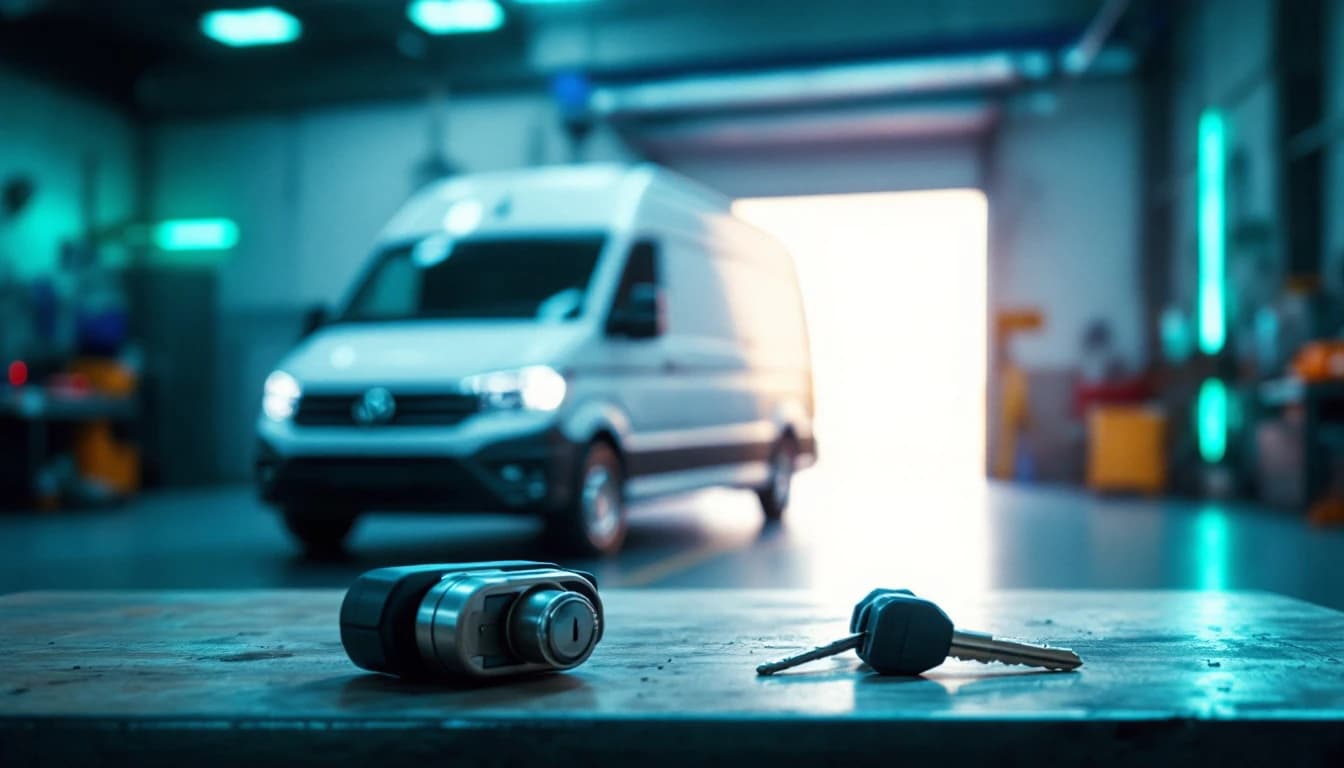
Both Sprinter key services are built from the same shipment — the EIS (WSP/SKREEM on T1N) plus the driver's door lock, cut decoded from the lock because these vans have no reliable key-code lookup. The choice is about the key itself:
The remote key, $375. Transponder start plus remote lock/unlock buttons. For an owner-operator or a camper conversion this is the normal choice — one key that does everything, exactly like the one that was lost.
The valet key, $250. A start-only transponder key with a cut blade: starts the van, works the door lock, no remote buttons. This is the fleet favorite, and not just for the $125 saved. A cargo van's key gets treated like a tool — dropped, copied, handed between drivers, lost again. At $250, valet keys are cheap enough to keep spares ahead of the failure: one in the van file, one in the office, one on the driver. Same immobilizer pairing as the expensive key; the only thing missing is buttons most fleet drivers never used.
Both prices are flat and both include all-keys-lost. Adding a spare while you still have a working key is the same job at the same price — and vastly less disruptive, since the van keeps working while the box travels.
START ERROR is not a key problem — do not order a key for it
One distinction saves Sprinter owners real money. The T1N generation is famous for a dash message that reads START ERROR, with a van that cranks (or won't crank) and refuses to run even with a known-good key. That is not a lost-key situation and a new key will not fix it — it is a fault in the immobilizer relationship between the WSP and the engine computer, and it has its own $299 bench repair service.
The sorting rule is simple:
- Keys are lost, worn, or you need a spare → key service (remote $375 / valet $250).
- Key is fine, van says START ERROR or suddenly stopped recognizing a good key → START ERROR repair, $299.
- Not sure → text the lab the VIN and symptoms before ordering. Routing you to the wrong service helps nobody; the diagnosis question costs nothing.
The same DAS-era bench techniques cover the passenger-car cousins, incidentally — the ML-Class AAM and the classic SLK/SL/W140 immobilizers are their own service line built on the same principles.
Which vans exactly, and where 2019+ owners go
Coverage runs all Sprinters up to 2018:
- T1N, 2001–2006 — Dodge Sprinter, Freightliner Sprinter (2500/3500), WSP/SKREEM immobilizer.
- W906, 2007–2018 — Mercedes-Benz Sprinter, Freightliner Sprinter, EIS immobilizer.
The VS30 generation (2019 and newer) moved to a newer FBS architecture that this bench path does not cover — if that is your van, send the VIN anyway and you will get a straight answer about options rather than a shrug. Keyless-start-era vehicles bring their own security regimes, a shift regulators have tracked since NHTSA began publishing guidance on keyless ignition systems; the industry's diagnostic-security norms trace back to standards like SAE J2186, and each generation has tightened further.
2003, 2005 and other T1N years: the lost-key job by model year
Owners of early vans search by year — a 2003 Sprinter lost key replacement, a 2005 Sprinter lost key replacement — because they assume the answer changes every model year. On the T1N it mostly does not. Every U.S. T1N from 2001 to 2006 uses the same family of Mercedes immobilizer, so the bench job, the parts you ship and the flat price are the same whether the title says 2002 or 2006. What changes is the badge, the engine and occasionally where the module is mounted, which is exactly why the VIN comes first.
| Model years (U.S.) | Usual badge | Immobilizer you ship | Plus | Remote key / valet key |
|---|---|---|---|---|
| 2001-2002 T1N | Freightliner | WSP / SKREEM immobilizer | Driver's door lock | $375 / $250 |
| 2003-2006 T1N | Dodge or Freightliner | WSP / SKREEM immobilizer | Driver's door lock | $375 / $250 |
| 2007-2009 W906 | Dodge, Freightliner or Mercedes-Benz | EIS (Electronic Ignition Switch) | Driver's door lock | $375 / $250 |
| 2010-2018 W906 | Mercedes-Benz or Freightliner | EIS (Electronic Ignition Switch) | Driver's door lock | $375 / $250 |
| 2019 and newer VS30 | Mercedes-Benz | Newer FBS architecture | Not covered on this bench path | Text the VIN first |
The 2003 to 2006 vans are the ones we see most often in this situation for a simple reason: they are old enough that the original keys have been through two or three owners, and the average light vehicle on American roads is now 12.8 years old, a record reported by S&P Global Mobility. A 2005 Dodge Sprinter is roughly twice that age. Keys go missing, remotes crack, spares were never cut, and the van arrives at a sale with one tired key or none at all.
For those years specifically, three details matter. The engine is the Mercedes five-cylinder diesel on most U.S. vans, which does not change the key job but does mean that START ERROR on a T1N is a common, separate fault — rule it out with the section above before ordering a key. The WSP/SKREEM module is not always where owners expect it, so do not start pulling trim until you have the pull instructions for your VIN. And the door lock matters as much as the module: these vans have no reliable key-code lookup, so the blade is cut by decoding the lock you send.
The price does not move with the year. A 2003 T1N and a 2018 W906 are both $375 for a remote key or $250 for a valet key, all keys lost included, plus the return shipping you choose at checkout.
What to ship, step by step
- Text your VIN first. T1N and W906 immobilizers live in different places, and one message gets you exact pull instructions for your van — which box, which connectors, which trim panel. This single step prevents the classic mail-in failure of shipping the wrong module and losing a day.
- Order online — remote key $375 or valet key $250 — choosing return speed at checkout (Standard $29.95, UPS 2-Day $54.95, overnight $94.95). The inbound leg rides the prepaid USPS ground label the lab emails you; a working van that cannot wait can add rush inbound (UPS 2nd Day Air to the lab, $55) and overnight return — do the math on your van's daily earnings and it usually makes itself.
- Pack the EIS (or WSP/SKREEM), the driver's door lock, and every key you still have, working or not, with your printed order confirmation. USPS: PO Box 120241, Arlington TX 76012. UPS/FedEx: 1009 Oakwood Ln # 120241, Arlington TX 76012.
- typical 24-hour bench turnaround. Module memory imaged, key generated and verified against your module, blade cut from the lock decode, remote functions programmed and tested on the remote key. Everything ships back together.
- Reinstall and drive. Module in, lock in, key in. No in-van pairing step exists or is needed — the key returns already married to your module.
T1N or W906? Identify your van in thirty seconds
Every part of this job — which module you pull, where it lives, what the key looks like — depends on which generation you own, and the badge is no help. The fast tells:
- Model year. U.S. vans 2001–2006 are T1N; 2007–2018 are W906 (NCV3). The changeover year is clean in North America.
- The nose. T1N vans have the shorter, rounder snout; W906 brought the taller, more vertical front with the big grille and a longer hood line.
- The key you lost. T1N keys are the earlier Mercedes style; W906 went to the familiar chrome-and-black SmartKey-era fob.
- The VIN. When in doubt, text it — the lab confirms the generation and the exact immobilizer location before you pull anything. On the earliest T1Ns especially, the WSP/SKREEM's mounting position surprises people, and thirty seconds of confirmation beats an afternoon of dash disassembly.
This matters double for the conversion and camper crowd. A huge share of surviving T1Ns and W906s are now RV conversions, and they trade constantly — often at auction, often with exactly one key of unknown health, sometimes with an aftermarket alarm spliced in decades ago by parties unknown. If you are buying a converted Sprinter, treat "how many keys come with it" as a real line item in the negotiation: a one-key van is a $250–375 bench job waiting to happen, and a zero-key van should be priced like one, because it is.
Packing the module so it arrives programmable
The EIS and WSP/SKREEM are electronics, and they travel like electronics:
- Photograph everything before disconnecting — connectors, orientation, mounting. Reassembly is trivially easy with photos and mysteriously hard without them.
- No loose rattling. Wrap the module in bubble wrap or clean cloth; the door lock is metal and will happily chew on anything sharing its box unprotected.
- Bag the small hardware — screws and trim clips in a labeled zip bag save the reinstall.
- Skip the packing peanuts against bare boards. If the module's case is open or damaged, wrap the assembly in a plastic bag first; static-generating loose fill against exposed electronics is a needless risk on a part that holds the only copy of your van's key data.
- Include every key, even dead ones — old keys sometimes carry recoverable data that speeds verification, and they return with the new one regardless.
- Insure the box for what downtime actually costs you, not what the parts cost. Carriers price declared value cheaply, and a route van's immobilizer is worth a week of that van's revenue while a replacement path gets sorted.
Frequently asked questions
My Sprinter says Dodge on the grille. Does Mercedes tooling really apply?
Yes — the badge is the costume, the van is a Mercedes. Every U.S. T1N regardless of badge runs the Mercedes DAS-family immobilizer, which is exactly why generic Chrysler key tooling gets nowhere with them and why the bench path reads the module directly.
Why do you need my door lock?
The new key needs a mechanical blade, and there is no reliable key-code lookup for these vans — the cut exists only in your locks. The driver's door lock is decoded wafer-by-wafer on the bench and the blade is cut to match. The lock returns with your key and reinstalls exactly as it came out.
Is all-keys-lost more expensive?
No. $375 remote / $250 valet, flat, spare-key and all-keys-lost alike. Losing every key is the expected case for this service.
How long is my van down?
Shipping both ways plus one bench day. Standard shipping typically means back on the road inside a week; rush inbound plus overnight return compresses it to roughly four business days. The van is immobile the whole time regardless — it cannot start without its EIS installed — which is the argument for pulling the module the day the last key disappears rather than after a week of hoping it turns up.
Can my mechanic do the removal?
Absolutely, and for a fleet that is the usual arrangement: shop pulls the parts, office ships the box, lab does the bench work. The pull instructions we text are written to hand to whoever holds the screwdriver.
The van cranks strong with my normal key but won't fire, and the dash says START ERROR. Which service?
Not a key service — that is the START ERROR repair at $299. A new key cannot fix a WSP/ECM authorization fault. If you are unsure which side of the line you are on, text the symptoms with the VIN and get routed before spending anything.
My van is a 2020. Options?
The VS30 uses a newer security architecture outside this service's coverage. Send the VIN — you will get an honest read on current options rather than a false promise.
The bottom line
A keyless Sprinter feels like a towing problem, a dealer problem, and a two-week problem. It is actually a shipping problem: the only two parts that matter — the immobilizer module and one door lock — fit in a small box, and a bench that speaks Mercedes DAS can hand back a working, cut, programmed key — typically in 24 hours — at a flat price. $375 for the full remote key, $250 for the start-only valet, all-keys-lost included, every badge and both generations through 2018.
Van down right now? Start with the Sprinter remote key service or the valet key service — or text the lab your VIN and get pull instructions for your exact van before you order.
Ship your module today
Flat-rate pricing, typical 24-hour bench turnaround, return speed your choice at checkout. Most jobs back on your bench within a week.