Key Codes, Blade Cutting, and Why We Need Your Lock
Why a mail-in key job sometimes asks for your door lock
You ordered a key service, read the shipping instructions, and there it is: send the immobilizer module and the driver's door lock. It looks like an odd request. The lock is not electronic, pulling it is more work than pulling the module, and nothing on the order page suggested you would be taking a door card off.
The reason is that a car key is two products sharing one shell. There is the electronic half — the transponder chip that satisfies the immobilizer, plus the RF board on a remote key — and there is the mechanical half, the cut blade that physically turns the lock and the ignition. Bench programming solves the electronic half completely. It produces nothing at all for the mechanical half. The blade has to be cut from information that exists somewhere, and on most vehicles that information is a key code the manufacturer keeps against your VIN.
On a specific and predictable set of platforms, that code is not available. Not expensive, not slow — not available. When there is no code, the cut still exists in exactly one place: the lock cylinders on your car. Decoding a lock recovers it. That is the whole reason a lock ends up in the box.
This guide covers how codes normally work, who can actually get one released, which platforms have no code path left, how decoding works mechanically, which of our services need the lock and which do not, and what changes when every key is gone.
How key codes normally work
A mechanical key cut is a short string of numbers. Each number is a depth at a fixed position along the blade — a wafer or disc height, expressed on the manufacturer's own depth scale. A common passenger-car key carries somewhere between six and ten of these positions, and the code is simply that list. Feed the code into a key machine with the right cutter and jaw, and you get a blade that matches the vehicle's locks without ever having seen them.
Manufacturers generate that code when the car is built, tie it to the VIN, and keep it in a key-code database. That database is why a dealer can normally make you a key from a title and a driver's license without touching the car. It is also why the code is treated as security information rather than parts information: anyone holding the code plus the VIN can produce a blade that opens and turns your specific vehicle.
Two practical limits matter. First, the code describes the car as it left the factory. If a door lock or an ignition cylinder has been replaced over the years with a used unit from a donor car, the factory code no longer describes that cylinder, and a code-cut key will turn some locks and not others. Second, records do not last forever. Manufacturers retire key-code data on their own schedules as platforms age out of support, and there is no legal obligation to keep it indefinitely.
That second limit is where most of the surprise comes from. Owners reasonably assume the code is permanent because the VIN is permanent. It is not.
Who can actually get a key code released
Key codes are not published. Access runs through a small number of controlled channels, and every one of them starts with establishing that the person asking has a right to the vehicle.
The obvious channel is the franchised dealer. Bring the vehicle's title or registration and a matching photo ID, and the dealer's parts department can pull the code for a supported model year and cut a key from it. Some brands also require the request to be logged against the VIN.
The second channel is the independent locksmith and module-programming trade, which reaches manufacturer key data through a credentialing system rather than through the dealer counter. A verified professional with a background check, an active credential, and a documented ownership record can request theft-relevant data on participating brands. We cover how that process works, what it can and cannot reach, and the documentation it demands in our guide to proof of ownership requirements for immobilizer and module work, and we describe the ordering side of it in our theft-relevant part order guide.
The third channel is not a channel at all. It is the case where the manufacturer no longer has, or no longer supplies, the data. No credential opens a record that has been retired, and no amount of paperwork conjures a key the parts system will not sell.
That the gate exists is a feature, not friction. Motor-vehicle theft remains one of the largest property-crime categories in the United States — the National Insurance Crime Bureau has reported roughly 1 million vehicles stolen nationally in recent years, and the FBI has put annual losses from vehicle theft at well over $7 billion. A key-code system with no ownership check would be an enormous gift to that problem.
The platforms where no key code is coming
Three overlapping situations produce a car with no usable key code.
The record has aged out. Late-1990s and early-2000s vehicles are now regularly twenty-five to thirty years old. The average age of vehicles on U.S. roads has climbed past 12 years and keeps rising, as Consumer Reports and other outlets have tracked, which means the population of cars older than their manufacturer's key-data retention window grows every single year. A car can be perfectly healthy, well maintained, and completely outside the window.
The lock is not original. A used ignition cylinder or a replacement door lock fitted by a previous owner breaks the link between the VIN and the code. The code is still on file; it just describes hardware the car no longer has.
The manufacturer stopped supplying the key entirely. This is the harshest version, and it is the reality on the Chrysler Crossfire. Chrysler dropped the Crossfire key from the parts system years ago. A dealer cannot order one at any price — this is not a pricing conversation, the part is gone. Mercedes classics from the same era sit in a similar gap: too old for the current key infrastructure to serve gracefully, too new to run without an immobilizer at all. The enthusiast press has written for years about exactly this problem on modern-classic ownership, and Hagerty has covered the broader pattern of electronic parts support disappearing long before the cars do.
The common thread is that none of these are solved by paying more. They are solved by changing where the cut comes from.
Decoding: how a blade gets cut with no code at all
If the code is gone but the car still exists, the information is still in the car. Every lock cylinder on the vehicle is a physical record of the key that operates it. Decoding is the practice of reading that record.
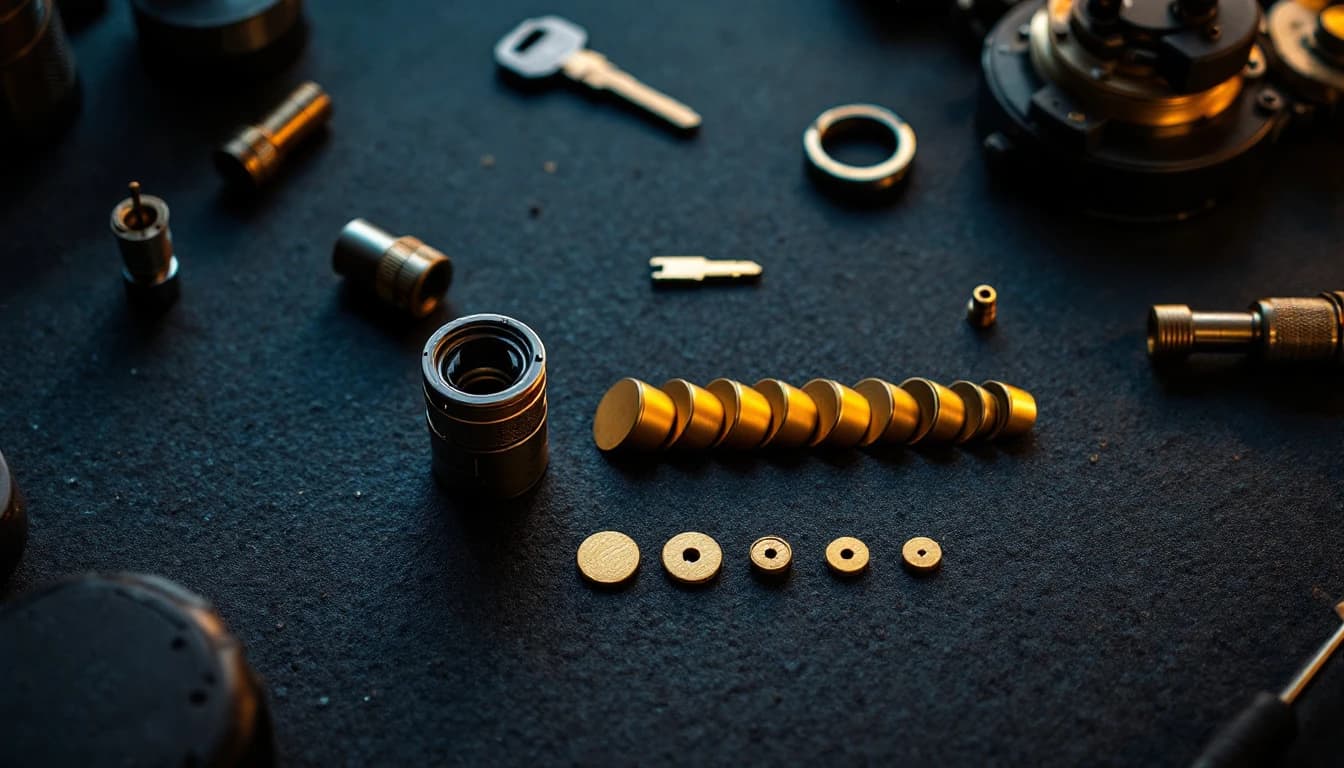
On the bench the process is deliberate rather than clever. The cylinder comes out of the shipped door lock assembly. The wafers or discs are read one position at a time, with the depth of each measured against the manufacturer's published depth-and-space specification for that keyway. The result is the same string of numbers a factory key code would have given us — recovered from hardware instead of from a database. From there the blade is cut on a machine using the correct jaw and cutter for the keyway, whether that is a conventional edge-cut blade or a milled track blade of the kind the Mercedes-derived platforms use.
Two things make this a bench job rather than a driveway job. The first is that decoding is easier and more accurate with the cylinder in hand, under light, on a fixture, than it is with the cylinder in a door. The second is that the finished blade has to be tested against the actual lock before it goes anywhere, and the lock is right there.
The obvious question is why the door lock specifically, rather than the ignition. The answer is wear, and it is worth its own section.
Wafers, discs, and why a worn lock decodes badly
A wafer lock holds a set of flat spring-loaded wafers in a plug. The correct blade lifts each wafer to exactly flush with the plug's shear line, and the plug turns. A disc-detainer lock does the same job with rotating discs instead of sliding wafers, which is why the high-security platforms feel different in the hand and need a different reading technique. Either way, the geometry is what encodes the cut.
Wear degrades that geometry. Every insertion drags the blade across the wafer edges. Over twenty years the wafers round off, the springs lose tension, and the chambers ovalize slightly. A worn lock will still happily accept a worn key, because the two wore together — but it decodes ambiguously. A wafer that should read cleanly as a depth 3 measures somewhere between 3 and 4, and if you guess wrong the new blade turns the door and binds in the ignition, or turns nothing at all.
This is exactly why the driver's door lock is what we ask for. On any car with a remote, the door lock is the least-used cylinder on the vehicle. The ignition gets operated every single trip; the door lock often has not seen a key since the remote battery was last good. The least-worn cylinder is the most honest witness to the original cut.
Where a lock is genuinely too far gone to read cleanly, the fix is not guesswork. Readings get taken across multiple positions, ambiguous depths get resolved against the manufacturer's depth increments, and the cut blade is tested in the lock we have in hand before anything ships back. If a decode cannot be trusted, we say so rather than shipping a blade that will fail in your ignition three days later.
"The door lock is the one cylinder most owners have never actually used. On a twenty-five-year-old car it is often the only place the factory cut still survives cleanly. I would rather decode a door lock I can hold than trust an ignition that has been turned forty thousand times." — Independent automotive locksmith and bench programmer, 20+ years, anonymized
Which of our services need the lock, and which do not
Here is the practical map. The rule underneath it is simple: if we can copy an existing working key, we do not need a lock. If there is no working key and no obtainable code, we need the lock.
| Service | Price | Ship the module? | Ship the door lock? |
|---|---|---|---|
| Mercedes AAM / DAS valet key (ML W163, SLK R170, SL R129, W140, G W461) | $250 | Yes — AAM or DAS/SKREEM | Yes for all keys lost; not if you send a working key |
| Mercedes classic DAS remote key (same chassis list) | $375 | Only for all keys lost | Yes for all keys lost; ship just your working remote otherwise |
| Mercedes AAM / DAS repair (ML no-start, key not recognized) | $299 | Yes — plus a key to verify | No |
| Sprinter valet key (T1N and W906, up to 2018) | $250 | Yes — EIS, or WSP/SKREEM on the earliest vans | Yes |
| Sprinter remote key and all keys lost (up to 2018) | $375 | Yes — EIS, or WSP/SKREEM on the earliest vans | Yes |
| Chrysler Crossfire valet key (2004-2008) | $250 | Yes — SKREEM, behind the instrument cluster | Yes |
| Chrysler Crossfire remote flip key (2004-2008) | $375 | Yes — SKREEM, behind the instrument cluster | Yes |
The Mercedes classic remote key service is the clearest illustration of the rule, because it can go either way. If you still have one working remote, ship that key on its own — the new key is built from it, the cut is copied from it, and your car never gets taken apart at all. If every key is gone, the same $375 job now needs the DAS or AAM module for the electronic side and the driver's door lock for the mechanical side. Same price, very different afternoon.
The Crossfire services never go the easy way, because a Crossfire owner who still has a healthy working key almost never needs us. Both the $250 start-only valet key and the $375 remote flip key work from the SKREEM plus the door lock. The same is true of the Sprinter pair: the $250 valet key and the $375 remote key both run from the EIS plus the lock — our Sprinter lost key replacement guide covers the T1N and W906 years one by one.
Note the one entry in the table that needs no lock at all. The $299 AAM / DAS repair is not a key job — it is a module repair for a car whose keys are fine and whose immobilizer has failed. Nothing is being cut, so nothing needs decoding.
What all keys lost actually changes
All keys lost changes the mechanical half of the job, not the price and not the electronic half.
On these platforms, adding a key when you still have a working one is genuinely easy. The existing key is both the pattern for the blade and, on several of these systems, a valid source for the data the new key needs. Nothing has to come out of the car.
All keys lost removes both of those. The immobilizer module now has to be read directly, because there is no working key to learn from — which is why the module ships. And the blade now has to be decoded, because there is no key to copy and no code to look up — which is why the lock ships. It is two extra parts in a box, not a different service and not a surcharge. Our all-keys-lost pricing is flat on every service in the table above, which is deliberately unlike how the dealer channel prices the same situation.
It is also why we tell one-key owners not to wait. If your classic is down to a single aging remote, the cheapest and easiest version of this job is available to you right now, and it disappears the moment that key dies. The same logic drives our general all keys lost mail-in module programming guide, which walks the broader decision across platforms.
Not every all-keys-lost car needs a lock, incidentally. On many modern platforms the key data and the mechanical pattern both live in modules the manufacturer still supports, so the job is entirely electronic. That is the situation when every key to a Range Rover is gone — the recovery runs through the vehicle's keyless modules rather than through a cylinder, and our KVM and RFA virginize walkthrough for JLR shows what that module-side work actually involves. Different era, different security architecture, completely different shipping list.
Proof of ownership is not a formality
Everything described here — reading an immobilizer, generating a key, decoding a lock — is security work on a specific vehicle. Proof of ownership is required for all of it, without exception, on every key and immobilizer service we offer.
What that means in practice: a title or current registration in your name, or documentation from the registered owner authorizing the work, plus photo identification that matches. Shops and locksmiths ordering on a customer's behalf provide the customer's ownership document along with their own business identification. If the vehicle was bought at auction or the title is still in transit, tell us what you have before you ship, not after.
This is not us being difficult. Engine immobilizers are one of the more effective anti-theft technologies ever mandated — research summarized by the Insurance Institute for Highway Safety has associated immobilizer-equipped vehicles with theft-loss rates on the order of 40 percent lower than comparable vehicles without them, and the National Highway Traffic Safety Administration maintains the federal theft-prevention standard that requires identifying marks on more than 12 major components of designated vehicle lines. A bench that will read anyone's immobilizer for anyone with a credit card undoes that work. We would rather turn down an order than be that bench.
Pulling and packing the lock
Two practical notes, because this is the part most owners have never done.
Removing a driver's door lock is a door-card job on every vehicle in the table above. The interior panel comes off, the vapor barrier gets peeled back, and the cylinder is retained by a clip or a small fastener on the outside of the door skin. Take photographs as you go. Before you touch anything, text us the VIN — we will tell you exactly which immobilizer module your specific chassis uses, where it lives, and what the lock retention looks like on your car. That one message is the single best defence against the most common failure in mail-in work, which is shipping the wrong part and losing a day.
Pack the lock and the module separately inside the same box. The module goes in an anti-static bag with padding around it; the lock is heavy, hard, and perfectly capable of destroying a circuit board if the two are allowed to move against each other in transit. Include any old keys, even broken ones — a dead key still carries a readable cut.
Ship to PO Box 120241, Arlington, TX 76012 if you are using USPS, or to 1009 Oakwood Ln # 120241, Arlington, TX 76012 if you are using UPS or FedEx, since neither courier can deliver to a PO Box. Work is performed at our Arlington bench. Return shipping is chosen and paid at checkout, from $29.95 standard, with UPS 2nd Day at $54.95 and UPS Next Day at $94.95 for vans and working vehicles that cannot sit.
Frequently asked questions
Why can't you just look up my key code like the dealer does? On the platforms in this guide there is no code left to look up. The record has either aged out of the manufacturer's retention window, or — as with the Chrysler Crossfire — the key was discontinued from the parts system entirely, which means no dealer can order one either. Decoding your own lock is not a workaround for a code we could not be bothered to request; it is the only remaining source of the cut.
Do I have to send the lock if I still have one working key? No. A working key is a better pattern than any code, because it reflects the cylinders as they actually are today rather than as they left the factory. On the Mercedes classic remote key service that means you ship only the key — no module, no lock, no dash teardown at all. The same shortcut applies wherever a genuinely working key survives.
Will you send my door lock back? Yes, always, along with the immobilizer module and every old key you sent. Everything you ship is returned in the same package as the new key, and the lock reinstalls exactly as it came out. Nothing you send is kept, consumed, or scrapped as part of the job.
Can you decode the ignition lock instead of the door lock? The door lock is strongly preferred because it is almost always the least-worn cylinder on the car, which makes it the most accurate record of the original cut. An ignition that has been operated tens of thousands of times decodes ambiguously, and an ambiguous decode produces a blade that binds. If your door lock has been replaced with a used unit, tell us before you ship so we can plan around it.
Does all keys lost cost more than adding a spare? No. Every key service in this guide is flat-priced whether you have keys or not — $250 for the valet and start-only keys, $375 for the remote keys, $299 for the AAM and DAS module repair. What changes with all keys lost is the shipping list, not the invoice. You will be pulling the immobilizer module and the door lock rather than dropping a key in an envelope.
What documentation do you need before you'll do the work? Proof that the vehicle is yours: a title or current registration in your name, or written authorization from the registered owner, plus matching photo identification. Shops and locksmiths supply the customer's ownership document alongside their own business identification. Send it before you ship anything — confirming paperwork after a module is already in transit helps nobody.
The bottom line
Programming and cutting are two separate problems that arrive in the same envelope. The electronic half is always solvable on the bench from your own immobilizer module. The mechanical half needs a source for the cut, and there are exactly three: an existing working key, a manufacturer key code, or a decode of one of your own locks.
On the Mercedes AAM and DAS classics, the Sprinter, and the Chrysler Crossfire, the middle option is frequently gone — retired, never retained, or discontinued along with the key itself. That is not a limitation of mail-in work; it is the same wall the dealer hits, and it is the reason these cars end up on a bench instead of in a service lane. Decoding your own door lock walks around it entirely, because your lock cannot be discontinued.
So the shipping list follows a rule you can apply yourself. Working key in hand? Send the key. No working key? Send the immobilizer module for the electronics and the driver's door lock for the blade. Either way, send proof of ownership, text us the VIN before you take anything apart, and let us confirm which module your specific chassis uses. That one conversation is worth more than any guide.
Ship your module today
Flat-rate pricing, typical 24-hour bench turnaround, return speed your choice at checkout. Most jobs back on your bench within a week.