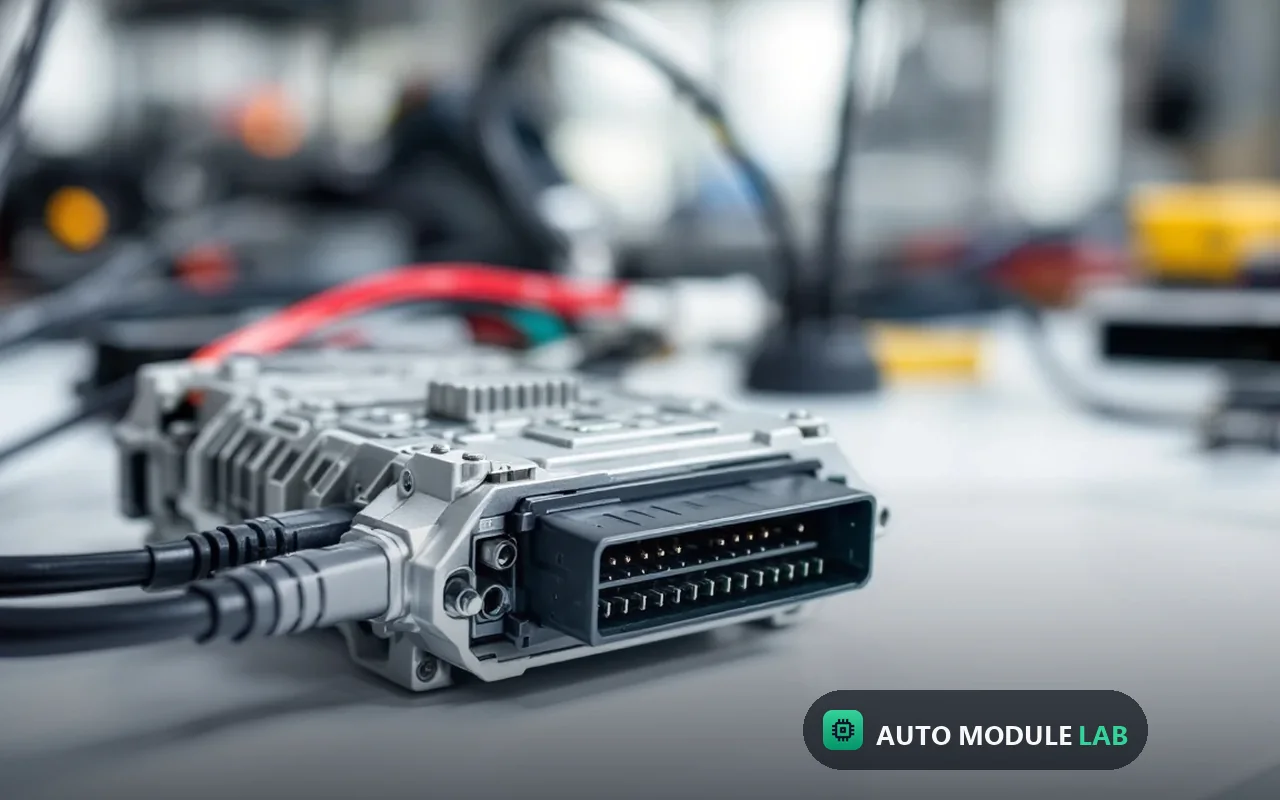
BMW DME EWS Delete: Bench Programming Guide (2026)
Who this is for
You're reading this because one of these is true:
- Your EWS module failed and a replacement is hard to source (E36/E39 EWS especially)
- You swapped engines and the donor DME won't sync to the recipient car's EWS
- Another shop attempted a key job, damaged the EWS or cluster, and now the car cranks but won't start
- You bought a project car with a missing EWS module and no realistic path to sourcing a matched one
- You're a locksmith or shop weighing whether to add EWS delete to your service menu
The decision tree is short. If your DME is on the supported list and the symptom is EWS-related, this $250 bench job is almost always the cheapest correct fix. If you're past the EWS era (2006+, CAS-equipped BMW), you need a different service — see our BMW CAS key programming page.
If you want to keep the immobilizer and simply make a used DME or a replacement EWS box work with your car, a delete is not the only answer — our guide on how to reset EWS on a BMW explains the re-sync paths (DME clone, EWS module clone, key programming) and why battery and key-cycling tricks never work.
As of September 2026, this service is $250 flat, with bench work typically completed within one business day of receipt.
What "EWS delete" actually changes
The BMW EWS (Elektronische Wegfahrsperre, or Electronic Drive Authorization) is the BMW immobilizer family used roughly from 1995 through 2005–2006 depending on chassis. It sits between the key transponder and the DME. Every start cycle, the DME asks the EWS module whether the key is authorized. Only on a clean handshake does the DME release fuel injection and ignition.
The EWS delete reprograms the DME to skip that handshake. After the delete:
- The DME no longer queries the EWS module
- Fuel and spark release on every key turn that mechanically rotates the ignition switch
- A working EWS module is no longer required for the engine to start
- Any compatible key that physically fits the ignition will start the car
What does not change:
- The mechanical ignition lock — you still need a key that fits
- Body modules (cluster, on-board computer, light module) — they are independent of the DME-to-EWS link
- A separately-equipped anti-theft alarm — it still arms
- Emissions or DTC behavior — the DME's diagnostic and emissions code is unchanged
The handshake itself is implemented as a challenge-response sequence held in specific DME firmware blocks. The delete is a software-only modification to those blocks; no hardware change is made to the DME.
Understand what you are giving up
This is the part most listings skip, and it deserves to come before the price.
The immobilizer is a theft-prevention device, and it works. The Insurance Institute for Highway Safety and its affiliated Highway Loss Data Institute have documented for years that vehicles equipped with electronic immobilizers show substantially lower theft-loss rates than comparable vehicles without them — the technology is one of the clearest anti-theft wins in the modern era. The National Insurance Crime Bureau has reported annual US vehicle thefts running at roughly 1 million vehicles in recent years, a reminder that the threat is not hypothetical.
So deleting EWS genuinely removes a layer of protection. It is the right call when the immobilizer has become the fault rather than the defense — a failed EWS module, an orphaned DME, a car that will not run otherwise — and it is the wrong call if your EWS system is healthy and you simply want a cheaper key. If your EWS works and you need keys, key programming is the correct service, not a delete.
Because this is security-relevant work, proof of ownership is required before we perform it: a registration or title matching the VIN. That requirement is standard for immobilizer work across the trade, it is not negotiable here, and it is the reason the Associated Locksmiths of America and the National Automotive Service Task Force both exist as bodies concerned with who is allowed to touch vehicle security data. We also archive your original EEPROM so the change is reversible.
The EWS generations, briefly
Knowing which generation you have explains why some cars are simple and some are not:
- EWS I / EWS II — the earliest implementations, roughly mid-1990s, using a simpler transponder and a separate control module.
- EWS III — the common one on E36, E39, E46 and E53. This is the generation most "EWS delete" work targets, and the one where donor-module swaps most often disappoint.
- EWS IV — the late implementation on the tail end of the era, with tighter coupling between modules.
- CAS — not EWS at all. From roughly 2006 BMW moved to the Car Access System, and from roughly 2011 the F-chassis cars moved again to FEM/BDC. Neither is served by an EWS delete.
That span means the EWS era covers roughly 10 model years of BMW production. Those cars are now old enough that, against an average US light-vehicle age that Consumer Reports and other outlets have tracked to well over 12 years, EWS-era BMWs are firmly in the value band where a four-figure dealer repair stops making sense.
Which DMEs are supported
Auto Module Lab handles the Siemens MS-family and Bosch ME-family DMEs used on E-chassis BMW from M52/M54/M62 through S54/S62/S65:
Siemens MS-family (M52/M54-era inline six and post-facelift):
| DME | Chassis | Engine families |
|---|---|---|
| MS41 | E36/E39 early | M52, M52TU |
| MS42 | E39/E46 transition | M52TU, M54 early |
| MS43 | E46, E39 facelift, E53 | M54 |
| MS45 / MS45.0 / MS45.1 | E83 X3, E85 Z4, E46 four-cylinder | Later M54, N46 |
Bosch ME-family (M62/M62TU and N62 V8s):
| DME | Chassis | Engine |
|---|---|---|
| ME 5.2 | E38, E39 5-Series V8 | M62 |
| ME 7.2 | E38, E39 5-Series V8 | M62TU |
| ME 9.2 | E60, E63 6-Series, E65 | N62 |
M-Power MSS-family (high-performance variants requiring extra-care bench handling):
| DME | Chassis | Engine | Notes |
|---|---|---|---|
| MSS50 | E39 M5 | S62 | NEC chip access often required |
| MSS52 | E46 M3 (early) | S54 | |
| MSS54 | E46 M3 (mid-late) | S54 | |
| MSS54hp | E46 CSL | S54 (388hp variant) | CSL software respected |
| MSS60 | E60 M5, E63 M6 | S85 V10 | Demands precision — chip-off in some cases |
| MSS65 | E92 M3 | S65 V8 | Less common but supported |
| MSS70 | Track / aftermarket | S65 V8 derivatives |
If your DME is on this list, EWS delete is straightforward bench work. If you can't read the DME part number from the label because it is faded or missing, text us a photo and we'll identify it from board markings before you ship anything.
The symptoms that say "EWS delete fixes this"
The diagnostic pattern is consistent:
- Car cranks normally — battery, starter, and cranking circuit are fine
- No fuel pulse and no spark on the cranking cycle (verify with a noid light or scope)
- DME diagnostics show EWS-link fault codes — "EWS not detected," "EWS code mismatch," or a generic anti-theft-active message
- A known-good EWS module from a same-chassis donor sometimes fixes it temporarily and sometimes doesn't, because the donor's rolling code doesn't match the DME
- Some chassis, E39 especially, display the EWS dashboard symbol
Immobilizer-blocked starts generally set manufacturer-specific fault codes rather than generic powertrain codes, which is why a basic code reader can show "no codes" on a car that plainly will not start. Diagnostic interfaces and data formats in this space are shaped by standards work at SAE International, but the specific immobilizer codes are BMW's own — you need a BMW-capable tool to see them.
If your scanner reports those codes and the basic cranking circuit checks out, EWS delete is a candidate repair.
Symptoms it won't fix
Be honest with the diagnosis before ordering. EWS delete does not solve:
- No-crank conditions — if the starter isn't engaging, that's a cranking-circuit problem: battery, neutral safety switch on automatics, ignition switch contacts, or starter relay
- Fuel pump failure — if cranking looks right and there's spark but no fuel, the pump or its relay is at fault
- Mechanical engine problems — compression loss, timing chain stretch, valve damage; none of this is electronic
- A separately-armed anti-theft alarm — some E-chassis BMWs have a factory-extended or aftermarket alarm that arms independently of EWS
- Cluster failure — the cluster on EWS-era BMW is generally not part of the immobilizer chain, though some early E38 builds have a quirk where a dead cluster prevents start
Intermittent faults deserve special care here, because a module that works cold and fails warm can imitate an EWS problem convincingly. If your no-start comes and goes with temperature, read our guide to intermittent and thermal module faults before condemning anything.
Why "buy another used EWS" is usually the wrong answer
The most common DIY attempt is to buy a used EWS module and code it in. It works sometimes. It fails often, for a specific reason.
EWS modules are paired to the DME's rolling code. A donor EWS pulled from another car carries the donor's code in EEPROM. Plug it in and the DME rejects it. The fix is either to clone your original EWS data onto the donor, or to reprogram the donor to match your DME's expected code. Both require bench work — and at that point the delete is faster, cheaper, and permanent.
There is a second problem people discover late: sourcing. EWS modules for these chassis are out of production, and used-module quality is a lottery. The general trap is the same one we describe in our VIN-locked module explainer and our guide to buying a used donor module — the part number matching is not the same as the data matching.
The bench process
When your DME arrives at the Arlington workshop, here's what happens:
- Visual inspection — confirm the DME is the part you described, with no shipping damage or obvious board issues
- Power-up bench test — confirm the DME boots, communicates with our bench harness, and returns the expected firmware version
- EEPROM read — dump the existing data and archive it, kept for 90 days in case rollback is needed
- EWS-link block modification — write the firmware blocks that bypass the handshake. On MS43/MS45 this is software-only; on some MSS-family M-Power DMEs the chip may need to be opened for direct programming
- Verification — write back, re-read, and compare byte-for-byte against the expected post-delete signature
- Bench start test — connect a test harness with an EWS-less load and verify the DME releases the start command
- Photo and ship — a photo of the bench result, then tracked return shipping
Total bench time runs 30–90 minutes depending on DME complexity. Most DMEs typically ship back within one business day of receipt.
What a typical job looks like
A representative case, described generically rather than as any identifiable customer: an independent BMW specialist has a 2003 E46 330i with an intermittent no-start. It cranks normally, has fuel pressure, and has spark on a bench-tested coil, but the scanner shows EWS-to-DME communication errors. The shop has already tried two salvage EWS modules without improvement — the classic rolling-code mismatch.
The shop pulls the MS43 DME and ships it. Bench work is done the day it lands and it goes back out the same afternoon. The DME goes in, the car starts on the first crank, and the EWS-related no-start does not return.
That is the ordinary outcome, and the shipping is the slow part — bench time is well under two hours, while the round trip is typically most of a week.
EWS delete is one of those bench-level operations that should just be part of the standard E-chassis BMW playbook. The modules are getting harder to source, the rolling-code work to make a donor EWS behave costs more than the delete, and the delete is reversible if you keep the original dump. For a car that is already immobilized by its own immobilizer, there is no real downside. — Master automotive locksmith, 15+ years European-specialty experience (anonymized)
Cost, shipping and what to send
EWS delete is $250 flat at the BMW DME EWS delete service page, with bench work typically completed within one business day of receipt. The original EEPROM is archived for 90 days.
Return shipping is paid by the customer and chosen at checkout, from $29.95 for standard ground, with two-day and overnight tiers available. We buy and send the inbound label so the DME reaches us tracked.
Send the DME only — no harness, no airbox. Photograph the label first. Handling matters on electronics this age; see our ESD handling guide and how to remove, package and ship a module.
Ship to the address matching your carrier: USPS goes to PO Box 120241, Arlington, TX 76012, while UPS and FedEx cannot deliver to a PO Box and must use 1009 Oakwood Ln # 120241, Arlington, TX 76012. Bench work is performed at the workshop at 1168 W Pioneer Parkway, Arlington, TX 76013.
Vehicle history and title status are worth checking before investing in any older car's electronics — services such as Carfax exist for exactly that — and if the car is a recovered theft or a rebuilt title, say so up front so we can advise properly.
Frequently asked questions
Will the car still start with my existing keys? Yes. EWS delete removes the DME's requirement for EWS-paired keys, so any physical key that mechanically rotates the ignition switch will release the start command. You do not need new keys cut or programmed, and your existing keys keep working exactly as they do for the door locks.
Do I need to remove the EWS module from the car? Not necessarily. The EWS can stay in place, where it will simply be ignored by the DME, or you can remove it entirely. Most customers leave it installed to keep the wiring loom tidy and to preserve the option of reversing the delete later.
Will my odometer reading change? No. The DME does not store the odometer reading — that lives in the instrument cluster, which this work never touches. Your mileage is unaffected by an EWS delete, and we do not alter odometer data on any service; mileage work is only ever synced to a vehicle's true reading.
Can you reverse the delete if I sell the car? Yes, within the archive window. We keep your original EEPROM dump for 90 days, and inside that window you can ship the DME back and we will restore the original software for $75. Outside 90 days, restoration becomes best-effort because the archived dump may no longer be available.
Does this affect emissions readiness or smog testing? No. EWS delete is independent of the emissions monitors and the OBD-II readiness state, and the DME's emissions calibration is unchanged. Note that readiness monitors do reset after any DME power interruption, so allow a normal drive cycle before a test.
Does deleting EWS make my car easier to steal? Yes, and you should weigh that honestly. The immobilizer is a genuine theft deterrent, so removing it returns the car to the security level of a pre-immobilizer vehicle. It is the right trade when the immobilizer has failed and is preventing the car from running; it is the wrong trade on a healthy system where key programming is the real answer.
What about CAS-equipped BMWs from 2006 onward? That is a different system entirely and an EWS delete does not apply. CAS replaced EWS from roughly 2006, so for those cars see our BMW CAS key programming service, and for 2013-and-later F-chassis cars with FEM or BDC modules see BMW FEM/BDC key programming.
The bottom line
EWS delete is the correct fix when your BMW is in the EWS era (E36, E39, E46, E53 plus some early E60 and E63), the DME is on the supported list (MS41–MS45, ME 5.2–9.2, or the MSS50–70 family), the symptom is EWS-related — cranks but no fuel or spark, with EWS-link fault codes — and the basic cranking circuit checks out.
It is the wrong fix if your immobilizer is healthy and you just want cheaper keys, because you would be trading away real theft protection for no repair benefit. Deleting a working immobilizer is a security decision, not just a cost decision.
It's $250 flat at the BMW DME EWS delete service page with typical one-business-day bench turnaround, customer-paid return shipping from $29.95, proof of ownership required, and your original EEPROM archived for 90 days so the change stays reversible.
If you're unsure whether your symptoms point at EWS, or whether your DME is on the list, text us a photo of the DME label and a one-sentence description of the symptom — we'll confirm fitment before you ship.
Ship your module today
Flat-rate pricing, typical 24-hour bench turnaround, return speed your choice at checkout. Most jobs back on your bench within a week.