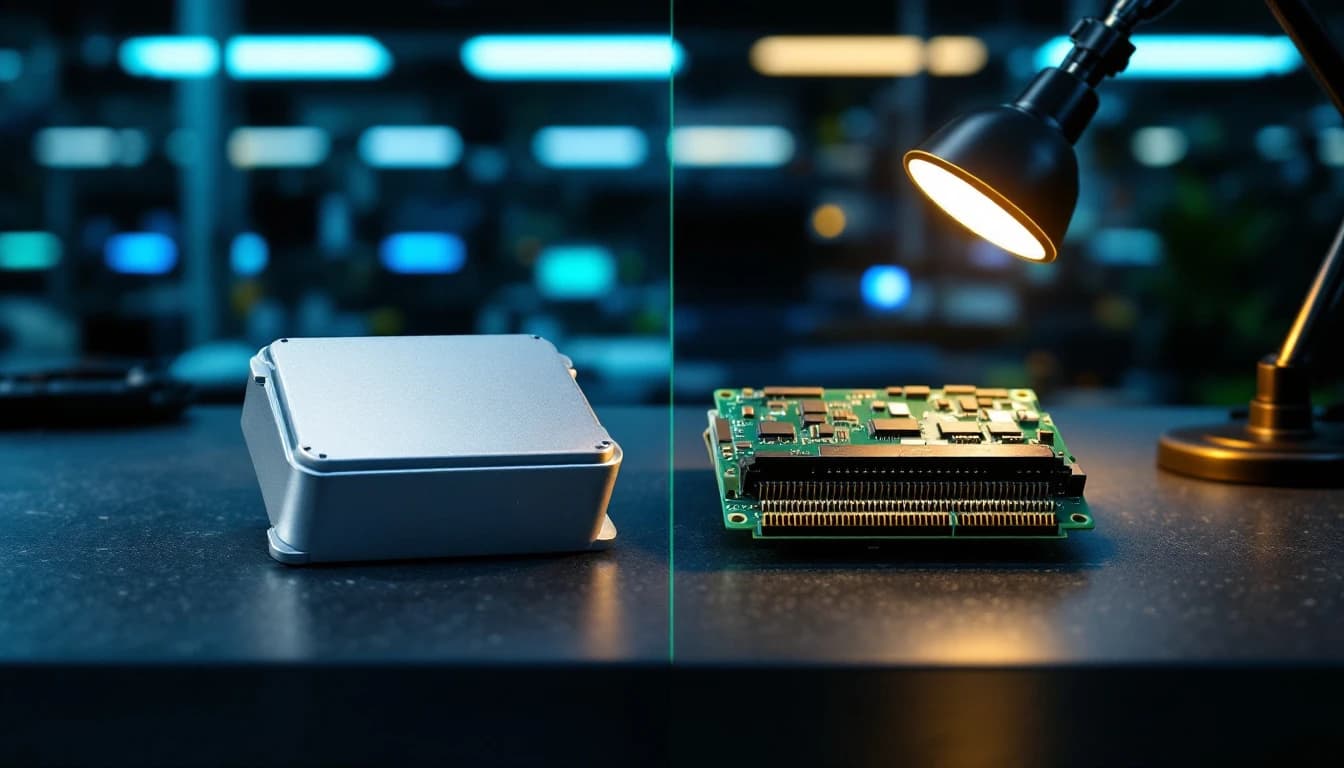
ESD: How Static Kills Car Modules, and How to Pack One
The failure you never watch happen
Every week a module lands on the bench in a grocery sandwich bag, wrapped in three feet of bubble wrap, sitting loose in a shoebox with the connector pins pressed into a wad of newspaper. Most of them are fine. Some are not. And the ones that are not almost never fail in a way anybody can trace back to the trip.
That is the whole problem with electrostatic discharge. ESD is the only damage mechanism in automotive electronics that leaves no evidence. No burn mark. No smell. No bulging capacitor. No cracked solder joint you can find under magnification. Frequently no immediate symptom either — a module gets zapped on a garage floor in January, works normally for six weeks, then starts dropping off the bus intermittently in March. By that point nobody connects the two events, and the story becomes "this module was just bad."
This article is the handling guide we wish every customer read before pulling a module out of a car. It covers what ESD actually is at a level that matters on a bench, why the human body is a far better static generator than people assume, the difference between a module that dies instantly and one that dies slowly, and then the practical half: exactly how to remove, hold, bag, and box a control module so that the journey to the workshop is not the thing that ends it.
What ESD actually is
Static electricity is charge separation. Two dissimilar materials touch and then separate; electrons transfer across the interface; one surface ends up net positive and the other net negative. That is the triboelectric effect, and it happens constantly and invisibly — shoe soles against carpet, a jacket sleeve dragging across a seat, a module sliding out of a polyethylene bag.
Charge sitting on a surface is harmless on its own. The damage occurs at discharge, when that stored charge finds a path to a lower potential and dumps through it in a few nanoseconds. If that path runs through a connector pin, down a trace, and across a semiconductor junction inside a microcontroller or a driver IC, the junction briefly sees a current density it was never designed to survive. Gate oxide punctures. Metallization vaporizes. Junctions short.
The reference body for this work is the ESD Association, whose ANSI/ESD S20.20 program is the framework static-control programs are built on across electronics manufacturing worldwide. The device-level stress models — Human Body Model, Charged Device Model, Machine Model — are defined through JEDEC and, internationally, through the IEC 61340 series published by the International Electrotechnical Commission. None of this is fringe. It is the same standards family every automotive tier-one supplier works under when they build the module you are about to unbolt.
The number that reframes the subject
Here is the fact that changes how most people think about this.
A human being cannot feel a static discharge below roughly 3,000 volts. Reference material published through the ESD Association puts the typical human perception threshold at approximately 3,000 V; you begin to hear the snap somewhere around 5,000 V and see a visible spark at roughly 10,000 V. Below about 3,000 V there is no sensation at all. Nothing.
Now put that next to what modern silicon tolerates. Under the Human Body Model classification maintained through JEDEC, a Class 0 device is one that can be damaged below 250 volts, and a great many contemporary fine-geometry CMOS parts fall into the lower classification bands. Some internal structures are vulnerable well under 100 volts.
So the arithmetic is genuinely uncomfortable: the smallest discharge a person can detect is more than ten times the level at which the most sensitive parts inside a control module can be damaged. Everything below your perception threshold is invisible, unlimited in frequency, and happening dozens of times an hour while you work.
The obvious objection is that automotive modules are hardened. They are — on the pins that were designed to be exposed. Manufacturers fit protection networks, clamping diodes, and series impedance on external harness pins precisely because a vehicle is a filthy electrical environment. Those networks protect the intended interface. They do not protect an unpopulated test pad, a board edge, an exposed ground plane, or the interior side of a connector on a module that has been unbolted, unplugged, and is now being carried across a carpeted hallway in someone's bare hand.
Where the volts come from
The everyday sources are mundane and enormous.
Reference tables published through the ESD Association put a person walking across carpet at roughly 35,000 volts at low relative humidity, and even at high humidity the same activity generates well over 1,000 volts. Walking across an ordinary vinyl floor, sliding out of a vehicle seat, peeling tape off a roll, or pulling a poly bag apart all land in the same order of magnitude. Removing a fleece or synthetic jacket in a dry room is one of the most reliable multi-kilovolt generators in existence.
Humidity is the single biggest modifier. Water in the air provides a slow, continuous leakage path that bleeds charge away before it accumulates. When indoor relative humidity falls, that path disappears and charge stays put. Heated indoor air in winter routinely drops far below the comfort band — NOAA and the National Weather Service both publish the underlying relationship: heating cold outside air without adding moisture drives indoor relative humidity down sharply, and figures below 20 to 30 percent are ordinary in northern winters. That is exactly the range where the same walk across the same carpet goes from producing a couple of thousand volts to producing tens of thousands.
Which gives you the practical seasonal rule: module handling is meaningfully more dangerous in winter, in a dry climate, on a carpeted or sealed concrete floor, wearing synthetic clothing. Nothing about the module changed. The environment did.
Modern vehicles make the exposure worse simply by containing more electronics. SAE International has documented for years the rise of distributed electronic control architectures, with contemporary vehicles carrying dozens to well over a hundred networked control modules and electronics accounting for a large and growing share of total vehicle content. Every one of those is a part somebody may eventually remove, handle, and ship.
Catastrophic failure versus latent damage
This is the distinction that matters most, and it is the one almost nobody outside electronics manufacturing knows about.
Catastrophic failure is the easy case. The discharge is large enough, or lands in a sensitive enough place, that the device fails immediately and completely. The module will not power up, will not communicate, or has a dead output driver. You plug it back in, nothing happens, and at least you know where you stand.
Latent damage is the ugly case. The discharge partially damages a junction or gate oxide without destroying it. The device still works. It passes every test you can perform. It powers up, it communicates, it drives its outputs. But the damaged region carries a defect that concentrates current and heat, and under normal operating stress — thermal cycling, vibration, load — that defect grows. Weeks or months later the device fails for good.
The ESD control literature treats latent failure as a recognized and significant category precisely because it is invisible at the point of test. That is the honest technical explanation behind a phenomenon we see constantly in this trade: a customer replaces a module, it works, and then the replacement fails too. Sometimes there is a genuine upstream cause — a charging fault, a chafed harness, water intrusion. But sometimes the second module was simply handled the same careless way the first one was, and it was carrying a wound from the day it was installed.
Industry estimates commonly attribute a substantial share of total electronic device losses to ESD; figures on the order of a third of electronic component failures are widely cited in static-control training material published through the ESD Association. Even if the automotive-specific share is lower, the mechanism is real, it is common, and it is entirely preventable with about four dollars of packaging and two minutes of discipline.
"I stopped arguing with customers about it and just started asking one question: what did you carry it in? When the answer is a Ziploc and a towel, and the module tests fine but the car has phantom faults three months later, I already know. You cannot prove it after the fact — that is exactly why it keeps happening. The people who bag things properly do not have this conversation with me." — Independent automotive electronics technician, 19+ years in module-level diagnosis and repair (anonymized)
Why an ordinary plastic bag is worse than no bag
This surprises people, so it is worth being precise.
An ordinary polyethylene bag — a sandwich bag, a produce bag, a parts bag from the auto store — is an excellent insulator and an excellent triboelectric generator. Sliding a module into it and out of it rubs two dissimilar surfaces together and separates them, which is the textbook definition of charge generation. The bag itself becomes charged, the module becomes charged, and because the bag is an insulator the charge has nowhere to go. It sits there until the module is removed and touches something.
Bubble wrap behaves the same way. So does foam packing, so does polystyrene, and so do loose polystyrene packing peanuts, which are notorious for it. Peanuts in direct contact with a bare board are one of the worst combinations you can put in a box: they are highly triboelectric, they migrate during transit, and they abrade whatever they are rubbing against.
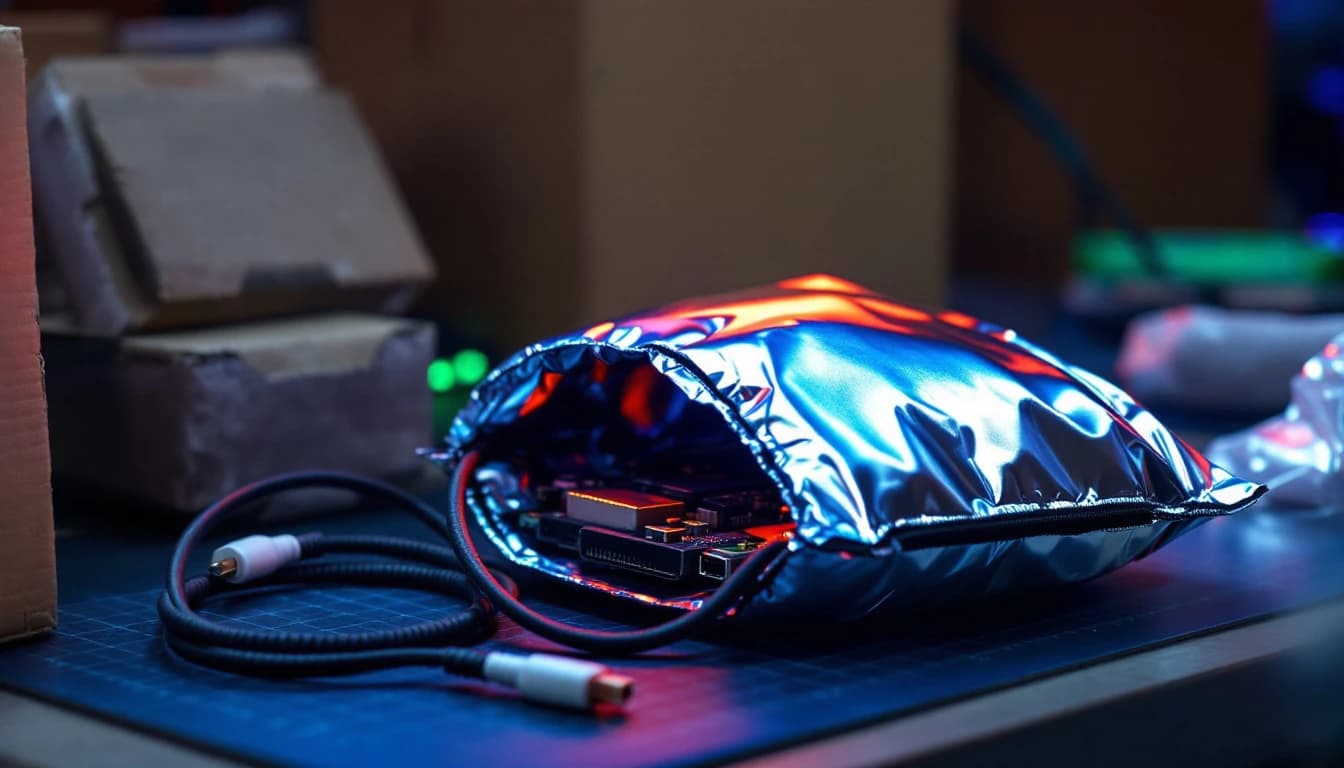
Proper ESD packaging solves this by controlling where charge can go. Anti-static (usually pink) poly is treated so it does not generate significant charge against the item inside it — it is anti-triboelectric, but it does not stop an external field. Static-shielding bags (the metallized silver or grey ones) go further: a buried conductive layer forms a Faraday shield, so an external discharge travels around the outside of the bag instead of through the contents. Static-dissipative material is designed to bleed charge away slowly and controllably rather than dumping it.
Here is the comparison in one place:
| Packaging | Prevents charge generation | Shields from external discharge | Safe against a bare board | Verdict for shipping a module |
|---|---|---|---|---|
| Ordinary plastic / sandwich bag | No — actively generates charge | No | No | Do not use |
| Bubble wrap (direct contact) | No — generates charge | No | No | Outer cushioning only, never against the board |
| Loose polystyrene peanuts | No — strongly triboelectric | No | No | Never against the module |
| Anti-static pink poly | Yes | No | Acceptable | Minimum acceptable option |
| Static-shielding metallized bag | Yes | Yes | Yes | Correct choice |
| Static-dissipative bin or tote | Yes | Partial | Yes | Good for transport within a shop |
The practical takeaway is short. A static-shielding bag is the right answer. Anti-static pink poly is an acceptable fallback. Anything else touching the board directly is a gamble you have no way to audit later.
How to remove a module without damaging it
The removal is where most of the risk lives, because that is when the module goes from being bonded to a large grounded metal structure to being an isolated object in a human hand.
- Kill the power and wait. Disconnect the negative battery terminal and give the vehicle several minutes before you unplug anything. Control modules hold residual charge in supply capacitance, and some networks stay awake for a period after key-off. Unplugging a live module risks both ESD and ordinary transient damage.
- Ground yourself deliberately, then stay grounded. Touch a bare, unpainted metal point on the body or chassis and keep contact for a moment before you reach for the module. A wrist strap connected to chassis ground is far better. Ground yourself again every single time you have moved, stood up, or walked anywhere.
- Release the connector by its latch, not by the wires. Automotive connectors have positive locks. Force applied to the harness rather than the lock damages pins and terminals, which produces exactly the intermittent-contact faults people then blame on the module.
- Never touch the pins. Not the module-side pins, not the harness-side terminals. The pins are the shortest, most direct path from your finger to the semiconductors inside. Handle the connector body, never the contacts.
- Hold the module by its case. Grip the metal or plastic housing and the mounting ears. Keep fingers off exposed board edges, off any visible circuitry, and off any exposed connector shell.
- Do not open it. Removing a lid to "look inside" exposes the board directly and, on modules with conformal coating or a sealed housing, can compromise the moisture seal. If a module needs to be opened, it gets opened on a grounded bench.
- Bag it immediately. Not later. Not after you finish the rest of the job. The module goes into its shielding bag the moment it is free of the vehicle, while you are still grounded.
If you are removing a module because you are chasing an intermittent fault and are not certain the module is even the problem, read how to know which module failed before you ship it first. Shipping a healthy module is an expensive way to rule something out, and every removal is another handling event.
How to pack a module correctly
Packing is a layered problem: charge control innermost, cushioning outside that, rigidity outside that.
Layer 1 — static control. The module goes into a static-shielding (metallized silver or grey) bag, or at minimum anti-static pink poly, sized so it is not straining the seam. Fold the open end over and tape it closed with the tape on the bag, not on the module. If you are also concerned about moisture — and you should be if the part is crossing a temperature gradient in winter — a desiccant pack inside the sealed bag is cheap insurance against condensation.
Layer 2 — cushioning. Now, and only now, the cushioning goes on. Bubble wrap is fine here, because it is no longer touching the board. Wrap generously, with particular attention to the connector end, which is the most fragile part of the assembly and the part most likely to take an impact.
Layer 3 — rigid outer box. Use a real corrugated box with at least two inches of clearance on every side, and fill the void so the module cannot move. A part that shifts inside a box is a part that gets shock-loaded every time the box is set down. Avoid loose fill against the wrapped module; block-and-brace with folded cardboard or firm foam instead.
Layer 4 — paperwork. Include a sheet with the vehicle year, make, model, VIN, the symptom, the module part number, and what you want done. Put the same information on the outside of the bag if you can. Modules with no paperwork sit in the queue while we work out whose they are. Key, immobilizer, and security-related work additionally requires proof of ownership, and providing it up front avoids a delay. If you are unsure what belongs in the box for your particular job, what to ship with your module by job type walks through it, and the general removal and packing walkthrough lives at how to remove, package and ship a car module.
What not to do, in one list: no loose polystyrene peanuts against the module, no bare module in a plain plastic bag, no module rattling loose in an oversized box, no padded envelope for a rigid part with a fragile connector, no tape stuck directly to the housing or the connector, and no shipping a module still wet from a parts washer or a flooded footwell.
Where to send it, and what happens next
Ship USPS to PO Box 120241, Arlington, TX 76012. Ship UPS or FedEx to 1009 Oakwood Ln # 120241, Arlington, TX 76012 — couriers cannot deliver to a USPS PO Box, so use the street address for those carriers. All work is performed at the Arlington workshop; Auto Module Lab is nationwide mail-in only. Return shipping is paid by you and chosen at checkout, from $29.95.
On arrival the module is opened on a grounded, static-controlled bench with a wrist strap and a dissipative mat, powered from a regulated supply rather than a marginal battery, and read before anything is written. Common bench services here include ABS module repair at $499, keyless entry module repair at $125, and instrument cluster repair with mileage sync at $200, where any mileage work is performed to the vehicle's true mileage only. The receiver side of a remote-entry system is one of the most static-sensitive parts we see, and our guide to key fob module faults covers how to confirm it before you pull one. If you genuinely do not know what is wrong with the part, bench evaluation at $150 exists for exactly that case. The full process is laid out at how it works.
One last note on expectations. ESD damage that happened before a part reached us is not something any bench can undo, and it is not something anyone can prove after the fact. That is precisely why the handling discipline matters on your end. If you want to understand what is and is not covered once a part has been worked on, read what to expect from a mail-in module programming warranty. And if you landed here because a dealer told you a module could not be programmed at all, what to do when the dealer says they cannot program your module covers the alternatives.
Frequently asked questions
Can static electricity really damage a car module through a plastic case? Yes, though not through the case itself — the damage path is almost always the connector pins, exposed board edges, mounting hardware, or an opened housing. The plastic case is an insulator, but the pins are directly connected to the semiconductors inside, and a module out of the vehicle has no chassis ground to absorb a discharge. That is why the rule is to hold the housing and never touch the contacts.
I have handled modules for years without a wrist strap and never had a problem. Why change? Because latent ESD damage is invisible by definition, so an absence of obvious failures is not evidence that nothing happened. A module that was weakened and then failed four months later gets recorded as a bad part, not as a handling error. The entire reason the electronics industry built a standards framework around this is that the failures do not announce themselves.
Is a regular Ziploc or grocery bag better than nothing? No, it is worse than a bare module in a static-shielding bag and arguably worse than careful bare handling. Ordinary polyethylene generates charge every time the module slides against it, and being an insulator it holds that charge until the part comes out. Use a metallized static-shielding bag, or at minimum anti-static pink poly.
Why is winter worse for static damage? Heated indoor air holds far less relative humidity, and humidity is what quietly bleeds accumulated charge away. In a dry room the same walk across the same carpet can generate an order of magnitude more voltage than it would in summer. Cold, dry climates plus carpet plus synthetic clothing is the worst-case combination for handling a bare module.
Should I use packing peanuts? Not against the module. Loose polystyrene peanuts are strongly triboelectric, they migrate during transit so the part ends up unprotected on one side, and they abrade whatever they rub against. Cushion with bubble wrap outside the sealed static-shielding bag, then block-and-brace with folded cardboard or firm foam so nothing can move.
Do I need to disconnect the battery before removing a module? Yes, and then wait several minutes before unplugging anything. Modules retain charge in supply capacitance and some vehicle networks stay awake after key-off, so unplugging a live module risks transient damage in addition to ESD. Disconnect the negative terminal, wait, then work.
Can you tell whether a module was damaged by static? Almost never with certainty. Catastrophic ESD damage looks like any other dead semiconductor once the part is on the bench, and latent damage looks like nothing at all until it progresses. This is a mechanism you prevent rather than diagnose, which is why the handling and packing procedure is worth the two minutes it takes.
The bottom line
Electrostatic discharge is the quietest way to ruin a control module. You cannot feel the discharges that matter, you cannot see the damage they cause, and in the latent case you will not find out for weeks. The environment stacks against you in exactly the conditions people most often work in — a dry garage in winter, a concrete or carpeted floor, a fleece jacket, and a part carried in a bare hand across a room.
The fix costs almost nothing. Disconnect the battery and wait. Ground yourself and stay grounded. Handle the housing, never the pins. Put the module straight into a static-shielding bag, cushion outside the bag, box it rigidly, and include the paperwork. Do not use ordinary plastic bags, and keep polystyrene peanuts away from the board entirely.
Ship USPS to PO Box 120241, Arlington, TX 76012, or UPS and FedEx to 1009 Oakwood Ln # 120241, Arlington, TX 76012, since couriers cannot deliver to a PO Box. Return shipping is paid by you and selected at checkout, from $29.95. Everything is worked on a grounded bench at the Arlington workshop, mail-in only, nationwide. Do the packing right and the trip becomes the least interesting part of the job — which is exactly what you want.
Ship your module today
Flat-rate pricing, typical 24-hour bench turnaround, return speed your choice at checkout. Most jobs back on your bench within a week.