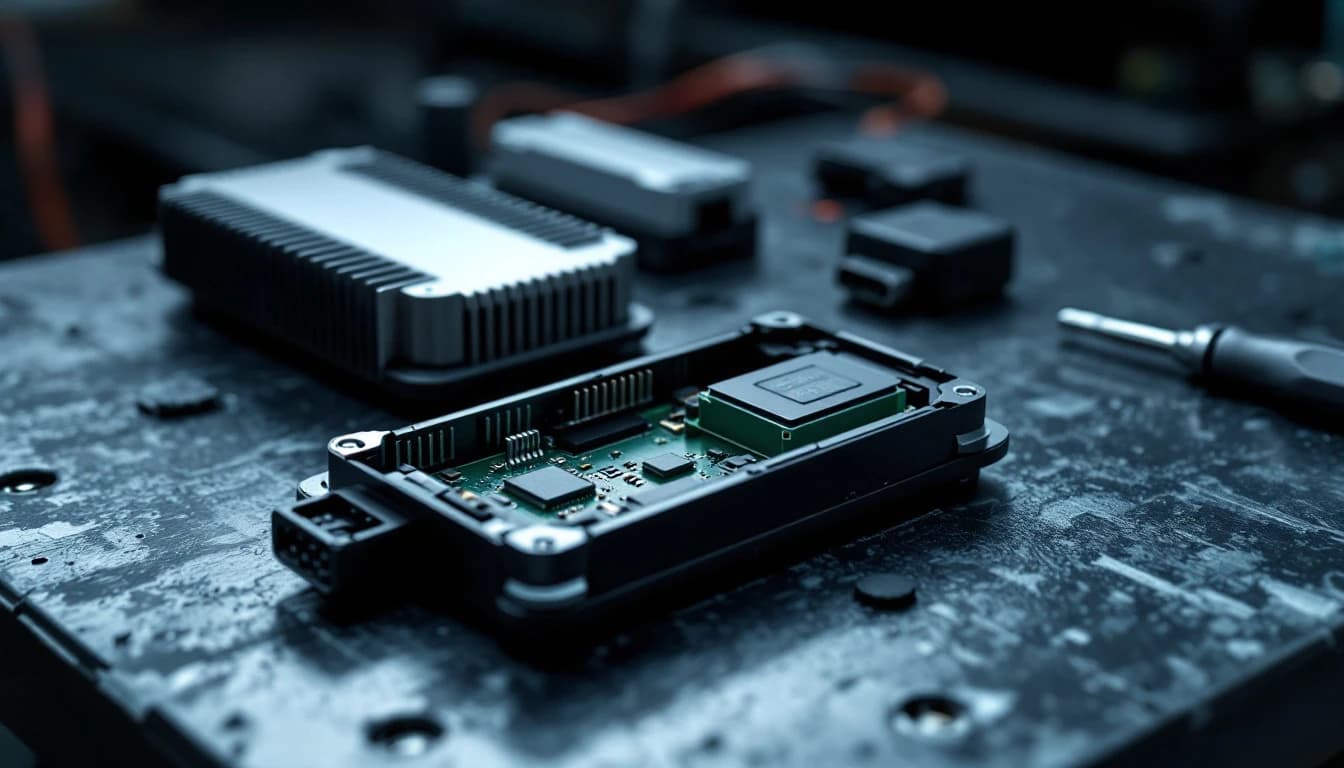
BMW Module Repair vs Replacement, Module by Module
Start here: what "repair" actually means on a BMW module
If you are holding a dealer estimate that says a module must be replaced and coded, understand what that sentence really means. A franchise service lane is set up to swap a part and run a factory coding routine. It is not set up to open a module, read its memory, repair a corrupted data block, or transfer identity data from a failed unit to a good one. Those are bench operations, and they are the reason a module a dealer calls scrap is frequently repairable.
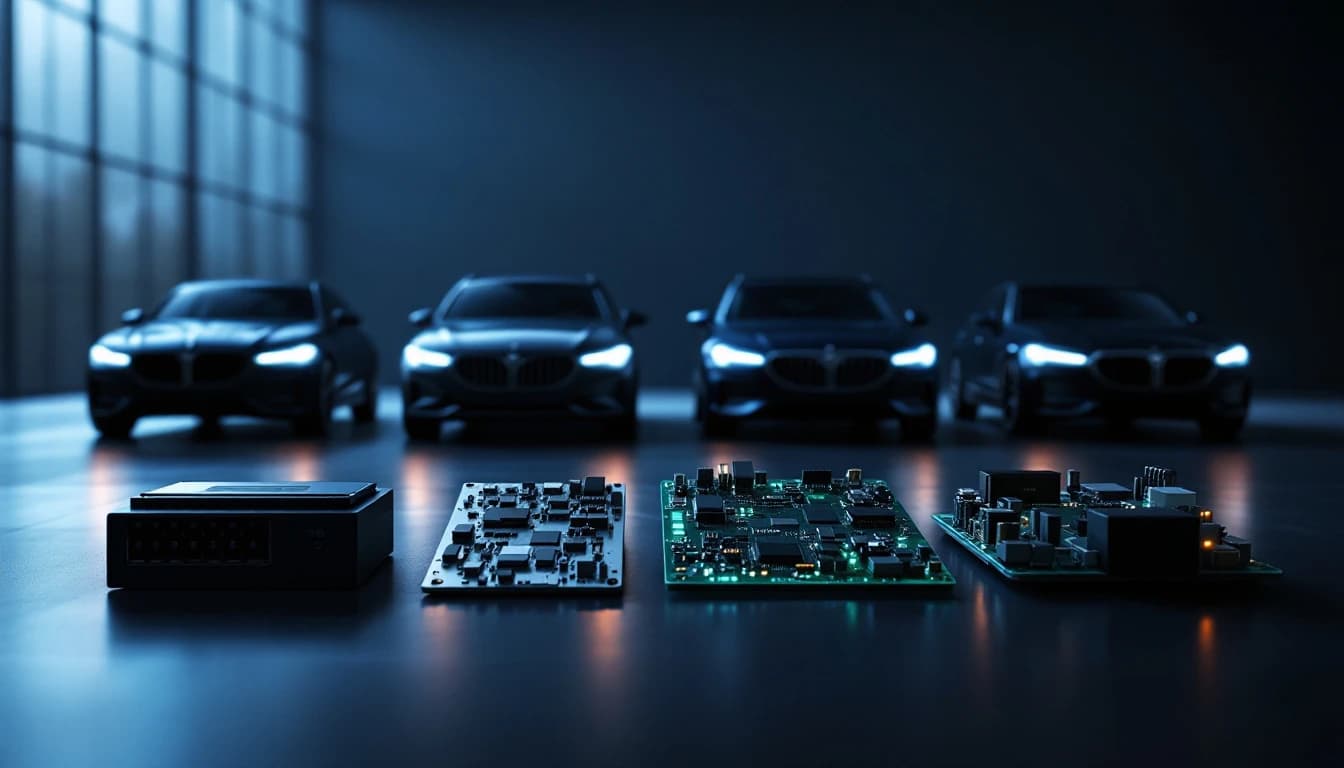
BMW is a particularly good example because the brand runs an unusually high electronic module count per car and changed the architecture repeatedly. The BMW Group reports deliveries well above 2 million BMW-brand vehicles in a single recent year, and a very large share of the U.S. fleet is now out of factory warranty. Reliability and ownership-cost coverage from J.D. Power and Consumer Reports has consistently flagged electronics and infotainment as among the most-reported problem categories across the industry, which is exactly the category these modules live in. Consumer Reports builds those findings from annual member surveys covering hundreds of thousands of individual vehicles, so the pattern is not anecdote. That combination — lots of modules, lots of out-of-warranty cars — is why "can this be fixed instead of replaced" is one of the most valuable questions a BMW owner can ask.
There are four honest outcomes for any BMW module, and the whole rest of this article is about matching your module to the right one:
- Repair — the module hardware or its stored data is fixed and the same physical unit goes back in the car.
- Recovery / reflash — the module is not physically damaged, but its memory is corrupted or half-written. It gets read, corrected, and written back.
- Clone / data transfer — the original is unusable, so its identity and security data are moved onto a matching donor module so the car accepts it without further coding.
- Replace — genuinely nothing to recover. Physical damage, water intrusion, or a security architecture that will not permit bench work.
Anyone who tells you every BMW module is repairable is selling optimism. Anyone who tells you none of them are is selling parts.
The BMW module decision table
Here is the whole guide condensed. Find your module, read the realistic outcome, and jump to that section for the detail.
| Module | What it does | What usually fails | Realistic outcome | Bench service and price |
|---|---|---|---|---|
| FRM3 (footwell) | Exterior/interior lighting, windows | EEPROM corruption after a battery or coding event — module goes silent | Recovery, almost never replacement | FRM repair $175 |
| CAS (car access) | Key data, immobilizer, ISN copy | Failed board, water damage, lost keys, donor CAS from another VIN | Program, or clone data to a donor | CAS key programming $150 · CAS clone/repair $250 |
| FEM/BDC | F/G body + gateway, key security | Half-written flash from an in-car programming attempt; key add/AKL | Read, unlock, program on the bench | FEM/BDC key programming $150 |
| DME (engine ECU) | Engine control + ISN half of immobilizer | Internal failure, water, a donor unit married to another car | Usually donor DME plus ISN match | DME ISN read/match $250 · F-series used DME $399 |
| EWS (older immobilizer) | Pre-CAS immobilizer handshake | Failed EWS, engine swap, lost keys on an older chassis | Program keys, or delete the handshake in the DME | EWS key programming $250 · DME-EWS delete $150 |
| ELV / steering lock | Electric steering column lock | Lock counter reaches its limit; column will not release | Counter reset on the bench | ELV counter reset $250 |
Notice how few rows say "replace." That is the real headline.
FRM: the classic BMW brick that is almost never a replacement
The footwell module is the single most common BMW module-repair job in the independent world, and it is the cleanest example of the repair-versus-replace gap.
The FRM3 controls exterior and interior lighting, power windows, and related body functions. It is not an immobilizer and has nothing to do with your keys. What makes it famous is a specific failure mode: during a low-voltage event — a dying battery, a jump start, a battery replacement, or a coding session that browns out — the module can corrupt its own internal EEPROM. The symptom is unmistakable. Headlights, tail lights, turn signals, or windows stop responding, and a scan tool cannot talk to the module at all.
Owners are frequently told this is a dead module. In practice, the silicon is usually fine. What is broken is a block of stored data. On the bench the module is opened, the memory is read directly off the chip, the corrupted region is reconstructed, and the module is written back and tested. That is a recovery, not a replacement, and it is why the BMW FRM footwell module repair service exists at a flat $175 rather than the cost of a new module plus dealer coding.
Two practical notes. First, a recovered FRM keeps its own coding and its own identity, so it goes back into the same car without re-coding — that is the main advantage over a used replacement unit, which arrives coded to a different VIN. Second, if the module has real physical damage — water intrusion, burned traces, a cracked board — recovery is off the table, and that is a case where replacement is honest. Our full walkthrough of the failure and the recovery sequence lives in the FRM3 bricked module recovery guide.
"Nine out of ten bricked FRMs that come across my bench are data problems, not hardware problems. The customer has a five hundred dollar dealer quote in one hand and a module in the other that just needs its EEPROM rebuilt. The tenth one is water damage from a plugged sunroof drain, and that one I tell them to replace. Being straight about which is which is the whole job." — Independent BMW specialist technician, 16+ years (anonymized)
CAS: program it, or clone it onto a donor
The Car Access System is where BMW stored key data, immobilizer authorization, and a copy of the engine ECU's ISN across a very large slice of the fleet — roughly the mid-2000s E-chassis cars through the early F-series. If your car is an E60, E90, E70, E82 or similar, CAS is your module.
CAS work splits into two very different jobs, and knowing which one you need changes the price.
Programming your existing CAS. If the module itself is healthy and you need an added key, or you are in an all-keys-lost situation, the module is read on the bench and the key data is written. Bench access matters here because the module can be read directly instead of fighting the car's security through the OBD port. That is the BMW CAS key programming service at a flat $150.
Cloning a failed CAS onto a donor. If the CAS board itself has failed, you are not out of options. A matching donor CAS can receive the original module's data — key data, immobilizer authorization, ISN, VIN identity — so the car accepts it as its own. That is a clone, and it is what makes a used CAS usable rather than a paperweight married to someone else's car. That deeper job is $250.
The version of CAS you have decides the workflow. CAS3 and CAS3+ differ in their encryption, and CAS4 and CAS4+ moved to a different chip that needs its own approach entirely. We verify the exact version from your VIN and a photo of the module label before accepting work, and the reasons the same three-letter label covers such different jobs are laid out in the CAS3+ versus CAS4 key programming guide.
The one case where CAS genuinely means replacement is physical destruction — a burned or water-flooded board where the memory cannot be read. Even then the goal is usually clone-to-donor rather than a blank dealer part, because a blank part still needs the car's data from somewhere.
FEM/BDC: read, unlock, write — and why in-car attempts create recovery jobs
Starting with the F-series, BMW folded body control, gateway duties, and key security into the Front Electronic Module, later renamed the Body Domain Controller. F20, F30, F32, F15 and the G-chassis cars that followed all live here.
FEM/BDC is rarely a "repair" in the FRM sense. It is a read-unlock-write job: the module comes out, its flash and data are read on the bench, the key is added or generated, and the module is written back. That sequence is the BMW FEM/BDC key programming service at a flat $150.
What makes this module worth its own section is the failure mode people create themselves. A generic tool used in a driveway, on a car with a marginal battery, that loses voltage or communication mid-write leaves the module partially flashed. The car goes from "needs a spare key" to "will not start and the gateway is half-written," and the recovery costs more than the original programming would have. The discipline that avoids it is simple and non-negotiable on a bench: read first, archive the read, write once, verify before it ships.
If you have already had a failed in-car attempt, say so up front. A half-written FEM is a different job than a clean key add, and pretending otherwise wastes everyone's shipping money.
DME: the module where a donor plus an ISN match usually beats a new part
The Digital Motor Electronics unit is the engine ECU, and it carries the other half of BMW's immobilizer marriage: the ISN, or Individual Serial Number. Whatever holds your key data — EWS, CAS, or FEM/BDC — has to agree with the DME's ISN or the car will crank and not start even with a perfect key.
DME questions almost always arrive in one of three shapes:
"My DME failed. Do I need a new one from the dealer?" Usually not. A new factory DME is one of the most expensive modules on the car, and it still needs to be married to your immobilizer. The realistic path on many cars is a used donor DME plus an ISN match, which is why the F-series used DME programming service exists at $399 — it takes a unit married to someone else's car and marries it to yours.
"I have a donor DME already. What do I need done?" You need the ISN read and matched. Reading the ISN off the original DME or the immobilizer module and writing it so the replacement agrees is the DME ISN read and match service at $250. This is also the number a locksmith frequently needs to complete certain all-keys-lost jobs on BMW.
"Can the original DME be repaired?" Sometimes, and it depends entirely on what failed. Common bench-repairable faults are driver-stage and communication-side failures. What is not repairable is a water-flooded board, a unit with heat-damaged traces, or a case where the memory cannot be read at all. That last point is the one to plan around: if the original DME can still be read, its ISN and calibration can be carried forward, which is why we ask people to ship the original unit even when it is dead. A readable dead module is worth far more than a discarded one.
Used-module economics are real here. Kelley Blue Book has tracked average used-vehicle transaction prices holding above $25,000 in recent years, and used-market coverage from Car and Driver illustrates how quickly a four-figure module quote approaches a meaningful fraction of an older luxury car's value — which is precisely why a donor-plus-programming path keeps an otherwise sound car on the road instead of writing it off over one control unit.
EWS: the older immobilizer, and the delete option
Before CAS there was EWS — Elektronische Wegfahrsperre, BMW's original electronic drive-away lock. The EWS module and the DME share a rolling code, and the car will not start unless they agree. E39, E46, E38 and E53-era cars sit here.
Two paths exist on these cars.
Program keys to the EWS. The module is read on the bench and keys are programmed or generated. On this older generation the work is more involved than a modern key add, which is why EWS key programming is $250 rather than the $150 CAS price.
Delete the handshake in the DME. On engine swaps, race and restoration builds, or where a failed EWS module is the actual problem, the immobilizer dependency can be removed from the DME calibration so the engine runs without the EWS handshake. That is the BMW DME EWS delete service at a flat $150, and the full technical walkthrough of what the delete does and does not change is in our BMW EWS delete bench programming guide.
Say the honest part clearly: an immobilizer delete removes a theft deterrent. Factory immobilizers work. The Insurance Institute for Highway Safety has documented large differences in theft loss rates tied to anti-theft and immobilizer design, and the National Insurance Crime Bureau tracks vehicle thefts still running near the one million per year mark nationally. That is why delete work is offered for repair, restoration, off-road and motorsport applications where legally permitted, with proof of ownership required — and why it is not the default answer for a car that just needs a key.
ELV and the electric steering lock
The ELV, the electric steering column lock, is a smaller job with a specific fingerprint: the lock has an internal operation counter, and when that counter reaches its programmed limit the column refuses to release. The car is immobile and it looks like a much bigger failure than it is.
The bench answer is a counter reset rather than a new lock assembly. The BMW ELV counter reset and steering lock service is $250. Replacement becomes the honest answer only when the lock has a mechanical failure — a broken actuator or a seized bolt mechanism — rather than an exhausted counter.
When replacement genuinely is the right call
Credibility means naming the cases where the bench cannot help.
- Water intrusion. A module that has sat in standing water usually has corroded traces and vias. Even if it reads once, it will fail again.
- Physical or thermal damage. Cracked boards, burned components, heat-lifted pads. Data recovery is sometimes still possible for the purpose of cloning, but the unit itself is done.
- Memory that cannot be read at all. If the stored data cannot be pulled, there is nothing to recover or clone forward, and you are into a blank replacement plus whatever coding the platform requires.
- A module that was never the fault. A surprising share of "dead module" cases are wiring, connector corrosion, ground faults, or a failed power supply upstream. Shipping a healthy module for repair fixes nothing. If you are not certain the module is the problem, diagnose the circuit first.
We would rather tell you before you ship than after. That is why fitment and failure mode get verified up front.
The mail-in workflow
Every service on this page is bench work. You ship a module, not a car — Auto Module Lab is mail-in only and serves the entire country from one workshop.
- Verify first. Text us your VIN, the module part or service number off the case label, and a clear photo of that label, plus a plain description of the symptom. We confirm the exact module — FRM3, CAS version, FEM versus BDC, DME variant, EWS or ELV — and quote the correct service before anything ships.
- Provide proof of ownership. For every key and immobilizer job — CAS, FEM/BDC, DME ISN, EWS programming, EWS delete — we require documentation matching the VIN, such as a registration or title. This is firm.
- Remove and pack the module properly. Anti-static bag, rigid box, real padding. Our step-by-step guide to removing, packaging and shipping a car module covers this in detail, including the disconnect-the-battery step people skip.
- Ship it to the workshop at 1009 Oakwood Ln # 120241, Arlington TX 76012.
- Bench read and archive. The module is powered on a regulated supply, read, and its original data archived before any change is made.
- Repair, recover, clone or program. Whatever the module actually needs.
- Verify on the bench. Communication and function are tested before the unit leaves.
- Return with tracking. The module ships back on the flat-rate return tier you chose at checkout, starting from $29.95 with faster options available. Return shipping is paid by the customer.
The regulated bench supply is not a detail. A voltage sag mid-write is the single most common way an in-car programming attempt turns a working module into a recovery job.
Cost: what the bench menu looks like against the alternatives
- FRM footwell module repair — $175
- CAS key programming — $150
- CAS clone / repair — $250
- FEM/BDC key programming — $150
- DME EWS delete — $150
- DME ISN read and match — $250
- EWS key programming — $250
- ELV counter reset / steering lock — $250
- F-series used DME programming — $399
Each is plus customer-paid return shipping from $29.95. Set that against the alternatives. A dealer replacement path means a new module at list price plus coding labor plus, frequently, a tow. Buying the tooling to do one car yourself costs more than a single send-in and hands you the brick risk. And a general independent shop often cannot complete F- and G-chassis module work at all without bench access.
Proof of ownership and compliance
Key and immobilizer work — CAS, FEM/BDC, DME ISN, EWS programming and EWS delete — requires documentation that the vehicle is yours before we perform any of it. That is a firm policy on all security-related work, and there are no exceptions. Consumer-protection guidance from the Federal Trade Commission on vehicle transactions and the theft data tracked by the organizations cited above are both good reasons the industry treats this seriously.
Immobilizer-delete work is offered for repair, restoration, off-road and motorsport applications where legally permitted. We confirm module support and perform the programming; you are responsible for compliance with the laws that apply to your vehicle and its use.
Frequently asked questions
Can a BMW FRM be repaired or does it need replacing? An FRM3 with the classic bricked-lighting fault is repairable in the large majority of cases, because the failure is EEPROM data corruption rather than hardware damage. The module is read, the corrupted block is reconstructed, and it goes back in the same car keeping its original coding, for $175. Only physical damage such as water intrusion forces a replacement.
Is a used CAS or DME from another BMW usable in my car? Yes, provided the donor module matches your car's variant and the data is transferred correctly. A used module arrives married to another VIN and another set of keys, so it must be cloned or matched to your car — CAS clone work is $250, and F-series used DME programming is $399 with an ISN match at $250. Without that step the donor unit will not start your car.
Why does my BMW crank but not start after I replaced the engine ECU? Almost always because the DME's ISN does not match what your immobilizer expects. BMW marries the engine ECU to the key security module by that Individual Serial Number, so a replacement DME with the wrong ISN will crank and refuse to run even with a perfect key. Reading and matching the ISN resolves it.
My module was damaged during an in-car programming attempt. Is it recoverable? Frequently yes, if the memory can still be read. A half-written FEM/BDC or a module that lost voltage mid-flash is a recovery job on the bench rather than a scrap part, though it costs more than the original programming would have. Ship the original unit and tell us what happened rather than starting over with a blank module.
Do you need proof of ownership for BMW key and immobilizer work? Yes, on every key and immobilizer service without exception — CAS, FEM/BDC, DME ISN, EWS programming and EWS delete all require documentation matching the VIN, such as a current registration or title. This protects vehicle owners and it is standard practice for reputable immobilizer work.
How do I know whether it is the module or the wiring? A module that reads and communicates on a bench but misbehaves in the car is usually pointing at wiring, grounds, connector corrosion, or an upstream power-supply fault. If you have not confirmed power and ground at the connector, diagnose the circuit before shipping — a healthy module returned as healthy fixes nothing but the shipping bill.
Is bench work really safer than programming the module in the car? Yes, materially. A regulated bench supply removes the voltage-sag risk that bricks modules mid-write, and reading a module directly avoids fighting the vehicle's security through the OBD port. Read first, archive, write once, verify — that discipline is why send-in work fails far less often than driveway attempts.
The bottom line
Most BMW dealer estimates say replace because replace is the only move a service lane has. On a bench the outcomes are wider. A bricked FRM3 is a data recovery at $175, not a new module. A CAS is a $150 programming job or a $250 clone onto a donor. FEM/BDC is a $150 read-unlock-write. A dead DME usually means a donor unit plus an ISN match at $250, or $399 for F-series used DME programming, rather than a four-figure factory part. EWS-era cars get keys programmed at $250 or the handshake deleted at $150. An ELV that will not release is a $250 counter reset.
Genuine replacement is reserved for water damage, physical destruction, and memory that cannot be read — and we will tell you that before you ship rather than after. Everything is mail-in bench work from the Arlington workshop, proof of ownership is required on every key and immobilizer job, and return shipping is customer-paid starting from $29.95. Not sure which module you have or which outcome applies? Text us your VIN, a photo of the module label, and a description of the symptom, and we will tell you honestly whether it is a repair or a replacement.
Ship it for the bmw msd80 injector driver repair — $295 flat
Typical 3-5 Business Day Bench Turnaround, return speed your choice at checkout. Prepaid inbound label by email the minute you order.