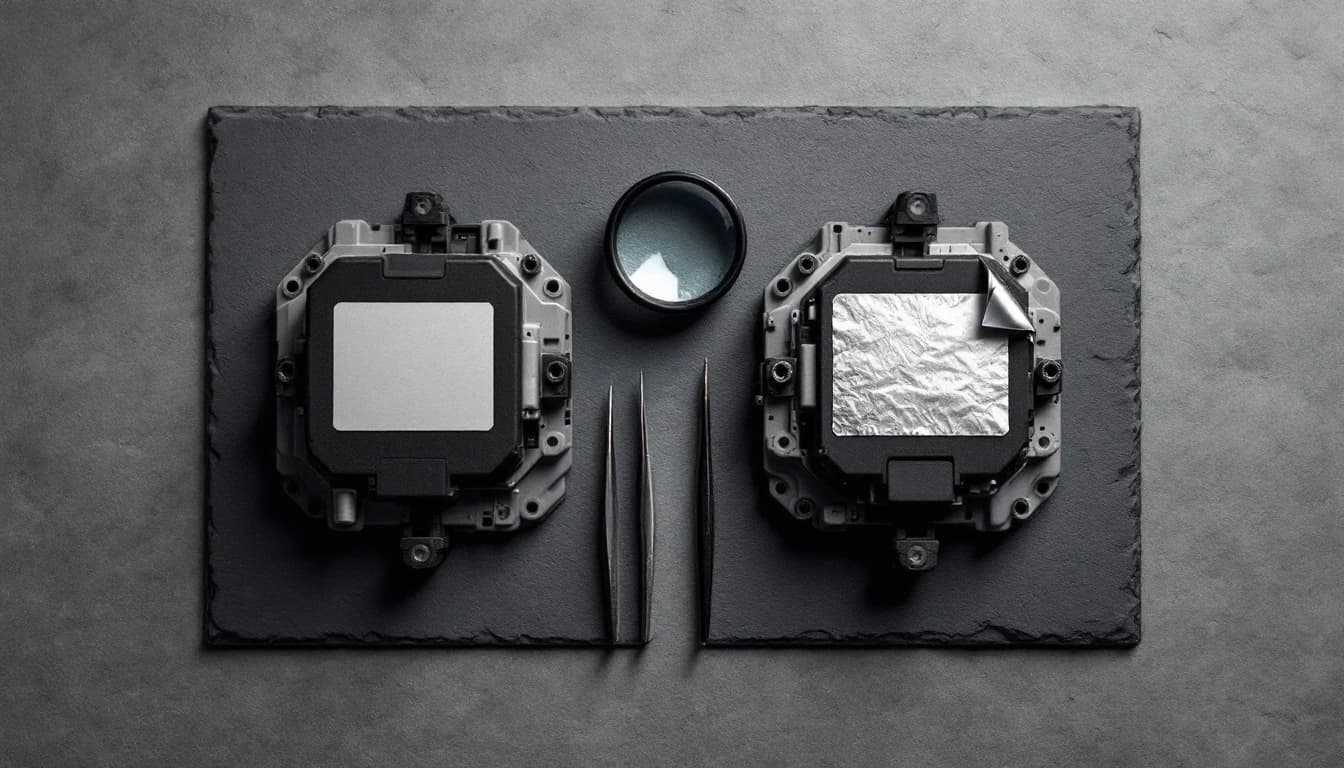
Counterfeit Modules and Cloned Programming Tools
Two different scams, one dead car
There are two ways the counterfeit economy reaches an ordinary module repair, and most owners only find out about the second one after the first one has already cost them money.
The first is the part itself. Somebody sells a control module online that is not what the listing claims: a used core with a freshly printed label, a "remanufactured" unit that was wiped down rather than rebuilt, a hardware revision that will never talk to your car, or a module that still holds the previous vehicle's identity in its memory. The second is the tool. Somebody sells a programming interface — a J2534 pass-through, or a copy of a manufacturer-branded diagnostic head — that looks correct, enumerates on the laptop, and then corrupts a write halfway through because its firmware was never validated by anyone.
Both problems arrive at a bench lab constantly, and they arrive together more often than you would expect: a customer buys a suspicious donor, tries to program it with a suspicious tool, and ships us two failures stacked on top of each other. This article separates them, because the diagnosis, the prevention, and the rescue path are different for each.
The scale of the counterfeit parts problem
Counterfeit automotive components are not a niche worry raised by parts manufacturers to protect margin. They are an active, funded enforcement priority.
U.S. Customs and Border Protection seizes counterfeit and pirated goods at ports and express-consignment facilities every single day; in a typical year the agency reports on the order of 20,000 seizures, carrying an estimated retail value of well over $2 billion had the genuine equivalents been sold, according to U.S. Customs and Border Protection. Automotive parts are a recurring category in that mix, and electronics are attractive to counterfeiters precisely because the value is concentrated in a small, light, easily shipped package.
The Federal Bureau of Investigation treats intellectual-property theft as a significant economic crime, with widely cited estimates putting the cost of counterfeit and pirated goods to the U.S. economy at $200 billion-plus every year. The National Highway Traffic Safety Administration has repeatedly warned consumers about counterfeit safety-relevant components, because a fake part in a safety system is not just a warranty problem — it is a crash-performance problem.
The consumer-fraud side is just as large. The Federal Trade Commission has reported consumer fraud losses well over $10 billion in a recent reporting year across all fraud types, with online shopping complaints among the most-reported categories. And the specialty-parts market that counterfeiters target is enormous: the Specialty Equipment Market Association tracks a U.S. aftermarket worth well over $50 billion a year, which is exactly the kind of volume that makes a convincing fake label worth printing.
There is also a provenance problem sitting underneath all of this. Vehicle theft in the United States has run at roughly 1 million vehicles a year in recent reporting periods according to the National Insurance Crime Bureau, and stolen and salvage vehicles are a real source of "used OEM" electronics on the open market. That is one reason a serious bench lab asks who owns the car before it touches anything that involves keys, immobilizers, or security access.
Scam one: the module that is not what the listing says
Relabeled part numbers and reprinted stickers
This is the most common version and the easiest to execute. A seller has a bin of used modules from one family — say, a body control module that came in six or seven hardware variants across a model run. Demand is highest for one specific service number. So the sticker gets reprinted.
Real OEM labels have consistent characteristics within a family: font weight, barcode density, the position of the manufacturer logo relative to the service number, the presence of a date code and a plant code, and often a security or holographic element. A reprint usually gets one or two of those right and misses the rest. Common tells:
- The label looks newer than the housing. A module with ten years of grime on the connectors and a bright, clean, sharp-edged sticker is telling you something.
- Barcode does not scan, or scans to a value that does not match the printed human-readable number underneath it.
- Font is close but not exact — thermal-printer output has a different texture than the original label stock.
- The label overlaps a molded feature or sits crooked relative to the housing ribs.
- Adhesive residue, a lifted corner, or a visible ghost of a previous label underneath.
- The service number on the label does not match the number etched, molded, or printed on the circuit board inside.
That last one is the definitive check, and it is the one a bench lab can actually perform. Manufacturers like Bosch and Continental mark boards and housings with their own internal identifiers that a counterfeiter has no reason to change, because he assumes nobody will open the case.
"Remanufactured" that means "cleaned"
Remanufacturing is a real, legitimate industry with a real process: teardown, component-level replacement of known-failure parts, board rework, functional test under load, and a documented warranty. What is frequently sold as remanufactured online is a used core that has been blown out with compressed air, wiped with a solvent, and put in a printed box.
The tells here are about what the listing does not say. A genuine remanufacturer will tell you what was replaced — the specific capacitor family, the solder joints reflowed, the connector pins reterminated — and will state a test procedure. A relabeler talks in adjectives: professionally remanufactured, fully tested, works perfectly. If the listing cannot name a single component that was replaced, nothing was replaced.
We covered the broader version of this question in the guide to whether a remanufactured or aftermarket module bought online will actually work, and the short answer is that the failure is usually not the electronics at all — it is the programming and identity work the listing quietly assumed you already knew how to do.
Mismatched hardware revisions sold as the right one
This is the subtlest failure because the part is genuine. It is simply the wrong genuine part.
Modules within a family get revised: a different microcontroller mask, a different flash device, a different communications transceiver, a different bootloader. Two modules can share a base part number and a housing and still be incompatible, because the software the car needs will not load onto the other silicon. The listing photographs the correct-looking module; the box contains a real OEM unit from a revision that cannot accept your calibration.
The result on the bench is characteristic: the module powers up, communicates, identifies itself — and then rejects the write, or accepts it and fails the checksum verification. Nothing looks broken. Nothing is broken. It is just the wrong revision, and no amount of programming will change the hardware. This is why part-number and hardware-software compatibility matter far more than the housing shape, and why a seller who cannot answer "what hardware revision is this, and what is on the board" should be treated as a seller who does not know what he is shipping.
Modules that still carry the previous car's data
A used module is not blank. It contains the identity of the vehicle it came from: a stored VIN, immobilizer or security data, configuration bytes, learned adaptations, sometimes crash or event records depending on the module type. A seller who describes a used module as plug-and-play is either misinformed or hoping you are.
Depending on the platform, that leftover data is either an inconvenience or a hard wall. On some controllers the previous identity is overwritten during normal programming. On others the module is locked to the donor and must be cloned, virginized, or unlocked on the bench before it will ever answer to your car — which is exactly the work behind services like PCM unlocking at $250. On security-relevant modules the leftover data is also a legal and ethical matter, which is why proof of ownership is required before any key, immobilizer, or security-access job is accepted.
If you want the deep version of how identity actually moves between modules, the BMW EWS delete walkthrough and the companion BMW EWS key programming guide show the mechanics on a platform where the marriage between engine controller and immobilizer is explicit and unforgiving.
Scam two: the cloned programming interface
Now the other half — and in our experience, the more expensive half, because it destroys parts that were previously fine.
A pass-through interface is not a dumb cable. It is a small computer that sits between the diagnostic software and the vehicle network, translating high-level requests into precisely timed bus traffic, buffering blocks, handling flow control, managing the security-access handshake, and keeping a reprogramming session alive across tens of megabytes of transfer. Its firmware is the product. The plastic is incidental.
A cloned interface copies the plastic, the silkscreen, the branding, and often a dumped copy of an older firmware image. What it does not copy is validation.
What a clone actually leaves out
- Validated, current firmware. Genuine tools ship firmware that has been tested against the manufacturer's reprogramming applications across the model range. A clone runs whatever image the cloner could obtain, frozen in time, sometimes patched to defeat a licence check. That patch is not tested against anything.
- Timing margin. Reprogramming protocols have timing windows. A genuine device is engineered with margin on transceiver slew rate, buffer depth, and interrupt latency. Clones use cheaper transceivers and cheaper crystals, and they lose margin exactly where it matters: during long, sustained block writes.
- Signal integrity. Correct termination, protection, and isolation on the bus lines cost money. Clones save it. The symptom is intermittent — fine on a short read, unreliable on a twenty-minute flash.
- Update and support path. When a manufacturer changes a reprogramming routine, genuine tools get an update. A clone cannot receive one, because it is not the thing the update is written for.
- Power behavior. Some clones do not correctly report or maintain the conditions a reprogramming session requires, so the software believes conditions are fine when they are not.
Why a clone bricks modules
A module flash is not one transaction. It is an erase followed by thousands of sequential block writes, each acknowledged, with the module sitting in a bootloader state in which the application software has already been erased. Until the last block lands and the checksum verifies, the module has no working program. That is the exposure window, and it can be many minutes long.
Anything that interrupts the sequence inside that window can leave the module unable to boot: a dropped frame that the tool mishandles instead of retrying, a firmware fault that closes the session, a USB stack that resets, a bus error the clone reports as success. The car does not know how to recover on its own. The next key cycle produces nothing.
Compounding it: many controllers have no user-accessible recovery mode. On a well-designed platform the bootloader survives a failed application write and you can retry. On plenty of real-world modules the bootloader itself is in the erase region, or the recovery path requires a manufacturer-only routine, or it requires direct access to the flash device on the board. At that point the vehicle-side tool is irrelevant — the fix is on a bench, with the case open.
This is a substantial share of the dead modules that reach a bench lab: not a module that failed in service, but a healthy module killed by a programming attempt. When we open one of those, the story is usually the same — an unbranded or suspiciously cheap interface, a flash that stalled at some percentage, and a customer who was told the tool was genuine.
"I stopped counting the ones that come in bricked by a cheap pass-through. The module was fine that morning. Somebody started a flash, it hung at sixty percent, and now the bootloader is gone. The tool cost them ninety dollars and the mistake costs them a module, a tow, and two weeks. I tell every shop the same thing — the interface is the cheapest part of the job to do right and the most expensive part to do wrong." — Independent module repair technician, 16+ years in automotive electronics (anonymized)
Genuine versus cloned: what you are actually paying for
| Attribute | Genuine interface / verified donor | Clone or relabeled part |
|---|---|---|
| Firmware provenance | Vendor-signed, tested against OEM reprogramming apps | Dumped or patched image, frozen, untested |
| Behavior on a long flash | Designed margin; retries and reports errors honestly | Loses margin under sustained writes; may report success on failure |
| Recovery when a write fails | Documented retry path; vendor support | None — you are on your own with a bricked module |
| Part-number verification | Board marking matches the case label and the listing | Label reprinted; board marking often contradicts it |
| Hardware revision | Stated, verifiable, matched to the calibration | Unstated, or asserted without evidence |
| Previous-vehicle data | Disclosed; identity work planned before purchase | Undisclosed; discovered after the part is installed |
| Documentation | Invoice, serial, warranty terms, named test process | Adjectives only — tested, working, professional |
| Real cost of a failure | Time | Module, labor, shipping, and the original purchase |
Before you buy a donor: what to photograph and ask
Treat a used-module purchase like a pre-purchase inspection, because that is what it is. Ask the seller for these, and be prepared to walk if you get excuses.
Photographs to request, every time:
- The full case label, straight on, in focus, with the barcode legible.
- The connector faces, showing pin condition — green corrosion, pushed-back pins, or melted plastic disqualify the part.
- All four sides of the housing, showing mounting tabs and any cracks.
- The board itself if the case opens without destroying it, or at minimum a photo through any vent.
- The donor vehicle, or the VIN plate, if the seller has it. Provenance matters.
Questions that separate real sellers from relabelers:
- What is the hardware revision, and does the board marking match the label?
- What vehicle did it come from — year, model, engine, trim, build date?
- Was it removed from a running vehicle, or from a wreck, or bought as part of a lot?
- Has anyone attempted to program, unlock, or clone it before?
- Does it still contain the donor's VIN and security data?
- What is your return policy if the part turns out to be the wrong revision?
A legitimate salvage or recycler answers all six without hesitation. A relabeler answers in adjectives, changes the subject to price, or sends a stock photo. Stock photos are their own red flag: if the seller will not photograph the actual unit shipping to you, assume he does not have the one in the picture. Price is the last tell, not the first — a donor priced far below every comparable listing is not a bargain, it is information.
Two more habits worth building. First, keep the packaging and the listing screenshots until the part is proven; disputes go better with evidence. Second, verify before you install, not after — a module that has already been mounted, wired, and cranked is much harder to return.
What a bench lab can rescue, and what it cannot
This is where honesty matters more than optimism.
Frequently recoverable on the bench:
- A module bricked mid-flash where the bootloader region survived, or where the flash device can be accessed directly on the board.
- A used donor still carrying the previous vehicle's identity, where the platform permits cloning, unlocking, or a clean identity write.
- A module whose calibration was corrupted but whose hardware is intact and verifiable.
- A part whose real identity is in question — reading the board and the memory contents tells you what the unit actually is, regardless of what the sticker claims. That is the core of a bench evaluation at $150: an evidence-based answer instead of a guess.
Usually not recoverable:
- A genuinely wrong hardware revision. No programming changes silicon. The part goes back to the seller.
- A module with physical damage from an overvoltage event, water intrusion with corrosion under the conformal coating, or a lifted pad from a previous repair attempt.
- A counterfeit board — not a relabeled genuine unit, but an actual copy of the circuit with substituted components. These sometimes run and rarely run reliably.
- A platform where the security architecture genuinely prevents third-party recovery. When that is the case we say so rather than sell you hope.
Because we are a mail-in bench lab serving customers nationwide, the practical step is always the same: the module comes to us, we look at it, and you get a real answer. Ship USPS to PO Box 120241, Arlington, TX 76012, or ship UPS or FedEx to 1009 Oakwood Ln # 120241, Arlington, TX 76012 — UPS and FedEx cannot deliver to a USPS PO Box, so use the address that matches your carrier. The work is performed at our workshop at 1168 W Pioneer Parkway, Arlington, TX 76013. Return shipping is chosen and paid at checkout, from $29.95 for standard service, with UPS 2nd Day Air at $54.95 and UPS Next Day Air at $94.95 if you need it back quickly. If the job touches keys, immobilizers, or security access, proof of ownership is required before anything begins.
If you are not sure which of our services fits what you have, the full service list is organized by platform and by job type.
Frequently asked questions
How can I tell if a used module listing is a relabeled part before I buy it? Ask for a straight-on photo of the case label with a legible barcode plus a photo of any board marking, then confirm the two agree. Relabelers reprint the outside sticker and never touch the internal marking, so a mismatch between the label and the board is the single most reliable tell available to a buyer who cannot open the part first.
Is a cheap J2534 interface always a clone? No — there are legitimate low-cost pass-through devices from real manufacturers with real firmware support. The distinction is not price alone, it is provenance: a genuine device comes from a named manufacturer with a serial number, a firmware update path, and published compatibility, while a clone imitates someone else's branding and cannot be updated because it is not the product the updates are written for.
My module bricked during a flash. Is it definitely dead? Not necessarily. Whether it is recoverable depends on whether the bootloader region survived and whether the flash memory can be reached directly on the board, which is exactly what a bench evaluation determines. Many mid-flash failures are recoverable on a bench with a regulated supply and direct memory access, even when the vehicle-side tool has run out of options.
Does programming a used module remove the previous car's data? Sometimes, and on some platforms not at all. Normal reprogramming overwrites application software but does not necessarily clear stored identity, immobilizer data, or configuration, which is why plug-and-play claims on security-relevant modules are usually wrong and why cloning, virginizing, or unlocking exists as separate bench work.
Can you tell me whether the part I bought is counterfeit? Yes, in most cases. Reading the board markings, the memory contents, and the software identifiers tells us what the unit actually is regardless of what the exterior label claims, and that is a routine part of a bench evaluation. What we cannot do is get your money back from the seller, so keep the listing, the invoice, and the shipping records.
Why does buying a stolen or unverified donor matter if the part works? Because security-relevant modules carry vehicle identity and immobilizer data, and working on them without proof of ownership is not something a legitimate lab will do. Vehicle theft remains a large-scale problem in the United States, salvage and stolen units circulate in the used-parts market, and provenance is the only defense a buyer has.
Is bench programming safer than programming the module in the car? Generally yes, for the specific failure mode this article describes. A bench setup uses a regulated power supply and a direct, short connection to the module instead of a vehicle battery of unknown condition and a long harness run, which removes the two most common causes of an interrupted write.
The bottom line
The counterfeit economy touches module repair from two directions. On the parts side you get relabeled service numbers, "remanufactured" units that were only cleaned, wrong hardware revisions in the right housing, and used modules still carrying somebody else's vehicle identity. On the tool side you get cloned interfaces with unvalidated firmware that fail in the worst possible place — the middle of a flash, when the module has no working program to fall back on.
Both are avoidable with the same discipline: demand evidence instead of adjectives. Photograph the label and match it to the board. Ask for the hardware revision and the donor vehicle. Buy interfaces from named manufacturers with a firmware update path. And when a part's identity is genuinely in question, get it read on a bench rather than guessing — a bench evaluation at $150 gives you a defensible answer, and where the module is locked to a previous vehicle, PCM unlocking at $250 is the path forward.
We are mail-in only and we work nationwide. Text us with what you have, what the label says, and what happened, and we will tell you honestly whether it is worth shipping — including when the answer is that the part should go back to the seller instead of to us.
What do you need?
I don't own a J2534
Get a programming kit — configured, shipped, and yours to keep.
Get a Programming KitI already own a J2534
Connect it and have our technicians program the vehicle remotely.
Request Remote ProgrammingI'm not sure
Tell us the vehicles you see and we will say what fits — no charge.
Ask Auto Module LabBuy once. Program with us anytime.
Kits from $199 ship configured and session-ready — add your first programming session in the same checkout, and keep the interface for every job after.