Car Module Repair vs Replacement vs Reprogramming
The one question that decides everything
Your car has a module problem. Before you spend a dollar, there is exactly one question worth answering:
Is the hardware bad, or is the data bad?
Every sensible repair decision falls out of that question. If the hardware is bad but fixable, you want repair. If the hardware is bad and not fixable, you need replacement, which almost always drags programming along with it. If the hardware is fine and the data is wrong, you need reprogramming, and buying any new part at all is money set on fire.
Most people never get asked that question. They get told "the module is bad" and quoted a replacement, because replacement is the fastest thing for a shop to sell and the only thing many dealer service departments are equipped to do. Sometimes replacement is genuinely right. Often it is not.
This is not a definitions article. If you need to know what the acronyms mean first, our guide to car module acronyms and what ECU, ECM, PCM, TCM, and BCM actually stand for covers that ground. This article assumes you know which box is being blamed and picks up at the harder question: what to actually do about it.
Why this decision costs more than it used to
Modules used to be a small line item. They are not anymore.
The National Highway Traffic Safety Administration has documented the steady growth in networked control units aboard mainstream vehicles, with a modern car commonly carrying well over 50 electronic control units. Industry coverage from Car and Driver and MotorTrend has repeatedly noted that electronics and software now account for a large and growing share of a new vehicle's cost, by some estimates approaching 40% of the value of a new car. When that much of a vehicle is computers, a single failed computer becomes a significant repair event.
The consequences show up in ownership data. Dependability research from J.D. Power has for years placed electrical and electronic complaints among the most-reported problem categories owners cite as vehicles age. Meanwhile Consumer Reports reliability surveying has consistently flagged in-car electronics as a leading source of owner-reported trouble across brands. The failure you are dealing with is not unusual. It is one of the defining maintenance realities of a modern car.
And it is a bigger deal on older vehicles specifically because they are worth keeping. Vehicle-history and ownership research published by Carfax has tracked the steady rise in how long Americans keep their cars, and with the average age of vehicles on U.S. roads now well past 12 years, a very large population of cars is old enough for electronics to fail and still good enough to be worth fixing properly. That is the entire economic reason bench module services exist.
The three failure classes
Almost every module problem sorts into one of three buckets. Learning to tell them apart is the whole skill.
Class 1 — Physical and electrical failure
The hardware itself has degraded or broken. Typical causes are the mundane ones: heat cycling that cracks solder joints, failed electrolytic capacitors, blown driver transistors that switch high-current loads, water intrusion through a leaking seal or a wet footwell, corrosion at the connector, and damage from a backwards jump start or a welding job done with the battery connected.
This class is the most commonly repairable one, and it is also the one most often quoted as a replacement. A module with two cracked solder joints and a dead capacitor is not scrap. It is a soldering job.
Class 2 — Data corruption or security lockout
The hardware is healthy but the contents are wrong. Memory has become corrupted, a flash was interrupted partway through, a module is locked out on security, or a crash event has written permanent fault data into a safety module and left it refusing to arm.
Airbag control modules are the textbook example. After a deployment the module stores crash data and stays locked out permanently, which is not a hardware failure at all. It is a module doing exactly what it was designed to do, and it is why an airbag SRS module crash data clear is a $75 bench service rather than a several-hundred-dollar replacement part.
Class 3 — Right module, wrong data
The module is brand new or a perfectly healthy donor. Nothing is broken. It simply does not match the car it has been installed in, because it carries the wrong VIN, the wrong configuration, the wrong mileage, or immobilizer secrets that belong to a different vehicle.
This is the class that produces the most frustration and the most wasted money, because the customer already bought the part, already installed it, and the car is now worse than before. The part is fine. It has never been told which car it lives in.
Symptoms that point to each class
The symptom pattern is usually enough to sort a problem into a class before anything is opened.
Points to physical or electrical failure:
- Symptoms worsen with heat, or appear only after the car has warmed up, or only on cold mornings
- Intermittent faults that come and go with bumps, vibration, or door slams
- One specific function dead while everything else on the same module works
- Visible corrosion, a water stain, or a burnt smell at the connector
- The module works after a firm tap, which is a classic cracked-solder tell
- Symptoms started gradually and got worse over months
Points to data corruption or lockout:
- Symptoms started abruptly, with nothing changed mechanically
- A programming or software update was attempted and interrupted
- The vehicle was in a collision and a safety module has not worked since
- The module communicates but reports itself as locked, blocked, or in a fault state
- A scan tool reads the module fine but functions refuse to arm or execute
Points to right module, wrong data:
- Symptoms began the moment a part was installed, not before
- The replacement is a used or new module that was never programmed
- Mileage, VIN, or configuration displays incorrectly after a swap
- Mismatch codes, VIN-mismatch codes, or component-protection faults appear
- Keys stopped working after a module change
- The old part worked and the new identical part does not
If the third list describes you, the diagnostic work is already done. You have a programming job, not a parts problem.
The comparison that matters
| Repair | Replacement | Reprogramming | |
|---|---|---|---|
| What is actually wrong | Hardware fault: solder, capacitors, drivers, water damage | Hardware damaged beyond economic recovery | Hardware fine, data or security is wrong |
| Keeps your original unit | Yes, with its original data intact | No | Yes, or brings a donor onto your car |
| Programming needed after | Usually none, the data was never lost | Almost always required | It is the whole job |
| Keys and immobilizer | Untouched | Frequently must be re-married | Handled as part of the work |
| Typical bench price band | $75 to $299 | Part cost plus programming | $75 to $350 depending on module |
| Risk of doing nothing | Fault worsens, may take out related parts | Vehicle stays down | Vehicle stays down or drives with wrong data |
| Common mistake | Being quoted a replacement instead | Buying a donor and skipping programming | Buying a second part when the first was fine |
The pattern is consistent. Repair is usually the cheapest correct answer, reprogramming is usually the second, and replacement is the most expensive and the most commonly over-prescribed.
Which module families are commonly repairable
Repairability is not evenly distributed. Some modules fail in well-documented, well-understood, entirely fixable ways. Others are effectively replace-only. Knowing which is which is worth real money.
Commonly repairable, with known failure modes:
- ABS modules. These fail in predictable ways, most often at the internal solder joints and driver circuits that switch the pump and solenoids after years of heat cycling in an engine bay. The symptoms are familiar: ABS and traction lights on together, a hard pedal, or a wheel-speed fault that follows the module rather than the sensor. An ABS module repair is a $499 bench job, against a dealer path that means a new hydraulic control unit plus programming plus bleeding.
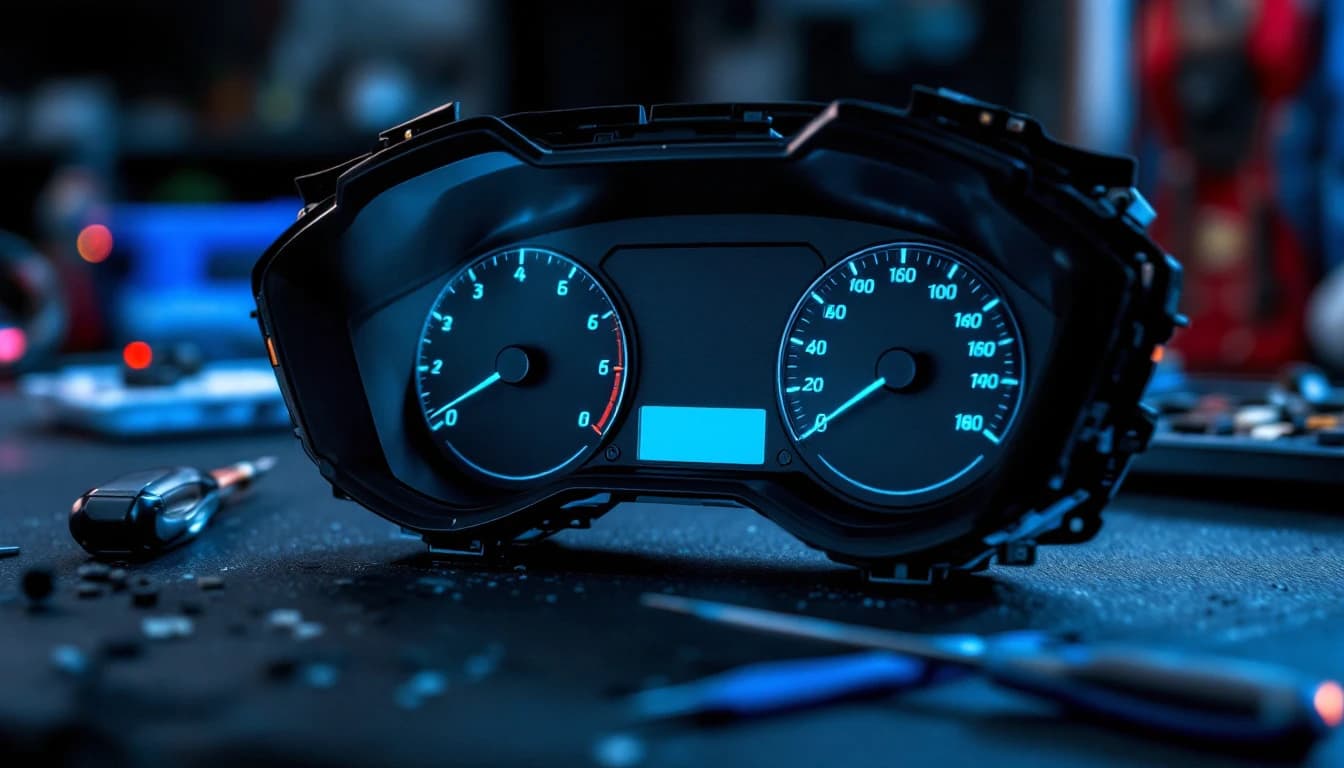
- Instrument clusters. Dead pixels, dead gauges, dim or missing backlighting, and stepper-motor needle faults are all classic repairable failures. Clusters also frequently store mileage, which is why cluster work is often a repair and data job at once. An instrument cluster repair with mileage sync is $200 and returns your original unit with your original mileage legally carried across.
- BMW footwell modules. The FRM is one of the best-documented repairable modules in the business. It commonly fails or corrupts in a way that kills lighting and window functions and leaves the module unresponsive, and it is recoverable rather than scrap. A BMW FRM footwell module repair is $175.
- Keyless entry and receiver modules. Fobs that only work at inches, one door that ignores the remote, or intermittent no-response are frequently module-side faults rather than fob faults. A key fob module repair for keyless entry is one of the cheapest wins on the whole list, and the bench service is $125. If you are still unsure whether the fault sits in the fob or in the car, our keyless entry receiver module failure diagnosis guide walks the tests that separate them.
- TIPM units on Chrysler, Dodge, and Jeep. The integrated power module is a notorious and very well-understood failure point, producing symptoms as varied as a fuel pump that will not shut off, wipers with a mind of their own, no-start conditions, and phantom battery drain. A TIPM repair for Chrysler, Dodge, and Jeep is $299, against a replacement unit that has historically been one of the more expensive single parts on those platforms.
- Airbag and SRS modules after deployment. Not a repair in the soldering sense, but decidedly not a replacement either. The crash data clear at $75 returns the module to a usable state where the hardware is undamaged.
Effectively replace-only, or replace-and-program:
- Modules with physical impact damage, cracked boards, or crushed housings
- Modules with severe long-term water immersion and widespread corrosion under the conformal coating
- Modules where the main processor itself has failed, as opposed to the support circuitry
- Units burnt through by a serious electrical event such as a reverse-polarity jump or a lightning strike
- Some late-model sealed units where the manufacturer designed no serviceable path
Even in that second group, replacement is rarely the end of the story. A donor or new module still has to be told which car it lives in, which puts you right back in reprogramming territory.
"The number of customers who were quoted a whole new module for a board with two cracked joints and a bad capacitor is the part of this job that still bothers me. Nobody is being dishonest, the dealer just is not set up to open anything. But when a two-hundred-dollar bench repair and a two-thousand-dollar parts-and-programming quote fix the same car, the customer deserves to know both numbers exist." — Independent module repair technician, 16+ years on domestic and European platforms (anonymized)
Why a bench evaluation exists
Sometimes the symptoms genuinely do not sort themselves. The car has been through three shops, parts have already been thrown at it, the codes contradict each other, or the module is unusual enough that no one can say from the outside whether it is repairable.
That is what a bench evaluation is for. The module is powered on a regulated bench supply, away from the vehicle's wiring, grounds, and battery condition, and tested in isolation so that the module's own behavior is the only variable. It gets opened, inspected under magnification for the physical tells, read where it still reads, and assessed honestly for whether repair, replacement, or reprogramming is the right call.
A bench evaluation is $150, and the reason it is worth paying for is arithmetic. It costs far less than a wrong replacement module, and it is the only way to get a definitive answer on a unit whose symptoms are ambiguous. Isolating the module from the car also settles a surprisingly common question: whether the module was ever the problem at all. A weak battery, a corroded ground, or a chafed harness will impersonate a failing module convincingly, and a bench test that finds a perfectly healthy unit has saved you the price of a replacement plus the programming behind it.
The cost logic, honestly
Here is the math people are usually not shown.
The bench path. Repair and reprogramming services in this catalog run roughly $75 to $350 depending on the module and the work. You keep your original unit, its original data usually stays intact, keys and immobilizer are typically untouched, and there is no programming bill behind the repair because nothing was replaced. Our module and ECU programming cost guide for 2026 lays out the full price list service by service.
The replacement path. A replacement module is a part cost plus a programming cost, and on many modern vehicles the programming is not optional. Dealer module replacement on common platforms routinely lands in the high hundreds and on plenty of vehicles well into four figures once the part, the labor, and the programming are added together. On modules that are part of the security system, key re-marrying is another line.
The used-part path. Cheapest on paper and the most likely to end badly. A donor module carries someone else's VIN, may be component-protected, and does not know your keys. On many platforms a raw swap will not work at all, which we cover in the guide to what a body control module does and why donor units are not plug and play. Buying used without a programming plan is how a $150 part becomes a $900 saga.
Nobody is claiming repair is always right. If a board is cracked in half, repair is a fantasy and replacement is honest. The claim is narrower and easier to defend: you should know which of the three you are buying before you buy it, and on the module families listed above the repairable share is a lot higher than the average quote implies.
A decision framework you can actually use
Work through it in this order.
- Rule out the cheap impostors first. Battery health, charging voltage, ground straps, connector corrosion, and fuses. A weak battery mimics module failure across half the car. Do this before spending anything.
- Ask when the symptoms started. Immediately after a part was installed points to class three, wrong data, and no new hardware is needed. Gradually over months points to class one, hardware. Abruptly with nothing changed points to class two, data or lockout.
- Ask whether the symptoms track temperature, vibration, or moisture. If they do, you are almost certainly looking at a physical fault, and physical faults on the families listed above are frequently repairable.
- Ask whether the module still communicates. A module that talks but refuses to function is usually a data or lockout problem. A module that has vanished from the bus entirely is more often hardware.
- Check whether your module family has a known repairable failure mode. ABS, clusters, BMW FRM, keyless entry, TIPM, and post-deployment airbag modules all do.
- When it is still ambiguous, buy the evaluation, not the part. $150 to know beats several hundred to guess, and the evaluation result tells you which of the three paths you are on.
- If you have already bought a replacement, plan the programming before you install it. That single step prevents the most common expensive mistake in this entire field.
The mail-in workflow
This is a nationwide mail-in bench workshop, so the vehicle stays where it is and the part travels.
- Text us first, before removing anything. Send the VIN, year, make, and model, the module part number from its label, a clear photo of that label, the symptoms, and when they started. That conversation usually sorts the failure class before a part moves.
- Provide proof of ownership for any work touching keys, immobilizer, or security functions. Nothing security-linked proceeds without it.
- Remove and ship the module to 1009 Oakwood Ln # 120241, Arlington TX 76012, in an anti-static bag inside a padded box.
- Bench read, inspect, and archive. The unit is powered on a regulated supply, inspected, read where it still reads, and its data archived before any change.
- Repair, program, or report. The agreed work is carried out. If evaluation shows the module is healthy and the fault lies elsewhere in the car, you get told that plainly rather than sold a repair you do not need.
- Bench verify before anything leaves the shop.
- Return with tracking, via the flat-rate return shipping tier you chose at checkout, from $29.95, with faster options available.
Doing the read and write on a clean, regulated bench supply also removes a genuine hazard of in-car programming: a voltage sag mid-write on a car with a marginal battery is one of the classic ways a healthy module gets bricked.
Frequently asked questions
Can an ABS module be repaired instead of replaced? Yes, in most cases. ABS modules typically fail at internal solder joints and driver circuits after years of engine-bay heat cycling, which is a repairable electronic fault rather than a dead unit. Bench repair is $250 and returns your original module, so no programming or re-coding is required afterward.
How do I know if my module needs repair, replacement, or reprogramming? Timing is the strongest clue. Symptoms that appeared right after a part was installed mean wrong data, not bad hardware. Symptoms that developed gradually or track heat and vibration point to a repairable physical fault. Symptoms that appeared abruptly with nothing changed suggest data corruption or a security lockout.
Is it cheaper to repair a module or buy a used one? Repair is usually cheaper once the whole job is counted. A used module has to be programmed to your VIN and configuration, may be component-protected, and often will not accept your existing keys, so the low part price is followed by a programming bill. Repair keeps your original data intact, which frequently means no programming at all.
What does a bench evaluation actually tell me? It tells you definitively which of the three paths your module is on, by testing the unit in isolation from the car's wiring, grounds, and battery. It is $150, it includes physical inspection under magnification, and it often reveals that the module is healthy and the real fault lies elsewhere in the vehicle.
Why does a new module still not work after I installed it? Because a new or donor module has no idea which car it is in. It has to be programmed with your VIN, your configuration, and where applicable your immobilizer and key data before the vehicle will accept it. The part is fine, the identity is missing, and installing a second one will produce exactly the same result.
Which modules are usually not worth repairing? Units with cracked boards, impact damage, long-term water immersion with widespread corrosion, a failed main processor, or damage from a reverse-polarity jump are generally beyond economic repair. Even then, the replacement unit still needs programming to your vehicle, so plan that cost in from the start.
Do you need proof of ownership for module work? Yes, for any job that touches keys, immobilizer functions, or vehicle security. Those capabilities have to be gated so they cannot be misused, so a registration, title, or equivalent document tying you to the vehicle is required before security-linked work begins. Consumer guidance from the Federal Trade Commission on vetting automotive services is worth reading if you are choosing a repair provider for the first time.
The bottom line
Three answers exist to a module problem, and they are not interchangeable. Repair fixes a physical or electronic fault and keeps your original unit and its original data, which is the cheapest correct outcome and applies far more often than most quotes suggest. Replacement is honest when hardware is genuinely beyond saving, but it almost always brings a programming bill with it. Reprogramming is the answer when the hardware was never the problem and only the data is wrong, which is the situation after every swap, every interrupted flash, and every crash lockout.
On the bench that means real, published numbers rather than an estimate: airbag SRS crash data clear at $75, keyless entry module repair at $125, BMW FRM footwell module repair at $175, instrument cluster repair with mileage sync at $200, ABS module repair at $499, TIPM repair for Chrysler, Dodge, and Jeep at $299, and a bench evaluation at $150 when the answer is genuinely unclear. Return shipping is a flat-rate tier you choose at checkout, from $29.95.
The expensive mistake is never the repair. It is the guess. Before you authorize a replacement, find out whether the hardware is bad or the data is bad, because that one answer is the difference between a modest bench bill and a four-figure parts-and-programming invoice. Text us the VIN, the module part number, and a photo of the label, and we will tell you which of the three you are actually dealing with.
Ship your module today
Flat-rate pricing, typical 24-hour bench turnaround, return speed your choice at checkout. Most jobs back on your bench within a week.