GM ECM Replacement: Why a Junkyard ECM Runs Wrong
Cranks, fires, dies — and the code list makes no sense
The 2015 Silverado came in on a hook. The owner had done everything by the book: correct part number pulled from a matching truck at the salvage yard, careful install, clean connectors, battery on a maintainer. The 5.3 cranks strong. It catches for a second. Then it dies, and the security light flashes at him like an accusation.
He orders a second used module, convinced the first was bad. Same result.
Nothing is bad. Both modules are fine. What is wrong is that neither one has ever been told it lives in his truck — and on a GM engine controller, that is not a small formality. It is the difference between a running vehicle and a very heavy paperweight.
What a GM engine controller actually carries
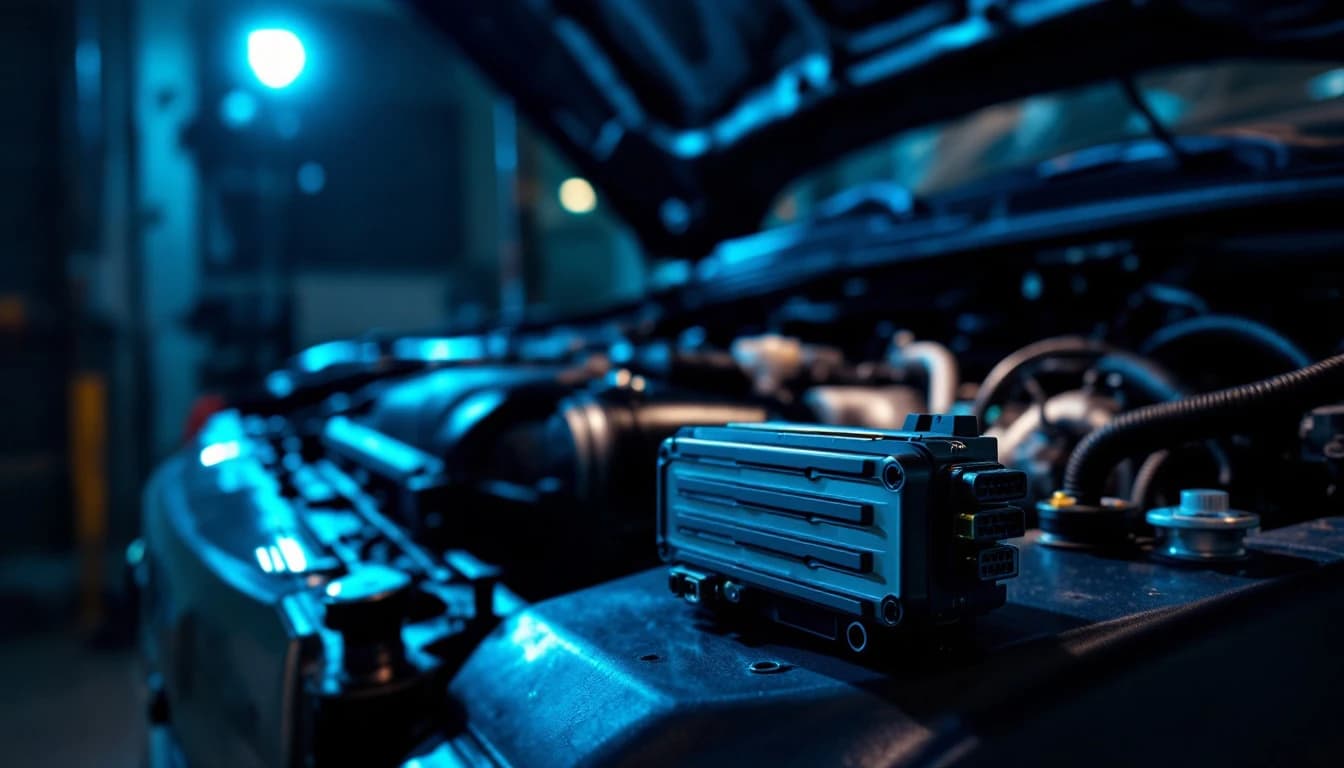
The E38, E67 and E92 controllers that cover the Gen IV and Gen V V8 trucks and SUVs hold three things that make them specific to exactly one vehicle:
Your VIN. The module carries it, and the rest of the network — the body control module in particular — expects everyone to agree. A mismatch produces the security-light behavior that owners describe as "it starts and dies."
A calibration built for your exact build. This is the part people underestimate. GM ships the same engine family behind different transmissions, different axle ratios, different emissions content, different tire sizes. The calibration in your ECM was assembled for one combination. A donor from a 6.2 with a different final drive is running the wrong math on your truck even when the part number is identical.
The immobilizer relationship. The engine controller participates in the theft-deterrent system, which is why a mismatched module refuses to keep the engine running rather than simply running poorly.
Take those three together and the outcome is predictable. Used GM ECMs do not "sometimes work." They work when someone programs them and not before.
Which controller do you have?
The naming trips people up, so briefly:
- E38 — Gen IV V8, the workhorse across a huge slice of 2007-2014 trucks and SUVs.
- E67 — Gen IV with variable valve timing and Active Fuel Management, common on the same era.
- E92 — Gen V, the 5.3 and 6.2 of the 2014-2020 K2 trucks and SUVs.
- E80 / E86 — related variants that turn up on specific applications.
Service numbers you will see stamped on these include 12633238, 12664768, 12686383, 12695211 and 12705110. The number on your module is the single most useful piece of information you can give a supplier, because supersessions mean online catalogs frequently disagree with what is physically bolted to your truck.
What SPS programming does, and why it costs what it costs
GM's factory method is the Service Programming System, delivered through Techline Connect. It is not a generic reflash. You supply a VIN, GM returns the calibration and configuration for that specific vehicle, and the module is written with it.
Two economics follow from that:
It is licensed per vehicle. Aftermarket access is sold that way — SPS2 access runs about $45 for a single VIN, with an unlimited annual Techline subscription available at a price that only pencils out at real volume. Every legitimately programmed module carries a traceable cost before anyone has touched a wrench.
It demands stable power. Writing to a live module is when it is most fragile, and an interrupted write is how modules get bricked. SAE International, whose J2534 standard defines how pass-through reprogramming is supposed to work, treats stable voltage and an uninterrupted link as preconditions rather than suggestions. On a bench with a regulated supply those conditions are guaranteed. In a driveway on a tired battery they are not, which is exactly where the horror stories come from.
"The number people can't get their head around is that the flash costs more than the box. They'll pay eighty dollars for the module and then balk at the programming, when the programming is the only part that makes it theirs. If your seller can't name the tool, you didn't buy a programmed module — you bought a used one with a nice description." — a master automotive locksmith (ALOA-credentialed) on our bench team
What this costs in 2026
Three tiers, and knowing them prevents the expensive mistake.
The dealer. Module at parts pricing, programming billed as labor, truck in the bay. Highway 71's 2026 ECM price guide and RepairPal both put full replacement of this class comfortably into four figures once everything is stacked.
Programmed specialists. A module supplied already flashed to your VIN. Garrett Tuning lists programmed GM ECMs around $324.95, and the broader market sits in a $325-450 band. Our own programmed GM ECM is $399 flat with the programming included.
Raw cores. The tempting number. Used E92 controllers list around $72 to $150 on eBay, with even the newest 2019-2020 units around $119. Genuinely cheap hardware, genuinely useless until programmed.
The spread between $100 and $400 is not markup on plastic and aluminum. It is a per-VIN license, controlled bench time, verification before shipping, and someone who answers the phone when the relearn goes sideways.
Programmed, cloned, or unlocked? Three different jobs
These get conflated constantly, and picking the wrong one wastes money.
Programming to your VIN writes your identity and the correct calibration into a donor module. Right when your original is dead or missing. Requires the security relearn afterward.
Cloning copies the data out of your original onto the donor, so the donor inherits everything — including the immobilizer relationship. Usually no relearn needed. Right when your original still reads, and cheaper than buying hardware you may not need.
Unlocking opens a locked controller so it can be worked on, which is a different operation entirely — that is our GM Global A ECM unlock service, and it is what you want if you already own the module and need it opened rather than replaced.
The rule that saves the most money: if your original module still communicates, do not buy hardware. Send it in and have it cloned or reprogrammed. People routinely spend $400 on a replacement when a $250 bench service on the module already in their truck would have solved it.
The security relearn nobody mentions
A newly programmed engine controller has to be introduced to the vehicle's theft-deterrent system. GM's standard procedure needs no tools:
- Key to ON, do not crank. Wait about ten minutes until the security indicator goes out.
- Key off.
- Repeat, three cycles total.
After the third cycle the system agrees and the truck starts. Some applications also want a crank relearn — a scan-tool procedure that teaches the module the crankshaft's exact signature, and without it you may get a misfire-detection code even though the engine is mechanically fine. Any reputable supplier tells you which of these apply and ships the written procedure in the box.
When the ECM is not your problem
Worth ruling out before spending, because these mimic module failure well:
Grounds and connectors. Corroded grounds produce faults that look exactly like a failing controller. GM trucks in particular get unhappy when reference voltages drift.
Battery and charging. A marginal battery generates a cascade of unrelated-looking codes. Test it first — this single check resolves a meaningful share of "my ECM died" calls.
A different module entirely. No-crank and electrical chaos are more often the body control module than the engine controller. Drivability faults belong to the ECM; body faults do not.
Mechanical faults. Fuel delivery, ignition components, and sensors all produce running complaints. A code pointing at a circuit is not the same as a code pointing at the computer driving it.
The general framework for sorting this out is the same one we apply to every module: work through repair, replacement, and reprogramming in order rather than jumping to the most expensive answer. Our broader GM ECM replacement guide covers the symptom side in more depth.
Why these trucks are worth the repair
It is a fair question on a ten- or fifteen-year-old truck. The market answer is increasingly yes: automotive research firm iSeeCars has documented how routinely full-size trucks cross 200,000 miles, and the GMT900 and K2 platforms are squarely in second- and third-owner territory. A $400 programmed module against a four-figure dealer bill is frequently the difference between the truck staying on the road and being parted out.
How to tell an ECM fault from everything that imitates one
Engine computers get blamed for a great deal they did not do. A short differential saves real money.
It is likely the ECM when the module will not communicate with a scan tool at all while other modules answer normally; when you have P0601, P0602 or P0606 internal processor faults stored; when multiple injector or coil drivers are dead simultaneously; or when the failure appeared immediately after water intrusion or a jump-start incident.
It is likely not the ECM when a single cylinder misfires (that is usually a coil, injector or mechanical fault), when the complaint is one sensor circuit (the sensor and its wiring are far more common than the computer driving it), or when the vehicle runs fine but a warning light is on.
The distinction matters because engine controllers sit at the expensive end of the catalog. Running a compression test and checking fuel pressure costs an hour; guessing wrong costs four hundred dollars.
What to expect the first day after installation
Assuming a properly programmed module, plan for this sequence rather than being surprised by it.
The vehicle should start after the security relearn completes. Some trucks will run slightly differently for the first few dozen miles while the module relearns fuel trims and transmission adaptives — this is normal and self-correcting, not a sign of a bad flash. A crank relearn, where required, is done with a scan tool and takes minutes; skipping it can leave a misfire-detection code stored even though the engine is mechanically healthy.
What should not happen is a persistent security light, a no-communication condition, or a truck that will not start at all after three full relearn cycles. Those indicate either an incorrectly programmed module or a part-number mismatch, and they are the point to call your supplier rather than start replacing sensors.
Why the bench beats the driveway
There is a practical reason credible suppliers program these on a workbench.
Writing calibration to a live module is the moment it is most fragile. A voltage sag or a dropped connection partway through the write leaves the module half-programmed — bricked, in the trade's language. SAE International's J2534 framework treats stable power and an uninterrupted link as preconditions for reprogramming precisely because interrupted writes destroy modules rather than merely failing.
On a bench those conditions are guaranteed by a regulated supply and a short, undisturbed connection, and the result is verified powered-up and communicating before it ships. In a driveway on a fifteen-year-old battery none of that holds, which is why the failure stories in this category cluster around on-vehicle attempts by people without a proper power supply.
A worked example: the 2015 Silverado from the top of this article
It is worth following that truck through to the end, because the resolution is instructive.
The owner arrived having spent roughly $160 on two used modules and a tow, with a truck that still would not run. The diagnosis took ten minutes: the module was communicating, reporting a VIN that did not match the truck, and the body control module was refusing to authorize. Nothing was broken.
The cheapest correct answer was not a third module. It was programming the second one he already owned. It went on the bench, the current calibration for his VIN was written to it, it was verified powered-up and communicating, and it went home with him. He ran the three security relearn cycles in his own driveway and the truck started on the third.
Total additional spend: one bench service. What he lost was not money on parts — it was two weeks and a tow bill, because nobody told him at the outset that a GM engine controller is not a bolt-in part.
That is the whole lesson of this category. The hardware is cheap and plentiful. The identity is the product. And the single question that would have saved him everything is the one worth asking before any purchase: does this module need to be programmed, and who is doing it?
Ordering without a mismatch
Three pieces of information prevent nearly every bad outcome:
Your VIN, because the calibration is built against it and nothing else will do.
The service number off your existing module. It is printed on the case. It beats every catalog lookup because supersessions mean the listing and the physical part regularly disagree, and a module that is one revision off can behave in ways that look like a failed flash.
Your engine, transmission and axle ratio if you know them. Not strictly required when the VIN is available, but it catches the rare case where a vehicle has been modified away from its build sheet — a swapped rear end being the classic example that produces a truck that runs but reports speed and shift points incorrectly.
A supplier who takes payment without asking for at least the first two has verified nothing, and the consequences of that land on you rather than on them.
Frequently asked questions
Can I install a used GM ECM without programming? No. It carries the donor truck's VIN and a calibration built for that truck's engine, transmission and axle ratio. Expect a no-start, a flashing security light, or poor running until it is programmed to your vehicle.
What tool is required? GM's Service Programming System (SPS2) through Techline Connect, licensed per VIN. A seller who cannot name the tool has not done the work.
Do I need a security relearn afterward? Yes on most applications — ignition ON for ten minutes until the security light clears, key off, three cycles. Some trucks also want a crank relearn with a scan tool.
What should a programmed GM ECM cost in 2026? Roughly $325-450 from specialists with programming included, against a dealer path well into four figures.
I already have a used ECM. Is that cheaper? Yes — mail it in for bench programming rather than buying another one. And if your ORIGINAL still communicates, cloning it is cheaper still and preserves your keys.
Will you load a performance tune? No. Factory calibration only. The module is not locked against you doing that afterward, but tuning is a separate discipline from replacement programming.
The bottom line
A GM engine controller is not a generic part. It holds your VIN, a calibration assembled for your exact build, and a role in the theft-deterrent system — which is why the correct-part-number donor from the salvage yard cranks, fires, and dies.
Programming with GM's factory system against your VIN is what makes it yours. That operation carries a real per-VIN license cost and needs controlled bench power, which is the honest explanation for why a $100 core and a $400 programmed module are not the same purchase.
Before you spend anything, do two things. Read the service number off your existing module. And check whether that module still communicates — because if it does, cloning or reprogramming the one you already own beats buying hardware, and no honest supplier will talk you out of the cheaper repair.
Ship your module today
Flat-rate pricing, typical 24-hour bench turnaround, return speed your choice at checkout. Most jobs back on your bench within a week.