
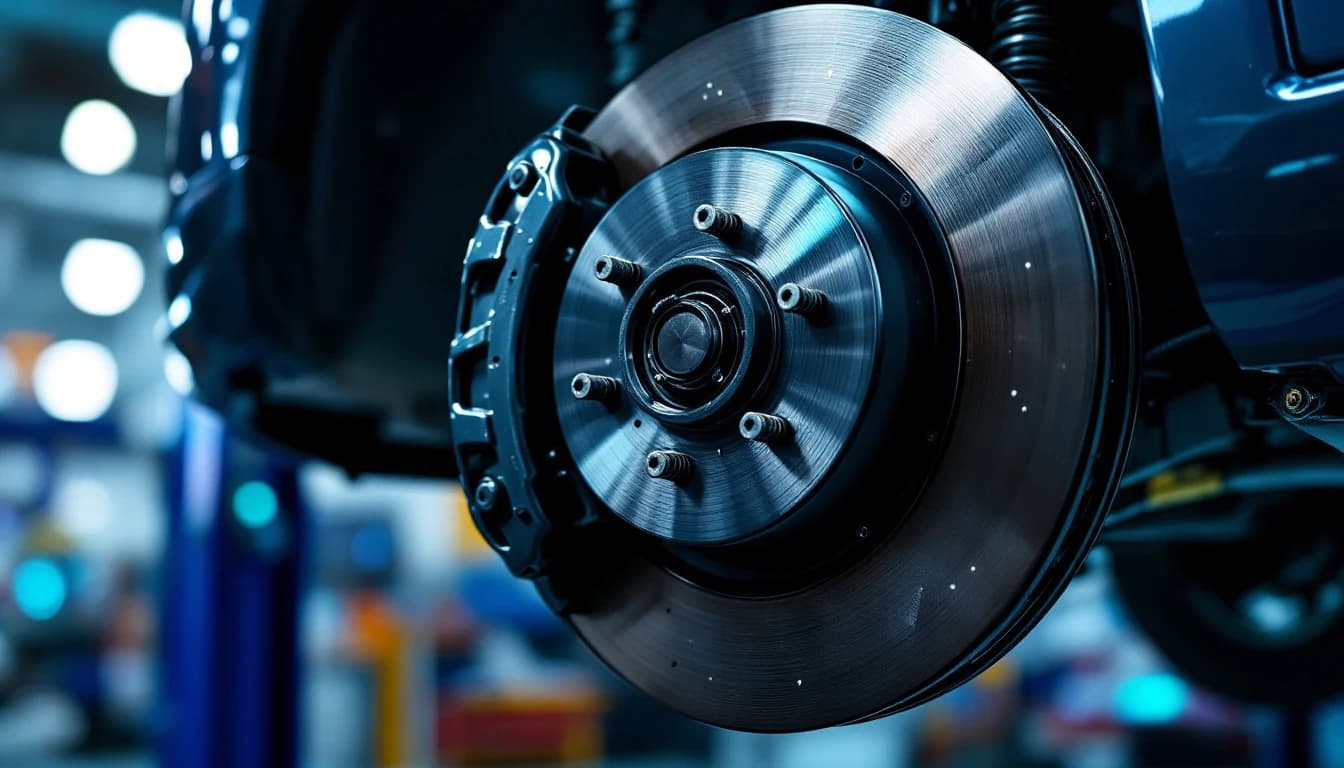
Acadia, Traverse, Enclave ABS/EBCM: Repair & Programming
Who this is for
- Your 2007-2016 GMC Acadia (or 2017 Acadia Limited), 2009-2017 Chevrolet Traverse, 2008-2017 Buick Enclave or 2007-2010 Saturn Outlook has the ABS light on with Service StabiliTrak or Service Traction Control
- A scan tool read U0121, C0561 or a C0035-C0050 wheel-speed code, and someone quoted you a new brake module
- You fitted a new or used EBCM and the lights stayed on
- You drive a 2017-or-later Acadia or a 2018-or-later Traverse or Enclave and want to know what differs on yours
These nameplates share GM's Lambda platform, which a former GM training-center instructor writing for Underhood Service notes carries ABS and StabiliTrak on every model. Watch 2017: GM sold the old-body Acadia Limited alongside the new second-generation Acadia, and they use different brake modules.
Not sure it is the module yet? Start with the ABS and traction-light symptom guide. The truck side of the family is in the GM EBCM replacement and programming guide.
Why is my Acadia or Traverse showing "Service StabiliTrak" with the ABS light?
The module behind those lights is the EBCM, which GM's parts catalog calls the electronic brake and traction control module. It reads the four wheel-speed sensors, the steering-angle sensor and the yaw and lateral-acceleration sensor, and it runs anti-lock braking, traction control and StabiliTrak, GM's electronic stability control. When anything it relies on looks wrong, it switches those functions off and lights the dash.
Your base brakes still work. What you lose matters: per the Insurance Institute for Highway Safety, electronic stability control cuts the risk of a fatal single-vehicle crash by about half, and of a fatal single-vehicle rollover by 75 percent in SUVs.
The catch is that the message looks the same whether the module failed, a sensor failed, or another computer told the EBCM to stand down. In NHTSA's complaint data for the 2011 Traverse, 39 of the 103 complaints filed under electronic stability control also describe reduced engine power. That combination sends you to the engine computer's codes first. If the red BRAKE lamp joins in and a scan tool cannot reach the EBCM, see U0121 below.
Which codes point at the EBCM, and which only look like they do?
Read the codes from the EBCM and from the engine computer. A reader that only shows powertrain codes misses most of what follows.
| Code | What it means | Where to look first |
|---|---|---|
| C0035 / C0040 / C0045 / C0050 | Wheel-speed sensor fault: left front, right front, left rear, right rear | Iron debris on the hub's magnetic encoder ring |
| C0561 | The EBCM switched stability or traction functions off and stored why | A code in another module, typically engine or body |
| U0121 | Lost communication with the EBCM | A failed EBCM, or a shorted sensor supply holding it offline |
| C056D / C056E | Rear park-brake circuit, second generation only | Park-brake actuator or wiring resistance |
| No code, lamps stay on | Self-test not finished since codes were cleared | A full power-down, then a drive above 10 mph |
Wheel-speed codes. GM's bulletin PIC5428G, filed with NHTSA, covers every year of all four first-generation models. For C0035-C0050 with the symptom bytes it lists, GM points to ferrous debris stuck to the magnetic encoder ring on the hub bearing, and says most repairs need neither a new hub nor a new sensor: clean the ring with a dry nylon brush, never a magnet.
C0561. Vehicle Service Pros, republishing GM guidance for the 2007-2012 Acadia, is blunt: do not replace the EBCM for C0561. Fix the codes in every other module first, including powertrain faults that never lit the check-engine lamp.
U0121. GM's bulletin PIT4056G, for the 2007-2012 Acadia, 2008-2012 Enclave, 2009-2012 Traverse and 2007-2010 Outlook, describes the ABS and red brake lamps on, no scan-tool contact with the EBCM, and its power, ground and network wiring all testing good, a pattern that can end in a new EBCM that fixes nothing. The cause it points to is circuit 2087, the supply to the yaw and lateral-acceleration sensor or the steering-angle sensor, shorted and dragging the EBCM down. Back that wire out of the EBCM connector; if communication returns, the module is fine.
Why does the EBCM itself fail?
When it really is the module, here is the hardware. The EBCM is the electronic half of a two-piece unit, bolted to the brake pressure modulator valve, or BPMV, which holds the pump and valves, and GM sells the halves separately. For the 2010 Traverse, GM's catalog lists module kit 25840308 at an MSRP of $2,635.40 and modulator valve kit 19418698 at $918.59. The electronics are the expensive half.
Inside are the driver stages that switch the pump motor and valve solenoids, the memory that holds the calibration and the vehicle's identity, the connector pin field, and the supply that feeds the chassis sensors, all living with years of heat cycles and vibration. The faults our bench repair addresses are the classic electronic ones: driver stages that stop switching, cracked solder at the pin field, corrupted memory, and communication failures. The ABS internal-failure guide has the detail.
Two things are not module failures. On 2007-2008 models, loud valve noise just after setting off is the unit's self-test at 15 km/h (9 mph), per Underhood Service, and the cure was a reflash that needed the vehicle's tire size. And a mechanically failed pump or valve in the BPMV is a hydraulic replacement, not an electronic repair.
Why does a new or used EBCM have to be programmed to my VIN?
Because it arrives knowing nothing about your vehicle. GM's description of module 20761339, as listed by the GM dealer Tasca Parts, says it requires programming and/or special setup per GM service information. The build matters too: that listing ties the part to variable-assist steering, and the 2007-2008 reflash needed the tire size. A used module still holds the donor's VIN and configuration until it is reprogrammed.
There are three ways to get it done:
- The dealer, using GM's Service Programming System with the vehicle in the bay.
- An independent shop or a capable owner through ACDelco TDS, GM's programming portal for the aftermarket. SPS2 for one vehicle is $51 and expires after 30 days or once the programming events equal the vehicle's programmable modules. You also need a J2534 interface and a steady battery supply, and GM warns there that counterfeit clone MDI interfaces get accounts blocked.
- Bench programming by mail. Our GM ABS/EBCM programming service writes your VIN and configuration to a new or donor module and verifies it communicates before it ships back: $250, with a typical 24-hour turnaround. Its published coverage is GM's 2014-2020 trucks and SUVs; other GM brake modules, like the 2017 Acadia below, are handled case by case, so send the VIN and part numbers first.
The second generation adds a trap. GM's bulletin PIT5662D for the 2017-2019 Acadia and the 2018-2019 Traverse and Enclave shows the rear electric park-brake actuators wired to the EBCM. High resistance there sets C056D or C056E with a Service Parking Brake message, and can make a replacement EBCM fail programming with error E6961. Fix the wiring or actuator on any circuit above 0.6 ohm, measured at the EBCM with the actuators plugged in, and if the error persists, power the EBCM down for more than five minutes before programming again.
Repair, new or used: what does each option really cost?
A first-generation EBCM is a four-figure job. RepairPal's Acadia estimate, updated September 3, 2026, averages $2,110 to $2,220, with labor of $236 to $346 and parts around $1,874; by year it runs $2,794 to $2,868 for 2007-2011 and $3,884 to $3,958 for 2012-2014. RepairPal's Traverse figures match for 2009-2011 and give $3,884 to $3,958 for 2012-2017.
The second generation is a different market. RepairPal puts a 2018-2021 Acadia at $657 to $799, and the 2017 Acadia catalog page shows why: the new-body module 84057107 lists at $468.51, the old-body 20761339 at $2,973.52.
| Option | What you pay | Needs VIN programming? |
|---|---|---|
| Shop replacement, 2007-2016 Acadia (RepairPal) | $2,794 to $3,958 by year | Yes, part of the job |
| Shop replacement, 2018-2021 Acadia (RepairPal) | $657 to $799 | Yes, part of the job |
| Used donor module | Varies, plus programming | Yes, it carries the donor's VIN |
| Your replacement programmed on our bench | $250 | This is the programming |
| Your original repaired on our bench | $499 flat, 1-year warranty | No, in most cases |
On the first generation the numbers favor repair, because your own module keeps its VIN and configuration and normally reinstalls with nothing to program. ABS module repair is $499 flat with a 1-year warranty (2 years +$50, 3 years +$100 or 5 years +$150 at checkout), about a week on the bench, or 2-3 business days with rush repair (+$100). It covers the electronics, not a mechanically failed pump or valve block or a wheel-speed sensor, and if testing shows your module cannot be repaired, we tell you first and quote a replacement before any extra charge. On the second generation, programming a new or donor module is often the sensible route; the ABS repair cost guide covers the wider market.
Which EBCM part number does my Acadia, Traverse or Enclave use?
These are the numbers GM's catalog lists, with MSRPs as listed in October 2026. They move.
| Catalog page | EBCM part numbers | MSRP |
|---|---|---|
| 2010 Traverse, 2010 Enclave, 2008 Outlook | 25840308 (replaces 25829830, 25812789); 25840309 (replaces 25812790) | $2,635.40; $1,415.42 |
| 2014 Traverse, 2017 Acadia Limited | 20761339; 20761340 | $2,973.52; $3,725.28 |
| 2017 Acadia, second generation | 84057107; 84057108 | $468.51; $476.60 |
| 2017 Acadia, module with pressure modulator | 84740921; 84740922 | $1,255.55; $1,045.22 |
| 2018 Acadia | 84401914; 86514989 (now 85769052) | $268.14; $425.12 |
Two numbers for one year is normal, because GM splits these modules by build. Match the number on your module's label, not the model year. The 2018 Acadia page even shows a kit that has since been superseded.
What do I remove and ship?
Disconnect the battery before you unplug anything. Then:
- Repairing your original: ship the EBCM only, not the BPMV and its lines, unless we ask. GM sells the halves separately, so the module comes off on its own; if you are unsure, send a photo of the unit and its label first.
- Programming a replacement: ship the new or donor module, plus your original if you still have it. On the 2017 Acadia below, the bench needed the original.
- In the box: each module in an anti-static bag inside a padded box, a printed copy of your order confirmation, the VIN, the part number from every label, and your name and return address.
We email you a prepaid inbound label, so shipping it to us costs you nothing. You choose the return speed at checkout: standard $29.95 (3-5 days), UPS 2-Day $54.95 or UPS overnight $94.95. If the second-generation part you bought includes the pressure modulator, such as 84740921, you are replacing hydraulics, and the bleed below applies.
Do I need to bleed the brakes after installing the EBCM?
Only if the hydraulics were opened. If just the electronic module came off and the BPMV and its lines never moved, there is no air to chase. If the BPMV came out or a line was cracked, the same Underhood Service write-up describes an automated bleed procedure that needs a scan tool: required when the modulator is replaced, and worth running even after a manual or pressure bleed. The sequence is left front, left rear, right front, right rear, at 25-30 psi on a pressure bleeder.
Then give the lamps a drive. GM's guidance for the 2008-2011 Enclave, republished by Vehicle Service Pros, says the EBCM needs a full power-down after codes are cleared: switch off, open and close the driver's door, wait at least 60 seconds, then drive above 10 mph. If the lamps stay on with no codes, disconnect the battery for at least 60 seconds and repeat. GM says not to replace the EBCM for that. Still lit? Work through the replaced-module checklist.
A real-world example
Vehicle: a 2017 GMC Acadia SLE, 3.6L. That is a second-generation Acadia from the first year of the new body, not the carry-over Acadia Limited.
The order: our $250 GM ABS/EBCM programming service, booked in late September 2026. The module arrived at the lab on October 1.
On the bench: the team noted that the original module was needed, and that the correct part might be required.
Result: programmed on the bench on October 14, shipped the same day, delivered on October 15.
Net: GM's catalog lists two module numbers for the 2017 SLE, so year and trim do not settle the part. Send the original with the replacement, and let us check both part numbers against the VIN before you ship. Those are the two things the bench raised on this job.
What experts say
"On these crossovers the dash message is the least useful clue you have. We want every module's codes, the VIN and the number off each label before anything ships, because GM's own bulletins describe a shorted sensor feed, a dirty encoder ring and an engine fault that all light the same lamps as a dead module. When it really is the module, your original is the best part you own: it already carries the VIN and the build." — Auto Module Lab bench team
The stakes are real. Per the IIHS, NHTSA estimates that electronic stability control saved about 4,100 lives in 2010-14.
Frequently asked questions
Is it safe to drive with Service StabiliTrak and the ABS light on?
The base brakes still work, but anti-lock, traction and stability control are off, and IIHS figures show stability control roughly halves fatal single-vehicle crash risk. Get the codes read soon. If the red BRAKE lamp is also on, or the pedal feels low, soft or hard, have it inspected before you drive further.
Will a used EBCM from another Traverse or Acadia work in mine?
Only once it is programmed to your VIN, and only if it is the right part number. A donor still carries the other vehicle's VIN and configuration, and GM splits these modules by build, so match your label, not the year. Send us both part numbers and the VIN first; our $250 service programs a matching donor on the bench.
How much does an ABS module replacement cost on these crossovers?
RepairPal estimates $2,794 to $2,868 for a 2007-2011 Acadia or 2009-2011 Traverse, $3,884 to $3,958 for a 2012-2014 Acadia or 2012-2017 Traverse, and $657 to $799 for a 2018-2021 Acadia. Repairing your original here is $499 flat with a 1-year warranty, and programming a replacement you already own is $250.
Can I program the EBCM myself?
Possibly. ACDelco TDS sells SPS2 programming for one vehicle at $51, valid 30 days or until the vehicle's programmable modules are done. You also need a J2534 interface, a steady battery supply and GM's procedure followed exactly, because an interrupted write can leave a module unresponsive. If that is too much risk, the bench service does it by mail.
Is there a recall for the ABS module on these crossovers?
NHTSA's recall records list none for the EBCM itself. The brake-related recalls cover other parts: campaign 09V-153 covered 15,393 model-year 2009 Traverses for a park-brake cable link that could fracture, and 16V-802 covered some 2017 Acadias built April 19-22, 2016 for front caliper piston seals. Check your VIN on NHTSA's lookup for anything open.
What is different on the 2017+ Acadia and 2018+ Traverse and Enclave?
The rear electric park-brake actuators are wired to the EBCM, so park-brake faults set C056D or C056E and, per GM's PIT5662D, can make a replacement module fail programming with error E6961 until the circuit is fixed. Parts are far cheaper: GM lists the second-generation module at $468.51 against $2,973.52 for the old-body 2017 module.
The bottom line
On a first-generation Acadia, Traverse, Enclave or Outlook, the ABS light with Service StabiliTrak is the EBCM reporting a problem, and the problem is not always the EBCM. Wheel-speed codes send you to the hub encoder rings, C0561 to another module, and U0121 to a dead module or a shorted sensor feed.
When the module has failed, keep the original if you can. A new first-generation EBCM lists at $1,415 to $3,725 and still needs programming, while repairing yours keeps its VIN and build. On the 2017-and-later models new modules cost a fraction of that, so programming a replacement often makes more sense, once any park-brake circuit fault is fixed.
Next steps
Have a new or used EBCM that needs your VIN? Start with GM ABS/EBCM programming: $250, a typical 24-hour bench turnaround, and a 6-month warranty on the programming work. Want to keep your failed original? ABS module repair is $499 flat with a 1-year warranty and about a week on the bench. Either way, send the VIN, the codes and the part numbers first, and we confirm the job before you ship. Everything else we handle is on the services page.
Ship it for the gm abs / ebcm programming (k2) — $250 flat
Typical 24-Hour Turnaround, return speed your choice at checkout. Prepaid inbound label by email the minute you order.
More from the Lab
Equinox, Terrain & SRX ABS Module: Codes, Cost & Repair
13 min · October 16, 2026
Kelsey-Hayes 325 ABS Module: C0265 on GM Trucks Explained
11 min · October 10, 2026
GM ABS/EBCM Replacement Needs Programming: Why
6 min · July 23, 2026
Replaced the ABS Module, Light Still On? What Was Missed
10 min · October 10, 2026