What Fails Inside an ABS Module: Bosch, ATE, Kelsey
The two halves of an ABS module, and why it matters
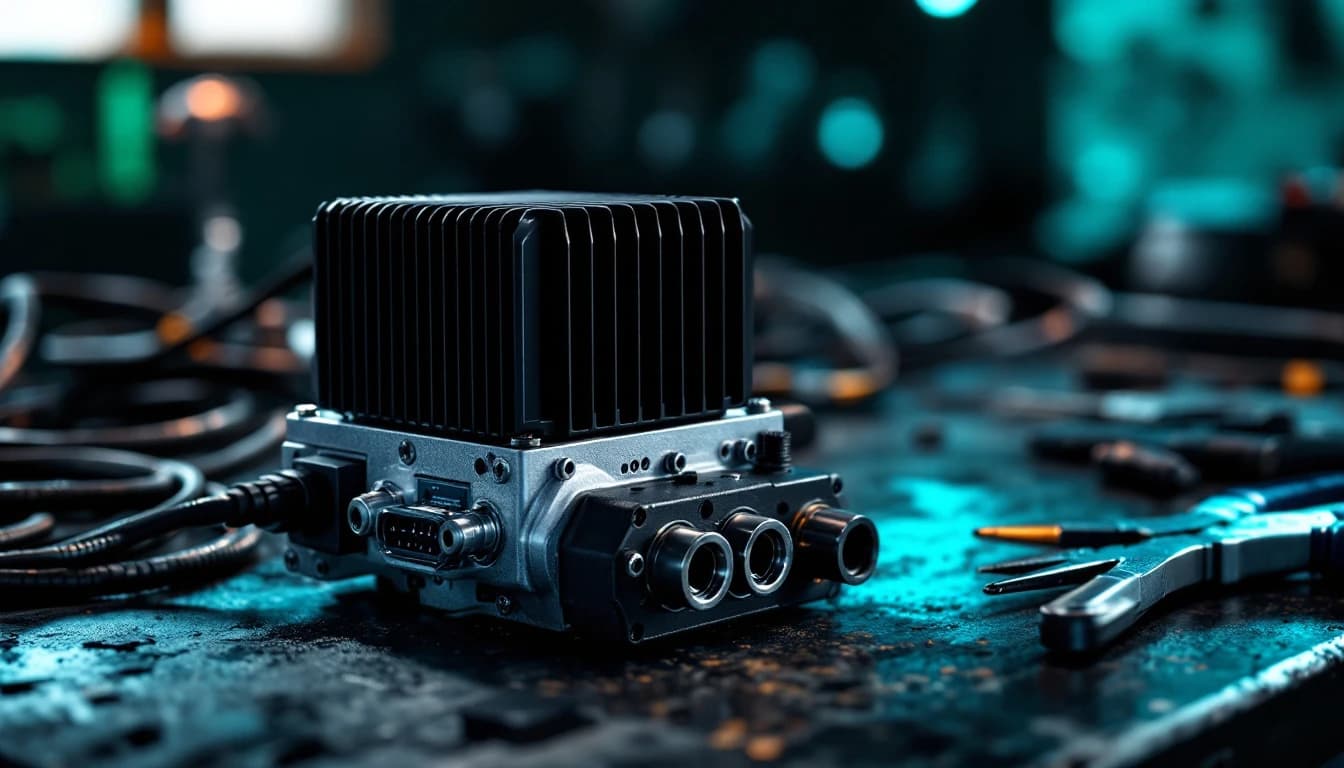
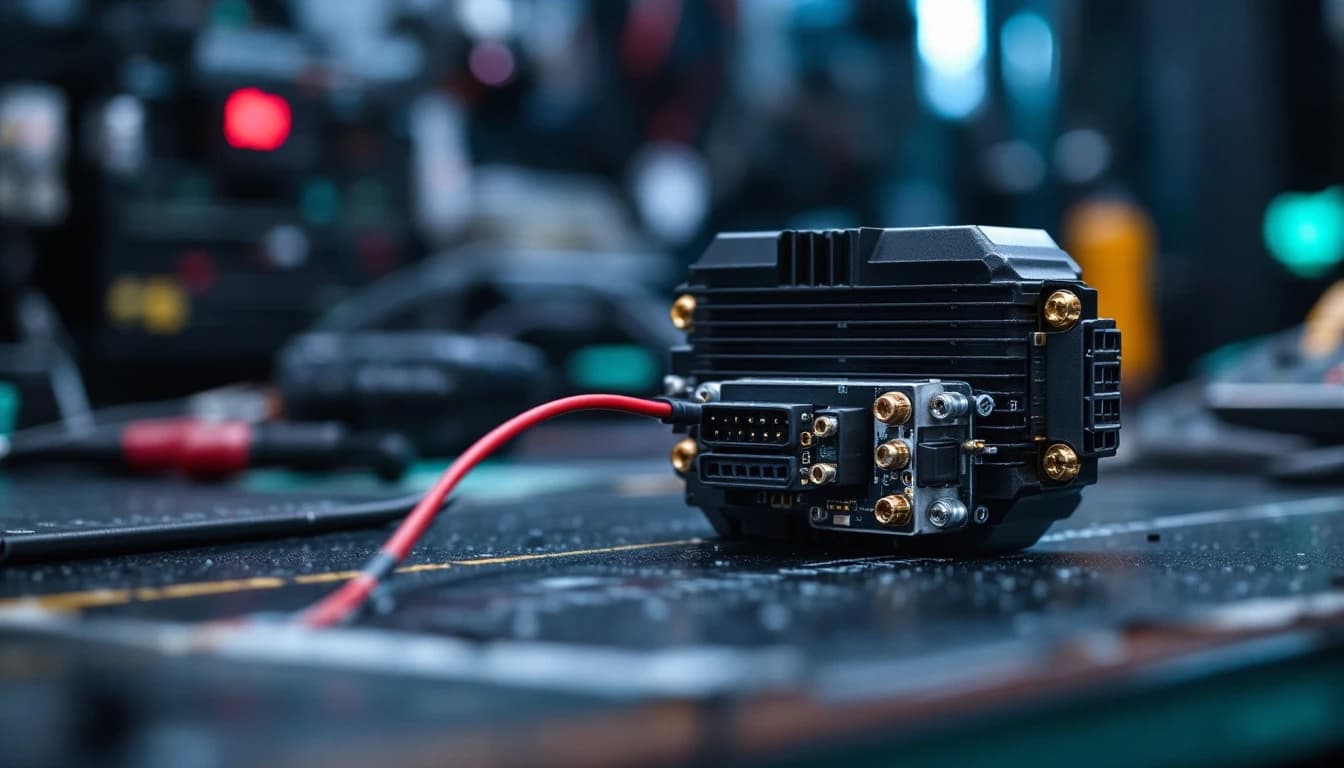
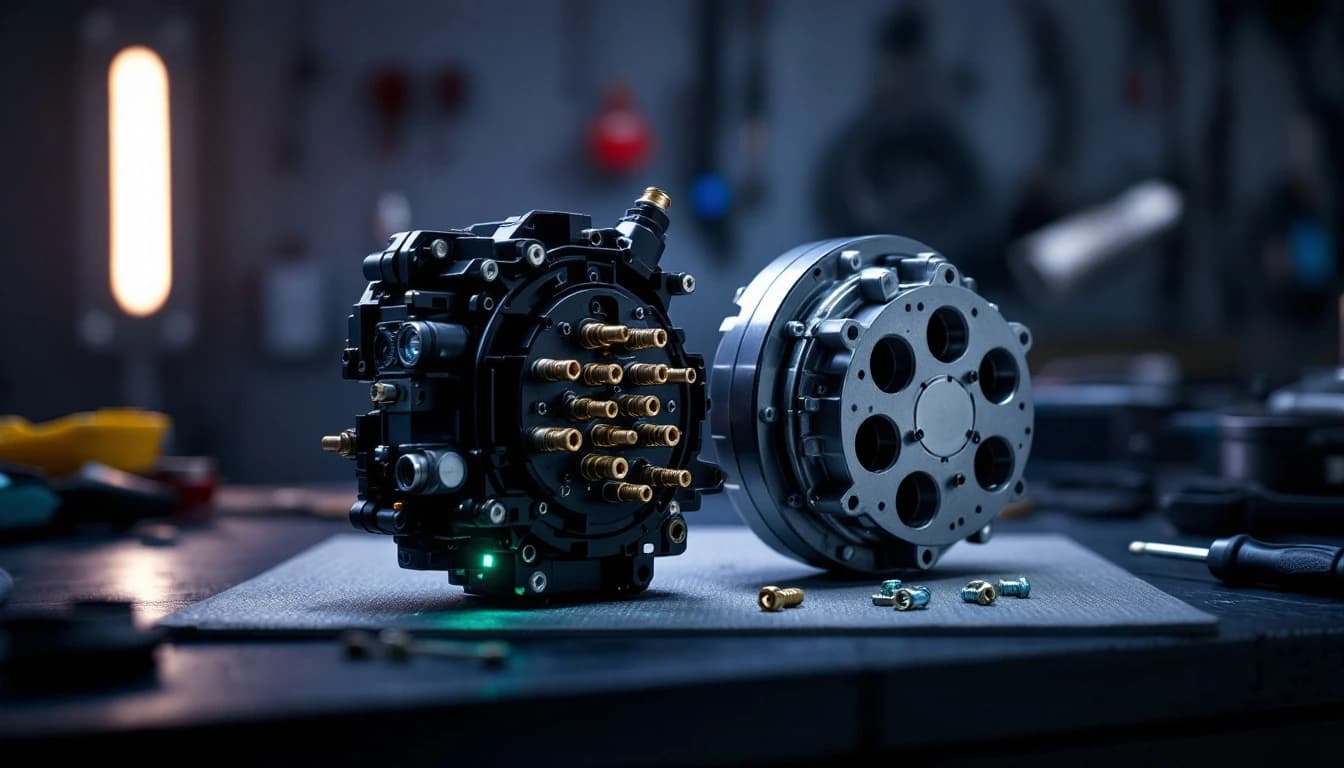
An ABS or ESC module is not one component. It is a hydraulic control unit and an electronic control unit bolted face to face, and on most families they come apart. Understanding that separation is the single most useful thing an owner or a shop foreman can know about this repair, because it determines whether a fault costs a few hundred dollars or well over a thousand.
The hydraulic control unit, usually called the HCU, is a machined aluminum block. It carries the brake line ports, the isolation and dump solenoid valve cartridges, low-pressure accumulator chambers, and a small electric pump. The valve cartridges are pressed into the block, and their coils sit on a carrier that stacks on top of them. This half is a precision hydraulic component and it is not electronically serviceable.
The electronic control unit, usually called the EBCM, ABS module, or controller, is the housing bolted to the block. Inside it is a circuit board carrying the microcontroller, the solenoid driver stages, the pump motor drive, wheel-speed-sensor input conditioning, an EEPROM holding configuration and calibration, a network transceiver, and a field of pins that presses down onto the solenoid coil terminals to make contact.
On most families the EBCM unbolts with two to four Torx fasteners and lifts straight off that pin field. Nothing hydraulic is opened when you do that. The brake circuit stays sealed and full, no fluid comes out, and no bleed is required afterward. That is why the electronic half can be removed, shipped in a small box, worked on, and reinstalled without disturbing the brake system at all. It is also why sending the whole assembly, brake fittings and all, is usually the wrong move.
There are exceptions and they matter. Certain later, highly integrated ESC units are not designed to be separated in service, and a few families use a single-use seal or staked pins that make separation a one-way trip. That is a question to settle at intake, before anything comes off the car.
Why any of this is worth repairing
ABS is not an optional convenience. The National Highway Traffic Safety Administration has required electronic stability control, which is built on top of the ABS hydraulic unit, on all new light vehicles sold in the United States since the 2012 model year. The Insurance Institute for Highway Safety has estimated that stability control reduces the risk of a fatal single-vehicle crash by roughly half, and reduces fatal rollover risk by an even larger margin. This is one of the highest-value safety systems ever mandated, and a dark ABS light means you are driving without it.
It is also a system that ages. Consumer Reports owner surveys have consistently ranked brake and electrical complaints among the more frequently reported problem areas on higher-mileage vehicles, and outlets like MotorTrend and Hagerty have covered ABS controller failure as a recurring, well-known ownership cost on a long list of platforms from the late 1990s onward. The failure is not exotic. It is a predictable consequence of putting a circuit board in an engine bay for twenty years.
The underlying engineering reason is documented and unglamorous. SAE International publishes a large body of work on solder joint thermal fatigue in automotive electronics: when materials with different rates of thermal expansion are soldered together and then cycled through thousands of hot and cold events, the joints accumulate microcracks and eventually go open. An ABS module in an engine bay can swing from below freezing to well past 200 degrees Fahrenheit in a single trip, several hundred times a year, for two decades. The joints that fail are exactly the ones you would predict: the biggest, stiffest, most thermally stressed pins on the board.
And the environment keeps getting denser. NHTSA has documented that a modern vehicle commonly carries well over 50 networked control units, while Car and Driver has reported electronics and software climbing toward roughly 40% of a new vehicle's value. More modules, more interconnection, more places for one aging solder joint to take down a safety system.
Failure mode 1 — Cracked solder at the solenoid coil pin field
This is the single most common internal ABS module failure, across every manufacturer, and it is the most repairable.
The mechanism: the EBCM contacts the hydraulic unit's solenoid coils through a field of stout pins, typically pressed into the board and soldered on the component side. Those pins are large, rigid, and thermally massive compared to the fiberglass board they are soldered into. Every heat cycle, the pin and the board expand at different rates and work the joint. After enough cycles the solder develops a ring crack around the pin, and the connection becomes resistive, then intermittent, then open.
What it looks like from the driver's seat:
- An ABS light that comes on and goes off with temperature. Fine on a cold morning, on by the afternoon. Or the reverse. Either pattern points here.
- A light that appears after a hard bump or a rough road, then clears at the next key cycle.
- Codes naming a specific solenoid or valve circuit, often more than one, and often a mix of "open circuit" and "circuit performance" descriptions.
- A fault that eventually becomes permanent and never clears again, which is the crack finally going fully open.
Under magnification the failed joints are usually obvious: a dull grey ring around the pin, sometimes a visible dark line, occasionally a joint that has fractured cleanly enough to see daylight.
Repairable: yes, and this is the highest-success bench repair in the category. The correct fix is not a blob of fresh solder over the top. It is removing the old fatigued solder, cleaning the pad and the pin with proper flux, and reflowing the joint with a controlled temperature profile so the new joint wets fully to both the pin barrel and the pad. On boards where the crack has lifted a pad, the pad and the trace to it have to be repaired as well. Every pin in the field gets addressed, not just the one the code named, because the ones that have not gone open yet have been through the identical number of cycles.
Failure mode 2 — Pump motor drive, relays and transistors
The ABS pump motor is the highest-current device the controller commands. Inrush on a cold pump can be tens of amps, and the motor is switched thousands of times over the module's life.
Two architectures, two failure patterns:
Older units use a physical relay. The relay is soldered to the same board, with heavy pins, and it fails in the same two ways relays always do. Contacts weld closed, and the pump runs continuously or runs with the key off until the battery is flat. Or the coil goes open, or the relay's own solder joints crack from the same thermal fatigue described above, and the pump never runs at all. Codes in this family typically name the pump motor circuit or the relay circuit.
Newer units use solid-state drive, a high-side MOSFET or a driver stage integrated into a power IC. When one of those fails it usually fails short or open, and the module normally detects it and sets a pump motor or controller internal fault. A shorted drive is the more dangerous version, because it can run the pump without a command.
There is a diagnostic trap worth naming. A dead pump can be a dead motor rather than a dead driver. The motor windings and brushes are on the hydraulic side, and a motor with worn brushes or a seized armature will produce a pump-circuit code that looks electronic. Measuring the motor's resistance directly at its terminals, with the controller off the block, separates the two in about a minute.
Repairable: often yes on relay-based units, where a quality replacement relay properly soldered in is a durable fix. Sometimes yes on solid-state units, when the failed device is an obtainable discrete part. No when the drive stage is buried inside a proprietary automotive power IC that is no longer available, which does happen on some families.
Failure mode 3 — Moisture ingress and connector corrosion
Where the module lives is the reason this one exists. ABS modules are frequently mounted low in the engine bay, near the master cylinder or on an inner fender, directly in the path of road spray, wash water, and anything that runs down from a leaking cowl or windshield seal.
Three specific entry points, in order of how often we see them:
- The pump motor terminal interface. The two heavy motor terminals pass through a rubber grommet between the controller and the block. That grommet hardens and shrinks with age and heat, and once water gets past it, it sits on the terminals. The result is green or white corrosion on the pins and, worse, capillary wicking of moisture up between the wire strands and onto the board.
- The main harness connector seal. The connector's perimeter seal and the individual wire seals both age. A connector that has been unplugged and replugged a few times over twenty years seals worse than it did new.
- The housing seam itself, particularly on units that have been previously opened by someone who did not reseal them properly.
The damage progresses in a predictable order: surface corrosion on pins, then corrosion under the conformal coating, then green corrosion creeping along traces, then open traces and lifted pads. Caught early it is entirely fixable. Caught late, the copper is simply gone in places and the board is not economically recoverable.
Repairable: yes if caught early. Cleaning corrosion properly, neutralizing residue, re-terminating or replacing corroded pins, repairing traces, and re-sealing the housing is real bench work with a good success rate. No, if the corrosion has reached under the coil pin field or eaten multiple traces in the driver section. At that point the honest answer is that the control unit is done, and the conversation becomes replacement plus programming.
Failure mode 4 — Wheel speed sensor input circuits
A shorted wheel speed sensor or a chafed harness can take out the input circuit for that channel inside the module, and this is the failure people misdiagnose most often.
Modern wheel speed sensors are active devices: two wires, powered by the module at a regulated voltage, returning a current-modulated square signal, commonly switching between roughly 7 and 14 milliamps. The module's input stage supplies that power and reads that current. It is a low-power circuit, and it is protected, but the protection has limits.
What kills it: a sensor that fails internally shorted, a harness that has rubbed through against a suspension component or a brake line and shorted to chassis ground or to battery voltage, or a repair where someone probed the wrong pin with a powered test light. Wheel speed sensor harnesses live in the worst possible place, running down a suspension arm through road salt, gravel, and constant flexing.
The symptom is a wheel speed signal fault on one channel that will not go away no matter what you replace on the outside of the car.
The test that settles it costs nothing: swap a known-good sensor onto the suspect channel, and swap the suspect sensor to a known-good channel. If the fault follows the sensor, the sensor is bad. If the fault stays on the channel with a good sensor and a verified air gap and a verified harness, the input circuit inside the module is damaged. Do this before condemning anything. It also catches the surprisingly common case of a damaged tone ring, which produces a signal fault with a perfectly healthy sensor and a perfectly healthy module.
Repairable: sometimes. On boards where the damaged element is a discrete series resistor, a protection diode, or a filter component ahead of the input, replacing it restores the channel. Not repairable when the damage is inside a multi-channel sensor interface ASIC, which is the more common outcome on later modules. Once that die is damaged, the channel is gone and no amount of soldering brings it back.
Failure mode 5 — EEPROM corruption and processor faults
The EEPROM is the module's memory of who it is. It holds the variant coding, the vehicle identification data, calibration constants, and learned values such as steering angle zero point and lateral acceleration and yaw sensor offsets. If that data is corrupt, a perfectly healthy board behaves like a failed one.
Corruption is nearly always caused by a low-voltage event during a write cycle. The usual suspects:
- A jump start done backwards or with a badly matched donor vehicle
- A dying battery that sags hard during cranking while modules are still writing
- Welding on the vehicle without disconnecting the battery
- Module programming attempted with a marginal battery charger instead of a proper power supply
- A failing alternator producing heavy AC ripple
The symptoms are distinctive. The module answers the scan tool but reports an internal or memory fault. Or it refuses to accept coding. Or it reports a configuration that does not match the vehicle. Or it works normally until a specific function is requested and then faults.
Repairable: frequently, and this is proper bench work. The EEPROM contents can be read, compared against a known-good dataset for the correct variant, corrected, and written back, with the original data archived first. That is far cheaper than a new module plus programming.
A dead microcontroller is a different story. If the processor itself has failed, from a voltage transient, an internal short, or age, the module is finished. There is no meaningful repair for a dead automotive-grade microcontroller in the field, and any shop suggesting otherwise is not being straight with you. The broader repair-versus-replace framework is covered in our guide to module repair versus replacement versus reprogramming.
Failure mode 6 — The brake pressure sensor circuit
Stability control units need to know master cylinder pressure, and the sensor that reads it is a common late-life failure.
On ESC-era hydraulic units there is a pressure sensor reading brake pressure directly from the block. On some families it is a discrete sensor threaded into the HCU with its own connector, which makes it individually replaceable. On others, and this is the important case, the sensor element is part of the electronic control unit and reads pressure through a port in the mating face. When that integrated sensor drifts or fails, there is no separate part to buy.
Symptoms are a brake pressure sensor code, an ABS and stability control light together, and frequently a complaint that the stability system intervenes when it should not or fails to intervene when it should. On some platforms a drifted pressure sensor also disables hill hold and adaptive cruise functions that depend on it.
Repairable: only sometimes. Where the sensor is discrete, replacement is straightforward. Where it is integrated into the control unit, the module is a replacement item, and the job becomes fitting a good unit and coding it correctly.
The families, and what each one is known for
Not every ABS module fails the same way. The construction differs, and so does the dominant failure.
Bosch
Bosch 5.3, from roughly the mid to late 1990s, is an ABS-only unit that appeared across a wide range of domestic and European vehicles. It is a straightforward two-piece design, the controller unbolts cleanly from the block, and its signature failure is cracked solder at the coil pin field and at the pump relay. Highly repairable, and one of the more satisfying units on the bench.
Bosch 5.7, early 2000s, adds traction control and more channels. Same basic architecture, same dominant failure at the pin field and valve relay, with more circuitry crammed into the same footprint.
Bosch 8.0 and 8.1, from the mid-2000s into the stability-control era, are considerably more integrated. Sensor data arrives over the network from a dedicated sensor cluster rather than from discrete wiring, there is usually an integrated pressure sensor, and the board is far more surface-mount. Solder-joint repair at the coil pins is still viable, but these units are much more sensitive to configuration, so any swap or replacement has to be followed by proper coding and calibration.
ATE and Continental Teves
Teves MK20, from the mid-1990s through the 2000s, appeared on an enormous range of European and domestic vehicles and is the archetype for cracked solenoid pin solder. If you have read a forum thread about somebody fixing their own ABS module with a soldering iron, it was probably an MK20. It is very repairable, and the failure pattern is consistent enough to be almost boring.
MK25 brought more integration and many more stability-control variants. The dominant failures shift away from pure solder cracking and toward input-side damage, connector corrosion, and configuration and EEPROM issues. Coding after replacement is not optional here.
MK60 and MK60E, mid-2000s through the 2010s, are common on European platforms. Known trouble spots are the pump motor terminal interface, where moisture and heavy current combine, and the pressure sensor circuit. These are also notably variant-sensitive, meaning a physically identical unit from a different model or option package will not simply drop in without being coded to match.
Kelsey-Hayes and TRW
Kelsey-Hayes EBCM units on full-size domestic trucks and SUVs are among the highest-volume ABS bench repairs performed in North America. The classic fault is cracked solder on the relay and pin field, producing an EBCM relay circuit code, an ABS light, and often a disabled traction control. It is a textbook thermal fatigue failure and it responds very well to a proper reflow.
TRW units, which followed on later domestic platforms, are more integrated and more programming-dependent. On these the conversation shifts from pure board repair toward setup and configuration after a replacement unit is fitted, which is exactly what our GM ABS and EBCM replacement programming guide covers step by step.
Family comparison: what fails, and can it be fixed
| Family | Dominant internal failure | Bench repairable | Coding needed after replacement |
|---|---|---|---|
| Bosch 5.3 | Coil pin and pump relay solder cracks | Usually yes, high success | Minimal on most applications |
| Bosch 5.7 | Coil pin solder, valve relay | Usually yes | Often yes |
| Bosch 8.0 / 8.1 | Solder plus EEPROM and configuration faults | Often yes | Yes, plus sensor calibration |
| Teves MK20 | Solenoid pin solder cracks | Usually yes, high success | Usually minimal |
| Teves MK25 | Input circuits, corrosion, EEPROM | Case by case | Yes |
| Teves MK60 / MK60E | Pump terminal corrosion, pressure sensor | Case by case | Yes, variant sensitive |
| Kelsey-Hayes EBCM | Relay and pin field solder cracks | Usually yes, high success | Often yes on later units |
| TRW EBCM | Configuration, drive stages, corrosion | Case by case | Yes, VIN and setup required |
Read that table as a starting point for the intake conversation, not a promise. The only way to know what a specific board needs is to open it, and that is what a bench evaluation is for.
"The units I turn away are almost never the ones with cracked joints. Those I can fix all day. It is the ones that sat under a leaking cowl for three winters, where the green has already crept under the coating and eaten the traces out from under the driver section. You clean it, you fix four traces, and two months later a fifth one lets go. At that point I tell the customer to buy a good used unit and let me program it, because that is the repair that actually lasts." — Independent automotive electronics technician, 21+ years in module-level brake and chassis repair (anonymized)
Why an electronic failure does not mean a new hydraulic unit
This is where most of the money gets wasted. A dealer or a chain shop will frequently quote a complete assembly, controller and hydraulic block together, for a fault that lives entirely in the electronics. Complete assemblies are expensive parts, and fitting one means opening brake lines, bleeding the system, and on many vehicles running a scan-tool-controlled service bleed that cycles the solenoids to purge air from the valve body.
When the fault is a cracked solder joint or a failed relay, none of that is necessary. The controller comes off the block, the brake system is never opened, and the repaired or replacement controller goes back on.
The hydraulic half genuinely does need attention in a narrower set of cases:
- A stuck or contaminated solenoid valve, usually the result of degraded, contaminated, or wrong-specification brake fluid. This is a real and separate failure and no electronics work fixes it.
- A mechanically failed pump motor, with worn brushes or a seized armature.
- An internal hydraulic leak in the block, which is rare but not unheard of on high-mileage units.
- External damage or corrosion to the block or its fittings.
Distinguishing hydraulic from electronic is not hard with a scan tool. A controller that can command each valve and read back the expected electrical response, but produces no braking change in a controlled test, points at hydraulics. A controller that reports open or shorted valve circuits points at itself.
Coding, VIN, and setup when a replacement unit is fitted
A used or new replacement ABS module is almost never plug and play on a modern vehicle. Expect some or all of the following:
- Variant coding. The module has to be told what vehicle it is in: brake system version, tire and wheel size affecting rolling circumference, engine and transmission type, presence of options such as hill start assist, trailer stability, or adaptive cruise. Get this wrong and the system will either fault or behave incorrectly, which on a safety system is not acceptable.
- VIN writing. Many platforms write the VIN into the module and will set a mismatch fault if the module remembers a different vehicle. A used module carrying a donor vehicle's identity is a common and entirely predictable source of post-installation faults, and our explainer on what a VIN-locked module means and what to do about it covers that situation directly.
- Sensor calibration. Steering angle sensor zero point, yaw rate and lateral acceleration sensor offsets, and on some platforms a longitudinal accelerometer zero, all performed on level ground with the wheels straight.
- A service bleed routine, if hydraulic lines were opened, in which the scan tool cycles the solenoids while the system is bled so air trapped in the valve body actually comes out.
On GM applications specifically, a replacement or used EBCM needs to be programmed with the correct calibration and set up for the vehicle. That is a defined bench service: GM ABS and EBCM programming at $250, done on the bench so the module arrives ready to install.
Board-level repair of your original module, which avoids all of the VIN and configuration questions entirely because the car already knows the unit, is the ABS module repair service at $499.
What to ship, and how
This is a nationwide mail-in bench workshop. No on-site or mobile service is offered.
- Message the lab first. Send the VIN, year, make, model, the module part numbers from the label on both the controller and the block if visible, a clear photo of the label, and every code you have with its exact description. That information identifies the family and determines whether the controller separates.
- Send the controller only, in the normal case. On separable families the EBCM unbolts from the hydraulic block with a few Torx fasteners and lifts off. The brake system stays sealed, no fluid is lost, and no bleed is needed. Protect the exposed pin field, put the unit in an anti-static bag, and pad it well.
- Do not open brake lines unless you have been told to. Sending the complete assembly costs more to ship, risks fluid contamination, and forces a bleed on reinstall that would otherwise not have been necessary.
- Shipping addresses. USPS goes to PO Box 120241, Arlington, TX 76012. UPS and FedEx cannot deliver to a PO Box, so couriers go to 1009 Oakwood Ln # 120241, Arlington, TX 76012. Packing details are in our remove, package and ship guide.
- Bench evaluation and repair. The unit is powered on a regulated supply, inspected under magnification, and repaired at board level where the damage is repairable. Where it is not, you get told that plainly rather than being sold a repair that will not hold.
- Return. Return shipping is a flat-rate tier chosen at checkout, from $29.95, with faster options available.
One safety note that is not negotiable. ABS and stability control are federally required safety systems on current vehicles. Nothing here should be read as a suggestion to disable them or to defer the repair. After any ABS work, the system should be verified with a scan tool and the vehicle road tested by someone competent to do it, and if hydraulic lines were opened the brakes must be properly bled before the vehicle is driven.
Frequently asked questions
What actually fails inside an ABS module? The most common internal failure by a wide margin is cracked solder at the pin field where the controller contacts the solenoid coils, caused by twenty years of thermal cycling. After that come pump motor relay and driver failures, moisture corrosion at the pump terminals and main connector, damaged wheel speed sensor input circuits, and EEPROM corruption from low-voltage events.
Can an ABS module be repaired instead of replaced? Yes, in the majority of cases. Cracked solder joints, failed relays, corroded connector pins, damaged traces, and corrupted EEPROM data are all genuinely repairable at board level on most families. What is not repairable is a dead microcontroller, damage inside a multi-channel sensor interface chip, or corrosion that has already eaten multiple traces under the driver section.
Do I have to replace the hydraulic unit too? No, not for an electronic fault. On most families the electronic controller unbolts from the hydraulic block with a few Torx screws without opening a single brake line, so the expensive hydraulic half stays on the car and no bleed is required. Only a stuck valve, a mechanically failed pump motor, or an internal hydraulic leak requires the block itself.
Why does my ABS light come and go with the weather? A fault that changes with temperature is the classic signature of a cracked solder joint. The crack opens and closes as the board expands and contracts, so the circuit is intermittent when cold and permanent later on, or the reverse. It is one of the most reliably repairable ABS faults there is.
Does a replacement ABS module need to be programmed? Almost always on modern vehicles. A replacement unit typically needs variant coding for the vehicle's brake system, tire size, and options, the VIN written where the platform requires it, and steering angle and yaw sensor calibration afterward. On GM applications that setup is a defined bench service, GM ABS and EBCM programming, at $250 - a separate job from the $499 repair of your own module.
Can a bad wheel speed sensor damage the ABS module? Yes. A sensor that fails internally shorted, or a harness that chafes through and shorts to ground or battery voltage, can damage the input circuit for that channel inside the module. Swap the sensor to a different corner before condemning anything: if the fault follows the sensor it is the sensor, and if it stays on the channel the module input is damaged.
How do I know whether my problem is electronic or hydraulic? Codes that report open, shorted, or performance faults on valve, relay, or sensor circuits point at the electronics. A controller that can command each valve and read back a correct electrical response but produces no change in braking during a controlled scan tool test points at the hydraulic block. A scan tool that can run valve activation makes this a short test.
The bottom line
Most ABS module failures are electronic, most electronic failures are on a short and well-understood list, and most of that list is repairable on a bench. Cracked solder at the solenoid pin field is the dominant fault across Bosch, Teves, and Kelsey-Hayes units alike, and it responds very well to a proper reflow rather than a smear of fresh solder. Pump relays and drive stages, corroded connector pins, and corrupted EEPROM data are all real bench work with good outcomes. The genuine dead ends are a failed microcontroller, damage inside a sensor interface chip, and corrosion that has already destroyed traces.
The money-saving insight is structural: the electronic half and the hydraulic half are separate parts. An electronic failure does not require a new hydraulic block, does not require opening a brake line, and does not require a bleed. Board-level repair of your original controller is a flat $499 through ABS module repair, which keeps the unit the vehicle already recognizes and sidesteps the whole VIN and coding question. If your unit is genuinely finished and you are fitting a replacement, GM ABS and EBCM programming at $250 covers the calibration and setup so the module arrives ready to bolt on. Return shipping is chosen at checkout from $29.95.
If you are staring at an ABS light and a quote for a complete assembly, message the lab with the VIN, the module part number, a photo of the label, and your exact codes before you agree to anything. Knowing which family you have and which half of the module is at fault is usually the difference between a few hundred dollars and four figures.
Ship your module today
Flat-rate pricing, typical 24-hour bench turnaround, return speed your choice at checkout. Most jobs back on your bench within a week.