
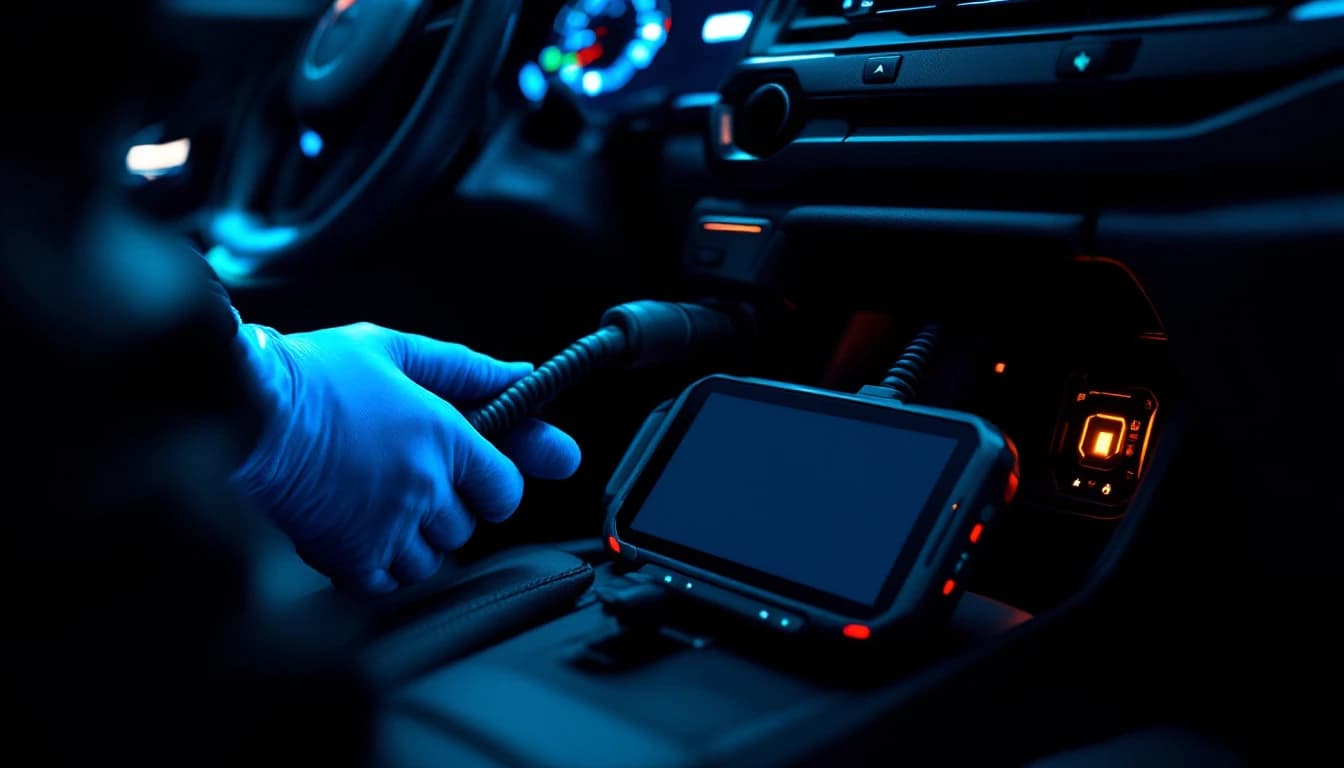
Replaced the ABS Module, Light Still On? What Was Missed
The complaint, and why the second module is rarely the problem
The ABS lamp came on. Somebody read a code, bought a module, new, remanufactured or used, bolted it on, and the lamp is still on. Sometimes a different lamp has joined it. Sometimes the car now has a hard pedal, or the speedometer is dead, or stability control has switched itself off. The temptation is to assume the replacement is faulty, send it back and buy another.
It is almost never the replacement. On a modern vehicle an ABS controller is not a part you swap; it is a part you swap and then teach the car about, and if any step in that teaching is skipped the lamp stays on no matter how good the new unit is. The eight causes below are, in our experience, the whole list, and they are in the order they should be checked. For the question of whether a module should have been fitted at all, the ABS and traction light symptom guide is the page to read first; this one assumes the swap has already happened.
1. The original codes were never re-read
The commonest miss of all. Before the swap, somebody saw an ABS lamp and read a code, perhaps only from the engine computer, and the code said something about the brake system. The module was condemned. In fact the stored codes named a wheel-speed sensor, a tone ring or a ground, and that fault is still there, because the module was never the cause.
Read the ABS controller's own codes now, with a scan tool that talks to the brake module. A code naming one corner, a wheel-speed circuit or signal at the left front, say, is a sensor, ring, bearing or harness at that wheel. A supply-voltage code is the battery, charging system or a ground. Only an internal-failure code, the C2200 class on Chrysler-group vehicles for instance, or a persistent loss-of-communication code with power proven at the module, points at the controller. Watch the four live wheel speeds while rolling; one that reads low or drops out finds the corner in a single drive. The false ABS activation guide covers that check in detail.
2. The replacement was never programmed or coded
On every anti-lock controller from the stability-control era onward, a replacement unit has to be programmed, coded or configured to the vehicle before it will work, and on many it will not even communicate properly until it is. The unit stores a vehicle configuration, the option content and tyre and axle data, the variant of the brake system it belongs to and, on most platforms, a relationship with the rest of the network. A new unit arrives blank; a used unit arrives with another car's identity. Either way the car rejects it, and the lamp stays on, often with configuration or communication codes alongside the original ABS code. The construction is the same across suppliers: Bosch, Continental and ZF, which now owns the TRW brake business, all describe their units as holding a vehicle-specific configuration that has to be written at installation, and the pass-thru tools that write it on most platforms are built to the SAE J2534 interface standard.
On General Motors vehicles this is a defined job, and it is the one we do most: GM ABS and EBCM programming at $250, which configures the replacement to the vehicle and is described step by step in the GM ABS and EBCM replacement programming guide. On other makes it ranges from coding with the factory tool to a configuration restore routine, and we tell you what your platform needs before you buy a module. On the older families, Bosch 5.3, Teves MK20, the Kelsey-Hayes 325 on the early-2000s GM trucks and the Delphi DBC-7, there is less to teach, which is why a swap on a twenty-year-old truck sometimes works where a swap on a ten-year-old car does not. The ABS module types identification guide lists which families need what.
3. The brakes were never bled properly
If the hydraulic unit came off the car, air got in, and air in an anti-lock hydraulic unit does not come out with a conventional two-person bleed. The pump and the accumulator circuits have to be cycled by a scan tool during the bleed, the automated bleed procedure on most platforms, and until that is done the pedal is soft or long, the controller may log a pressure or pump fault, and on some vehicles the lamp stays on because the self-test fails. An electronics-only swap, where the controller came off and the block stayed on the car with its lines connected, does not open the hydraulics and does not need this; a whole-assembly swap always does.
4. The sensors were never calibrated
Stability control needs to know where straight ahead is, which way is up and how hard the driver is braking. After a module replacement on many platforms the steering-angle sensor, the yaw and lateral-acceleration sensor and the brake-pressure sensor have to be calibrated or relearned, by a scan-tool routine on some vehicles and by a lock-to-lock steering relearn on others. Skip it and the stability and traction lamps stay on, sometimes with the ABS lamp off, which is the clue: an ABS lamp that has gone out while the ESP or traction lamp has not is a calibration miss, not a module fault.
5. The used module carries the donor car's configuration
A used controller from a salvage yard is not a blank part; it is another car's part. It carries that car's VIN relationship, option content, tyre data and variant coding, and some platforms will reject it outright while others accept it and behave wrongly. The fix is the programming in point two, where the platform allows it, and where it does not, a used unit was never going to work. This is one of the two reasons we would rather repair your original than program a stranger's: your own controller never lost its identity. The ABS module repair cost guide sets the arithmetic out across the four routes.
6. It is the wrong variant, even though it bolted up
Physically identical controllers exist in several variants for one vehicle, differing by brake package, drivetrain, tyre size, trailer-tow option or market. A controller for the base brake package bolts onto the block of a performance car, communicates, and gives wrong behaviour or a lamp that will not clear. The part number on the label, not the fit, decides. Before buying any replacement, match the full part number from your original's label, and on a vehicle with a trim-specific brake package treat the variant as non-negotiable.
"Half the second modules that come to me for evaluation are perfectly good. The car has a sensor code the owner never read, the unit was never configured, or nobody bled the hydraulics with a tool. The other half are used units from the wrong variant. I can count the genuinely dead replacements on one hand." — Independent chassis-electronics technician, 17+ years on ABS and stability controllers (anonymized)
7. Battery, grounds and the module's supply
A replacement controller on a weak battery or a corroded ground logs the same supply-voltage and communication codes the original did, and a loss-of-communication code can hide a blown fuse or a chafed harness that nobody checked because the module was presumed guilty. Load-test the battery, check charging voltage, prove battery voltage at the module's supply pins with the key on, and clean the ground. On a vehicle that has had water in the engine bay, pull the module connector and look for corrosion; a bad connector takes a healthy module off the bus as surely as a dead one. Do this with the replacement fitted, not from memory of the original: a connector that was marginal with the old unit is still marginal with the new one, and a fresh module seated into a corroded socket is the single most common way a correctly programmed replacement ends up reporting a communication fault on its first drive.
8. The unit that came off was never the problem
Which brings the list back to where it started. If the original controller was condemned on a single code read from the engine computer, a pulsing pedal at walking pace, or a lamp that came and went, there is a fair chance it was healthy and the fault is elsewhere. Hold on to it. If the replacement is now proven good and programmed and the lamp remains, the original can go back on with nothing to program, and the real fault, the sensor, the ring, the ground, can be found with the live data that should have been looked at first.
Working the list in order
| Step | What to check | What it costs to put right |
|---|---|---|
| 1 | Read the ABS controller's own codes and the four live wheel speeds | A scan-tool session; a sensor, ring or hub job if a corner is found |
| 2 | Confirm the replacement was programmed or coded to the vehicle | On GM, the $250 ABS and EBCM programming job; on other makes, the factory coding or configuration routine |
| 3 | Confirm a scan-tool bleed was done if the hydraulic unit was opened | An automated bleed at any shop with the tool |
| 4 | Calibrate the steering-angle, yaw and pressure sensors where the platform requires it | Usually part of the same scan-tool visit |
| 5 and 6 | Match the full part number and variant on the label against your original | A different module if the first was wrong; the reason to photograph the label first |
| 7 | Load-test the battery, check charging, prove supply and ground at the module | Often the cheapest finding on the list |
| 8 | Reconsider whether the original failed at all | A bench evaluation at $150 per hour proves it one way or the other |
The scale of the problem is simple arithmetic. The average light vehicle on U.S. roads was about 12.6 years old in 2024 according to S&P Global Mobility, electronic stability control has been required on every new light vehicle since the 2012 model year under the standard published by the National Highway Traffic Safety Administration, and every one of those stability systems runs on a controller that has to be taught about its car when replaced. The number of vehicles reaching a first ABS module replacement is at an all-time high, and so is the number of replacements done without the teaching.
The route that skips most of the list
Repairing your own controller avoids steps two, five and six entirely, usually avoids step three, and often avoids step four. Your original unit keeps the car's configuration, its variant and its network relationship, so it goes back in with nothing to program and no risk of being the wrong part, and if only the electronic side came off, no hydraulic line was opened and no bleed is needed. The ABS module repair at $499 repairs the driver stages, the pin-field solder, the connector interface and the memory on the unit you own, with a 1-year warranty and about a week on the bench; the Kelsey-Hayes 325 repair on the early-2000s GM trucks is $325. The ABS internal failure guide describes what we find inside.
That route still depends on step one. A repair, like a replacement, fixes nothing if the fault was a sensor all along, which is why we ask for the code list and the live data before the unit ships, and why we would rather tell you by text that your left front reads low than receive a healthy module.
Stability control is worth having back. The Insurance Institute for Highway Safety estimates that it cuts the risk of a fatal single-vehicle crash by roughly half, and it is disabled on most cars for as long as the ABS lamp is on. Hourly shop rates commonly reported in the low-to-mid hundreds per hour by outlets such as Kelley Blue Book are the reason the list above is worth working in order: every step skipped is another hour paid for twice.
Frequently asked questions
I replaced my ABS module and the light is still on. Is the new module bad? Almost certainly not. The usual reasons are that the original fault was a sensor, ring or ground that is still there, that the replacement was never programmed or coded to the vehicle, that the brakes were never bled with a scan tool, or that the sensors were never calibrated. Work those before condemning the second unit.
Does a replacement ABS module need to be programmed? On every stability-control era vehicle, yes. The controller stores the vehicle configuration, variant and a relationship with the network, and a new or used unit has to be taught them before the lamp will clear. On GM vehicles that is the $250 ABS and EBCM programming job; on other makes it is the factory coding or configuration routine.
Why is the ABS light off but the traction or ESP light still on after the swap? That pattern is a calibration miss. The steering-angle, yaw or brake-pressure sensors have to be calibrated or relearned after a module replacement on many platforms, and until they are, stability and traction control stay disabled even though the anti-lock function is working.
Do I need to bleed the brakes after replacing an ABS module? If the hydraulic unit came off the car, yes, with a scan tool that cycles the pump and the valves; a conventional bleed does not clear air from the ABS circuits. If only the electronic controller came off and the block stayed on the car, no hydraulic line was opened and a bleed is usually unnecessary.
Can a used ABS module from a salvage yard work on my car? Only after it is programmed to your vehicle, and only if it is the correct variant for your brake package and options. It arrives with the donor car's configuration, and on some platforms it cannot be reprogrammed at all. That is why we prefer repairing your original, whose configuration never left the car.
How do I know if my original ABS module was actually bad? Read the stored codes from the ABS controller itself and watch the four live wheel speeds. A code naming one corner is a sensor, ring or hub, not the module. If you still have the original, a bench evaluation at $150 per hour powers it up, tests its input circuits and drivers, and tells you whether it ever failed.
What does it cost to put a failed ABS module replacement right? Programming on a GM vehicle is $250; a scan-tool bleed and sensor calibration are a shop visit; a sensor or hub is a modest-to-mid-range job. If the original turns out to have been healthy, refitting it costs nothing to program. If it did fail, repairing it is $499, or $325 for the Kelsey-Hayes 325, with its coding intact.
The bottom line
A replacement ABS module that leaves the lamp on is telling you a step was skipped, not that the module is bad. Read the controller's own codes and the live wheel speeds, confirm the replacement was programmed or coded to the car, confirm the hydraulics were bled with a scan tool if they were opened, calibrate the sensors the platform requires, match the variant on the label, and prove the battery, grounds and supply. If all of that is clean and the lamp remains, reconsider whether the original ever failed. Repairing your own controller, with its coding intact, skips most of that list, which is the quiet argument for it; but nothing, repair or replacement, fixes a fault that was a sensor all along. Look at the data first.
Ship it for the gm abs / ebcm programming (k2) — $250 flat
Typical 24-Hour Turnaround, return speed your choice at checkout. Prepaid inbound label by email the minute you order.
More from the Lab
GM ABS/EBCM Replacement Needs Programming: Why
6 min · July 23, 2026
ABS Module Repair Cost: Why Quotes Range $150-$1,800
14 min · August 4, 2026

Acadia, Traverse, Enclave ABS/EBCM: Repair & Programming
13 min · October 16, 2026
Equinox, Terrain & SRX ABS Module: Codes, Cost & Repair
13 min · October 16, 2026