
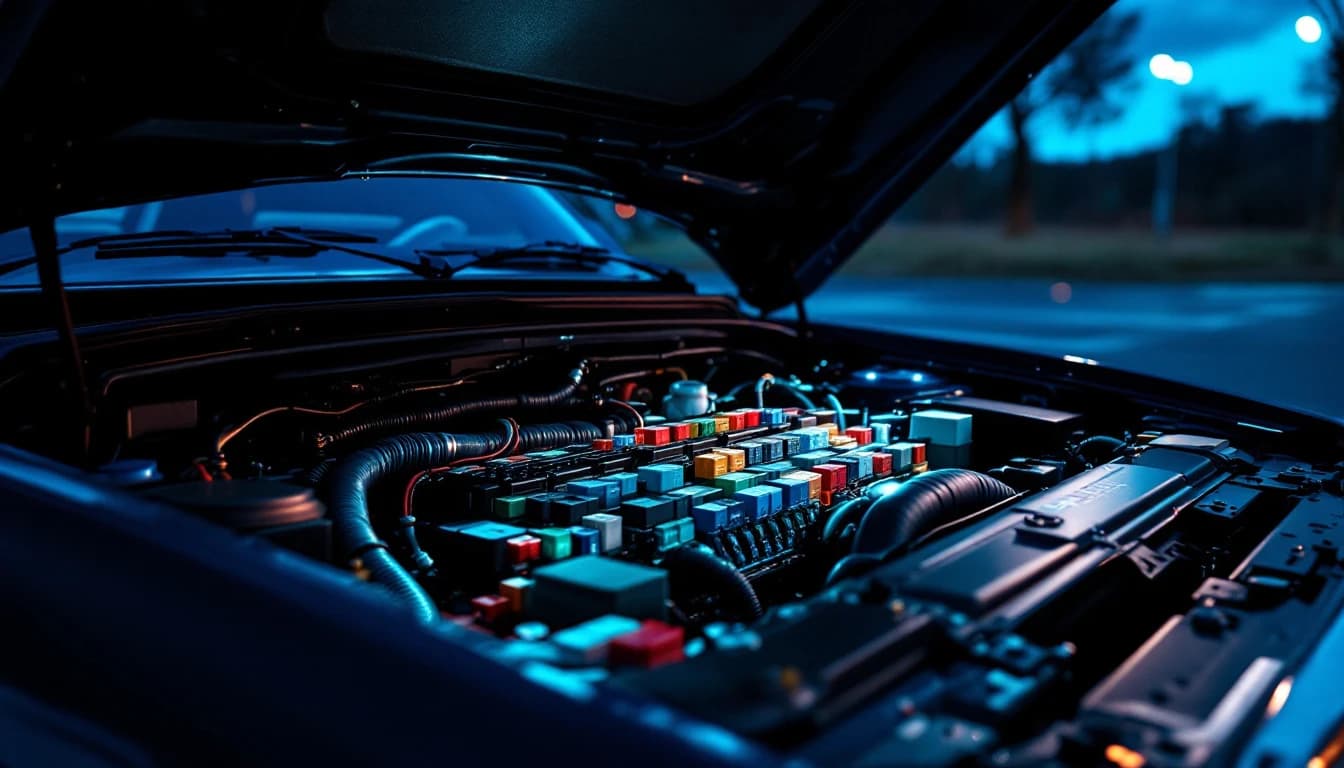
TIPM Replacement and Programming
The decision you have already made, and the one you have not
This article starts after the diagnosis. You have already worked out that the TIPM is the problem, whether that was a dead fuel pump that runs when you tap the box, wipers that sweep on their own, a horn that fires at 2 a.m., or a crank-no-start that follows the module rather than the wiring. If you are still at the symptom stage, our guide to TIPM failure symptoms on Chrysler, Dodge and Jeep vehicles is the right starting point, and if you are unsure whether the fault is even in this module, read how to work out which module actually failed before you ship it first.
The decision most people have not made yet is the one that costs them money: where the replacement TIPM comes from, and what that choice obligates them to do afterwards. There are three options, they are genuinely different jobs, and only one of them avoids programming entirely.
What a TIPM actually is
TIPM stands for Totally Integrated Power Module. On Chrysler Group vehicles from roughly the mid-2000s onward it is the box in the engine bay that combines what used to be three separate things: the underhood fuse and relay centre, the power distribution wiring junction, and a control module that sits on the vehicle data bus and makes decisions.
That third part is the whole story. Older power distribution centres were passive. Current came in, fuses divided it, relays switched it, and the relays were commanded by switches and other modules through discrete wires. A TIPM replaces most of that discrete wiring with software. The body module, the engine controller, and the TIPM talk over the CAN bus, and the TIPM decides which of its internal outputs to energize based on messages rather than wires.
The benefit is a large reduction in harness complexity and weight. The consequence is that a failure inside the TIPM can look like a failure of almost anything downstream of it, and that swapping the part is a control-module operation rather than a fuse-box operation.
The network standards underneath all of this are published by SAE International, and the on-board diagnostics that let you see any of it became mandatory when the Environmental Protection Agency required OBD-II on light vehicles sold in the United States beginning with the 1996 model year. Since then module counts have only climbed. The National Highway Traffic Safety Administration has documented that a mainstream modern vehicle commonly carries well over 50 electronic control units, and reporting from Car and Driver has put electronics and software at a large and rising share of new-vehicle cost, by some estimates approaching 40% of the value of a new car. The TIPM is one of the boxes that absorbed all that consolidation.
Why a TIPM is not plug and play
Three reasons, and each one on its own is enough.
It carries the VIN. The module stores the vehicle identification number, and other modules on the bus compare it. A TIPM with the wrong VIN produces stored faults and, on many models, functional refusals rather than a clean start.
It carries a build configuration. Which outputs it drives, which options it expects to see, and how it behaves are set by configuration data that matches the vehicle's factory build. Fog lamps, trailer tow package, remote start, security alarm, heated mirrors, automatic headlamps, and the specific fuel pump control strategy are all configuration-dependent. A donor from a differently optioned truck can be electrically identical and behaviourally wrong.
It participates in the security chain. On many Chrysler, Dodge, Jeep and Ram models the TIPM sits between the immobilizer module and the systems that actually let the engine run, and in some model years the immobilizer function is integrated into the TIPM itself rather than living in a separate box. That makes a TIPM swap security work, with everything that implies.
Add those together and the picture is clear. Fitting a used TIPM and expecting the truck to start is the same optimism that produces a garage full of used engine controllers that crank and never fire. If you want the general version of that lesson, our piece on why used module swaps fail to be plug and play covers it across brands.
The fuel pump relay story, and why TIPMs got famous
The reason a fuse box has a reputation at all comes down to one internal relay.
On a large population of 2007 to 2014 Chrysler Group vehicles, the fuel pump relay integrated into the TIPM developed a well-documented failure mode. The relay contacts degrade, the solder joints under the relay on the TIPM board suffer heat cycling, and the relay either fails to close, closes intermittently, or in the worst case sticks closed and keeps the fuel pump energized with the key off. The symptoms range from an intermittent no-start to a stall while driving to a drained battery overnight.
This became a safety matter rather than an inconvenience. NHTSA recall records document a Chrysler recall covering roughly 188,000 vehicles for a TIPM-related fuel pump relay condition that could cause an engine stall, and the agency's complaint database carries a large volume of related owner reports across the affected model range. Consumer coverage followed: Consumer Reports and MotorTrend have both written about TIPM reliability on Chrysler Group vehicles, and the issue became prominent enough that resale guides from Kelley Blue Book and vehicle history services like Carfax are worth checking when buying an affected-year vehicle.
The important technical point for anyone shopping for a replacement: the famous failure is usually a component-level failure on the board, not a design failure of the whole module. That distinction is exactly what makes rebuilding a viable third option.
Relay-level fault versus board-level fault
These are not the same problem and they do not have the same fix.
A relay-level fault is confined to one internal relay and its solder joints. The relay contacts are pitted or welded, or the joints under the relay have cracked from heat cycling and current. Everything else on the board is healthy. This is the classic fuel pump relay case, and it is repairable at component level: the failed relay is desoldered and replaced with a new part, the pads and traces are inspected and repaired, and the joints are reflowed properly.
A board-level fault is broader. Water intrusion through a failed seal or a cracked case, corrosion across a connector, a failed driver transistor, a cooked trace, a damaged microcontroller, or physical damage from a jump-start reversal. Some of this is repairable and some of it is not, and honest evaluation is the difference between a fixed truck and a wasted month.
How to tell them apart before you ship anything: a relay-level fault is usually circuit-specific and repeatable. One system misbehaves, the others are fine, and the fault often responds to temperature or to tapping the box. A board-level fault tends to be multi-circuit, or to come with communication faults, or to arrive alongside visible corrosion at the connectors. It is not a perfect rule, and this is exactly the sort of thing a bench evaluation resolves in an hour instead of by guesswork.
Why bypass harnesses are a band-aid
The aftermarket answer to the fuel pump relay problem is a bypass harness: an external relay, usually with an inline fuse, that takes the fuel pump circuit out of the TIPM and switches it separately.
It works, in the narrow sense. The pump runs, the truck starts, and the immediate problem stops. There are situations where it is a defensible temporary measure, especially on a vehicle stranded far from anywhere.
It is still a band-aid, and here is why:
- It does not repair the module. The degraded relay and the compromised solder joints are still in the box. If the failure is spreading, it keeps spreading.
- It leaves a stuck-closed failure mode partially in play on some installation styles, depending on where the bypass takes its trigger signal.
- It adds an unfused or differently fused external circuit to an engine bay, often with crimp connections that were never designed for underhood heat and vibration.
- It confuses the next diagnosis. The next technician who works on the vehicle finds a factory circuit that no longer behaves like the wiring diagram.
- It does nothing for the other circuits in the same module that may be heading the same way.
A permanent fix either repairs the board properly or replaces the module properly. The bypass is what gets you home.
What a bench rebuild actually replaces
This is the option most people do not know exists, and it is the one that avoids programming entirely.
Rebuilding your own TIPM on the bench means the module keeps its original VIN, its original build configuration, and its original security data. Nothing has to be written, nothing has to be virginized, and no key relearn is required, because from the vehicle's point of view the same module went away and came back healthy.
A proper rebuild typically covers:
- Replacing the failed relays with new components rather than reflowing tired ones, including the fuel pump relay that started the whole reputation.
- Repairing the solder joints under high-current components, which is where heat-cycling damage concentrates.
- Inspecting and repairing traces and pads that have been damaged by heat or by a previous attempt at repair.
- Replacing failed driver components on output circuits where a transistor or driver has gone down.
- Cleaning and treating corrosion at connector interfaces, and evaluating whether corrosion has wicked into the board.
- Bench testing outputs under load rather than just confirming the module powers up.
That work is the TIPM repair service for Chrysler, Dodge and Jeep at $299, and the service-level detail lives in our TIPM repair guide. What matters for this article is the consequence: a rebuilt original needs no programming, no configuration, and no key relearn.
"Nine out of ten TIPMs that land on my bench have one bad relay and a set of tired solder joints under it. The customer has already been quoted a new module plus programming plus a tow, and the actual repair is component-level work on a board that is otherwise fine. The ones I cannot save are the water-damaged ones, and you can usually see that before you power it up." — Independent Chrysler and Ram electrical technician, 16+ years (anonymized)
The three sourcing options, compared
| New from dealer | Used or salvage donor | Rebuild your own unit | |
|---|---|---|---|
| Arrives with | Blank or generic factory data, no VIN | The donor vehicle's VIN, configuration, and security data | Your vehicle's correct data, unchanged |
| VIN programming | Required | Required after virginizing or data transfer | Not required |
| Build configuration | Must be written to match your vehicle's options | Must be corrected unless the donor is an exact build match | Already correct |
| Security and immobilizer | Must be aligned, key relearn commonly required | Donor security data must be cleared, then aligned and keys relearned | Untouched, keys keep working |
| Part number matching | Must be correct for the build | Must be correct for the build, and the build itself must match | Not applicable |
| Risk of a wrong donor | None | High, this is where most failed attempts happen | None |
| Original failure removed | Yes | Unknown, donor may be heading toward the same fault | Yes, at component level |
| Proof of ownership | Required for security-linked steps | Required for security-linked steps | Required for security-linked steps |
Reading that table left to right is the argument for reading it right to left. Rebuilding the original is the only column with no programming obligations and no donor risk, and it is the only one where the failure that actually happened is the failure that actually gets fixed.
A fourth route: a replacement that arrives already programmed
As of October 2026 there is one more option the table above does not show, and it exists for the cases where rebuilding is off the table: the original is burned, flooded, missing, or already replaced by a donor the vehicle refuses. Our TIPM programmed to your VIN service supplies the module itself with your VIN written on the bench and the configuration matched, so you send nothing in and it arrives ready to install. Pricing starts at $599 for the common 2011-2013 part numbers and is confirmed against your exact module before you order, because donor cost varies more on TIPMs than on any other module. It removes the two steps that sink most used-TIPM attempts, the VIN write and the configuration match, but it does not change the first rule of this article: if your only symptom is the fuel pump circuit, ask before you buy a whole module, because a $299 repair of your original is usually the right-sized fix. For how the TIPM options sit next to every other Chrysler-group module, see the Chrysler, Dodge and Jeep module programming cost guide.
Sourcing a used TIPM without wasting money
If a rebuild is genuinely off the table, because the module is water-damaged or physically destroyed, a used unit can work. It just has to be the right used unit.
Match the part number exactly. Chrysler Group TIPM part numbers change with model year, powertrain, and equipment level. A number that is one digit off can be a different output map.
Match the build configuration, not just the vehicle. Two same-year trucks can differ in trailer tow wiring, fog lamps, remote start, alarm, and fuel system control. The closer the donor's build is to yours, the less configuration has to be rewritten and the fewer surprises appear later.
Ask about the donor's history. A TIPM pulled from a flood vehicle or a fire vehicle is not a bargain. Vehicle history data from Carfax is worth a look when a donor's provenance is known.
Assume it needs work before it works. A used TIPM has to be virginized, or have your data transferred onto it, and then configured and aligned to your vehicle. Budget for that at the start, not after the box arrives.
Do not assume it is healthy. A donor from the same failure-prone year range has the same relays and the same heat-cycled joints. Buying a used TIPM to replace a failed TIPM sometimes just resets the clock.
The SKIM and SKREEM interaction
On Chrysler Group vehicles the immobilizer is called SKIM (Sentry Key Immobilizer Module) or SKREEM (Sentry Key Remote Entry Module), depending on model and year, and on several platforms its function is integrated into or tightly coupled with the TIPM.
The chain works like this. The key transponder is read by an antenna ring at the ignition. The immobilizer module validates it. The immobilizer module then tells the engine controller that the key is authorized. The engine controller allows fuel and spark. Where the TIPM sits in that chain varies by model, but on integrated platforms it is directly in it, which is why a TIPM swap on those vehicles produces a crank-no-start with a flashing security indicator until the security data is aligned and the keys are relearned.
Two practical consequences follow.
First, a TIPM job on an integrated platform is a key job. Plan for a key relearn, and tell us how many working keys you have at intake, because on some procedures all keys are written at once and any key that is not present stops working.
Second, proof of ownership is required, without exception. Anything that results in a vehicle accepting keys is security work. That applies to the Chrysler SKIM and Sentry Key delete service at $250 as well, which exists for legitimate repair situations, off-road and competition vehicles, and orphaned cases where the original security data is genuinely unrecoverable. It is not a shortcut around a lost key, and the customer is responsible for compliance with local, state and federal law.
If your vehicle is currently a crank-no-start and you are not yet certain whether you are looking at an immobilizer problem or a power-distribution problem, our guide to telling an immobilizer no-start apart from a module failure separates the two, and the Dodge, Ram and Jeep no-start walkthrough covering TIPM, PCM and SKIM together covers the specific three-way confusion these vehicles produce.
The reason all this security exists is the obvious one. The National Insurance Crime Bureau reports vehicle theft in the United States running into the hundreds of thousands of vehicles per year, and the Federal Bureau of Investigation tracks motor vehicle theft as one of the more common property crimes in the country. Immobilizer chains got tighter because the pressure never let up.
Where the PCM fits, and when it needs work too
A TIPM job sometimes turns out to be a TIPM plus PCM job, and it is better to know that at the start.
On these vehicles the powertrain control module is its own security participant, and a PCM that has been replaced or that carries the wrong VIN produces its own no-start regardless of what the TIPM is doing. Where the PCM needs stock factory calibration written or an OEM-level reprogram, the Mopar stock OEM reprogramming service at $350 covers that side of the work, and our Mopar stock OEM reprogramming guide explains what that job includes.
The interaction to watch for is the one where a customer replaces two modules at once, gets a no-start, and cannot tell which of the two caused it. Changing one variable at a time is old advice and it is still correct.
After the module goes back in and it still will not start
It happens, and it is usually one of a short list of things: the VIN was written but the configuration was not, the security alignment was completed but the keys were never relearned, the donor's build configuration does not match the vehicle, a second module in the chain is also faulty, or the original diagnosis was wrong and the TIPM was never the problem. We wrote the full triage sequence in what to check when a module has been programmed and the car still will not start, and it is the right next read if you are staring at a freshly fitted module and a cranking engine.
The honest limits
A flood-damaged or fire-damaged TIPM is usually not economically repairable. Corrosion wicks along traces and under components in ways that are not visible from the top of the board, and a repair that looks good can fail weeks later. We say so after evaluation rather than taking the job on hope.
Some late-model configuration steps require online factory access. On newer platforms with tighter component protection, certain authorization or configuration operations are designed to be completed only through the manufacturer's secure systems. That is architecture, not an obstacle a clever tool routes around, and we identify those cases at intake.
Configuration cannot create hardware. Writing a trailer tow configuration into a TIPM does not install trailer tow wiring. Options can be enabled only where the vehicle can actually support them.
A used donor from the wrong build family is a dead end. Part number families change with model year and equipment, and configuration cannot bridge a hardware generation gap.
Software does not fix a mechanical relay. If the relay contacts are welded, the answer is a new relay, not a reprogram.
The mail-in workflow
This is a nationwide mail-in bench workshop. The sequence is the same wherever you are.
- Message the lab before you remove anything. Send the VIN, year, make, model, engine, the TIPM part number from the label, a clear photo of that label, a description of the symptom, whether the unit is your original or a donor, and how many working keys you have.
- Provide proof of ownership. Required for anything touching immobilizer or key data.
- Ship what we ask for. Usually the TIPM alone. On some jobs the immobilizer module or a working key as well. Pack the module in an anti-static bag inside a padded box, and protect the connector faces.
- Ship to the carrier-correct address. USPS: PO Box 120241, Arlington, TX 76012. UPS or FedEx: 1009 Oakwood Ln # 120241, Arlington, TX 76012. Couriers cannot deliver to a PO Box, so use the street address for UPS and FedEx.
- Bench evaluate. The module is powered on a regulated bench supply, outputs are tested, and the board is inspected before any decision is made. This is where relay-level and board-level faults get separated.
- Repair, or program and configure. A rebuild replaces the failed components and preserves all original data. A replacement unit gets the VIN, configuration, and security alignment it needs.
- Bench verify. Communication and output behaviour are checked under load before anything is packed.
- Return with tracking. Return shipping is a flat-rate tier you choose at checkout, from $29.95, with faster options available.
Frequently asked questions
Does a replacement TIPM have to be programmed? Yes, unless it is your own original unit rebuilt on the bench. A new or used TIPM has to receive the vehicle VIN and the build configuration that matches your options, and on platforms where the module participates in the immobilizer chain it also needs security alignment and a key relearn. Only a rebuilt original arrives with all of that already correct.
Can I install a used TIPM from the same year and model? Only after it has been virginized or had your vehicle's data transferred onto it, and only if the part number and build configuration actually match. Two same-year vehicles can differ in trailer tow wiring, fog lamps, remote start and alarm equipment, and those differences live in configuration data that has to be corrected before the module behaves properly.
Is a fuel pump relay bypass harness a permanent fix? No. A bypass moves the fuel pump circuit outside the module so the truck runs, but the degraded relay and the heat-damaged solder joints are still in the box and other circuits in the same module may be heading the same way. It is a reasonable way to get a stranded vehicle home, not a repair.
Why does my truck crank but not start after replacing the TIPM? Most often because the security side of the job was not completed. On Chrysler Group platforms where the TIPM participates in the immobilizer chain, the module has to be aligned to the vehicle and the keys relearned before the engine controller is authorized to run. A flashing security indicator during cranking points straight at that.
Can a TIPM be repaired instead of replaced? Frequently, yes. The most common TIPM failures are component-level, typically a degraded internal relay and the heat-cycled solder joints beneath it, on a board that is otherwise healthy. Bench repair replaces those components and preserves the original VIN, configuration and security data, so no programming or key relearn is needed afterwards.
What cannot be repaired on a TIPM? Water damage and fire damage are the usual dead ends, because corrosion travels along traces and under components where it cannot be seen and a repair that tests good can fail weeks later. Severe physical damage to the case or connector, a failed microcontroller, or extensive trace loss from a previous repair attempt also commonly end in replacement.
Do I need to send my keys with the TIPM? Sometimes, and you should always tell us how many working keys you have at intake. On integrated-immobilizer platforms a key relearn may be part of the job, and on some procedures every authorized key is written at once, which means a key left in a drawer at home stops working. Proof of ownership is required for all key and immobilizer work.
The bottom line
A TIPM is a control module wearing a fuse box's clothes. It carries the VIN, it carries a build configuration that decides which circuits and options it drives, and on many Chrysler, Dodge, Jeep and Ram platforms it sits inside the immobilizer chain. That is why the sourcing decision drives the whole job.
Rebuild your own unit and nothing has to be programmed, because the original VIN, configuration and security data never leave the module. Buy new and everything has to be written, VIN, configuration, and security alignment with a key relearn. Buy used and you inherit another vehicle's identity, which has to be removed before yours can be written in, on a donor that has to match by part number and by build configuration, and that may be carrying the same tired relays yours failed on.
The famous fuel pump relay failure that made TIPMs notorious is a component-level problem on an otherwise healthy board far more often than it is a dead module, which is exactly why bench repair is worth evaluating before you buy anything. Bench pricing is public: $299 for TIPM repair on Chrysler, Dodge, Jeep and Ram, from $599 for a replacement TIPM programmed to your VIN, $250 for Chrysler SKIM and Sentry Key delete, and $350 for Mopar stock OEM reprogramming, with return shipping chosen at checkout from $29.95. Proof of ownership is required for all security-linked work.
If you are holding a quote for a new module and a tow right now, send the VIN, the part number from the TIPM label, and a description of exactly which circuits misbehave. A bench evaluation answers the repair-or-replace question for real, and it is cheaper than finding out the hard way. And if the complaint is a FOBIK key that will not turn or a no-crank with the dash lit rather than dead circuits, read the WIN module diagnosis guide first, because that is a different module with a different fix.
Ship your module today
Flat-rate pricing, typical 24-hour bench turnaround, return speed your choice at checkout. Most jobs back on your bench within a week.
More from the Lab
Chrysler, Dodge, Jeep Module Programming Cost (2026)
15 min · October 2, 2026
TIPM Replacement: Why a Used Chrysler TIPM Won't Work
10 min · July 30, 2026
TIPM Repair Chrysler Dodge Jeep Ram 2007-2018: Mail-In 2026
12 min · June 18, 2026

FOBIK Key Won't Turn or No Crank? WIN Module Diagnosis
14 min · October 2, 2026