
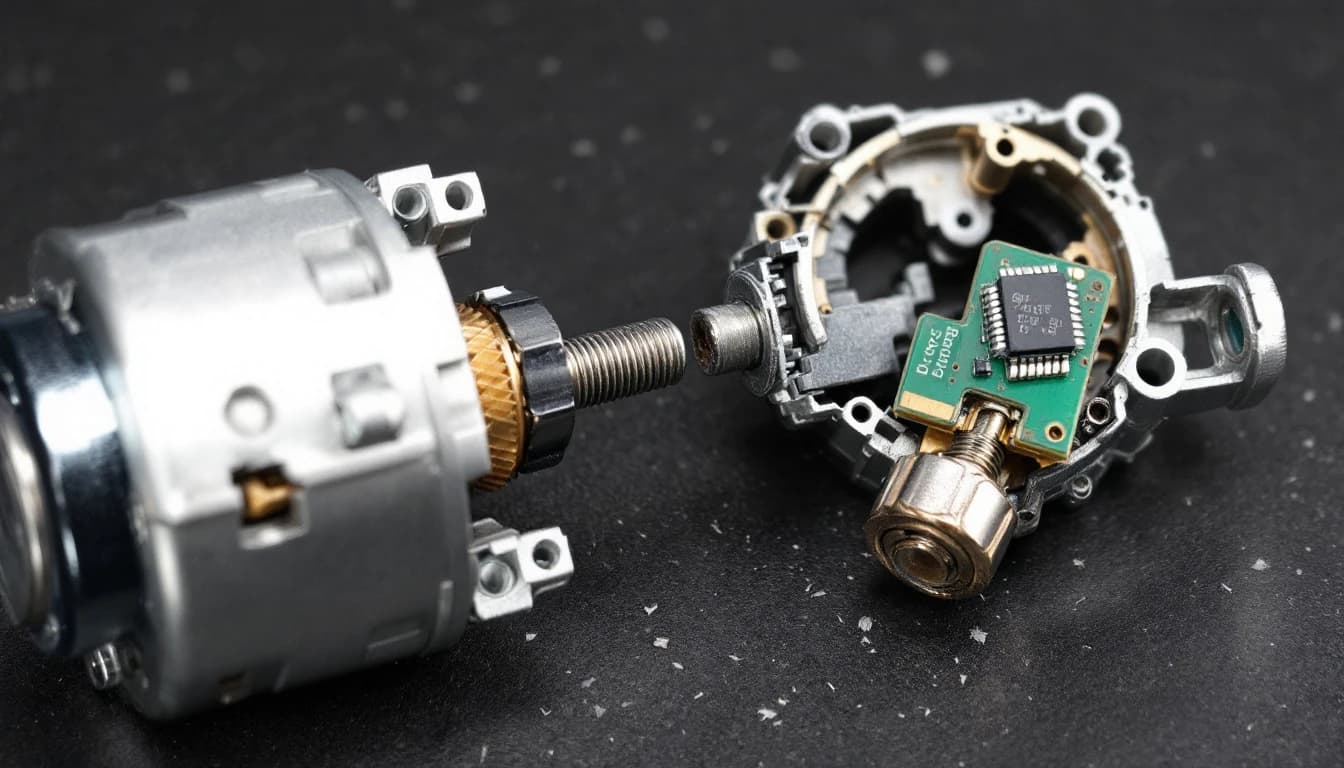
VW / Audi ELV / ESL Electronic Steering Lock Failure
The failure everybody describes the same way
The wording changes but the story does not. You put the key in, or press start, and one of these happens:
- The engine cranks perfectly well, but the steering wheel stays locked solid and the car will not run
- Nothing happens at all — no crank, no attempt — and the dash lights up with a steering column lock malfunction message
- The column released fine yesterday, locked itself in a parking lot today, and now the car is stranded where it sits
- The lock cycles noisily, engages and disengages several times, then throws a fault
- A shop already replaced the module with a used one from a breaker and the car is in exactly the same state, sometimes worse
Every one of those is the electronic steering lock. On the Audi A6, S6, RS6 and Allroad of the C6 generation (roughly 2005 to 2011) and the first-generation Q7 (4L, roughly 2007 to 2015), that assembly is a well-known wear item, and it is the reason a perfectly healthy engine, battery, starter and key can add up to a car that will not move.
This guide is about what the module actually is, why it fails in two very different ways, why the obvious fix — buy another one — usually does not work, and what a bench clone genuinely transfers. If you are still at the stage of not knowing whether your no-start is the immobilizer, the steering lock, or something else entirely, start with our immobilizer vs module no-start diagnosis walkthrough first and come back here once the steering lock is the suspect.
What the ELV actually is on a VW or Audi
ELV is the German abbreviation — Elektrische Lenkungsverriegelung. In English-language documentation and scan-tool text it usually appears as ESL, the electronic steering lock. Both names describe the same thing, and both are used interchangeably by owners, forums and shops.
Mechanically it is simple: a small electric motor drives a hardened bolt into a slot on the steering shaft. Bolt in, the column is locked. Bolt out, the column turns. That is the entire job.
Electronically it is not simple at all, and that is the part people underestimate. The steering lock on these platforms is not a dumb solenoid on a wire. It is a networked control unit with its own microcontroller and its own memory, mounted in the access and start authorization control head — the assembly VAG service literature identifies as J518, with the dedicated steering-column-lock controller appearing as J764 on platforms that split the function into a separate unit. Depending on the exact build, it sits on the vehicle's CAN or LIN network and talks to the immobilizer, the engine control unit and the instrument cluster.
Those two networks are not interchangeable, which matters when you are trying to work out why a scan tool can see part of the car and not the rest. Bosch, which developed CAN, describes high-speed CAN carrying data at rates up to roughly 1 Mbit/s, while the low-cost LIN sub-buses used for simple actuators and switches typically run three orders of magnitude slower, on the order of 20 kbit/s. A steering lock reached over one of those is a very different diagnostic problem from one reached over the other.
That networking is the whole reason electronic steering locks exist. Regulators and insurers pushed the industry toward theft deterrence that could not be defeated by attacking a mechanical key barrel, and the electronic lock, paired to the immobilizer, was the answer. The broader case for immobilizer-grade theft deterrence is well documented — the National Insurance Crime Bureau, which has tracked vehicle theft for decades, has reported U.S. vehicle thefts running to well over 700,000 units in a single year, and has repeatedly noted that platforms with strong electronic start authorization are attacked differently than those without. The trade-off owners live with is that a security device this deeply integrated cannot be casually swapped.
The scale explains why these modules turn up so often on a bench. Audi has reported annual global deliveries on the order of 1.7 million vehicles or more in recent years, and the C6 and 4L platforms sold in volume across a long production run. When a common wear item lives on a platform that large, it stops being an obscure fault and becomes a category of work.
Why the electronics matter more than the metal
It is tempting to think of the ELV as a lock with a motor on it. It is closer to a small computer with a lock attached.
Modern premium cars carry an enormous amount of distributed electronics — component suppliers such as Continental and Bosch have described well over 50 networked electronic control units in a typical premium vehicle, with the highest-content models running considerably more. Each of those units is expected to answer when addressed. If the steering lock stops answering, or answers with an implausible state, the modules that depend on it will refuse to authorize a start. The car is not being difficult; it genuinely does not know whether the column is locked.
This is also why so many of these cases produce a confusing mix of symptoms. A column that is physically unlocked but whose controller cannot report that fact is functionally identical, to the rest of the car, to a column that is jammed shut.
Failure mode one: the locking mechanism
The first dominant failure is mechanical. The bolt, the motor, the gear train and the position sensing that tells the controller where the bolt actually is all wear.
What that looks like in practice:
- The motor runs but the bolt does not fully retract, so position feedback never reaches the unlocked state and the controller reports a fault
- Grease has hardened over a decade of heat cycles and the bolt binds
- The bolt retracts but the sensing that confirms it has become unreliable, producing intermittent faults that come and go with temperature
- Column loading matters — a wheel left under tension against the lock bolt makes retraction harder, which is why some cars release if you rock the steering wheel and others do not
Mechanical failure tends to announce itself with noise. Owners describe a whirring, a repeated clacking, or several audible attempts before the fault message appears. If the module is audibly trying and failing, the mechanism is the prime suspect.
Age is the driver here. Industry reporting compiled by outlets including Car and Driver puts the average age of vehicles on U.S. roads at well over 12 years, which means a large share of C6 and 4L cars are now operating far beyond the point where a motorized lock assembly cycled tens of thousands of times can be assumed healthy.
Failure mode two: the electronics
The second dominant failure is the board itself, and it is at least as common.
The steering lock module lives in a hostile spot — column heat, vibration transmitted directly from the road and the steering system, and thermal cycling every single time the car is used. The classic outcome is solder fatigue: cracked joints at the motor driver, at connector pins, or around components with mass that vibrates against a rigid joint. Alongside that you see failed driver stages, damaged voltage regulation, and corrupted memory after a brownout.
Electrical failure tends to be silent. No motor noise, no attempt, just a fault message or a dead unresponsive module. If the lock makes no sound at all and the car reports a steering-lock malfunction, the electronics are the prime suspect.
Two related points matter enormously here, because they decide whether a replacement module survives:
Voltage quality. A weak battery, a failing alternator diode putting AC ripple onto the DC system, or a corroded ground path will damage the replacement exactly the way it damaged the original. This is not theoretical; it is the single most common reason we see a customer's second module fail. Before you spend anything, read why charging-system and ground faults keep killing replacement modules and go test the car's electrical foundation.
Jump starts and boosts. An overvoltage event during a badly executed jump start can take out a column module along with everything else on the bus.
One bench technician who works on these weekly put it plainly:
"Half the steering locks that come across my bench are not worn out at all — the mechanism is fine and the board is dead. And a good number of the dead boards were killed by the car, not by age. If the customer does not fix the charging system, I am going to see that same car again with the new module dead in it." — Independent European-marque module technician, 14+ years on VAG platforms (anonymized)
Why a used ELV is plug-and-play hostile
Here is the part that costs people the most money.
The steering lock is a security component. It is tied to the specific vehicle it came from through the same component-protection and start-authorization relationship that governs the immobilizer. A module pulled from a donor car carries the donor's relationship, not yours. Bolt it in and one of three things happens:
- It refuses outright and you sit in the same fault, several hundred dollars poorer
- It half-works — the column releases but the car will not authorize a start, or the fault returns after a sleep cycle
- It appears to work briefly and then locks the car in a worse state than before
This is the same structural problem that makes used engine controllers, clusters and body modules fail to drop in across the VAG range. If you want the underlying mechanism explained properly — how VIN association, security access and stored identity data actually work on modern Bosch-family VAG controllers — our guide to VW and Audi newer ECU immo-off and cloning covers the same territory on the engine-management side, and the logic transfers directly.
The mistake worth naming: buying a used module is not wrong. Buying a used module and expecting it to install itself is.
What a bench clone actually transfers
Cloning solves the problem by moving the identity rather than the hardware.
Your original module comes to the bench. It is powered on a regulated supply, communication is established, and its stored data — the part that ties it to your car — is read out and archived. That data is then written onto the new or donor module you supplied. What goes back to you is physically a different unit that your car regards as the original.
Concretely, that means:
- The replacement carries your vehicle's stored relationship, not the donor's
- No dealer adaptation session is required for a clean clone of a readable original
- The mechanical assembly you receive is new or known-good, so a worn bolt and motor are gone
- Part numbers must match, which is why we verify the number before you buy anything
There is an important caveat, and we would rather you hear it now than after shipping. If the original module's memory is unreadable, a clone is not possible. Physically destroyed memory has nothing to copy. In that case the job shifts to preparing the replacement so it can be coded to your car instead. Tell us up front if your original is completely dead, because it changes what you should ship and what to expect.
The three real options, compared
| Bench clone of your original | Bare used module installed as-is | Dealer replacement | |
|---|---|---|---|
| Carries your car's security relationship | Yes — copied from your original | No — carries the donor's | Yes — written by the dealer |
| Dealer adaptation session needed | No, on a clean clone | Usually yes, and often refused | Included, by definition |
| Works if your original memory is unreadable | No — shifts to a prepared-replacement path | No | Yes |
| Mechanism replaced | Yes, you install a new or known-good unit | Yes, but unknown wear history | Yes |
| Vehicle has to be present | No — mail the module in | No, but it will not work | Yes — car goes to the dealer |
| Part-number match required | Yes, verified before you buy | Yes, and rarely checked | Handled by the dealer |
| Our price | $250 flat, typical 24-hour bench turnaround | Cost of a module you may not be able to use | Highest of the three |
The economics matter because repair affordability is real. AAA has reported that roughly one in three U.S. drivers could not cover an unexpected repair bill of several hundred dollars without borrowing. Buying a used module that cannot work, then paying again for the correct path, is precisely the outcome that budget cannot absorb.
Proof of ownership is required — no exceptions
The electronic steering lock is a theft-deterrent device tied to the immobilizer. Work on it is security work.
We require proof of ownership on every ELV / ESL order. That means documentation tying the vehicle to the person ordering — title, registration, or an equivalent record, along with the VIN. If you are a shop working on a customer's car, we accept the shop's documentation of the job along with the customer's vehicle paperwork.
This is not a formality we apply reluctantly. Start-authorization components are exactly the parts a stolen-vehicle operation needs, and the National Highway Traffic Safety Administration maintains a public complaint database holding well over 1 million owner-filed vehicle complaints, a body of record that makes the consequences of sloppy handling of security components very visible. Any bench service that will do immobilizer-adjacent work without checking who owns the car is a service you should not be sending your parts to.
What to ship, and how the mail-in job runs
Auto Module Lab is a nationwide mail-in bench service. You never bring a vehicle anywhere; you send a part from wherever you are.
- Text us first, before you buy anything. Send your VIN, the year and model, the part number off your original module if you can reach it, and a photo of the label. We confirm the platform and the part-number match. If your candidate replacement is wrong, you find out before you spend money on it.
- Tell us the condition of the original. Specifically: does the lock make noise when you try to start, or is it silent? Silent usually means the board; noisy usually means the mechanism. And tell us if the original is completely dead, because that decides clone versus prepared-replacement.
- Pull the module and pack it properly. Anti-static bag, then padded box with the module immobilized so it cannot move in transit. Connector pins get bent by loose packing more often than you would think.
- Ship it. USPS goes to PO Box 120241, Arlington, TX 76012. UPS and FedEx cannot deliver to a USPS PO Box, so those go to 1009 Oakwood Ln # 120241, Arlington, TX 76012. Include your original module, the new or donor replacement if you want the clone transferred onto it, your VIN, proof of ownership, a printed order confirmation, and your name and return address.
- Bench work. The module is powered on a regulated supply, the original data is read and archived before any change, and that data is written to the replacement. The result is verified on the bench before it leaves.
- Return with tracking. The module ships back on the flat-rate return tier you chose at checkout — Standard at $29.95 for 3 to 5 business days, UPS 2nd Day Air at $54.95, or UPS Next Day Air at $94.95. Return shipping is chosen and paid by you at checkout; we buy and email you a prepaid inbound label so the trip to us is handled.
Bench work is performed at our workshop at 1168 W Pioneer Parkway, Arlington, TX 76013. That is where the work happens — it is not the mail-in address. Use the shipping addresses above.
One sentence on Mercedes, then back to VAG
Because it comes up constantly: Mercedes electronic steering locks are a different animal with a different fix, generally handled through an ELV emulator programming service at $350 rather than a data clone, so do not apply anything in this article to a W204 or W207.
Everything above is VW and Audi specific. If your platform is not an A6 C6 or Q7 4L, text us the VIN and part number before assuming coverage — VAG used several steering-lock architectures across the range and we confirm the match rather than guessing at it.
Diagnose before you pull anything
A steering lock fault is easy to assume and worth confirming. Before the column comes apart:
- Check battery voltage properly, under load, not just resting. A marginal battery produces module faults across the car.
- Scan the network, not just the engine module. You want the fault stored in the steering-lock and start-authorization addresses, not an inference from a no-start.
- Listen. Silent versus noisy is genuinely diagnostic, and it costs nothing.
- Rule out the key and immobilizer side. A key that is not being read produces a no-start that can look similar from the driver's seat.
- Check whether the fault is current or stored. A historic steering-lock code from a flat battery two winters ago is not a reason to replace anything.
If the cluster is also acting up, or the car has a history of dash work, note that VW and Audi clusters hold immobilizer data too — a VW/Audi cluster clone is a separate service and a separate diagnosis, and mixing the two problems together is a good way to replace the wrong part.
Frequently asked questions
What is the difference between the ELV, the ESL, and J518? They describe the same functional area. ELV is the German abbreviation for the electronic steering lock, ESL is the English one, and J518 is the VAG designation for the access and start authorization control head that carries the lock on these platforms, with J764 appearing where the steering-lock controller is a separate unit. Owners, shops and scan tools use all of these terms for the assembly that locks and releases your steering column.
Why will a used steering lock from a breaker not just bolt into my car? Because the module carries a security relationship to the specific vehicle it came from, tied to the immobilizer and start authorization. Installed as-is, a donor unit typically leaves you in the same fault, or in a worse one where the column releases but the car still refuses to authorize a start. The identity data has to be moved onto it, which is what a bench clone does.
My steering lock makes noise but the column never releases. Is that different from a silent one? Yes, and the difference is useful. Noise means the motor is being driven and the mechanism is failing to complete the movement or report its position, which points at the mechanical assembly. Complete silence with a fault message points at the board — solder fatigue or a failed driver stage. Tell us which one you have when you text us, because it shapes what we expect to find.
What if my original module is completely dead — can you still clone it? Only if its memory can still be read. A module that is electrically dead at the connector may still have readable memory, and often does; a module with physically destroyed memory has nothing to copy. If a clone is not possible, the job shifts to preparing your replacement so it can be coded to your car instead. Tell us up front that the original is dead so we set the right expectation before you ship.
Do I need to send the car anywhere, or can this be done by mail? This is entirely a mail-in bench service, nationwide. You remove the module, ship it to us, and reinstall the one we send back — the vehicle never leaves your driveway or your shop. That is the whole point of doing the work on a bench with a regulated power supply instead of in a column with a marginal battery.
Do you really need proof of ownership for a steering lock? Yes, always. The electronic steering lock is a theft-deterrent component tied to the immobilizer, so we require documentation connecting the vehicle to whoever is ordering, along with the VIN. Any shop or service willing to do this class of work without verifying ownership is one you should be cautious about using.
How long does the whole thing take? Bench turnaround is typically 24 hours once your module arrives, plus transit each way. The realistic end-to-end window is driven by shipping, which is why the return tier you pick at checkout matters — Standard at $29.95 runs 3 to 5 business days, and there are 2nd Day and Next Day options if the car is blocking a bay.
The bottom line
An Audi C6 or Q7 4L that cranks but will not release its steering column, or that greets you with a steering column lock malfunction, is almost always the electronic steering lock — either a worn and binding mechanism or a fatigued board, and the noise it makes while failing usually tells you which. What it is not is a part you can buy used and bolt in, because that module carries a security relationship to the car it came from.
The bench clone moves your original module's data onto a new one so your car accepts it as its own, no dealer adaptation session, at $250 flat with a typical 24-hour bench turnaround once it arrives. Proof of ownership is required because this is immobilizer and security work, part numbers are verified before you buy anything, and return shipping is chosen and paid at checkout from $29.95.
Fix the car's electrical foundation first, confirm the fault is actually stored against the steering lock, then text us your VIN and a photo of the module label. See the Audi ELV / ESL steering lock clone service page for what to ship, or browse the full bench services list if you are still narrowing down which module is at fault.
Ship your module today
Flat-rate pricing, typical 24-hour bench turnaround, return speed your choice at checkout. Most jobs back on your bench within a week.
More from the Lab
Electronic Steering Lock Failure by Brand: ESL and ELV
15 min · August 17, 2026
Mercedes ELV/ESL Emulator: How the Bypass Works
11 min · July 13, 2026

Mercedes ESL ELV Repair and Clone Guide (W204 W212) 2026
12 min · June 18, 2026
VW & Audi Module Cloning: Which Modules Can Be Cloned
14 min · September 11, 2026