
ABS Module Types Explained: Bosch, ATE, Kelsey-Hayes, TRW
Why the family on the label matters more than the car it came out of
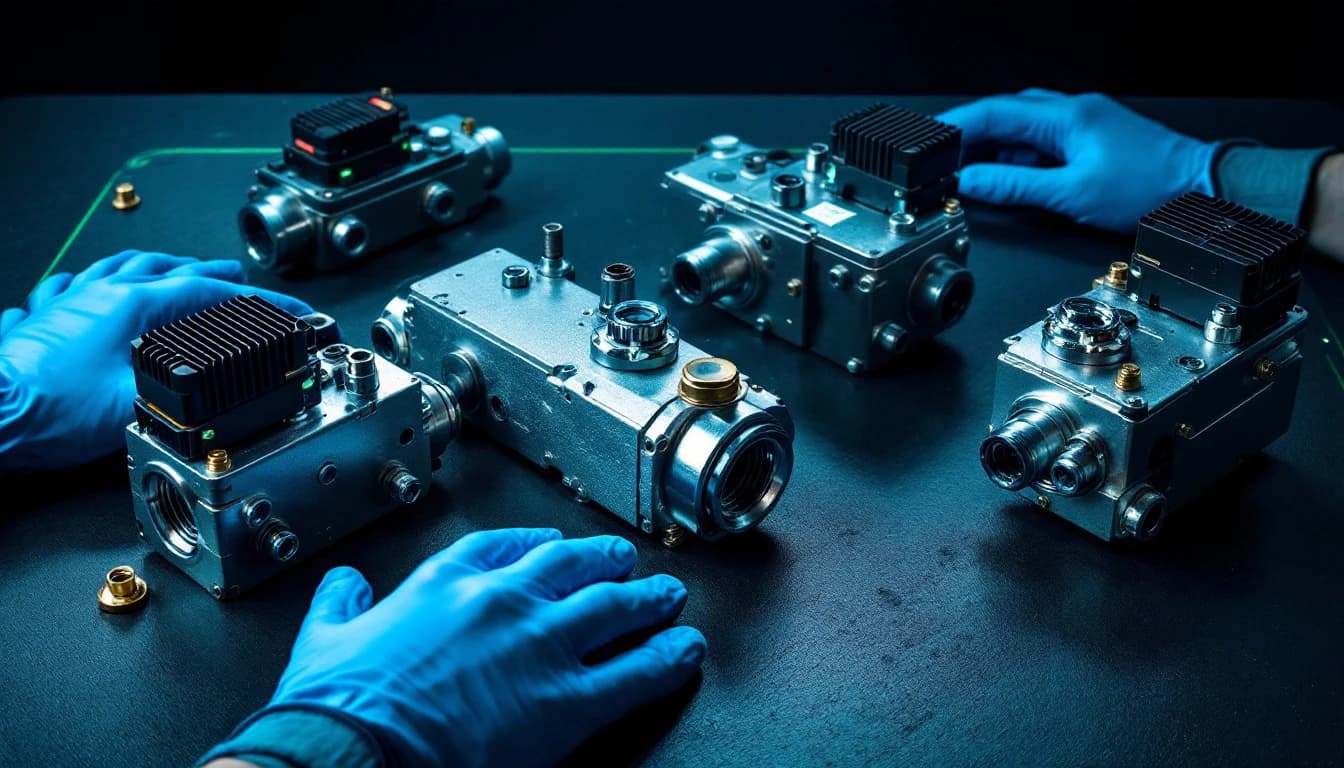
Ask what an ABS module repair involves and the honest answer is a question back: which family? A great many vehicle brands sell cars with anti-lock brakes, but a short list of electronics suppliers built nearly all of the modules inside them, and the supplier family decides almost everything that matters on the bench. It decides which component is likely to have failed, whether the electronic controller unbolts from the hydraulic block so it can be repaired on its own, whether the unit stores a vehicle identity that a replacement would have to be taught, and therefore whether the right answer is a $499 repair of the unit you own, a programmed replacement, or no module work at all.
This guide goes family by family: Bosch, ATE and Continental Teves, Kelsey-Hayes, TRW and ZF, Delphi, Nissin, Advics and Mando. For each one it covers the generations, where you commonly find them, the signature failure, whether the controller separates from the block, what the unit stores, and what we can do about it. If you want the component-level view of what breaks inside, the ABS internal failure guide is the companion; this page is organised by identification. If you are still deciding whether the module is the problem at all, start with the ABS and traction light symptom guide.
Two cautions. Suppliers changed across a model's life and sometimes within a model year, so every attribution below is the common case and the label on your own unit is the only authority. And an ABS module is a safety component. Everything we do keeps the hydraulic side intact and your original coding in place; nothing here is a recipe for improvising on a brake system.
How to read the label
The electronic controller carries a label, and it usually names the supplier directly: BOSCH, ATE or CONTINENTAL, TRW, KELSEY-HAYES or KH, DELPHI, NISSIN, ADVICS or MANDO. Beside it sits the vehicle manufacturer's part number and, on most units, the supplier's own number.
Bosch numbers are ten digits in groups, typically beginning with 0 265, and the generation is often printed as well, for example 8.0 or 9.0. Continental Teves units are usually marked with an MK designation, MK25 or MK60 or MK100, and a long numeric string. GM units carry a GM part number and the EBCM designation, and the Kelsey-Hayes 325 family is usually marked KH 325 or simply 325 on the controller. Delphi units are marked DBC-7 or similar. Japanese and Korean units carry the vehicle maker's part number with the supplier name on a small moulded or printed mark.
A photo of that label, with the VIN, is enough for us to tell you which family you have before you remove anything. That matters because the number of these units reaching the age where they fail is enormous. Electronic stability control, which runs on the same controller as the anti-lock function on every modern car, has been required on all new light vehicles in the United States since the 2012 model year under the standard published by the National Highway Traffic Safety Administration, and the average light vehicle on U.S. roads was about 12.6 years old in 2024 according to S&P Global Mobility. The first full generation of mandatory-stability cars is now at the age where the controller is a normal repair.
Bosch
Generations. Bosch 5.3 from the mid to late 1990s; 5.7 from the early 2000s; 8.0 and 8.1 from the mid-2000s into the first stability-control years; 9.0 and 9.1 from roughly 2010 onward, carrying the ESP functions on most of the cars built to the 2012 mandate. Bosch supplied the first series-production anti-lock system in 1978, according to Bosch, and has been the largest single source of these units ever since.
Where you find them. Everywhere. European cars across the board, a large share of General Motors, Ford and Chrysler-group vehicles from the 2000s onward, and many Japanese models. The Chrysler, Dodge, Jeep and Ram vehicles of the 2011 to 2018 era are a Bosch stronghold, which is why our Ram 1500 ABS guide and our Charger and Challenger ABS guide both describe Bosch units.
Signature failure. On the 5.3 and 5.7, cracked solder at the solenoid coil pin field and the pump relay. On the 8.x and 9.x, failed pump-motor and solenoid driver stages, fatigued solder at the pin field, and corrupted memory that reports as an internal module fault, the C2200 class of code on Chrysler-group cars and the pump-motor supply fault C2116 that travels with it.
Separable. Yes on almost every Bosch generation: the controller unbolts from the hydraulic block, which is what makes a bench repair of the electronics possible without touching the hydraulics.
What it stores. On the 8.x and 9.x, the vehicle configuration and, on most applications, a relationship with the vehicle network that a replacement unit has to be taught. That is why a used Bosch 9 unit from another car arrives configured for that car.
What the bench does. ABS module repair at $499 on the unit you own, coding intact, about a week on the bench with rush available, 1-year warranty on the repair.
ATE and Continental Teves
Generations. Teves MK20 from the mid-1990s through the 2000s; MK25 and MK25E from the early 2000s; MK60 and MK60E from the mid-2000s through the 2010s; MK70 and MK100 on later platforms. ATE is a Continental brand, and Continental reports group sales of roughly 41 billion euros a year, a good part of it brake systems.
Where you find them. European cars first, including a large share of Volkswagen, Audi, BMW, Mercedes and Volvo, and then Chrysler-group and Ford vehicles in specific model years. The Jeep Wrangler JK and the WK2 Grand Cherokee carried ATE units in some years and Bosch in others, which is exactly why our Wrangler JK ABS guide and our Grand Cherokee WK2 ABS guide both insist on the label before the part number.
Signature failure. The MK20 is the archetype of cracked solenoid-pin solder; the MK25 shifts toward input-circuit and connector faults and memory corruption; the MK60 and MK60E are known for the pump-motor terminal interface, where moisture and heavy current meet, and for the pressure-sensor circuit. The later MK70 and MK100 add more integration and more configuration sensitivity.
Separable. Yes on the MK20 through MK60 families; the controller lifts off the block. Later units separate too but are more variant-sensitive, meaning a physically identical unit from another option package will not simply drop in.
What it stores. Variant coding on the MK25 onward, and on many applications a vehicle relationship that has to be coded after replacement.
What the bench does. The $499 repair of your own unit, which sidesteps the variant-coding problem entirely because your original keeps its identity. Where a replacement is unavoidable on a GM application, the GM ABS and EBCM programming job at $250 configures it; on other makes we tell you what the platform needs before you buy anything.
Kelsey-Hayes
Generations. The Kelsey-Hayes 325, marked KH 325, on full-size GM trucks and SUVs of roughly 1999 to 2006, and related Kelsey-Hayes EBCM designs on other domestic platforms of the same era.
Where you find them. Silverado and Sierra 1500 through 3500, Tahoe, Suburban, Avalanche, Yukon, Yukon XL and Escalade of that generation. This is one of the highest-volume ABS repairs in North America, and it has its own page here for that reason.
Signature failure. Cracked solder on the internal relay and the pin field, which sets the classic C0265 EBCM relay circuit code, lights the ABS and brake lamps and usually disables traction control. A textbook thermal-fatigue failure, and the one most likely to be fixed properly by a reflow and a driver-section repair.
Separable. Yes; the controller comes off the hydraulic block with the valve body staying on the truck in many cases, which is why owners often ship the electronics alone.
What it stores. Less than the later units. On most applications a repaired original goes back in with no programming, and even a replacement needs comparatively little setup compared with a modern integrated unit.
What the bench does. GM Kelsey-Hayes 325 ABS repair at $325 on your own module, which is cheaper than the universal repair because the failure is so consistent.
TRW and ZF
Generations. The TRW EBCM units that followed Kelsey-Hayes on later domestic platforms, from the late 2000s onward. TRW's automotive business is now part of ZF, which continues the brake-systems line.
Where you find them. Later General Motors cars and trucks, and some Chrysler-group and Ford applications. These are the units behind most of the configuration questions on the 2014 and newer GM vehicles.
Signature failure. More integrated electronics, so the dominant problems shift from pure solder cracking toward drive-stage failures, connector corrosion, and configuration and setup faults when a unit is swapped.
Separable. Usually, but the controllers are more programming-dependent, so a swap is never just mechanical.
What it stores. VIN, configuration and setup data; a replacement must be programmed and set up to the vehicle. The GM ABS and EBCM replacement programming guide covers that process step by step.
What the bench does. Repair of your own unit at $499 where the failure is electronic; the $250 GM programming job when a different unit is fitted.
Delphi
Generations. The Delphi DBC-7 family on General Motors cars of roughly 1999 to 2005, Buick, Pontiac, Oldsmobile, Chevrolet and Cadillac sedans among them.
Signature failure. Solder fatigue at the pin field and the pump relay, loss of a wheel-speed input channel inside the controller, and the occasional memory fault. The DBC-7 era cars are now old enough that connector corrosion is a frequent companion.
Separable. Yes; the controller unbolts from the hydraulic block.
What the bench does. The $499 repair where the fault is electronic, which on these cars is the normal case. A replacement unit on a DBC-7 car is increasingly hard to find new, which is another argument for repairing the one you have.
Nissin and Advics
Where you find them. Nissin builds the VSA modulators on most Honda and Acura vehicles. Advics, a Toyota-group supplier, builds the brake actuators and skid-control electronics on most Toyota and Lexus vehicles, and Advics describes those integrated actuator units on its own site.
Signature failure. Internal solenoid and pump-driver faults, pressure-sensor and accumulator-related codes on the units that integrate a pump and accumulator, and solder fatigue. On these units the electronics are often more tightly integrated with the hydraulic assembly than on a Bosch or ATE two-piece design.
Separable. Sometimes. Some Honda modulators and many Toyota actuators have electronics that do not lift cleanly off the block, and on those the honest answer is a bench evaluation first.
What it stores. Comparatively little vehicle identity, so a replacement often needs calibration of the brake and steering-angle sensors rather than VIN programming.
What the bench does. The $499 repair where the controller is accessible and the fault is electronic; the bench evaluation at $150 per hour where the construction makes the outcome uncertain before the unit is opened.
Mando
Where you find them. Mando builds the hydraulic electronic control units on most Hyundai and Kia vehicles, and on some others.
Signature failure. Solenoid and pump-driver faults, communication faults that take the unit off the network, and solder fatigue under heat.
Separable and what it stores. Case by case; many separate cleanly, and most need variant coding and sensor calibration after a replacement. Our approach is the same as for the Japanese units: label photo first, bench evaluation where the construction is uncertain, repair of your own unit where it is not.
The families side by side
| Family | Era | Commonly found in | Signature failure | Controller separates | Replacement needs programming | Bench service and price |
|---|---|---|---|---|---|---|
| Bosch 5.3 / 5.7 | mid-1990s to early 2000s | European, domestic, some Japanese | Coil-pin and relay solder cracks | Yes | Minimal to moderate | Repair $499 |
| Bosch 8.0 / 8.1 / 9.x | mid-2000s onward | European, GM, Ford, Chrysler-group, Japanese | Driver stages, pin-field solder, memory faults | Yes | Yes, plus sensor calibration | Repair $499 |
| ATE / Teves MK20 | mid-1990s to 2000s | European, some domestic | Solenoid-pin solder cracks | Yes | Usually minimal | Repair $499 |
| ATE / Teves MK25 / MK60 / MK70 / MK100 | 2000s to 2010s | VW, Audi, BMW, Mercedes, Volvo, Chrysler-group, Ford | Input circuits, pump-terminal corrosion, pressure sensor, memory | Yes, variant-sensitive | Yes | Repair $499 |
| Kelsey-Hayes 325 | roughly 1999 to 2006 | Full-size GM trucks and SUVs | Relay and pin-field solder cracks, C0265 | Yes | Usually not on a repaired original | KH325 repair $325 |
| TRW / ZF EBCM | late 2000s onward | Later GM, some Chrysler-group and Ford | Drive stages, corrosion, configuration | Usually | Yes, VIN and setup | Repair $499; GM programming $250 |
| Delphi DBC-7 | roughly 1999 to 2005 | GM cars | Pin-field and relay solder, input channels | Yes | Minimal to moderate | Repair $499 |
| Nissin / Advics | 2000s onward | Honda, Acura, Toyota, Lexus | Solenoid and pump drivers, pressure and accumulator faults | Sometimes | Calibration more than VIN | Repair $499 or evaluation $150 per hour |
| Mando | 2000s onward | Hyundai, Kia | Drivers, communication, solder | Case by case | Variant coding and calibration | Repair $499 or evaluation $150 per hour |
Return shipping on every mail-in job is chosen and paid at checkout from $29.95. The universal repair carries a 1-year warranty, about a week on the bench with rush repair available for 2 to 3 business days, and the warranty can be extended at checkout.
"I can tell you most of the story from the label before the box is open. A KH 325 is cracked joints at the relay, nine times in ten. A Bosch 9 off a Charger is a driver stage or the memory. An MK60 off a BMW is the pump terminals if it ever saw water. The car matters less than the family." — Independent chassis-electronics technician, 17+ years on ABS and stability controllers (anonymized)
Two-piece or integrated: the question that decides repairability
Across every family, the single most important construction detail is whether the electronic controller unbolts from the hydraulic control unit. On a two-piece design, which covers most Bosch, ATE, Kelsey-Hayes, TRW and Delphi units, the electronics can be shipped on their own, repaired on a bench, and bolted back to the hydraulic block that never left the car. On many of those applications the brakes do not even need bleeding afterward, because no hydraulic line was opened.
On an integrated design, where the electronics are potted into or bonded to the hydraulic assembly, the whole unit has to come off, the brakes have to be bled on reinstallation, and the repair itself is sometimes not possible without destroying the housing. Some Honda modulators and Toyota actuators fall into this group. We do not guess on those; a bench evaluation tells you what you have before any repair is quoted.
The other decisive question is whether the hydraulic side has failed. A seized pump motor, a stuck valve or an internal hydraulic leak is a mechanical failure that no electronics repair can fix, and on those the honest answer is a replacement assembly. We confirm which side has failed on the bench before anyone commits to a new unit.
What each family stores, and why a replacement is never just a swap
The older families, Bosch 5.3, Teves MK20, Kelsey-Hayes 325 and Delphi DBC-7, store comparatively little vehicle identity. A repaired original goes back in with nothing to program, and even a replacement typically needs little setup.
Everything from the stability-control era onward is different. The Bosch 8.x and 9.x, the ATE MK25 through MK100, the TRW units and most Nissin, Advics and Mando units carry variant coding, a vehicle configuration and, on many platforms, a relationship with the rest of the network. A used unit from another car arrives with that car's identity. On General Motors vehicles the fix is a defined job, GM ABS and EBCM programming at $250. On other makes it ranges from coding with the factory tool to calibrating the steering-angle, yaw and pressure sensors, and we tell you what your platform needs before you buy a module.
This is the quiet argument for repairing your own unit. Its coding never left the car, so it goes back in configured, and the programming step and its cost disappear. The ABS module repair cost guide works through what that saves against a dealer assembly, a remanufactured exchange and a used donor.
Stability control is worth keeping working, which is the other reason to resolve a dead module rather than drive around it. The Insurance Institute for Highway Safety has estimated that electronic stability control cuts the risk of a fatal single-vehicle crash by roughly half, and every function it performs runs on the controller this guide is about.
What to send
Ship the electronic controller, or the complete unit if yours does not separate, in a padded box with the lines capped. Include the VIN, the year, make and model, the full code list from the ABS controller itself rather than a generic engine-code reader, a photo of the label, and a note on whether the pump runs after key-off or the battery has been going flat. Typical bench time on the universal repair is about a week, with rush available at checkout, and the Kelsey-Hayes 325 repair runs on its own line. We text updates to the number on the order, and a unit we cannot economically repair is reported before any charge.
Frequently asked questions
How do I know which ABS module type I have? Read the label on the electronic controller: it names the supplier, Bosch, ATE or Continental, Kelsey-Hayes, TRW, Delphi, Nissin, Advics or Mando, beside the vehicle manufacturer's part number and usually the generation. A photo of that label with your VIN is enough for us to identify the family before you remove anything.
Which ABS module types can be repaired on a bench? Most two-piece designs, where the controller unbolts from the hydraulic block: the Bosch, ATE and Teves, Kelsey-Hayes, TRW and Delphi families in particular. Integrated units, including some Honda modulators and Toyota actuators, are case by case and start with a bench evaluation. Mechanical hydraulic failures are never an electronics repair.
Does an ABS module need programming after repair? Not when the repaired unit is your own original, because its coding and identity never changed. Programming is needed when a different unit is fitted, and on the stability-control era families it is not optional; on GM vehicles that is the $250 ABS and EBCM programming job.
What does the universal ABS module repair cost? $499 flat for a board-level repair of the unit you own, with a 1-year warranty on the repair and about a week on the bench, plus return shipping chosen at checkout from $29.95. The GM Kelsey-Hayes 325 repair is $325 because that family's failure is so consistent.
Can I put a used ABS module from a salvage yard on my car? On the older families, sometimes, with little setup. On the Bosch 8.x and 9.x, ATE MK25 and later, TRW and most Japanese and Korean units, the used module carries the donor car's configuration and will not work correctly until it is programmed or coded to yours, and it brings unknown electronic health with it.
Will my brakes need bleeding after a module repair? Usually not if only the electronic controller came off and the hydraulic block stayed on the car with its lines connected. If the whole assembly was removed, or the unit is an integrated design, expect a scan-tool-assisted bleed at reinstallation and budget for it separately.
Why do ABS modules of every type fail the same way? Because they share a construction: a circuit board carrying pump and solenoid drivers, a soldered pin field into the hydraulic block, and memory, all living under the hood with heat, vibration, voltage spikes and moisture. The family changes which of those gives way first, not whether one of them eventually does.
The bottom line
ABS modules come in families, and the family on the label tells you the failure, the repairability and the programming picture before the box is open. Bosch, ATE and Teves, Kelsey-Hayes, TRW, Delphi and most Mando units are two-piece designs whose electronics repair on a bench, $499 on the unit you own with your coding intact and a 1-year warranty, or $325 for the Kelsey-Hayes 325. Nissin and Advics units are case by case and start with an evaluation. Every stability-control era family needs programming when a different unit is fitted, which on GM is the $250 job and on every make is the cost a repair of your own unit avoids. Photograph the label, send it with the VIN, and the right path is clear from the start.
Ship it for the abs module repair — $499 flat
About 1 Week Bench Time (Rush 2–3 Days Available), return speed your choice at checkout. Prepaid inbound label by email the minute you order.
More from the Lab
What Fails Inside an ABS Module: Bosch, ATE, Kelsey
19 min · July 28, 2026
Chrysler 300 ABS Module Failure: 2011-2014 Repair Guide
14 min · October 16, 2026
Dodge Journey ABS Module Failure: Recall, Codes, Repair
13 min · October 16, 2026
Sprinter ABS/ESP Module Failure: Lights, Codes & Repair
13 min · October 16, 2026