
Can a Mail-In Service Program to My VIN, No Dealer?
The short answer
Yes — for most module families a mail-in bench service can program a module to your VIN without any dealer involvement, because the VIN and the module's security data live in non-volatile memory inside the module itself, and a bench setup reads and writes that memory directly. The dealer's scan tool is one way to reach that data through the car's network; a bench connection is another way to reach it at the source, and on a large share of jobs it is the more capable of the two.
The exceptions are real and worth naming immediately, because a service that pretends they do not exist is not a service worth trusting. Where a manufacturer issues the security unlock only from an online server, where a late-model central gateway must authorize any write, or where a component-protection scheme ties a module to the vehicle through a factory-only handshake, the dealer or an authorized shop with a factory online subscription genuinely is required. Everything below is the detail behind both halves of that answer.
What "VIN programming" actually is at the hardware level
Strip away the marketing language and a control module is a small computer with three relevant pieces: a processor, program memory holding the software or calibration, and non-volatile data memory holding everything specific to your individual car. That last piece is the important one. It is usually EEPROM, or a data region inside a flash chip, and it holds the VIN, configuration bytes, options coding, mileage where applicable, and the security or immobilizer data that lets the module authenticate to the rest of the vehicle.
When someone says a module is "VIN-locked," what they physically mean is that a string of bytes in that memory carries a VIN that does not match your car, and other modules on the network reject it as a result. When someone says a module needs to be "programmed to your VIN," they mean those bytes — and the security data that travels with them — need to be correct for your vehicle. We wrote a full explainer on the symptom and its consequences in the VIN-locked module guide.
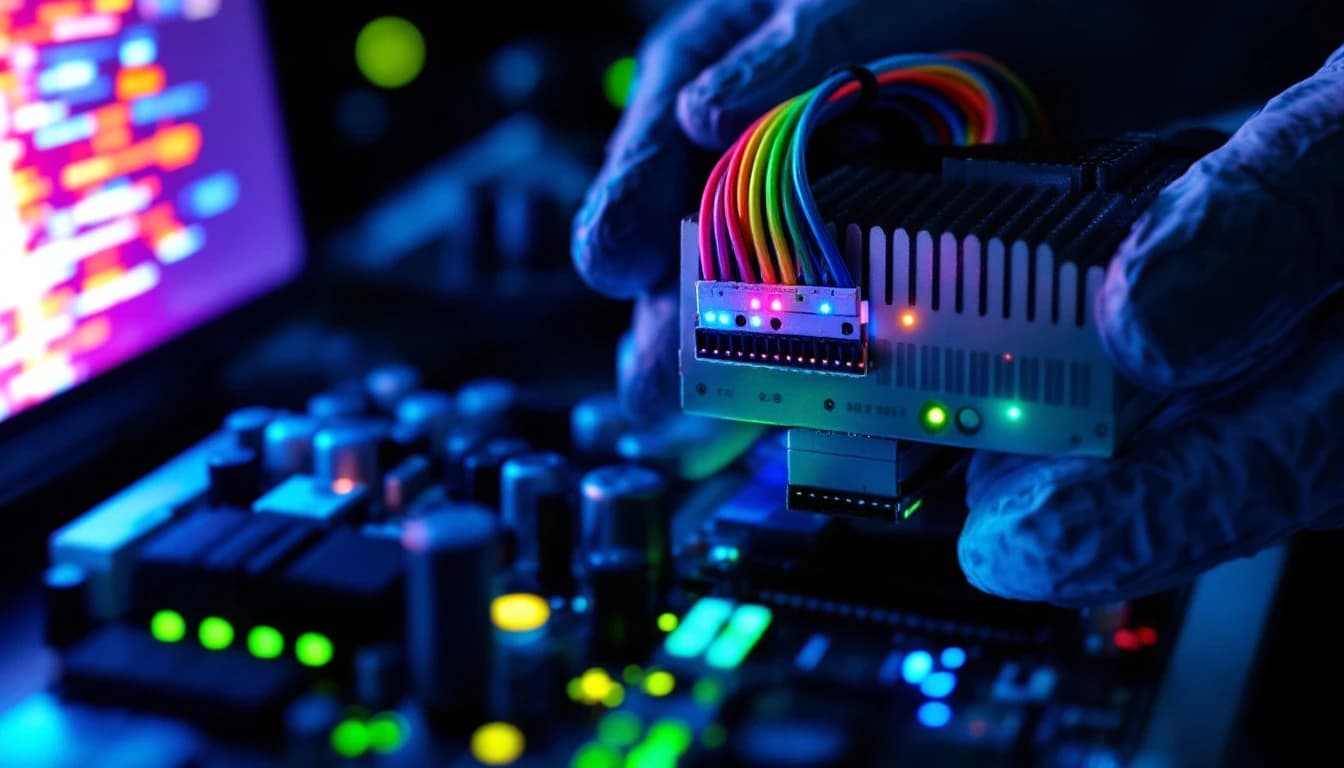
Bench programming reaches that memory directly. Depending on the module that means connecting to its own connector on a regulated power supply, using a manufacturer or bootloader protocol at the module's native interface, connecting to the debug or programming pins on the board, or in some cases reading the memory chip itself. The module is powered, read, its original contents archived, the relevant data written, and the result verified — all outside the car.
The mechanics of how identity and immobilizer data actually move between modules are covered in depth in our guide to how ECU cloning works at the EEPROM level. The short version is that a clone is not a copy of a file; it is a controlled transfer of the specific data regions that make a module belong to a particular car.
Why bench access is often more capable than an OBD session
The intuition most people carry is that the dealer tool is the powerful option and everything else is a workaround. For a large class of jobs that is backwards, and the reasons are structural rather than a matter of who has the better software.
A bench connection does not require a working car. An OBD session needs the vehicle powered, the network intact, and the target module willing to respond. If the module is bricked, half-flashed, in a bootloop, or refusing to communicate, the scan tool sees nothing. On the bench that same module can often still be read at a lower level, because the read does not depend on the module's normal application software running.
A bench connection does not depend on the car's security gate. Reaching a module through the OBD port means going through the vehicle's own security handshake. Reaching the module's memory directly bypasses the negotiation entirely for the module in hand — which is exactly why all-keys-lost work is so often a bench job. When there is no working key, there is nothing to authenticate with, and reading the security data at the source becomes the only practical path. Our Range Rover all-keys-lost walkthrough is a good illustration of that logic on a platform where in-car access is difficult.
A bench setup removes the biggest cause of failed writes. Voltage. A programming session that browns out mid-write leaves a module partially flashed and frequently unusable. On a bench the supply is regulated and constant; in a driveway it is a battery of unknown health. That single difference accounts for an enormous share of the recovery work that lands on benches in the first place.
The original data is archived first. A disciplined bench workflow reads and stores the module's original contents before changing anything. That archive is what makes a bad outcome recoverable. Very few in-car programming attempts start with a complete backup.
"People assume the factory tool can do everything and the bench is the poor substitute. In practice it flips the moment the module stops talking. Once a unit will not answer on the bus, the scan tool is a paperweight and the bench is the only thing that can still read it. I tell customers the tools solve different problems — the factory tool is for a healthy car, the bench is for a module." — Independent module-programming technician, 14+ years in bench diagnostics (anonymized)
What a dealer tool genuinely adds
Being honest about bench capability requires being equally honest about what factory tooling brings that a bench does not.
Online calibration lookup. A dealer tool can query the manufacturer's servers for the exact current calibration a specific VIN is supposed to have, including any that superseded the original. That lookup is a subscription service tied to the manufacturer's database, and no bench setup reproduces it.
Warranty, recall and campaign flashes. Software campaigns are distributed through factory channels. If your vehicle has an open safety recall, that work belongs at a franchise dealer — for free, in most cases. The National Highway Traffic Safety Administration maintains the public recall lookup for U.S. vehicles and reports that tens of millions of vehicles are covered by open recalls at any given time, with a persistent gap between recalls issued and repairs completed. If your module problem overlaps a recall, check that first. It may cost you nothing.
Server-issued security unlock. On several late-model platforms, the credential required to write to a protected module is issued per-session by the manufacturer's online system to a subscribed, authenticated tool. That is a deliberate design choice, not an obstacle a bench can engineer around.
Post-installation vehicle-level configuration. Some jobs need the car present after the module goes back in — variant coding, calibration relearns, or system initializations that only exist as an in-vehicle procedure.
Whole-vehicle diagnostics. A bench service diagnoses and programs the module you send. It cannot see your wiring, your grounds, or the four other modules that might actually be causing the symptom.
Right-to-repair rules mean much of this factory information is available to independent shops as well as dealers, which is why the honest framing is "factory online access" rather than "the dealer." The Federal Trade Commission has publicly pressed on repair-restriction practices, and coverage from outlets including Consumer Reports and MotorTrend has tracked how service information access has broadened. The practical point for you is that "the dealer is required" often really means "a subscription to the manufacturer's online system is required," and an independent shop can sometimes hold that too.
Bench versus dealer: the honest comparison
| Capability | Mail-in bench programming | Dealer / factory online tool |
|---|---|---|
| Write VIN and configuration data to module memory | Yes, on most module families | Yes |
| Transfer identity and security data from a failed original | Yes — this is a core bench strength | Rarely; the factory path is a new part |
| Work on a module that will not communicate on the bus | Yes, frequently | No |
| All-keys-lost with zero working keys | Yes, via direct read of the security data | Sometimes, often with dealer-only tooling |
| Archive original data before writing | Standard practice | Not typically |
| Regulated power during the write | Yes | Depends on the shop's supply |
| Pull the current factory calibration for your VIN | No | Yes |
| Perform recall and warranty software campaigns | No | Yes |
| Obtain a server-issued security unlock | No | Yes, where required |
| In-vehicle relearns after installation | No — done by you or your shop | Yes |
| Diagnose the rest of the vehicle | No | Yes |
| Requires the car to be present | No | Yes |
Read that table as a division of labour rather than a scoreboard. For getting a specific module to carry the right identity and security data, the bench is the stronger tool. For anything that needs the manufacturer's servers or the whole car, factory access wins.
Module families we routinely match to a VIN on the bench
Concrete examples make this easier to evaluate than general claims.
GM Global A virginizing. Global A modules from a donor vehicle arrive carrying the donor's VIN and configuration, and the receiving car rejects them. Virginizing returns the module to an unconfigured state so it can accept your vehicle's identity — which is what turns an affordable used part into a usable one. That is the GM Global A virginize service at $150, and the platform-specific detail sits in our GM Global A ECM unlock guide.
Ford PCM cloning and VIN transfer. When a Ford PCM fails, a donor unit of the correct hardware can receive the original's calibration and VIN identity so the vehicle accepts it as its own. That is the Ford PCM clone and VIN transfer service at $250. It is the classic example of the bench doing something the factory path does not offer at all — the dealer answer to a failed PCM is a new part, not a data transfer.
GM HMI radio and cluster VIN unlock. Infotainment head units and instrument clusters are among the most commonly swapped modules from salvage, and among the most frequently VIN-locked. Unlocking and matching them to the receiving vehicle is the GM HMI radio and cluster VIN unlock service at $250.
Not sure what you have? A bench evaluation at $150 exists for exactly that case. The module is powered, read where possible, and assessed, and you get a straight answer about whether it can be programmed, cloned, recovered — or whether it is genuinely finished.
The economics behind all of this are worth stating plainly. Kelley Blue Book has tracked average used-vehicle transaction prices holding above $25,000 in recent years, which means a four-figure module quote can consume a meaningful fraction of an older car's entire value, and Consumer Reports has repeatedly documented repair costs rising faster than general inflation. A donor module plus bench programming is often the difference between fixing a car and abandoning it.
Where the dealer or factory online access genuinely is required
This is the section that decides whether you should trust the rest of the article.
Gateway-protected late-model platforms. Many manufacturers now place a security gateway between the diagnostic connector and the vehicle's internal networks, and any write operation requires authenticating through it. Where a module's programming path cannot be reached outside that gate, the vehicle needs an authenticated tool. This is increasingly common on the newest model years across brands.
Server-issued unlock credentials. Some platforms require a session credential minted by the manufacturer's online system for each write. There is no bench equivalent. If your module family works this way, we will tell you before you ship rather than after.
Component protection architectures. Certain manufacturers implement a scheme where a module, once installed, is cryptographically tied to the vehicle and cannot be released or re-adopted without a factory online session. A bench can prepare such a module up to a point, but the final adoption belongs to an authorized tool.
Recall and campaign software. Covered above and worth repeating. Check NHTSA for open recalls on your VIN before paying anyone. Recall work is a dealer job and it is usually free.
Anything requiring the vehicle present. In-vehicle relearns, variant coding at the car level, and calibration procedures that only exist as an on-car routine cannot be done by mail. Some jobs are a bench step plus an in-car step, and we will say so up front so you can plan the second half.
The reason to publish this list is simple: the value of an honest capability statement is that you can act on it. A service that claims everything is possible will happily take your shipping money before discovering otherwise.
Proof of ownership — why we ask, and what counts
Any work touching keys, immobilizers, or vehicle security requires documentation that the vehicle is yours. A current registration or a title matching the VIN is the standard. This is firm, and there are no exceptions.
The reasoning is not bureaucratic. Vehicle theft remains a serious national problem — the National Insurance Crime Bureau has tracked thefts running near one million vehicles per year in the United States, and the Insurance Institute for Highway Safety has reported whole-vehicle theft loss results running several times the fleet average on the worst-performing models, a spread that tracks closely with anti-theft and immobilizer design. Security-relevant programming done without verifying ownership is exactly how those numbers get worse. Reputable operators verify first. If a service does not ask you for proof of ownership on immobilizer work, that tells you something about the service.
Vehicle history and title status also matter for salvage and rebuilt-title projects, where documentation is often the difference between a legitimate rebuild and a problem. Records services such as Carfax exist because that history has real consequences for a vehicle's identity.
Related reading if you are working on a key or immobilizer module specifically: the CAS3+ versus CAS4 key programming guide shows how much the required workflow can change between two revisions of what looks like a single module family.
How a mail-in job gets verified before it ships back
The reasonable worry about mail-in service is receiving a module back that still does not work. The workflow is built around closing that gap.
- Confirm before you ship. Text us the VIN, the module part or service number from the case label, a clear photo of that label, and a plain description of the symptom or the job. We confirm the module family is one we can VIN-match, and tell you honestly if it needs factory online access instead. Nothing ships until that is settled.
- Proof of ownership on security work. Registration or title matching the VIN, before any key or immobilizer job.
- Ship the module to 1009 Oakwood Ln # 120241, Arlington TX 76012. Anti-static bag, rigid box, real padding. Auto Module Lab is mail-in only and works with customers nationwide — you ship a module, not a car.
- Bench read and archive. The module goes on a regulated supply, the original contents are read and archived, and the failure mode is confirmed against what you described.
- Program, clone, unlock or virginize. Whatever the job requires, done at the memory level with the original preserved.
- Verify before it leaves. The module is powered and checked on the bench, and the written data is read back and compared. A write that does not verify is not a finished job.
- Return with tracking. The module ships back on the flat-rate return tier you selected at checkout, starting from $29.95 with faster and overnight options available. Return shipping is paid by the customer.
- Tell us what happens on installation. If the car behaves differently than expected once the module is back in, we want to hear about it while the archived read is still in hand.
If you are unsure whether your module is even the fault, start with the bench evaluation rather than guessing, or browse the full services list to find the family that matches your part.
Frequently asked questions
Can a mail-in service really program a module to my VIN without the dealer? Yes, for most module families. The VIN and security data live in the module's own EEPROM or flash memory, and a bench setup reads and writes that memory directly rather than going through the car's OBD port and security gate. The main exceptions are platforms where the manufacturer issues the security unlock only from an online server.
Is bench programming less capable than a dealer scan tool? Not for the work it is designed to do — in several respects it is more capable. A bench can read a module that will not communicate on the vehicle bus, transfer identity data from a failed original to a donor, and complete all-keys-lost jobs, none of which a factory tool typically does. What it cannot do is pull current calibrations from the manufacturer's servers or perform recall software campaigns.
When do I actually need the dealer? You need the dealer or a shop with a factory online subscription for recall and warranty software, for server-issued security unlocks on platforms that require them, for component-protection adoption on certain architectures, and for gateway-protected late-model vehicles where any write must be authenticated. Check your VIN for open recalls first, since that work is usually free.
Do you need my VIN before I ship the module? Yes, along with the module part or service number and a clear photo of the case label. That information is how we confirm your exact module family is one we can VIN-match before you spend money on shipping, and it is why we can tell you up front if a job needs factory online access instead.
Do you require proof of ownership? Yes, on every key, immobilizer and security-related job, without exception. A current registration or a title matching the VIN is the standard. Vehicle theft is a serious problem and reputable module programming is done with ownership verified, so a service that does not ask you for it should raise a flag.
Will the module work as soon as I plug it back in? On many jobs yes, because the module leaves the bench already carrying your vehicle's identity and verified against the written data. Some vehicles additionally need an in-car relearn or initialization that can only be performed with the car present, and when that applies we tell you before you ship so you can plan the second step.
What if the module turns out to be unrepairable? We tell you before doing anything else, and the bench evaluation at $150 exists specifically for that determination. Water intrusion, physical or thermal damage, and memory that cannot be read at all are genuine dead ends, and being direct about them is cheaper for you than an optimistic attempt.
The bottom line
Yes — a mail-in bench service can program most modules to your VIN without the dealer, because the VIN and security data live in the module's own memory and bench access reaches that memory at the source. For a failed original, a donor part, an all-keys-lost car, or a module that will not talk on the bus, the bench is frequently the stronger option rather than the fallback.
The limits are equally real. Recall and warranty software, server-issued security unlocks, component-protection adoption, gateway-protected late-model platforms, and anything requiring the vehicle physically present belong to factory online access. We will tell you which side of that line your module sits on before you ship it.
Concrete starting points: GM Global A virginize at $150, Ford PCM clone and VIN transfer at $250, GM HMI radio and cluster VIN unlock at $250, and a bench evaluation at $150 when you want a straight assessment first. All of it is mail-in bench work from the Arlington workshop serving customers nationwide, proof of ownership is required on every security-related job, and return shipping is customer-paid starting from $29.95. Text us your VIN and a photo of the module label and we will tell you exactly what is possible for your vehicle.
Ship your module today
Flat-rate pricing, typical 24-hour bench turnaround, return speed your choice at checkout. Most jobs back on your bench within a week.
More from the Lab
Mercedes Module Programming Cost by Module (2026)
16 min · October 2, 2026
GM Module Programming Cost by Module (2026)
14 min · September 23, 2026
Porsche Module Cloning Cost: DME, Alarm Box, BCM (2026)
13 min · September 23, 2026
Fiat 500 Cranks, No Start After ECU Swap: Diagnosis
12 min · September 23, 2026