
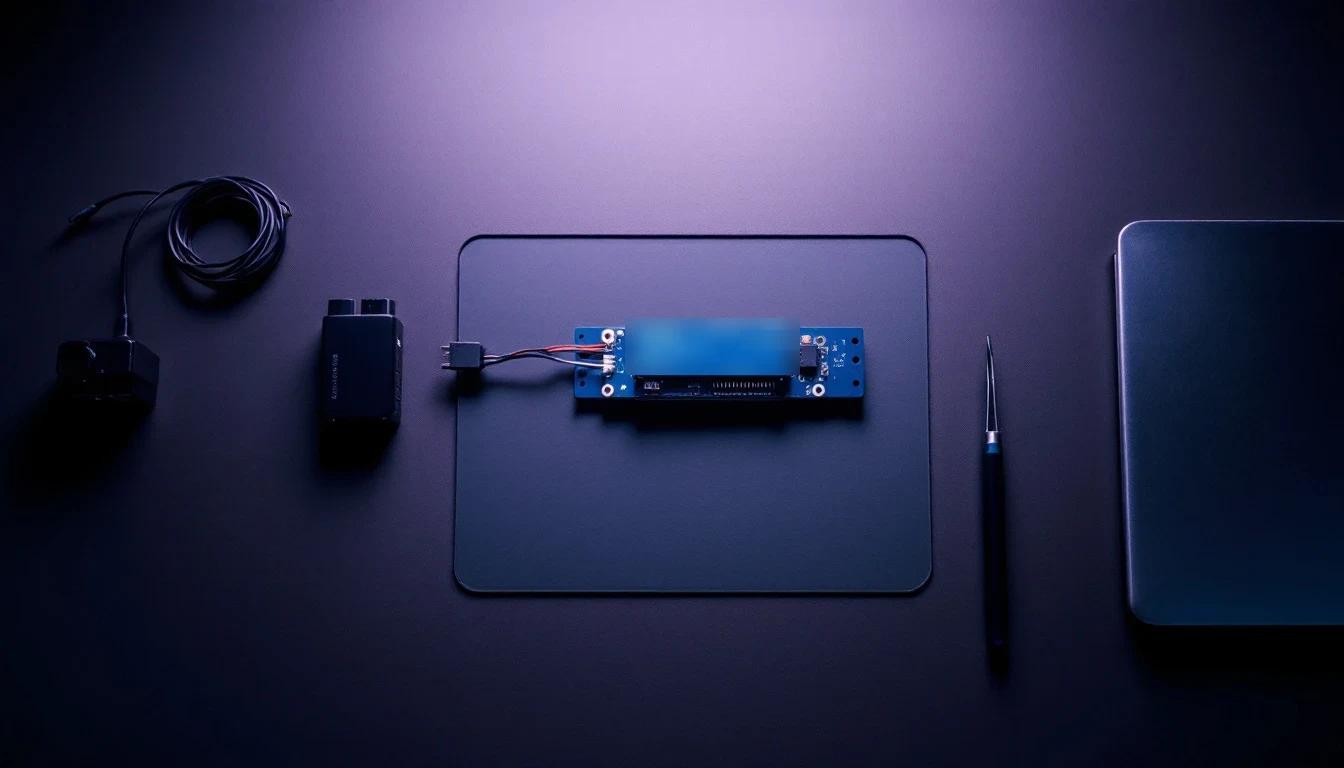
BMW FRM Repair Cost — Mail-In Bench Programming (2026)
The short answer: what a BMW FRM repair costs by mail
As of November 2026, bench recovery of a BMW FRM, FRM2, FRM3 or FRM3R footwell module is $175 flat on our BMW FRM repair service. We email a prepaid inbound label, you ship the module in, we read the surviving EEPROM data, restore the firmware and bench-test the unit, and then it comes back to you. Return shipping is paid by you and picked at checkout, starting from $29.95 for standard. The typical all-in total is $204.95, or $229.95 with the 2-day tier and $269.95 with the overnight tier.
That is the whole price structure. There are no per-symptom surcharges, no coding fee on the repair itself, and no need to recode the car afterwards because the original coding is preserved. The variables that can change your total are the return speed, whether the board has physical damage the bench cannot undo, and whether the FRM is even the module at fault. The rest of this guide covers each of those, how to decide, and how to ship the module without creating a new problem.
Every price for our services in this article comes from our own service catalog. We do not quote a dealer price for the FRM here, because we do not publish one on the service page and a figure from memory would not be reliable. Ask your dealer for a written quote for the part, coding and labor, and compare it to the table below.
What the FRM is and why it bricks
The Footwell Module sits behind a plastic cover in the driver-side footwell on left-hand-drive cars. On the E-chassis BMWs it controls exterior and interior lighting, turn signals and parking lights, power windows and mirrors on many trims, wiper control, central locking feeds and several comfort functions, and it talks to the rest of the car over the body bus. It is built around a microcontroller with non-volatile memory, and that memory is why the module is both capable and fragile.
The common failure story is short. The battery is disconnected, replaced or weak, and the car is then coded, flashed or woken with a diagnostic tool, or the module is in the middle of a write when voltage sags. The write is interrupted. The firmware or the stored data ends up corrupted and the module no longer responds. Our service page lists the typical causes plainly: battery disconnected during coding, low battery during coding, a failed firmware flash, or a power surge during start. The result is a car with no headlights, dead turn signals, windows and mirrors that do not move, or a diagnostic session that shows no communication with the FRM at all.
Our deeper write-ups cover the symptoms in BMW FRM footwell module failure symptoms, the chassis differences in the FRM by chassis guide, and the recovery story for the newer, harder-to-save units in the FRM3 bricked recovery guide. This page is about the money.
The fleet picture matters for price. S&P Global Mobility reports that the average age of light vehicles in the US reached 12.8 years in 2025, with passenger cars at 14.5 years. The FRM-era E-chassis BMWs are now mostly in the 12-to-18-year bracket. Owners of cars that age usually weigh a repair against the resale value of the car, and a $175 recovery sits on a very different part of that scale than a replacement and recoding visit.
The price table: every outcome in one place
| Outcome | What you pay | What you get | Notes |
|---|---|---|---|
| FRM, FRM2, FRM3 or FRM3R recovered (standard return) | $175 + $29.95 = $204.95 | Original module repaired, coding preserved | About 3 to 5 transit days on return |
| Same repair, UPS 2-Day return | $175 + $54.95 = $229.95 | Faster return | Pay for speed |
| Same repair, UPS overnight return | $175 + $94.95 = $269.95 | Fastest return | Highest shipping tier |
| F-chassis car (FEM or BDC, not FRM) | Different service | Not covered by the FRM repair | See the FEM/BDC service |
| Physical board damage (water, impact) | Not fixable by this service | Diagnosis only | The repair covers firmware and data, not a destroyed board |
| Unsure the FRM is the fault | Bench evaluation, $150 per hour | A defined cause | Separate from the flat repair |
The return tiers come directly from our shipping table: standard $29.95, UPS 2-Day $54.95 and UPS overnight $94.95. Exactly one tier is billed per order, and the inbound label is bought and emailed by us.
What changes the price: the variables
1. Your return tier. The gap between $29.95 and $94.95 is $65, and for a parked car that is usually not worth paying. For a car that is your daily driver with no headlights, the faster tiers can make sense, though a car without working lights should not be driven at night anyway.
2. Whether the module is the cause. A dead-footwell symptom list overlaps with several other faults. A blown fuse, a corroded ground, a failed window regulator, a broken wiring harness in the door jamb and a bad light-switch cluster can all produce the same thing: lights or windows not working. If the FRM is healthy, a $175 repair does nothing. This is the largest risk to your money, and it is why we ask for a diagnostic printout or a description of what the scan tool reports before you ship. If the tool cannot communicate with the module at all, that points strongly at the FRM. If it communicates and reports a specific lamp fault, it may not be the FRM.
3. Board condition. The service does not cover physical damage from water or impact. A footwell that has been wet, whether from a leaking door seal, a blocked drain or a coolant leak from the heater core, can leave corrosion on the module. We assess that on receipt. The repair we perform restores firmware and data; it does not rebuild a destroyed board.
4. The correct chassis. Our service lists FRM versions FRM, FRM2, FRM3 and FRM3R and the E-chassis cars E60, E70, E81, E82, E87, E88, E84, E89, E90, E91, E92 and E93. F-chassis BMWs use a different architecture, called FEM or BDC, and that is a separate service. A common and avoidable error is paying for the wrong repair. If you drive an F30, F32 or F10, look at the BMW FEM/BDC service rather than this one, and read the FEM/BDC bricked recovery guide.
5. Whether you need a new module instead. If a repair cannot recover the unit, the alternative is a used or new module, which then needs to be coded to the car. That coding is a separate job with its own cost, and a quote for a replacement should say who performs it and what it costs. Our repair avoids the issue entirely, because the original module goes back with its original coding.
How the repair compares with the other routes
Bench recovery (this service). You keep your own module and your own coding. The price is fixed, the work is performed on the bench, and the typical turnaround after receipt is about 24 hours. The service photographs the bench test before the module is returned. The cost to you is the time the car lacks a module while it ships both ways.
Dealer replacement and coding. A new part and coding from the dealer is the cleanest route if the module is physically dead. The price depends on the part, on labor and on the coding session, and should be requested in writing. We do not list a dealer figure for the FRM because we cannot verify one for every region.
Used module plus a coding session. A used FRM from a salvage yard is cheap on paper, but it comes with the donor car's data and needs to be adapted to your car. If the donor module is itself marginal, you can end up with the same problem in a different footwell. Our BMW module programming cost guide shows where the FRM sits among the other BMW module lines, and how those programming jobs are priced.
Doing nothing. Driving with a dead FRM means no lights on the road. That has a safety cost that no table captures. NHTSA and IIHS both publish material on why working lighting matters for crash avoidance, and a car with no reliable lights should be parked until it is repaired.
A worked example, step by step
Take a 2009 BMW 335i, an E90. The owner replaced the battery in a driveway, then used a consumer coding tool to change a setting while the new battery was still on a trickle charge from a weak charger. The coding session dropped out partway. Now the headlights, the turn signals and the interior lights do not work, and the diagnostic tool reports no communication with the footwell module.
- Step 1. The owner sends us the symptoms, the VIN and a photo of the module label once removed. We confirm the pattern matches an FRM3 that bricked during coding.
- Step 2. The module is removed from behind the cover in the driver-side footwell, bagged and boxed, and shipped on the prepaid label.
- Step 3. On the bench, we read the surviving EEPROM data, restore the firmware and confirm the module communicates. The bench test is photographed.
- Step 4. The module ships back on the standard return tier. The owner plugs it in and the lights work. The original coding was preserved, so nothing needs to be redone.
- Total. $175 + $29.95 = $204.95.
If the same owner had instead paid for a replacement module and a coding session, the total would have depended on part pricing and labor that we do not control. The mail-in route has a cap and a fixed price, which is why most owners of this chassis choose it first.
How to avoid bricking it again
A recovered module that is bricked a second time is the most expensive way to learn a lesson. Our service includes a short do-not-brick sheet with the return shipment. The core rules are simple:
- Put the car on a proper battery support unit, not a trickle charger, before any coding or flashing. The support needs to hold a stable voltage for the entire session.
- Never disconnect the battery during a write.
- Let the car sleep before and after a session so the modules finish their housekeeping.
- Do not stack coding sessions. Make one change, verify, then proceed.
- Keep a backup of the original coding before you change anything.
Our guide on how to ship BMW modules safely covers the packing details, which apply equally to a footwell module.
How to remove and ship an FRM
The FRM is behind a plastic cover in the driver-side footwell on left-hand-drive cars. Disconnect the battery first, wait a few minutes, photograph the connectors, release the retaining clips and lift the module off its mounting. Do not pry on the circuit board and do not open the housing. Pack it in an anti-static bag, wrap it in padding so it cannot move inside a box, and include a printed copy of your order confirmation, the VIN, and the part number from the module label. Use the prepaid inbound label we email. For a vehicle with immobilizer or security data nearby, proof of ownership is required for any key or security work, and you should have the registration or title details ready in case a follow-on service is needed.
"Nine out of ten dead-footwell BMWs I get are the same story: a battery swap, a coding tool, a voltage dip. The module is usually recoverable. The ones that are not are the cars that sat with a wet carpet for a year." — Independent BMW electrical technician, 15+ years on E-chassis body modules (anonymized)
Common mistakes that cost money
- Paying for FRM repair on an F-chassis car. The F-series uses a different module.
- Skipping the basic checks. Fuses and grounds are free to check.
- Coding on a weak battery. It is the cause of most bricked modules.
- Shipping without the VIN and label number. It slows intake.
- Opening the module to look. It risks the board you are paying to save.
For a broader view of where this repair sits against other module repair prices, see our cross-module repair price menu. For the wider context on body-control modules, what a body control module does explains how the FRM fits into the picture, and our map of every control module in a modern car shows the neighbors.
Where to read more
For safety and lighting regulations, NHTSA is the authority. For ownership-cost context on older BMWs, Hagerty, MotorTrend and Car and Driver publish long-term ownership coverage. SAE International maintains the electrical and network standards that the vehicle bus builds on. For the security side of why we preserve rather than reset data, NICB reporting through Insurance Journal puts 2025 US vehicle thefts at 659,880, a 23 percent decline from 2024.
Frequently asked questions
How much does a BMW FRM repair cost by mail-in service?
A mail-in BMW FRM or FRM3 repair costs $175 flat as of November 2026, plus a return-shipping tier chosen at checkout starting from $29.95. A standard-shipping job totals $204.95, with the 2-day tier at $229.95 and the overnight tier at $269.95.
Will I lose my coding after the FRM repair?
No. Our service page states that your original coding, such as lights and comfort settings, is preserved, and that the module is plug and play when you reinstall it. The repair restores the firmware and data of your own module rather than swapping in a different one.
Can a bricked FRM3 really be recovered?
Yes, in the common case. A module that bricked after a battery disconnect or a coding attempt on low voltage is the single most common FRM3 failure and is recoverable when the surviving EEPROM data can be read. Physical damage from water or impact is the exception and is not covered.
Does this service work on F-series BMWs?
No. F-chassis cars such as the F30, F32 and F10 use the FEM or BDC rather than the FRM, which is a different module with a different service. If you own one, use the FEM/BDC service page, and text us the VIN if you are unsure which module your car has.
How long does the repair take?
Bench work typically takes about 24 hours after the module arrives. Your total time is mostly transit: the prepaid inbound trip plus the return tier, which is about 3 to 5 days on standard and shorter with the 2-day or overnight options. We send a photo of the bench test with the tracking.
How do I know the FRM is the problem and not a fuse?
If a diagnostic tool reports no communication with the FRM, or the lights, windows and wipers all fail together after a battery or coding event, the module is the likely cause. Check fuses and grounds first, since they cost nothing, and text us the scan results before you ship.
Do I pay for return shipping separately?
Yes. Return shipping is paid by the customer and chosen at checkout, from $29.95 for standard, $54.95 for UPS 2-Day and $94.95 for UPS overnight. We buy and email the inbound label for the trip to us, so only the return leg is added to your bill.
The bottom line
A BMW FRM repair by mail is a flat $175 plus a return tier that starts at $29.95, which makes the typical all-in price $204.95 with your original coding intact. The things that can change that are the return speed, a board that is physically damaged, a car that has the F-chassis module instead, and the possibility that the FRM was never the fault. Check fuses and grounds, confirm the chassis, keep the battery supported during any future coding, and text us the symptoms and VIN before you pull the module. Start from the BMW FRM repair service page when you are ready to ship.
Ship it for the bmw frm footwell module repair — $175 flat
Typical 24-Hour Turnaround, return speed your choice at checkout. Prepaid inbound label by email the minute you order.
More from the Lab
TIPM Repair Cost — Mail-In Bench Programming (2026)
11 min · November 9, 2026
Car Key Programming Cost — Mail-In Bench Programming (2026)
15 min · November 16, 2026
Stock ECM Reflash Cost — Mail-In Bench Programming (2026)
11 min · November 16, 2026

Can a Mail-In Service Program to My VIN, No Dealer?
13 min · July 26, 2026