
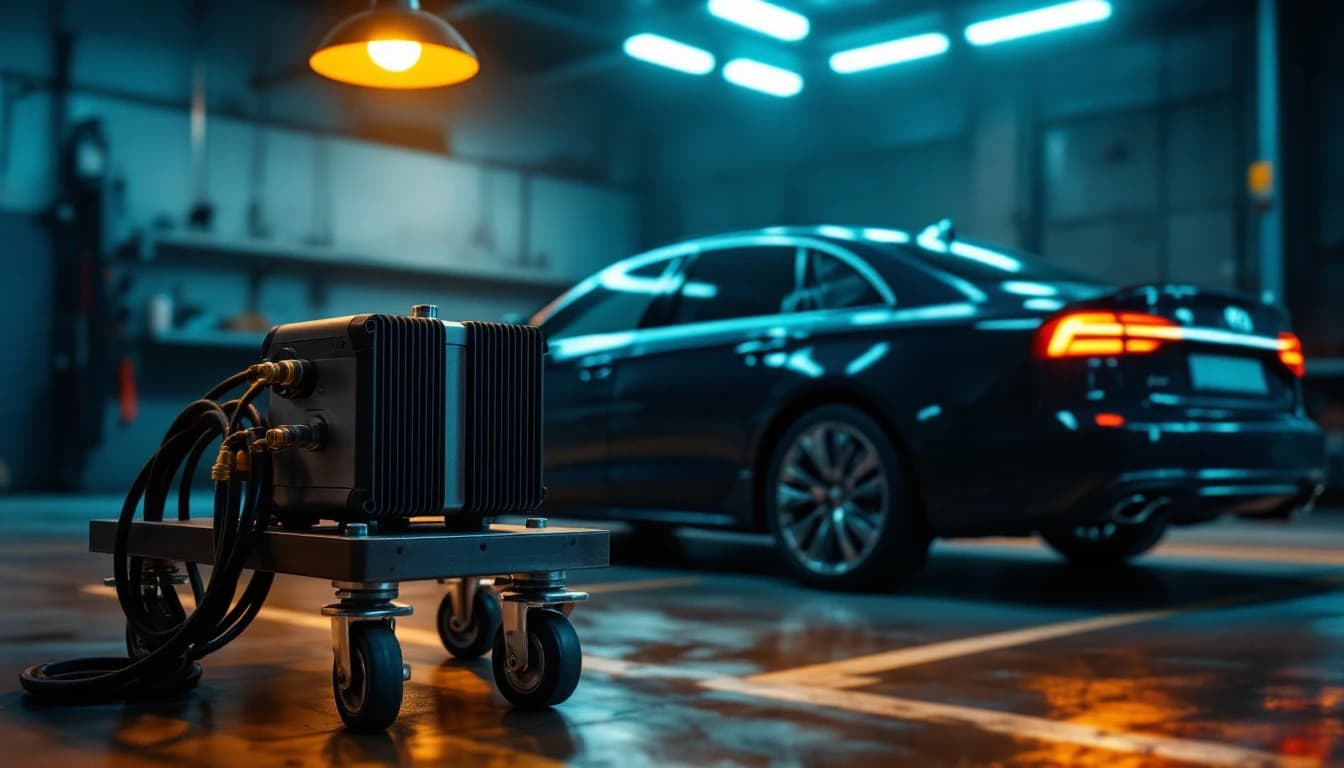
Dodge Charger ABS Module Failure by Generation (2006-2023)
What a Charger with three lights on is telling you
A Charger that lights the ABS lamp, the traction-control lamp and the ESP lamp together, switches those systems off and keeps braking normally on the pedal is reporting a failure in the controller that runs all three. The anti-lock, stability, brake-assist and traction functions share one electronic control unit bolted to one hydraulic control unit in the engine bay, so an internal electronic fault takes every one of them down at the same instant. A wheel-speed sensor fault, by contrast, usually names a corner and may flicker with speed.
The Charger has been on sale as a sedan since 2006 and has carried three generations of that controller, which is how this guide is organised. The combined Charger and Challenger C2200 guide goes deep on the 2011 to 2016 cars and the code that defines them; this page covers the Charger alone across its whole run, the earlier and later cars included, and the fleet population that makes the Charger unlike anything else on this site.
Dodge sold roughly 80,000 Chargers a year in the United States through the model's later years according to the Stellantis North America newsroom, on top of the much larger volumes of the early years, and with the average light vehicle on U.S. roads at about 12.6 years old in 2024 according to S&P Global Mobility, the first two generations of Charger ABS controllers are now squarely in the failure window.
Which ABS controller your Charger carries
2006 to 2010, the original LX Charger. The first modern Charger shared its platform architecture with its Chrysler 300 and Magnum siblings, and its anti-lock and stability controller is commonly an ATE Continental Teves unit on the cars we see, though the label decides. These controllers separate from the hydraulic block and fail in the way their family is known for: fatigued solder at the pin field, pump-motor terminal and relay faults, and corroded connectors on cars that have seen fifteen winters. Codes on these cars are less uniform than on the later Bosch units, so the full list from the ABS controller matters more.
2011 to 2014, the LD Charger. The redesigned car introduced the Bosch electro-hydraulic controller whose internal failure is the single best-known Charger ABS fault. It stores C2200, often shown as C2200-49, an internal electronic error that no sensor or wire outside the unit can set, and it clears for exactly as long as it takes the module to run its next self-test. This is the generation that produced the forum threads, and it is the generation we repair most.
A correction from our bench (October 2026): not every 2011-2014 car carries the Bosch unit. A 2012 Chrysler 300 3.6L RWD module we worked on this fall (Mopar 68157545AB) was an ATE 28.52-series unit, and the 3.6L Charger of those years shares that platform, so read the label on yours before you buy anything or ship it. Our Chrysler 300 ABS guide covers that car in detail.
2015 to 2023, the facelifted LD Charger. The later cars, including the Scat Pack and the Hellcat, carry a later Bosch generation with its own part numbers. The brake package changes with the trim, up to the large Brembo systems on the performance cars, but the controller family does not change with the calipers; the calibration does. The failure pattern on the bench is the same as the 2011 to 2014 cars: driver stages, pin-field solder and memory.
On every generation the deciding step is the same. Photograph the label on the electronic controller, send it with the VIN, and we confirm the family, whether it separates from the block and what the repair involves before you remove it. The ABS module types identification guide explains how to read that label and what each family is known for.
The codes that name the module
Read the ABS controller's own codes. A basic reader that only sees powertrain codes will not show them.
| Code | What it means | On a Charger it is usually |
|---|---|---|
| C2200 / C2200-49 | ABS module internal electronic failure | A failed driver stage or corrupted memory inside the controller; the defining 2011-and-later fault |
| C2116 | ABS pump-motor supply voltage low | The pump-motor driver or supply circuit inside the controller; occasionally a mechanically bad pump, which the bench separates |
| U0121 | Lost communication with the ABS module | The controller has gone quiet on the bus; prove power and ground at its connector first |
| C2100 | Controller supply voltage out of range | Battery, charging or a module ground; the honest first check on any Charger |
| C1xxx codes naming a wheel | Wheel-speed sensor circuit or signal at one corner | A sensor, tone ring, hub or harness at that wheel, not the module |
The pattern is what matters. A solid C2200 with good battery voltage and good grounds points inside the controller, full stop. A C2100 on its own points at the battery and the charging system, which on a Charger, with its long list of electrical consumers and, on the fleet cars, its idle hours, is a frequent finding. A code naming one wheel points outward. The ABS and traction light symptom guide walks the general version of that logic.
The fleet and police angle
The Charger is the one sedan on this site with a large working population. The Charger Pursuit was for years one of the most common police vehicles in the country according to Dodge, and a police car lives a life no commuter sedan does: hours of idling with every electrical system running, repeated hard stops from speed that heat the brake system and cycle the ABS pump, voltage sags from radios and lighting, and mileage accumulated at a pace that puts a six-year-old car where a twelve-year-old civilian car would be.
Every one of those conditions works on the ABS controller. Heat cycling fatigues the soldered pin field, repeated pump cycling wears the pump-motor driver, and voltage sags set supply codes and can corrupt memory. Fleet managers see the same C2200 the civilian owners see, only sooner and in multiples, and the dealer's answer, a complete hydraulic-and-electronic assembly plus programming per car, scales badly across a fleet.
The economics of repair scale the other way. A fleet that ships controllers to a bench, rather than buying assemblies, keeps each car's coding intact, avoids the programming appointment, and gets the unit back with a 1-year warranty for $499. On a fleet of Chargers, the rush option at checkout, which moves the bench time to 2 to 3 business days, is usually worth it; a patrol car off the road is a different cost from a commuter car in the driveway.
"The fleet Chargers come in by the pair. Same code, same failure, same year, because they were bought together and they have lived the same hard life. Repairing the electronics and keeping the coding is the only version of this job that makes sense across a dozen cars." — Independent chassis-electronics technician, 17+ years on ABS and stability controllers (anonymized)
The Charger's siblings: 300, Magnum and Challenger
The Charger never stood alone. The 2006 to 2010 car shared its platform and its brake electronics family with the Chrysler 300 and the Dodge Magnum wagon of the same years, and every Charger generation since has shared its controller family with the Challenger coupe built alongside it. That matters in two directions. A 300 or Magnum owner reading this with the same three lamps on is looking at the same family, the same codes and the same repair, with their own part numbers. And a Challenger owner should read the Challenger by generation guide, because although the controller is the same family, the way a coupe is owned, stored, modified and driven produces a different set of false alarms than a sedan's. What never changes across any of them is the rule that the label decides the part number, not the badge.
Before you condemn the module: the checks
Battery and charging first. Load-test the battery and check charging voltage. A Charger with a tired battery sets supply codes and can drop the ABS module off the bus, and on the fleet cars the electrical load makes this the first thing to rule out, every time.
Grounds and the connector. Check the module's ground and the main connector for corrosion, pushed-back pins and water. The controller sits in the engine bay near the master cylinder and sees heat and, on some cars, moisture.
Supply with U0121 stored. Prove battery voltage at the module's supply pins with the key on. No supply means a fuse, a harness or a power-distribution problem, not the module.
Wheel speeds. With a scan tool that reads the ABS controller, watch the four live wheel speeds while rolling. One that reads zero, drops out or disagrees with the others is a sensor, a tone ring or a hub.
Then the module. If the battery, grounds, supply and sensors check out and the code is a solid C2200 or C2116, the controller is the suspect, and on the 2011-and-later cars that is the normal finding.
Repair your controller or replace the assembly: the real cost
The dealer answer is a complete new hydraulic-and-electronic assembly, plus labour, programming to configure it and a scan-tool-assisted bleed. That is right when the hydraulic unit has failed mechanically. It is the expensive answer when the fault is a driver stage or a cracked joint on a controller bolted to a perfectly good block.
| Route | What it addresses | Programming | Bleed | Cost |
|---|---|---|---|---|
| Dealer new assembly | Everything, hydraulics included | Yes, dealer-performed | Yes | Commonly well into four figures once the part, labour, programming and bleed are counted, based on the parts and labour picture reported by outlets such as Kelley Blue Book |
| Remanufactured exchange | A rebuilt assembly for your core | Usually yes | Usually yes | Moderate plus a core deposit and days of downtime |
| Used donor unit | Cheapest part, unknown health | Almost always yes | Yes | Frequently the most expensive outcome once programming and a second failure are counted |
| Board-level repair of your own controller | The electronic fault on the unit you own | No; your coding never left the car | Often not, if the block stayed on the car | $499 flat plus return shipping from $29.95; 1-year warranty; about a week on the bench, rush 2 to 3 business days available |
| Bench evaluation | Nobody has proven which side failed | n/a | n/a | $150 per hour, applied before any repair is quoted |
The row that changes the arithmetic is the repair. Because your original controller keeps the car's configuration, there is nothing to program when it goes back in, and if only the electronic side came off, there is often nothing to bleed. The ABS module repair cost guide works through the same comparison across all makes.
The stability system is worth restoring rather than driving around. The Insurance Institute for Highway Safety estimates that electronic stability control cuts the risk of a fatal single-vehicle crash by roughly half, and the National Highway Traffic Safety Administration has required it on every new light vehicle since the 2012 model year. On a rear-drive sedan with the Charger's power, that is not a feature to do without.
What we repair on a Charger controller
On the Bosch units that dominate the 2011-and-later cars, the electronic controller is a circuit board carrying the pump-motor and solenoid driver stages, a soldered pin field into the hydraulic block and the memory holding the unit's configuration, the construction Bosch describes for its integrated units; the earlier ATE-family controllers follow the same pattern with their own weak points at the pump terminals and the pin field. The failures we repair are the driver stages and memory behind C2200, the pump-motor driver and supply circuit behind C2116, fatigued solder at the pin field, and corroded connector interfaces. The repaired unit goes through a powered test cycle including thermal cycling before it ships, which is why the standard bench time is about a week.
What we do not do is invent a repair. A pump motor or valve block that has failed mechanically is a replacement, not a bench fix, and we say so before any charge.
What to send, and how it runs
Ship the electronic controller, or the complete unit if yours does not separate, in a padded box with the lines capped and the connector protected. Include the VIN, the year and trim, the full code list from the ABS controller, a photo of the label, and a note on whether the battery has been going flat or the pump runs after key-off. Fleet customers can include a fleet number and a single return address for several units. Choose a return shipping tier at checkout; the rush option moves the bench time to 2 to 3 business days. We text updates to the number on the order, and the repaired controller goes back with the work documented and its coding untouched.
Frequently asked questions
Why are the ABS, traction and ESP lights all on at once on my Charger? Because on the Charger those functions run on one controller. An internal electronic fault in the ABS module takes anti-lock, stability, brake assist and traction control down together while the hydraulic brakes keep working normally. A wheel-speed sensor fault usually names a corner instead.
What does C2200 mean on a Dodge Charger? C2200, often shown as C2200-49, is an ABS module internal electronic failure: the controller's own self-test has found a fault in a driver stage or its memory. Nothing outside the unit sets it and clearing it does not help. On the 2011-and-later cars it is the defining module failure.
Is the ABS module the same on a 2008 Charger and a 2015 Charger? No. The 2006 to 2010 cars, the 2011 to 2014 cars and the 2015 and later cars each carry a different generation of controller with its own part numbers, and the label on the controller decides what you have. The repair approach is the same once the family is confirmed.
Does a Scat Pack or Hellcat Charger use a different ABS module? The brake package changes with the trim, but the controller family does not change with the calipers; the calibration does. Confirm the part number from the label rather than assuming a performance car is special, and do not fit a controller from a different trim without checking the variant.
Does a repaired Charger ABS module need programming? No. The repaired unit is your own original, so its configuration never changed and it goes back in configured. Programming is only required when a different unit is fitted, which is one of the main costs a repair avoids.
How much does a Dodge Charger ABS module repair cost? A board-level repair of your own controller is $499 flat plus return shipping chosen at checkout from $29.95, with a 1-year warranty on the repair, about a week on the bench and a rush option for 2 to 3 business days. A dealer assembly with programming and a bleed commonly runs well into four figures.
Can a police fleet send several Charger ABS modules at once? Yes. Each controller is repaired and documented individually and goes back with its own car's coding intact; ship them together with the VIN and fleet number on each, choose one return address, and use the rush option if the cars are off the road.
The bottom line
A Charger with the ABS, traction and ESP lamps on together is showing a failed ABS controller, and which controller you have depends on the generation: an ATE-family unit on most 2006 to 2010 cars, the Bosch unit behind C2200 on the 2011 to 2014 cars, and a later Bosch generation on the 2015 to 2023 cars, all identified from the label rather than the model year. Prove the battery, grounds, supply and wheel speeds, and when the code is a solid C2200 or C2116, repair the controller you own for $499 with its coding intact rather than buying and programming a whole hydraulic assembly. On a civilian car that is the cheaper path; on a fleet of Chargers it is the only one that scales.
Ship it for the abs module repair — $499 flat
About 1 Week Bench Time (Rush 2–3 Days Available), return speed your choice at checkout. Prepaid inbound label by email the minute you order.
More from the Lab

Dodge Challenger ABS Module Failure by Generation, 2008-23
10 min · October 10, 2026
Dodge Journey ABS Module Failure: Recall, Codes, Repair
13 min · October 16, 2026
Dodge Charger & Challenger ABS Module: C2200 Fix
13 min · October 3, 2026
Chrysler 300 ABS Module Failure: 2011-2014 Repair Guide
14 min · October 16, 2026