
Dodge Journey ABS Module Failure: Recall, Codes, Repair
Who this is for
- Your Dodge Journey has the ABS, traction-control and brake lights on together, and maybe the cruise control has quit too
- A scan tool pulled C2200, or a shop says the ABS unit needs replacing
- You own a 2012-2015 and want to know if the recall covers it, or a 2011 or 2016-2020 it never covered
- You have a quote near $900, or a dealer who cannot get the part, and want to know if your own module can be repaired
If you are not yet sure the module is the problem, start with the ABS and traction-light symptom guide. This guide covers 2009-2020 Journeys, focusing on the 2011-2020 cars.
What do the ABS, traction and brake lights mean on a Journey?
The Journey's anti-lock brakes, electronic stability control (ESC) and traction control all run from one controller: an electronic module bolted to a hydraulic control unit (HCU), the pump-and-valve block the brake lines run through. When that module faults, it switches off everything it runs and lights the lamps. FCA (Fiat Chrysler, now Stellantis) found that most Journeys with the ABS lamp on also had the ESC lamp on, per the chronology FCA filed with NHTSA.
You lose the electronic help, not your brakes: the pedal still stops the car through normal hydraulics, but anti-lock, stability control and traction control are gone. Owners of 2016 Journeys have told NHTSA that cruise control dropped out with them.
The stability system matters most. Describing stability control in general, Bosch says the control unit compares the vehicle's actual movement with the intended direction 25 times per second and brakes individual wheels when the two disagree.
The lamp pattern is a clue. Lamps that come and go, particularly after rain, fit the water story below; lamps that come on every drive and stay on fit an internal failure.
Is my Journey covered by the ABS recall?
Maybe. NHTSA campaign 15V-675, FCA recall R61, covers 2012-2015 Journeys built from April 21, 2012 to April 14, 2015, and NHTSA's acknowledgment lists 275,614 vehicles. FCA's dealer instructions narrow it to left-hand-drive cars with electronic stability control.
Water running off the windshield crosses the right front shock tower and collects inside the heat-shrink on two ground eyelets there. One of those eyelets carries two ground wires to the ABS connector, and the water wicks along the wire, through the connector and into the module, even though the module and connector are a sealed design. The chronology points to an April 2012 change from dual-wall to single-wall heat-shrink; dual-wall returned at the Toluca plant on April 14, 2015.
The remedy is free and takes about 2 hours, according to FCA's owner letter. The dealer seals the eyelets, inspects the connector for moisture and corrosion, fits a new ground circuit where needed, and replaces the ABS module if the lamp stays on with C2200 stored.
Check your VIN at NHTSA's recall lookup. It shows unrepaired recalls only, so a clean result means the work was done or your car was never in the population. Three groups fall outside it: 2009-2011 and 2016-2020 Journeys, 2012-2015 cars built outside those dates, and recall-replaced modules that have failed since. One 2015 owner told NHTSA in August 2026 that exactly that had happened.
Which Journey years and part numbers are we talking about?
The ABS hardware changed over the Journey's 2009-2020 run. The genuine Mopar catalog at MoparPartsGiant splits each Journey unit into the electronic module and the hydraulic control unit, sold separately:
| Model years | Electronic ABS module (examples) | Hydraulic control unit (examples) |
|---|---|---|
| 2009 | 68038226AA, 68045540AA | 68038227AA, 68045542AA |
| 2010 | 68067661AA, 68067670AA | 68067662AA, 68067671AA |
| 2011 | 68089576AA (now 68194695AG), 68089577AA | 68067662AA, 68067671AA |
| 2012-2017 | 68194693 series (now 68194693AG), 68194695 series (now 68194695AG) | 68164594AA, 68164597AA |
| 2018-2020 | 68397222AA, 68397222AB | 68164594AA |
Two things stand out. The 2011 module supersedes into 68194695AG, the same number that replaces the 68194695-series modules on 2012-2017 cars, and one hydraulic unit, 68164594AA, spans 2012 to 2020. That shared lineage is why the 2011-2020 cars are the core of this guide. And FCA's recall kit came in two module versions, with and without hill start assist, so a module that bolts on is not automatically the right variant.
Treat the table as a map, not an order form: labels can carry assembly numbers that match no service number, so photograph yours and send it with the VIN. The ABS module types guide explains how to read one.
Which codes point at the ABS module?
Read the ABS module's own codes. A basic engine-code reader will not see them.
| Code | What it means | What it usually points to on a Journey |
|---|---|---|
| C2200 | ABS module internal failure | The module itself; FCA's recall procedure replaces it when C2200 stays after the wiring repair |
| C2116 | ABS pump-motor supply voltage low | The pump-motor driver or supply inside the module, occasionally the pump motor |
| U0121 | Lost communication with the ABS module | A module that has stopped talking; prove power, ground and the connector first |
| C2100 | Battery voltage low | Battery, charging system or a module ground |
| A code naming one wheel speed sensor | Sensor, tone ring or wiring at that corner | Not the module |
C2200 carries the most weight because FCA itself treats it as the verdict. In the dealer service instructions for recall R61, the technician seals the ground, cleans and greases the connector, then checks the lamp: on with C2200, the module is replaced; on with other codes, normal diagnosis follows. Fix the wiring first, then judge the module.
The C2200 code explainer covers the general logic. On a Journey, also unplug the module connector and inspect the terminals and socket for moisture or corrosion, as FCA's procedure does. A corroded connector or ground can set codes on a healthy module.
Why does the Journey ABS module fail?
On the recall cars, water is the documented cause. Of roughly 90 modules returned between July 2014 and January 2015, about 40 percent had failed from water inside. By August 28, 2015, moisture had turned up in 72 of 212 field-returned parts, or 37 percent, per the chronology. By late September 2015, FCA had logged about 306 customer assistance records tied to ABS and ESC lights.
Read that 37 percent the other way, too. Even inside the recall investigation, most returned modules did not have water in them, and FCA's filing does not say what failed in the rest. Electronics that ride on an engine-bay hydraulic unit for a decade have the usual suspects: solder joints cracked by heat cycles and vibration, driver stages that switch the pump and valves, and memory corrupted by low-voltage events. The ABS internal-failure guide walks through those failures by component.
Age makes all of it more likely now. The average light vehicle on U.S. roads was 12.8 years old in 2025, according to S&P Global Mobility, and a 2012-2015 Journey is 11 to 14 years old today. On the 2015 Journey alone, NHTSA's public file holds 553 owner complaints, 51 of them filed under electronic stability control.
What does a new module cost compared with a repair?
RepairPal puts the average Journey ABS control module replacement at $821 to $935, with labor at $244 to $358 and parts around $577; for a 2016 it lists $818 to $932. That parts figure sits close to the $574.00 list price of a 2012-2017 electronic module alone in the Mopar catalog. If the hydraulic control unit has to be replaced as well, it lists at $945.43 on its own, so a whole new assembly runs about $1,519 in parts at list before labor.
Then add what the quote leaves out. A new or used module must be initialized with a scan tool, and the part may not be there: Journey owners told NHTSA as recently as May 2026 that the module was backordered or discontinued while their Journeys went without ABS or stability control.
| Option | Typical cost | Programming or initialization | Keeps your Journey's own data |
|---|---|---|---|
| New module installed (RepairPal average) | $821 to $935 | Yes, scan tool | No |
| New module plus new hydraulic unit | About $1,519 in parts at list, plus labor | Yes, plus a brake bleed | No |
| Used module from a salvage yard | Varies | Yes, and the variant must match | No |
| Repair of your own module at AML | $499 flat plus return shipping | Plug-and-play in most cases | Yes |
Our terms, in full: ABS Module Repair + Reprogram is $499 flat with a 1-year warranty, extendable at checkout to 2 years (+$50), 3 years (+$100) or 5 years (+$150). Bench time is about a week after the module arrives, or 2-3 business days with rush repair (+$100). We email you a prepaid inbound shipping label, so sending it to us costs you nothing, and you choose return shipping at checkout: $29.95 standard (3-5 days), $54.95 UPS 2-Day or $94.95 UPS overnight. If testing shows your module cannot be repaired, we tell you first and quote a replacement before any extra charge.
The limit is just as plain: we repair electronics, not a mechanically failed pump or valve block, and not wheel speed sensors. The ABS repair cost guide compares the numbers across makes.
What should you remove and ship?
Before you pull anything, text us photos of the unit and its label, the VIN and the codes, and we will tell you whether to send the electronic module alone or the complete ABS/HCU assembly. For the 2016 Journey in the example below, we asked for the complete assembly.
Do not improvise the split. FCA's procedure says to clean the whole unit before opening it, remove four screws, and separate the module about 1.5 inches (38 mm) from the hydraulic unit before lifting it away, or the pressure sensor or pump-motor connection can be damaged, and then the hydraulic unit has to be replaced. Reassembly takes twelve new solenoid valve-stem seals, a seated pump/motor O-ring and four new screws at 17 in-lb (2 N·m).
Disconnect the negative battery cable first. On every engine, FCA's module-replacement steps start by removing the cowl top screen, both wiper arms, the cowl screen, the eight-bolt wheelhouse brace and the fresh-air plenum. The unit hangs on a bracket beside the frame rail, and its ground eyelet sits on the right front shock tower.
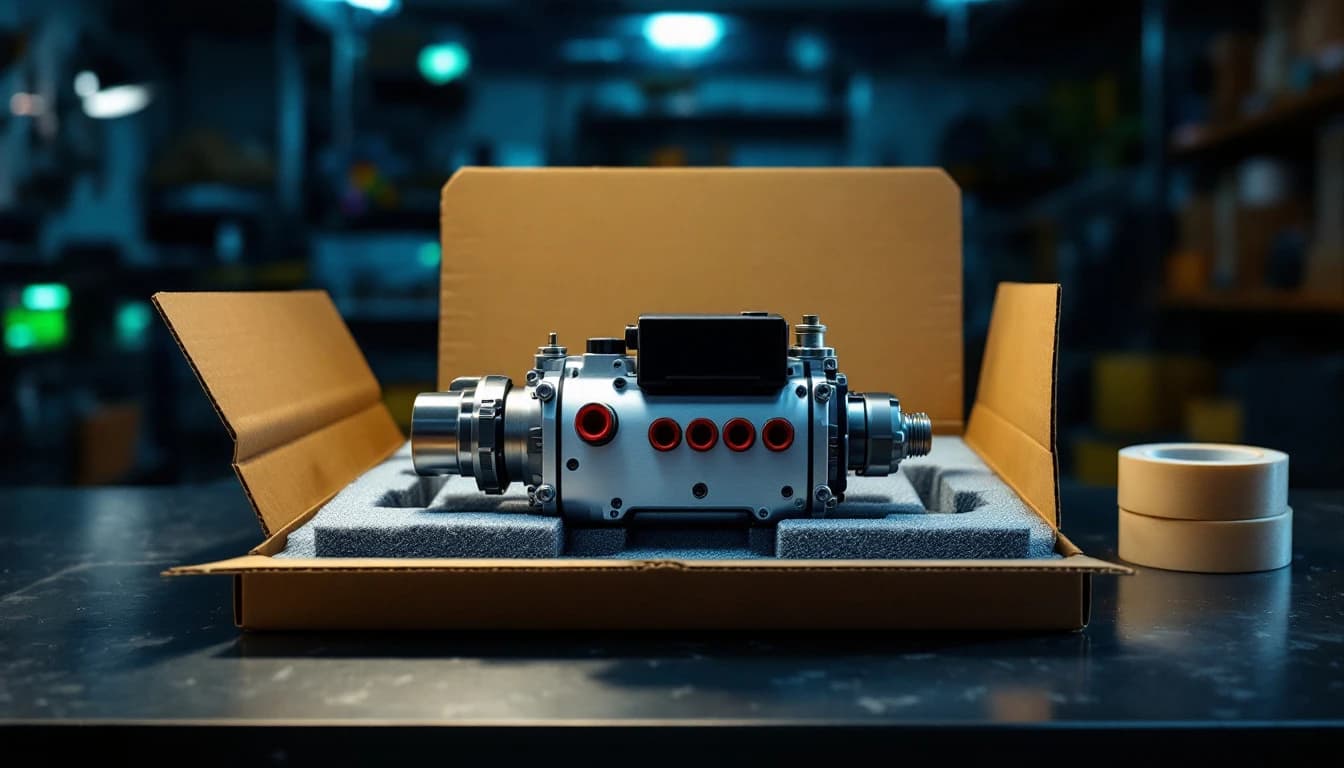
If you remove the complete assembly, the brake lines come off. Cap the lines and the ports so dirt and moisture stay out, protect the connector, and pack the unit in a padded box with your order confirmation.
How do programming and bleeding work after the swap?
A new or used module arrives without your Journey's setup. FCA's instructions say it must be initialized with the wiTECH scan tool, or the ABS lamp flashes continuously; the wheels must point straight ahead, the drive test needs a 90-degree turn, and FCA warns a replaced module may show an active dynamic-sensor code.
Your own repaired module is different. On the Journey in the example below, we backed up the module's stored identity, the EEPROM data that ties it to that car, before any work, and it went back programmed. In most cases that means plug-and-play: reconnect, clear the codes, drive.
Bleeding depends on what came apart. If only the electronic module came off the hydraulic unit, the brake fluid circuit was never opened. If the whole assembly came out, it was, and the brakes need a bleed, scan-tool assisted if air may have reached the hydraulic unit. The replaced-module guide covers the bleed and the sensor calibrations in detail.
Then drive it properly. FCA's procedure calls for at least five minutes on the road, the wheel turned lock to lock, gentle curves at 6 to 15 mph and several anti-lock stops, and notes that some pump-motor and sensor lamps only go out after driving above 9 mph for several minutes.
A real-world example
Vehicle: 2016 Dodge Journey SXT with the 3.6L V6, customer anonymized. As a 2016, it sits outside recall 15V-675.
Before: Before ordering, the owner texted us photos and the assembly's part number, P68272500AB. We asked for the complete ABS/HCU assembly rather than the electronic module alone.
On the bench: The assembly arrived on Tuesday, September 8, 2026. The first step was backing up the module's stored identity, the EEPROM data that makes it this Journey's module. Then the work was finished, the module was programmed, and the assembly shipped back on Monday, September 21.
Results: Delivered on Friday, September 25, 17 days after it reached us: the owner's own unit, programmed, not a replacement.
Net: For a 2016, RepairPal's replacement estimate is $818 to $932, before any wait for parts. The repair is $499 flat plus the return tier chosen at checkout. Standard bench time is about a week, and rush repair (+$100) cuts it to 2-3 business days.
What experts say
"On a Journey there are two stories, and they get separated before anyone buys parts. One is water that followed a ground wire into the module, and while the recall is open, that belongs at the dealer. The other is a module that has simply aged out. For that one, the first thing we did on the 2016 in this article was save what the module knows about the car, so it went back as that Journey's own module." — Auto Module Lab bench team
FCA's own recall letter is blunt about the stakes: without working ABS or ESC, the Journey's braking and handling can change and a crash can happen without warning. Per IIHS, electronic stability control cuts the risk of a fatal single-vehicle crash by about half and the risk of a fatal single-vehicle rollover by 75 percent in SUVs, and NHTSA estimated it saved 1,580 lives in 2014 alone. A Journey with its ESC lamp on has none of that.
Frequently asked questions
Is my Dodge Journey covered by the ABS recall?
Only a 2012-2015 built between April 21, 2012 and April 14, 2015, the population in NHTSA campaign 15V-675 (FCA recall R61). Check your VIN at NHTSA's recall lookup. If the recall is open, the dealer remedy is free, including a new ABS module when C2200 remains after the wiring fix.
Why are the ABS, traction and brake lights on together in my Journey?
One module runs the anti-lock brakes, stability control and traction control, so when it faults it shuts them all off and lights the lamps together. A wheel speed sensor fault can light the same lamps, so read the ABS codes before buying anything.
Is it safe to drive a Journey with the ABS light on?
Your hydraulic brakes still stop the car, but anti-lock and stability control are gone, so hard stops and slippery roads carry more risk. Drive gently and get it fixed, and if the red brake warning stays on or the pedal feels different, have the brakes checked first.
Does a repaired Journey ABS module need programming?
Usually not on your end. Your own module keeps its stored identity; on the 2016 in our example we backed that data up first and returned the module programmed, so in most cases it reinstalls plug-and-play. A new or used module must be initialized with a scan tool, or the ABS lamp flashes.
Do I send just the module or the whole ABS unit?
Text us photos of the unit and label, the VIN and the codes first, and we will tell you; for the 2016 in our example we asked for the complete ABS/HCU assembly. If you separate them yourself, part them about 1.5 inches before lifting the module away, as FCA warns, or the pressure sensor or pump-motor connection can be damaged.
How much does the repair cost and how long does it take?
$499 flat with a 1-year warranty, extendable to 2, 3 or 5 years at checkout, and about a week on the bench, or 2-3 business days with rush repair (+$100). We email a prepaid inbound label, and return shipping runs from $29.95 standard to $94.95 overnight. If the module cannot be repaired, we tell you first and quote a replacement before any extra charge.
The bottom line
A Dodge Journey with the ABS, traction and brake lamps on together usually has a failed ABS module, and the first question is the recall. If your 2012-2015 was built between April 21, 2012 and April 14, 2015 and the recall is open, the dealer fix is free. Otherwise you are choosing between a replacement averaging $821 to $935 that still needs initialization and may be backordered, and a $499 repair of the module you already own.
Either way, prove it is the module first: battery, grounds, the connector and the wheel speed sensors, then the codes. A solid C2200 after the wiring checks out is the same verdict FCA uses.
Next steps
Pull the codes, photograph the label on the unit, and send both with the VIN; we will confirm the application and tell you what to remove before you ship. The ABS module repair service is $499 flat with a 1-year warranty, and the services page lists the other modules we repair.
Ship it for the abs module repair — $499 flat
About 1 Week Bench Time (Rush 2–3 Days Available), return speed your choice at checkout. Prepaid inbound label by email the minute you order.
More from the Lab
Chrysler 300 ABS Module Failure: 2011-2014 Repair Guide
14 min · October 16, 2026
Dodge Ram 1500 ABS Module: Lights, Codes & Repair
13 min · October 3, 2026
Dodge Charger & Challenger ABS Module: C2200 Fix
13 min · October 3, 2026
Sprinter ABS/ESP Module Failure: Lights, Codes & Repair
13 min · October 16, 2026