
Chrysler 300 ABS Module Failure: 2011-2014 Repair Guide
Who this is for
- Your 2011-2014 Chrysler 300 has the ABS, ESC and traction-control lights on together, maybe with adaptive cruise switched off too
- A scan tool read C2200 or C2116 from the ABS module, or a shop says the ABS unit must be replaced
- The lights come and go when the car is hot, or they arrived with a battery saver message
- You have a four-figure quote, or a dealer that cannot get the part
This guide covers the 2011-2014 model years of the second-generation 300, commonly called the LD generation; Chrysler's own service paperwork files the 300 under the LX code and the Charger under LD. Where something also holds for the 2005-2010 car or the 2015 and later facelift, we say so. If you are not sure the ABS system is involved at all, start with the ABS and traction-light guide.
What do the ABS, ESC and traction lights mean on a 300?
The car has switched off anti-lock braking and everything built on it: stability control, traction control and brake assist. They all run through the ABS module, so when it faults or loses power they drop together. The red brake lamp may come on too, and on equipped cars adaptive cruise and forward collision warning shut off. Normal braking stays; the anti-lock and stability help in a hard stop does not.
How the lights behave tells you where to look first:
- On through every key cycle, with C2200 stored: the module is the prime suspect.
- Coming and going, worse when the car is hot: on a 2011 or 2012, check the fuse recall below first.
- Arriving with a battery saver message, a flickering dash or a stall: think alternator.
- One wheel named in the codes: a wheel speed sensor, tone ring or harness at that corner.
As of October 2026, NHTSA's complaint file for the 2012 Chrysler 300 holds 426 complaints; 33 list the service brakes and 24 list electronic stability control. One owner describes ABS, stability control, forward collision warning and adaptive cruise all cutting out when the ABS fuse seemed to lose contact on a hot car. Others point to a failed alternator, a wheel speed sensor or, in 2023, an ABS module the dealer could not get.
Which fault codes point at the ABS module?
Read the ABS module's own codes; a reader that only shows engine codes will not see them.
| Code | What it means | What it usually points to on a 2011-2014 300 |
|---|---|---|
| C2200 (often C2200-49) | ABS module internal failure | A fault inside the controller: driver stage, processor or solder joint. Returns right after clearing |
| C2116 | ABS pump motor supply voltage low | The pump motor supply, inside the unit or upstream of it. Prove the feed first |
| U0121 | Lost communication with the ABS module | The controller is off the network. Check its fuse, power and ground first |
| C2100 | ABS module supply voltage low | Battery, alternator or a ground; check the recalls below |
| A C-code naming one wheel | Wheel speed sensor circuit or signal | The sensor, tone ring, hub or wiring at that corner, not the module |
ECU Testing's catalogue entry for the P68157545AB unit, the label number on the 2012 300 in our example, names C2200 and C2116 as the codes it stores when its internal components break down. A C2200 that returns straight after clearing, with good battery voltage and clean grounds, is the clearest verdict you will get; our C2200 code page walks the checks in order. C2100 and U0121 mean bad power or a silent module, which the recalls below can cause.
Could a recall be causing your 300's ABS lights?
Three recalls can switch off the ABS and stability systems with a healthy ABS unit. Check them before you pay for a module.
Recall 12V-197 (Chrysler M10), 2011-2012 cars. Chrysler's defect report to NHTSA covers 119,072 300s and Chargers: 2011s built from May 6, 2010 to July 26, 2011 and 2012s built from February 9 to December 20, 2011. Heat made the plastic insert around the ABS/ESC fuse expand and contract until it distorted a bus bar terminal in the power distribution center, which could cut ABS/ESC power intermittently. Chrysler put the share of affected cars at roughly 100 percent. Its dealer instructions for M10 give a check you can do with the hood open: remove the power distribution center cover and look at position 6. A 25-amp cartridge fuse there means no further action is needed; if it is missing, the dealer relocates and upgrades the fuse free.
Recalls 14V-634 (P60) and 17V-435 (T36), alternators. The first covers 435,081 vehicles with the 3.6L V6 and a 160-amp alternator, the 2011-2014 300 among them, and Chrysler's amended report traces it to heat fatigue in the alternator's diodes. The second, recall 17V-435, covers 442,214 vehicles with electro-hydraulic power steering and the 3.6L or 5.7L, including 180- and 220-amp alternators. Both reports state that system voltage can drop to critical levels and disable the ABS and stability control.
A dealer can check all three against your VIN.
Why does the ABS module fail on these cars?
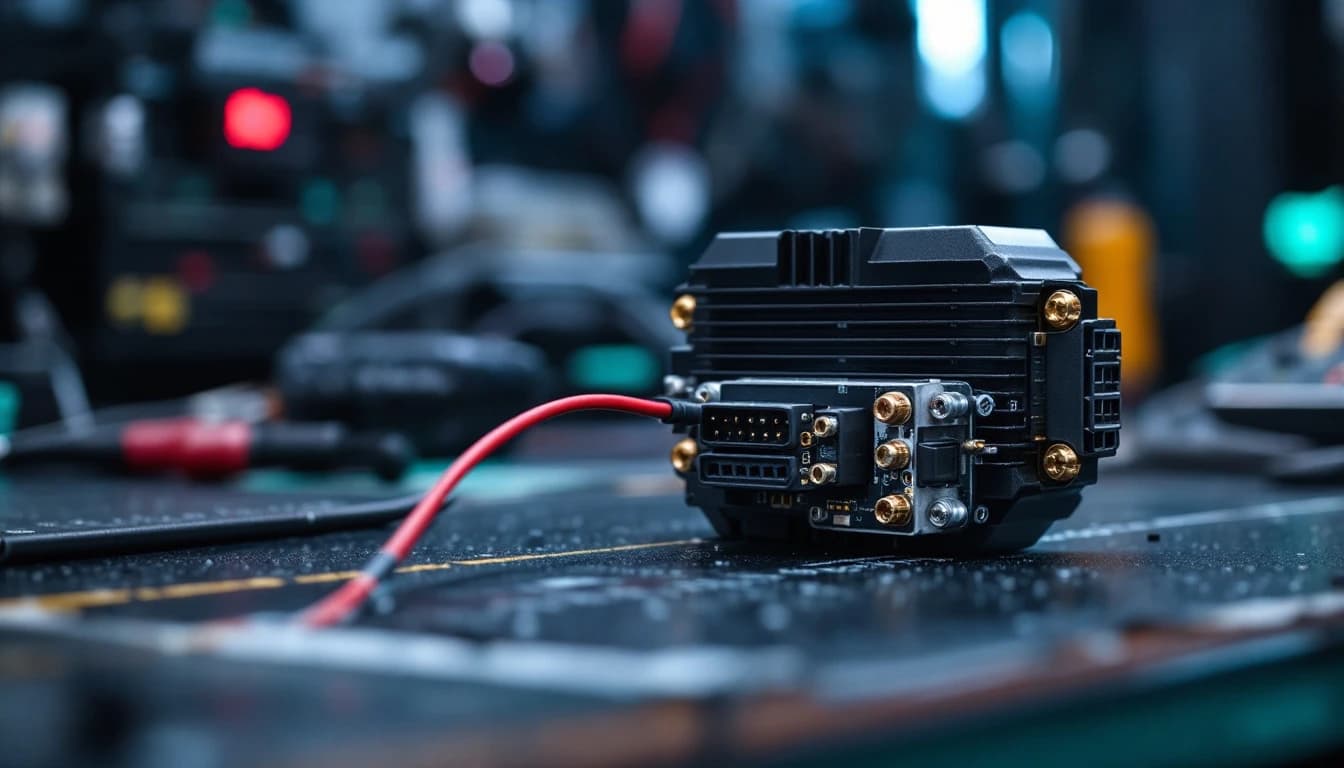
The unit is two pieces: an electronic controller screwed to a hydraulic block that holds the pump motor and valves. ATE, the Continental brand behind the unit on the 2012 car in our example, describes that layout for its MK60 ABS control unit and notes that you can still brake normally if the electronic unit fails. The 300's unit is not necessarily an MK60, but the split is the same, and the failures we repair are electronic.
The controller lives in the engine bay through years of heat cycles and vibration. What gives out is on its board: the driver stages that switch the pump motor and valve coils, the solder joints that carry that current, and the processor and memory. That is why C2116 can be an internal fault. Heat already drove two recalls on this car: the fuse terminal behind 12V-197 and the alternator diodes behind 14V-634. Age adds the rest. U.S. passenger cars now average 14.5 years old, according to S&P Global Mobility's 2025 analysis as reported by The Shop, and a 2011-2014 300 is 12 to 15. Our ABS internal-failure guide has the component-level detail.
We do not fix mechanical failures: a seized pump motor or a stuck valve needs a replacement unit, and a failed wheel speed sensor is on-car work.
Repair, new or used: what does a 300 ABS module cost?
RepairPal puts the average Chrysler 300 ABS module replacement at $802 to $863, with labor at $130 to $191, but by year it runs $1,544 to $1,618 for a 2011, $1,419 to $1,493 for a 2012 and $735 to $809 for a 2013 or 2014. Its procedure ends with a brake bleed and manufacturer software updates.
New parts are drying up. The 2012 module, Mopar 68160269AB, is marked discontinued on MoparPartsGiant; on October 16, 2026 we checked all 14 ABS service numbers that catalog lists for 2011-2014 cars, and every one carried the same note. A 2013 owner told NHTSA in 2021, in the 2013 Chrysler 300 complaint file, that the dealer had hundreds of these modules on back order with no fulfillment date.
A used salvage unit costs less up front, but it is as old as yours, has an unknown history and arrives set up for its donor car.
| Route | What you pay | Setup after install | The catch |
|---|---|---|---|
| Dealer or shop replacement | $735 to $1,618 by model year (RepairPal) | Configure to the car, bleed | New service parts marked discontinued |
| Used salvage unit | Part price plus labor and setup | Configure to the car, bleed | Same age as yours, unknown history |
| Repair of your own unit | $499 flat plus return shipping from $29.95 | None in most cases | Fixes the electronics, not a mechanical pump or valve fault |
Our ABS module repair keeps your unit's configuration, so it goes back plug-and-play in most cases, with a 1-year warranty; if it cannot be repaired, you get a replacement quote before any extra charge. The ABS repair cost guide runs this comparison for other makes.
Does AWD or RWD change the ABS part number?
Not in the parts catalog. MoparPartsGiant lists the 2012 module, 68160269AB, for both rear-drive and all-wheel-drive versions of the Base, Limited, 300C and 300S with the 3.6L, 5.7L and 6.4L. The numbers split by year and engine instead. On the 2013 Chrysler 300 listing, 68195727AA covers 3.6L and 5.7L cars only, and its replacement, 68210119AB, adds the 6.4L SRT versions, listed as rear-drive only, and runs through 2014. That is the exact pair the 2013 owner's NHTSA complaint names.
The label on your unit carries a different number. The 2012 car in our example has P68157545AB, and ECU Testing's Chrysler 300 ABS catalogue lists it alongside P68157545AF and P68224181AB, which it gives for 2011-2014 cars, each paired with a 28.52-series supplier number; ours read ATE 28.5265-6503.3. None of those label numbers appears among MoparPartsGiant's 2011-2014 service numbers, so match by the label and the VIN rather than a catalog search.
The 2005-2010 car and the 2015 facelift use different units and different numbers in both catalogs. The diagnosis in this guide carries over; the part numbers do not.
What do you remove and ship?
Before anything comes off, read the ABS codes, photograph the label and note the VIN, then send us the photo so we can confirm the application and what to ship.
In most cases we want the electronic controller only. On ATE units it is screwed to the hydraulic block, so with the battery disconnected and the connector unplugged it can usually come off while the block stays on the car, lines closed. If the whole unit comes out, the lines open and the brakes need bleeding.
Pack it in a padded box with the connector protected, cap the ports if you send the whole unit, and add a note with the VIN, the codes and the recall status. We email you a prepaid inbound label, so shipping to us costs you nothing. Return shipping is chosen at checkout: $29.95 standard (3-5 days), $54.95 UPS 2-Day or $94.95 UPS overnight. Bench time is about a week, or 2-3 business days with rush repair (+$100).
Does the module need programming and a bleed after install?
Your own repaired unit does not, in most cases. Its configuration never changed, so you reconnect it, clear the codes and road test.
A different unit, whether new, used or supplied by us, has to be configured to your car before the lights will stay off. Chrysler's pattern shows in FCA service bulletin 08-061-17 for the 2017 300 and Charger: hold the battery between 13.2 and 13.5 volts with a charger while the module is reprogrammed, run the brake pedal calibration and then the ABS initialization, and clear the codes. That bulletin covers the later car and we found no public equivalent for 2011-2014, so treat it as the shape of the job. When we supply a replacement, we configure it to the car before it ships.
Bleeding depends on what was opened: nothing, if only the controller came off and the block stayed plumbed in. With the whole unit out, bleed the brakes, and if air may have reached the hydraulic block, finish with a scan-tool ABS bleed that cycles the pump and valves. Our guide to a replaced ABS module whose light stays on covers setup, bleeding and sensor checks.
A real-world example
Vehicle: 2012 Chrysler 300 with the 3.6L Pentastar V6 and rear-wheel drive. Owner anonymized.
The unit: ABS module labeled P68157545AB, an ATE unit carrying ATE's number 28.5265-6503.3.
The order: Placed in mid-September 2026 for our $499 repair, with UPS overnight chosen for the return. The module reached the bench on September 17.
On the bench: Testing found the unit beyond repair; not every controller can be saved. The owner heard the finding and a replacement quote before any extra charge.
The fix: With the owner's approval, we sourced a matching unit, configured it to that car so it would install plug-and-play, and shipped it back. The job closed in early October.
The bill: The replacement unit added $275. A shipping error on our side meant we refunded the $94.95 overnight return fee, so the order closed at $774.
Net: It became a replacement, not a repair, and we would rather say so plainly. RepairPal's estimate for replacing the module on a 2012 is $1,419 to $1,493, and the Mopar service part is listed as discontinued.
What experts say
"On a 2011 or 2012 300 we ask about the fuse recall before we ask for the module, and with battery saver messages we ask about the alternator. Both can shut off the ABS and stability control on a car whose ABS unit is fine. When the recalls are done, the battery and grounds check out and C2200 comes straight back, the fault is on the controller's board. If that board is past saving, as it was on the 2012 in this guide, the owner hears it before paying anything more." — Auto Module Lab bench team
Chrysler's filings back that order. Both alternator recall reports say a failing alternator can let system voltage fall far enough to disable the ABS and stability control, and the M10 report describes intermittent loss of ABS/ESC power from a heat-distorted fuse terminal, with nothing wrong in the ABS unit.
Fixing it is worth it. Per the Insurance Institute for Highway Safety, electronic stability control cuts the risk of a fatal single-vehicle crash by about half, and NHTSA estimates it saved about 4,100 lives from 2010 to 2014.
Frequently asked questions
Is it safe to drive a Chrysler 300 with the ABS and ESC lights on?
The car still stops on its normal hydraulic brakes. You lose anti-lock braking, stability control and traction control, which matter most in a panic stop or on a wet road; IIHS puts the cut in fatal single-vehicle crash risk from stability control at about half. Drive gently and get it checked.
Why do my 300's ABS and ESC lights come and go?
On a 2011 or 2012, lights that come and go and get worse when hot fit recall 12V-197, a heat-distorted fuse terminal in the power distribution center. A 25-amp cartridge fuse in position 6 of that box means no further action is needed; if it is missing, the free dealer fix is still owed. With battery saver messages, check the alternator recalls.
How much does it cost to replace the ABS module on a 2011-2014 Chrysler 300?
RepairPal estimates $1,544 to $1,618 for a 2011, $1,419 to $1,493 for a 2012 and $735 to $809 for a 2013 or 2014. Any replacement has to be configured to the car, and the new Mopar service parts are marked discontinued. Repairing your own unit here is $499 flat plus return shipping.
Does a repaired 300 ABS module need programming?
In most cases, no. A repair keeps your original unit and its configuration, so it reinstalls plug-and-play: reconnect, clear the codes and road test. A different unit, new or used, has to be configured; when we supply one because yours cannot be saved, we configure it before it ships.
Is the Chrysler 300 ABS module the same as the Dodge Charger's?
They are close relatives: same platform, same recall 12V-197, and ECU Testing lists the same P68157545AB label number for the 3.6L Charger. Do not swap units on that basis alone; match the label and the VIN, and configure any swapped unit. Our Charger and Challenger C2200 guide covers that car.
What happens if my 300's module cannot be repaired?
We tell you before any extra charge and quote a replacement, and nothing is charged unless you approve it. That is how the 2012 car in this guide went: the original was beyond repair, the owner approved the quoted replacement, and we configured it to the car so it went back plug-and-play.
The bottom line
On a 2011-2014 Chrysler 300, the ABS, ESC and traction lights on together usually point at the ABS unit, but rule out three recalls first: the 12V-197 fuse recall on 2011-2012 cars and the two alternator recalls. When those are done, the battery, grounds and wheel speeds check out and C2200 keeps coming back, the controller is the problem.
A replacement runs $735 to $1,618 by year per RepairPal, needs configuring and comes from a parts line marked discontinued. Repairing the unit you already own is $499 flat and goes back plug-and-play in most cases; if it cannot be saved, you hear that first, with a quote.
Next steps
Pull the ABS codes, photograph the label and have a dealer check the three recalls against your VIN. Send us the label photo, the VIN and the codes, and we confirm the application and what to remove before you ship. When you are ready, start a $499 ABS module repair, or see the services page if your 300 has more than one module acting up.
Ship it for the abs module repair — $499 flat
About 1 Week Bench Time (Rush 2–3 Days Available), return speed your choice at checkout. Prepaid inbound label by email the minute you order.
More from the Lab
Dodge Journey ABS Module Failure: Recall, Codes, Repair
13 min · October 16, 2026
Equinox, Terrain & SRX ABS Module: Codes, Cost & Repair
13 min · October 16, 2026
Jeep Wrangler JK ABS Module: ESP/BAS Lights & Repair
13 min · October 3, 2026
Dodge Ram 1500 ABS Module: Lights, Codes & Repair
13 min · October 3, 2026