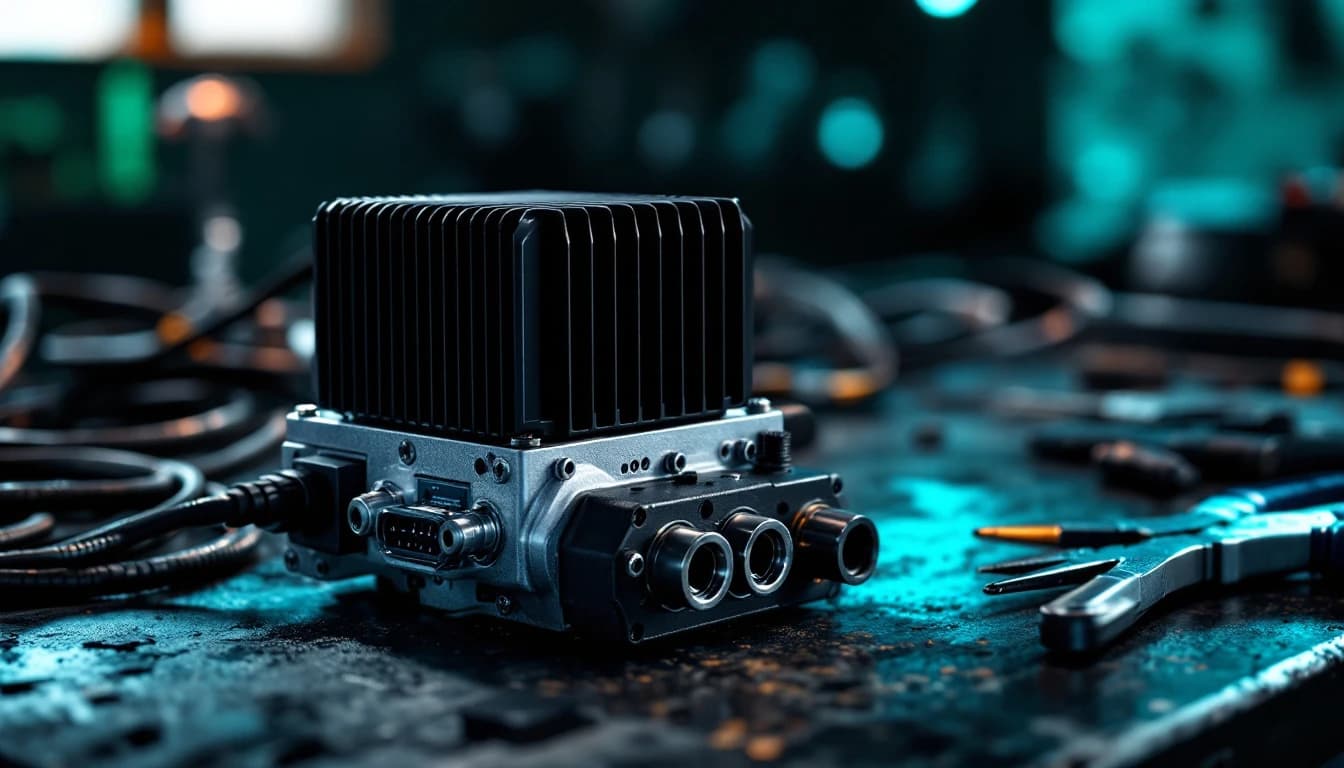
Jeep Wrangler JK ABS Module: ESP/BAS Lights & Repair
Who this is for
- Your Jeep Wrangler JK (2007-2018) has the ABS, ESP/BAS and traction-control lights on together and you want to know what it actually is
- You pulled codes C2116 or C2200 and a shop told you the whole ABS unit needs replacing
- Your ABS pump is running with the key off and killing the battery overnight
- You got a dealer quote for a new module and it seems enormous next to a repair quote, and you cannot work out why
- You run a shop or wrench on your own Jeep and want the straight version: new part cost, repair cost, the codes, the warranty, and the process
If you have not yet proven the module is the problem, read the ABS and traction-light symptom guide first. Spending money before that question is answered is the single most common way JK owners overpay on this repair.
The three-light symptom, and why it points at the module
On the JK Wrangler the failure almost always shows up the same way: the ABS light, the ESP/BAS light and the traction-control light all illuminate at once, usually with a chime, and the systems behind them all switch off. You still have normal hydraulic brakes - the pedal works - but anti-lock, stability and traction assistance are gone, and on some trucks the speedometer drops to zero.
The reason all three light together is that they share one controller. The ABS module on a JK is a combined assembly: an electronic control unit bolted to a hydraulic control unit with the pump and the solenoid valve block. The electronic side runs ABS, stability (ESP), brake assist (BAS) and traction control off the same processor and the same wheel-speed inputs. When that controller faults internally, every function that depends on it drops at the same moment - which is exactly the three-light pattern JK owners report over and over on the JK-Forum community.
The most telling JK-specific symptom is the pump that will not stop. According to the module specialists at ECU Testing, a common failure mode on these units is the pump-motor relay getting stuck in the "on" position, so the ABS pump keeps running after key-off and drains the battery overnight. If you have come out to a dead battery more than once and can hear a motor humming under the hood with the key out, that is your module.
"On a JK the giveaway is the pump relay sticking on - the controller keeps the pump energized after key-off and flattens the battery by morning. That is an electronic failure inside the unit you already own, not a hydraulic one, and it is exactly the case that repairs on the bench and goes back in with its original coding intact." — Auto Module Lab bench team
The fault codes that point at the module
Two codes do most of the talking on a JK ABS failure. Read the ABS module's own codes with a scan tool that can talk to the brake controller - a cheap code reader that only sees engine codes will miss them.
| Code | What it means | What it usually is on a JK |
|---|---|---|
| C2116 | ABS pump-motor supply low voltage | Internal pump-motor driver or relay inside the controller |
| C2200 | ABS control module internal failure | Failed driver stage or corrupted memory inside the module |
ECU Testing lists both C2116 and C2200 as the codes commonly stored by defective units on the Compass and Wrangler JK, and both set the ABS warning light. C2200 in particular is a flat statement that the module has an internal electronic fault - there is no wheel-speed sensor or wire outside the unit that sets C2200 on your behalf. C2116 points at the pump-motor supply circuit, which on this assembly is driven from inside the controller, which is why it so often travels with the stuck-pump, dead-battery complaint.
If you are seeing C-codes that name a specific wheel instead - a single wheel-speed sensor circuit, for example - that is a different and usually cheaper problem. Those point outward at a sensor, a tone ring or a harness, not at the module. The module-internal codes are the ones that justify repairing or replacing the controller.
New ABS module versus repairing yours - the real cost
This is where JK owners get the biggest sticker shock, so here is the honest breakdown with real numbers.
A new genuine Mopar module is expensive. Genuine Mopar listings for the JK ABS control module run from roughly $1,006 up past $1,500 at MSRP, with some specialist and OEM listings between $1,395 and $1,799, per current Mopar parts pricing. An aftermarket new or remanufactured unit is cheaper - commonly $400 to $590 on the open market through listings like these Jeep Wrangler ABS parts - but it is still a different unit than the one that came off your truck.
And the part price is not the whole bill. Any module that is not your original has to be programmed to your VIN before the Jeep will accept it; the old unit's data has to be cleared and your vehicle's identity written in, which is dealer or locksmith-level work. On top of that, if the hydraulic unit was opened or came off the truck, the job needs a scan-tool brake bleed that cycles the ABS pump and valves to purge trapped air. Neither of those shows up in the part price.
Here is the same decision laid out as what you actually pay and what you actually keep:
| Option | Typical part cost | Programming needed | Keeps your VIN coding |
|---|---|---|---|
| New genuine Mopar module | ~$1,000 to $1,800 | Yes, plus bleed | No |
| Aftermarket new / reman module | ~$400 to $590 | Yes, plus bleed | No |
| Used salvage module | varies, often low | Yes | No |
| AML bench repair of your own unit | $499 flat | No | Yes |
The reason bench repair is the value play on a JK is not just the headline price. When we repair the controller you already own, its original VIN and coding never change, so there is nothing to program when it goes back in - the Jeep sees the same module it has always seen. You are also not buying the hydraulic valve block and pump motor a second time, because the mechanical half of the assembly never failed and never leaves your truck.
The exact part number on your unit depends on model year, and the suffixes change across production. These are real Mopar ABS control-module part numbers that have appeared on the JK:
| Model year | Example Mopar ABS part number |
|---|---|
| 2007 | 68003363AF |
| 2010-2018 (service unit) | 68067457AA |
| 2012-2014 | 68145835AE |
| 2014-2017 | 68223570AB |
| 2015-2018 | 68259556AD |
Do not order a part off a year chart alone. The safe move is to read the label on your own module - the part number and the ABS unit family are printed right on it - and send us that number. The JK shipped with more than one ABS hardware family across its run; industry teardown references list ATE MK20, ATE MK61, Bosch 8.0 and Bosch 9.0 units across these trucks, and the exact one on your Jeep is settled by the label, not by the model year.
Confirm it is actually the module first
We will tell you this before we take your money, because it is true: the three-light pattern on a JK is not always the module, and you should rule out two cheaper causes first.
The first is the clockspring. The clockspring behind the steering wheel is a well-known JK failure point, and when it goes it can set the ESP/BAS and related lights because the steering-angle signal it carries is part of the stability system. If your lights came on around steering-wheel or airbag symptoms, the clockspring is a strong suspect and it is a completely different repair from the ABS module.
The second is a wheel-speed sensor, tone ring or harness. A single bad wheel-speed sensor, a chewed sensor wire from off-road use, or a packed-with-debris tone ring will set ABS and traction lights too - and the module is only reporting the fault, not causing it. The NHTSA complaints database and third-party trackers show how common wheel-speed and stability-light reports are on these trucks; CarComplaints logs 13 NHTSA stability-control complaints on the 2007 Wrangler alone, at an average of 109,137 miles, and a chunk of those trace to sensors and wiring rather than the controller.
The way you tell them apart is the code set and live data. A module-internal code (C2200) or a pump-supply code (C2116) with the stuck-pump, dead-battery behavior points at the controller. A single-wheel sensor code, or clean module-internal status with one wheel reading zero in live data, points outward. If you are not sure, that is what a bench evaluation is for - and it is far cheaper than mailing a healthy module back and forth.
What we actually repair on the JK unit
When the codes and the behavior do point at the controller, here is what the bench repair addresses on these ATE and Bosch units. The internals on the JK are, per Bosch mobility and the teardown references above, a circuit board carrying the motor and solenoid driver stages, a soldered pin field into the hydraulic block, and the memory that holds the unit's configuration.
The failures we see and fix are the classic ones for this construction: the pump-motor driver and its relay (the stuck-on-pump, C2116 case), solenoid driver stages that drop ABS and stability function, fatigued solder joints at the pin field from years of engine-bay heat and off-road vibration, and corrupted memory that throws C2200. These are board-level electronic repairs on the controller you ship in. We break the family-by-family internals down further in the ABS internal-failure guide for Bosch, ATE-Teves and Kelsey-Hayes units.
What we do not do is invent a repair that is not there. If the fault is in the hydraulic pump motor itself or the valve block - mechanical, not electronic - we tell you, because that is not a bench-electronics fix. The honest split is simple: we repair the electronics on the controller; genuinely mechanical hydraulic failures are a different animal.
The warranty and exactly how the process works
Every ABS repair we do is flat $499 and carries a 1-year warranty on the repair. If the bench diagnosis finds the rarer case where the main processor itself has failed - more parts and more bench time - that job is an additional $100, and we contact you with the finding and a price before doing the extra work. You approve it, or we ship your module back as-is and refund per our terms. There is no surprise on the invoice.
Here is the full mail-in process, start to finish:
- Text or email us the module part number, your VIN, and the ABS codes. A photo of the label on the unit is ideal. We confirm it is a JK ABS controller we repair and that the symptom actually points at the module before you ship anything.
- We email you a prepaid inbound shipping label. Shipping it to us costs you nothing. Remove the electronic controller - in most cases you ship the controller only, not the hydraulic block, but we will tell you which on your specific unit.
- We repair and bench-test it - about a week on the bench after it arrives, or 2-3 business days with rush repair. The unit keeps its original VIN coding, so it comes back configured to your Jeep.
- We ship it back - you choose the speed at checkout: Standard $29.95 (3-5 days), UPS 2-Day $54.95, or UPS overnight $94.95.
- You reinstall it plug-and-play. No programming, because it is your original unit. If the hydraulic block came off during removal, do a normal or scan-tool bleed afterward.
That is the whole thing: the full job on your own module for $499 flat ABS module repair, warrantied for a year, with no programming because nothing about your module's identity ever changed. Browse the rest of what we handle on the services page if your JK has more than one module acting up.
Frequently asked questions
Why are my ABS, ESP/BAS and traction lights all on at once on my JK?
On a Jeep Wrangler JK those three systems share one controller, so an internal fault in the ABS module drops all three at the same moment. It is the most common cause of the simultaneous three-light pattern on this platform, especially alongside codes C2116 or C2200, though a failed clockspring or a wheel-speed sensor can also set the stability lights and should be ruled out first.
What do codes C2116 and C2200 mean on a Wrangler?
C2116 is ABS pump-motor supply low voltage, and C2200 is ABS control-module internal failure. Both point inside the controller: C2200 is a direct statement that the module has an internal electronic fault, and C2116 points at the pump-motor supply circuit that is driven from inside the unit. Together they are the codes that justify repairing or replacing the controller rather than a sensor.
My ABS pump keeps running after I turn the Jeep off - is that the module?
Almost certainly yes. A pump-motor relay sticking in the "on" position inside the controller is a known JK failure, and it keeps the ABS pump energized after key-off, which flattens the battery overnight. That is an internal electronic failure in the module you already own, and it is exactly the kind of fault that repairs on the bench rather than needing a whole new assembly.
How much does a new Jeep Wrangler ABS module cost versus repairing mine?
A new genuine Mopar module commonly runs about $1,000 to $1,800, and an aftermarket new or remanufactured unit roughly $400 to $590 - and either one still needs VIN programming and usually a scan-tool bleed on top. Repairing the controller you already own is $499 flat here, and because it keeps its original coding there is no programming step, which is why the bench repair is usually the better value.
Does the repaired module need to be programmed to my VIN?
No. When we repair your original controller, its VIN and configuration never change, so it goes back into the Jeep already matched to it - fully plug-and-play with no programming. Programming is only required when a different unit is fitted, whether new, remanufactured or used, because that unit carries the wrong vehicle's identity and has to be reconfigured to yours.
What is the warranty and turnaround on the repair?
The repair is flat $499 with a 1-year warranty (extendable at checkout to 2, 3 or 5 years), and bench time is about a week after we receive your module - or 2-3 business days if you add rush repair (+$100) at checkout. We email you a prepaid inbound label so shipping to us is free, and you choose the return speed at checkout from standard to overnight. If the rare main-processor failure is found, that is an extra $100 and we get your approval before doing it.
The bottom line
On a 2007-2018 Jeep Wrangler JK, the ABS, ESP/BAS and traction lights coming on together - especially with codes C2116 or C2200, and especially with a pump that will not shut off and a battery that keeps dying - is most often the ABS control module itself. It is a combined pump-and-controller assembly, and when the electronic side faults internally, every function it runs drops at once.
Your two honest options are a new unit or a repair. A new genuine Mopar module is roughly $1,000 to $1,800, an aftermarket unit is $400 to $590, and either one needs VIN programming and a brake bleed before your Jeep will trust it. Repairing the controller you already own is $499 flat, keeps your original coding so there is no programming, and carries a 1-year warranty.
Before you spend anything, confirm it is the module and not the clockspring or a wheel-speed sensor - the code set and live wheel-speed data will tell you. Then text us the part number from the label, the VIN, and the codes, and we will confirm the application before you ship. That one step is what stops you paying to mail a part that was never the problem.
Ship your module today
Flat-rate pricing, typical 24-hour bench turnaround, return speed your choice at checkout. Most jobs back on your bench within a week.