BMW N54 Misfire That Is Not the Injector (MSD80)
The misfire that is not the injector
If you are here, the car is almost certainly a 2007-2013 BMW with the N54 twin-turbo inline-six — a 135i, 335i, 535i, X6 xDrive35i, Z4 sDrive35is or one of their siblings — and it is misfiring on the same cylinders every time. You have probably already swapped coils. You may have already bought injectors. The misfire came back.
Here is the short version. A misfire confined to a fixed group of cylinders, with fault codes 30BA or 30BB stored in the DME, is an injector activation fault. That means the electrical path that fires the injector is not doing its job. That path has two ends: the injector itself, and the output stage inside the MSD80 engine control module that switches it. A failure at either end produces the same code, the same misfire and the same rough idle. Telling them apart before you spend money is the entire point of this article.
As of September 2026, the money at stake is real in both directions. A set of index-matched N54 injectors is a four-figure purchase at most parts counters. Board-level repair of the injector driver stage inside your own MSD80 is 295 dollars flat, typical 3-5 business day bench turnaround, plus return shipping you choose at checkout from 29.95 dollars. Buying the wrong one first is the expensive mistake, and it is a common one.
What the MSD80 actually does with your injectors
The N54 was BMW's first mass-produced direct-injection turbocharged petrol engine, and direct injection changes the electrical problem completely. A port-injected engine opens a simple solenoid with battery voltage. A direct-injection engine has to force fuel past combustion-chamber pressure, so the injector needs a high-voltage boost pulse to open fast, then a lower hold current to stay open — all inside a window measured in fractions of a millisecond.
The MSD80 does that work itself. Inside the module is a boost supply section that steps voltage up, and a set of output stages — the drivers — that switch each injector. Those stages carry real current, they switch it thousands of times a minute, and they get hot. They are, by design, one of the harder-working parts of any engine control module.
They are also arranged in groups, not one isolated channel per cylinder. That grouping is the single most useful diagnostic fact in this whole article, because it is why a genuine driver failure almost never presents as one lonely dead cylinder. It presents as a set — a fixed, repeatable set — and that pattern is the fingerprint you are looking for.
Direct injection is not a niche technology to get precious about; it is the mainstream. Industry reporting from outlets including Car and Driver and MotorTrend has tracked gasoline direct injection going from a specialty feature in the mid-2000s to the dominant arrangement on new petrol engines, and the Society of Automotive Engineers has published extensively on the injector-driver current profiles that make it work. The N54 was early to it. Early adopters find the failure modes first.
The codes: 30BA, 30BB and what they really mean
BMW's DME fault memory will typically show 30BA and 30BB described as injector activation or injector output-stage faults, sometimes alongside cylinder-specific misfire counters.
Read that description literally, because it is precise and people misread it constantly. The DME is not telling you the injector is bad. The DME is telling you that when it commanded an injector to fire, the electrical result was not what it expected. It saw current where it expected none, or none where it expected current, or a short to ground or to battery on that output.
There are exactly three ways to produce that result:
- The injector has failed low-resistance or shorted. It now draws far more current than the driver was built to supply. The driver sees an out-of-range condition and reports it. The hardware in the DME may be completely healthy.
- The wiring or connector between them is damaged. A chafed lead, a corroded pin, a spread terminal, a connector that has been unlatched and re-seated one too many times.
- The output stage inside the MSD80 has failed. Now it cannot switch correctly no matter what you plug into it.
Cause 1 is the most common. Cause 3 is the least common. That ranking matters, because the repair everyone reaches for first is the module — and the module is usually innocent.
There is also a nasty interaction between causes 1 and 3 that explains a lot of repeat failures: a shorted injector can damage the driver that was trying to run it. So a car can genuinely need both repairs, and a car that had a shorted injector replaced six months ago and is misfiring again is a strong candidate for a driver stage that was quietly wounded at the time.
The free test that decides whether you ship anything
Before anything comes off the car, do this. It costs nothing and it is decisive.
Move the suspect injector to a different cylinder. Swap it with a known-good one from a cylinder that is not misfiring, clear the codes, and run the engine.
- If the fault follows the injector to its new cylinder, the injector is bad. The DME is fine. Replace the injector, code its index if your platform requires it, and you are done.
- If the fault stays with the original cylinder while the moved injector behaves perfectly in its new home, the fault is downstream of the injector — wiring, connector, or the driver stage in the DME.
Then, before you blame the module, check the harness properly. Inspect the injector connector pins for spread, corrosion or green. Wiggle-test the harness with the engine running. Measure continuity from the DME connector to the injector connector on the affected circuits. Rodent damage in particular loves the warm, tight runs on top of an engine, and it produces intermittent faults that mimic module failure almost perfectly — we wrote about that pattern in the guide on rodent damage versus module failure.
Only when the injector is exonerated and the harness is clean does the DME become the prime suspect.
"The number of N54 modules I get sent that turn out to have a healthy driver and a shorted number-five injector is genuinely depressing. Two minutes with a pair of injectors swapped between cylinders would have saved that customer a shipment and a week of downtime. I tell everyone the same thing: make the fault move before you make the module move." — Independent European driveability technician, 17+ years on BMW direct-injection platforms (anonymized)
Ranking the causes honestly
| Cause | How it presents | How to confirm it | Typical cost path |
|---|---|---|---|
| Shorted or low-resistance injector | Misfire plus 30BA/30BB; fault moves when the injector moves | Swap the injector to another cylinder; measure coil resistance cold | Injector replacement and index coding; DME untouched |
| Damaged wiring, pin or connector | Intermittent, changes with vibration, temperature or a wiggle test | Continuity and voltage-drop test DME-to-injector; visual pin inspection | Harness or terminal repair; usually the cheapest outcome |
| Failed injector output stage in the MSD80 | Fault stays with the cylinder group no matter which injector is fitted | Fault does not move with the injector; harness proven good | MSD80 injector driver repair at 295 dollars flat |
| Fuel supply or mechanical fault | Misfire without injector-activation codes; often fuel-trim or pressure codes instead | Live fuel pressure data; compression and leak-down | Fuel system or mechanical repair; not a module job at all |
| Injector short that also killed the driver | Misfire returns after a correct injector replacement | Fault stays with the cylinder group after the new injector is fitted | Injector plus MSD80 driver repair |
That last row is the one people miss, and it is worth reading twice. If you replaced an injector correctly and the misfire came back on the same cylinder, do not assume you got a bad new injector. Assume the original short took the driver with it.
When it really is the driver stage
The picture that points cleanly at the module looks like this:
- The misfire sits on a fixed group of cylinders, not one random cylinder, and not a group that wanders.
- The fault does not move when you move injectors.
- Wiring and connectors have been genuinely tested, not just glanced at.
- The codes come back immediately after clearing, sometimes before the engine is even warm.
- In the more advanced cases, the affected cylinders show no injector activity at all rather than poor activity.
Heat is usually what finally exposes it. Output stages that are marginal will often work cold and drop out once the module reaches operating temperature, which is why a real subset of these cars start fine, run fine for ten minutes, and then stumble. That thermal pattern is not unique to BMW — it is the classic signature of fatigued solder joints and heat-stressed semiconductors across every manufacturer, which we cover in detail in the piece on heat, solder fatigue and module failure.
Age is a factor too. The N54 went into production in the mid-2000s, which makes even the newest examples well over a decade old. J.D. Power dependability research consistently shows that electrical and electronic complaints rise as a proportion of all reported problems on older vehicles, and owner-complaint data published by the National Highway Traffic Safety Administration shows electrical-system entries among the more frequently filed categories across the fleet as a whole. A module that has been switching high-current loads for 150,000 miles and more is simply a plausible failure point in a way it was not at 40,000 miles.
Why repairing your own DME beats fitting a used one
This is where the N54 has a sting in the tail, and it is the reason a straight module swap is worse than it looks.
The MSD80 does not just run the engine. It participates in the car's drive-authorisation chain. It holds an ISN — an individual serial number that has to agree with the value held by the CAS immobilizer module. When those two values match, the car starts. When they do not, the car cranks and does nothing, which is exactly the position a lot of people find themselves in after buying a used DME on the strength of a matching part number.
So a used-module swap is never just a swap. It is a swap plus a synchronisation job — either matching the donor DME to your CAS, or writing your original ISN into it. That is real work with real risk attached, and we walk through the whole decision in DME clone versus used DME programming.
Repairing your original module sidesteps all of it:
- Your VIN stays your VIN. No mismatch, no re-coding, no adaptation reset.
- Your ISN is untouched, so CAS and DME still agree and your existing keys still work.
- Your calibration stays as it was — including, on a stock car, the factory data BMW put there.
- There is nothing to source. No hunting a donor, no gamble on a seller's description, no core to chase.
If a used module really is the right call for your situation — a physically destroyed board, water immersion, fire damage — we can still help on the data side with DME cloning or an ISN read and match. But for a failed output stage, repairing the module you already own is both cheaper and less disruptive, and that generalises well beyond this one part number — the same logic runs through our BMW module repair versus replacement guide.
What actually happens on the bench
When an MSD80 reaches us for injector driver repair, the work is component-level, not board-swapping:
- Intake and identification. We read the label and confirm it is genuinely an MSD80. The later MSD81 is a different conversation, and so is the N55 family, which uses a different DME entirely. We ask for a photo of the DME label with your VIN before you ship precisely so nobody pays freight to be told they have the wrong part.
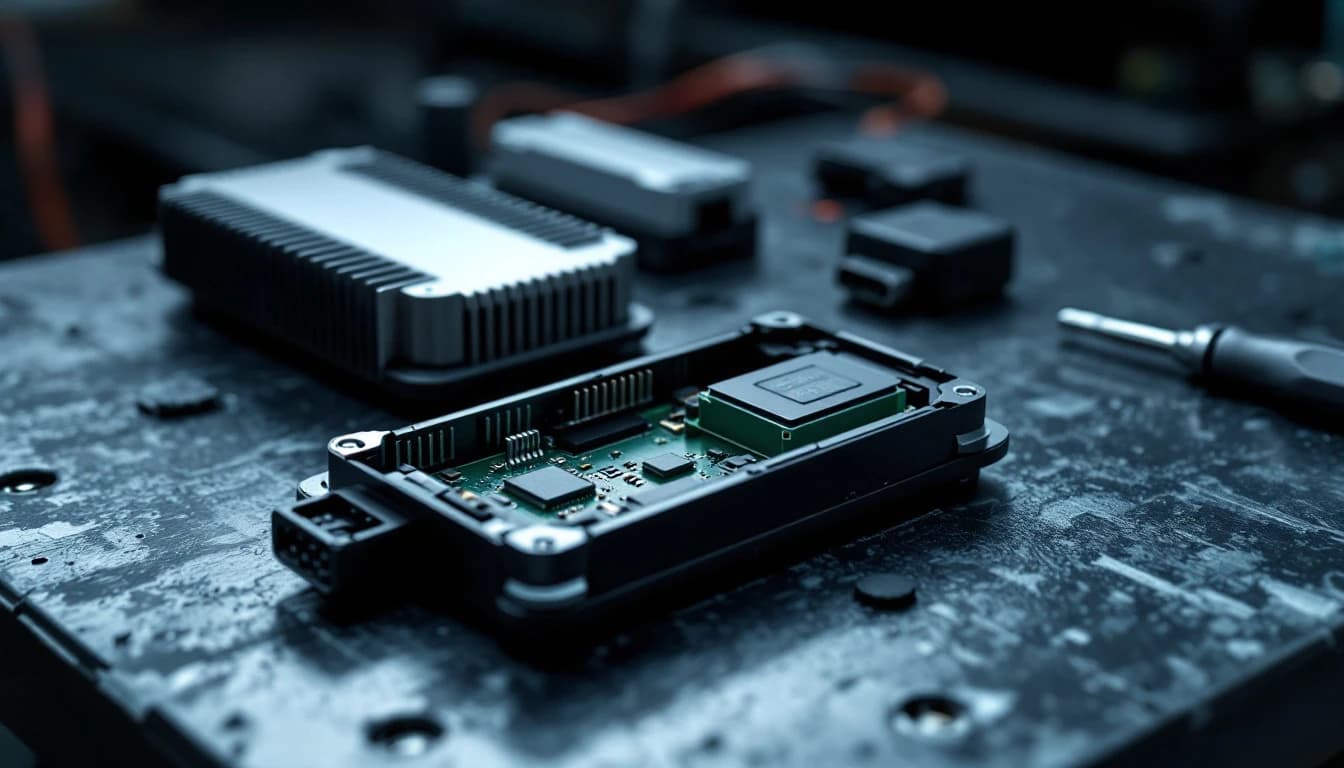
- Opening and inspection. The housing comes apart and the board is examined under magnification — output devices, the supply section that feeds them, and the joints underneath, which is where thermal fatigue shows up first.
- Electrical testing on a bench harness. The module is powered and exercised outside the car so the outputs can be watched directly, without the engine, the injectors or the harness adding variables.
- Board-level repair. The failed output devices and any damaged supporting components are replaced, and fatigued joints in the affected area are reworked.
- Re-test and verification. Outputs are verified again on the bench before the module is closed up.
Your original data is never overwritten. Nothing is coded, nothing is virginised, nothing is reset. You get your own module back doing the job it used to do.
A caveat we state plainly because it protects you: if the driver failed because an injector was shorted, and that injector is still fitted, the repair will not last. Fix the cause before the module goes back in. We will tell you when the damage pattern points that way.
How the mail-in process runs
Auto Module Lab is a nationwide mail-in bench service. Nothing about this job requires the car — it requires the module.
- Confirm first. Text us a photo of the DME label together with your VIN and a short description of the symptom. We confirm what you have, usually within minutes, before you spend a cent on freight.
- Remove and pack. The DME lives in the E-box on the N54. Disconnect the battery first. Handle the module by its housing, keep it in an anti-static bag, and pack it so it cannot move inside the box.
- Ship it. Standard, ground-level service is fine for a module this size.
- Return shipping is chosen and paid by you at checkout, from 29.95 dollars, with faster air options available if the truck is down and time matters more than money.
- Reinstall. The module goes back where it came from. No coding, no adaptation, no key work.
One honest scope note. This service repairs the injector output stages and the supply section feeding them. It is not a general-purpose fix for every possible MSD80 complaint. If your symptom is a no-communication DME, water damage, or a module that will not power up at all, tell us that up front — some of those are recoverable and some are not, and you deserve to know which before you ship rather than after.
Frequently asked questions
Does a 30BA or 30BB code mean my MSD80 is bad?
No. 30BA and 30BB mean the injector activation circuit did not behave as commanded, and the most common cause is a shorted or low-resistance injector loading a perfectly healthy output stage inside the DME. Wiring and connector damage is the second most common cause. An actual failure of the driver stage is real but it is the least frequent of the three, so confirm it before you remove the module.
How do I tell the difference between a bad injector and a bad driver?
Move the injector to a different cylinder, clear the codes and run the engine. If the fault follows the injector to its new position, the injector is at fault and the DME is fine. If the fault stays with the original cylinder while that injector runs cleanly elsewhere, the problem is downstream of the injector — either the harness or the output stage in the MSD80. This test costs nothing and settles the question faster than any parts purchase.
What does MSD80 injector driver repair cost?
BMW MSD80 injector driver repair is 295 dollars flat as a mail-in bench service, plus return shipping you select at checkout from 29.95 dollars. Typical bench turnaround is 3-5 business days once the module arrives. The price covers board-level repair of the injector output stages and the supply section that feeds them on your own original DME.
Will I need new keys or any coding after the repair?
No. Because we repair your original module rather than fitting a replacement, your VIN, your ISN and your key data all stay exactly as they were, so the CAS immobilizer and the DME still agree and your existing keys keep working. The module goes back in the car and runs. That is the main practical advantage of repair over a used-module swap, which does require the ISN to be matched or written.
Can you repair an MSD81 or an N55 DME the same way?
Not under this service as written, which is scoped to the MSD80 used on N54 applications. The later MSD81 and the N55 platforms use different modules and need to be confirmed individually before anything ships. Text us a photo of your DME label with your VIN and we will tell you honestly whether what you have is in scope rather than letting you pay freight to find out.
My misfire came back after I replaced the injector. What happened?
That pattern usually means the original shorted injector damaged the output stage that was driving it, so you now genuinely need both repairs. Confirm it the same way as before: with the new injector fitted, check whether the fault stays with that cylinder group. If it does, the driver stage is the remaining fault and repairing it should end the cycle — provided the injector that caused the damage has actually been replaced.
Do I have to send the whole car or any other modules?
No. This is a bench repair on the DME alone, so you ship the module and nothing else. We do not need the CAS, a key, or the vehicle, because no immobilizer synchronisation is involved when your original module is being repaired and returned. That is a meaningful difference from a used-DME swap, which does pull the immobilizer side of the car into the job.
The bottom line
A fixed-group misfire with 30BA or 30BB on an N54 is an injector activation fault, and that describes three possible repairs, not one. Most of the time it is an injector. Sometimes it is a connector or a chafed wire. Least often — but often enough that the service exists — it is the output stage inside the MSD80 itself.
The diagnostic order is what saves money. Swap the injector to another cylinder and watch whether the fault moves. Test the harness properly. Only when the fault refuses to move and the wiring is proven clean does the module deserve the blame.
When it genuinely is the driver stage, repairing your own module is the better outcome on every axis that matters: no donor to source, no ISN to match, no keys to worry about, no calibration to restore. MSD80 injector driver repair is 295 dollars flat with a typical 3-5 business day bench turnaround, and it comes back as the same module that left, doing the job it used to do.
Before you ship anything, text us a photo of the DME label with your VIN. Confirming the part costs nothing and has saved a lot of people a wasted shipment. Broader context on where BMW modules fail and what each one costs to put right lives in our BMW module programming cost guide, and the full mail-in catalogue is on the services page.
Sources and further reading: Society of Automotive Engineers, National Highway Traffic Safety Administration, J.D. Power, Car and Driver, MotorTrend, Hagerty, Robert Bosch, BMW Group.
Ship it for the bmw msd80 injector driver repair — $295 flat
Typical 3-5 Business Day Bench Turnaround, return speed your choice at checkout. Prepaid inbound label by email the minute you order.