Instrument Cluster Repair: What Is Actually Fixable
The question behind "can my cluster be fixed?"
When someone searches for instrument cluster repair, they are almost never asking an academic question. They are asking two practical ones at the same time: is this thing fixable at all, and is fixing it cheaper than replacing it?
The honest answer is that the two questions are linked, and the link is not obvious. A cluster that is technically repairable might still be the wrong thing to repair. A cluster that is unrepairable might still cost far less to deal with than a dealer quote suggests, because a donor unit programmed to your car is a legitimate middle path that most owners never hear about.
So this guide is organized around feasibility and money rather than symptoms. If you are still trying to work out what your cluster is doing wrong — dead gauges, black screen, warning-light storm, no communication on a scan tool — start with the symptom-first walkthrough in instrument cluster not working: dead gauges and no-communication diagnosis, then come back here for the repair-or-replace decision.
Below, every common cluster failure is sorted into one of three outcomes:
- Repair — the fault is component-level and your original cluster goes back in your car with its identity and mileage untouched
- Data transfer — your original is beyond economical repair, so a donor cluster is programmed to your VIN and synchronized to your true mileage
- Replace-only — the unit is physically destroyed and no bench work will bring it back
Failure by failure: what is repairable
Stepper motors and gauge-sweep faults
Usually: repair.
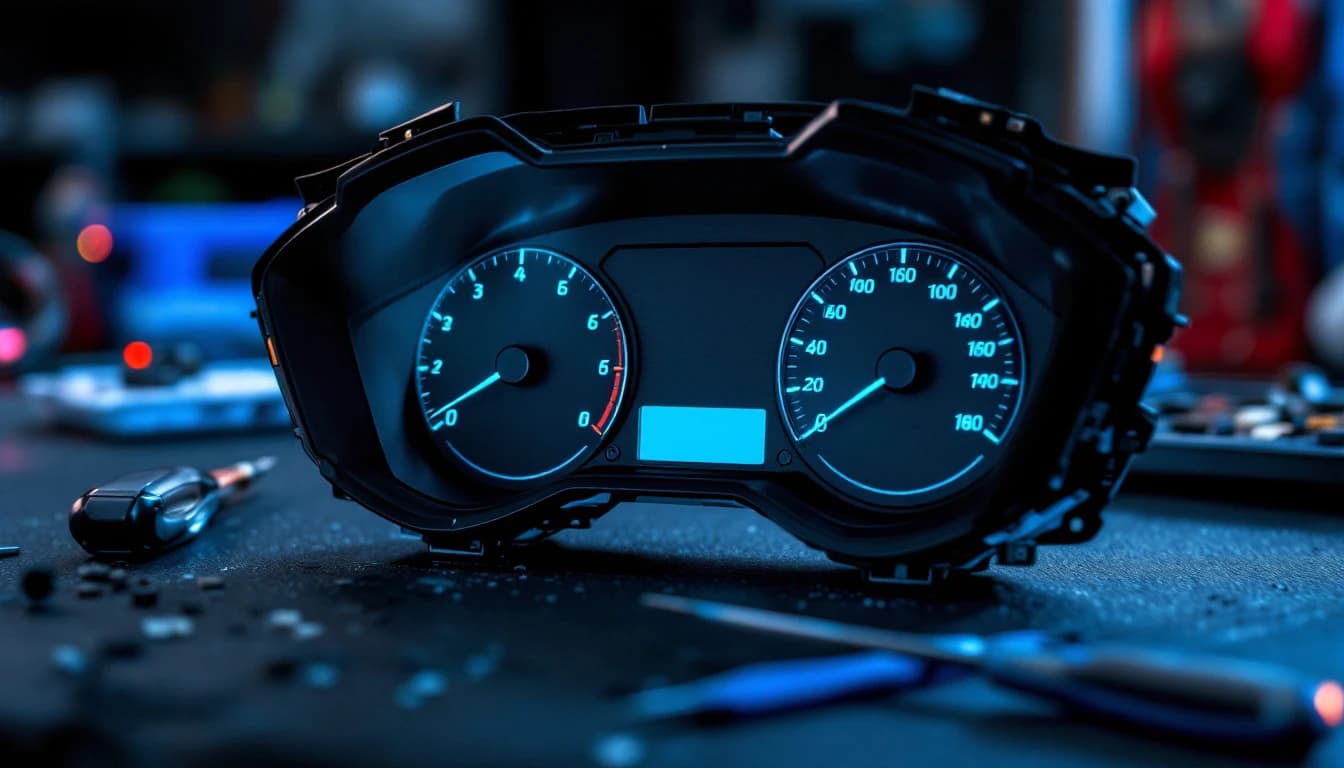
Every analog needle in a modern cluster is driven by a tiny stepper motor soldered to the circuit board. The classic symptoms are a needle that sits dead while the others work, a speedometer that reads high or low by a consistent amount, needles that sweep erratically or "chatter" during the ignition self-test, or gauges that stick at a value and refuse to fall back.
These motors are inexpensive commodity parts. Replacing one or all of them is textbook bench work: disassemble the cluster, desolder the failed motors, fit new ones, recalibrate the needles to their zero stops, and reassemble. Nothing about the vehicle's identity changes because it is still your cluster. This is one of the highest-success, lowest-drama repairs in the entire module business.
Worth knowing: a wrong-reading speedometer is not always a cluster fault. If your speedometer went wrong right after a tire, wheel, or gear change, the cluster may be working perfectly and simply calculating from the wrong constant — that is a calibration job, covered in speedometer wrong after tire size or gear change, not a stepper-motor failure.
Cold-solder joints and cracked reflow
Usually: repair.
Dashboards live a brutal thermal life — baking in summer sun, cold-soaked overnight in winter, cycling like that thousands of times. Solder joints fatigue and crack microscopically under that cycling, and a cracked joint behaves like an intermittent switch: a gauge that quits over bumps, a display that flickers when the dash heats up, a backlight zone that comes and goes.
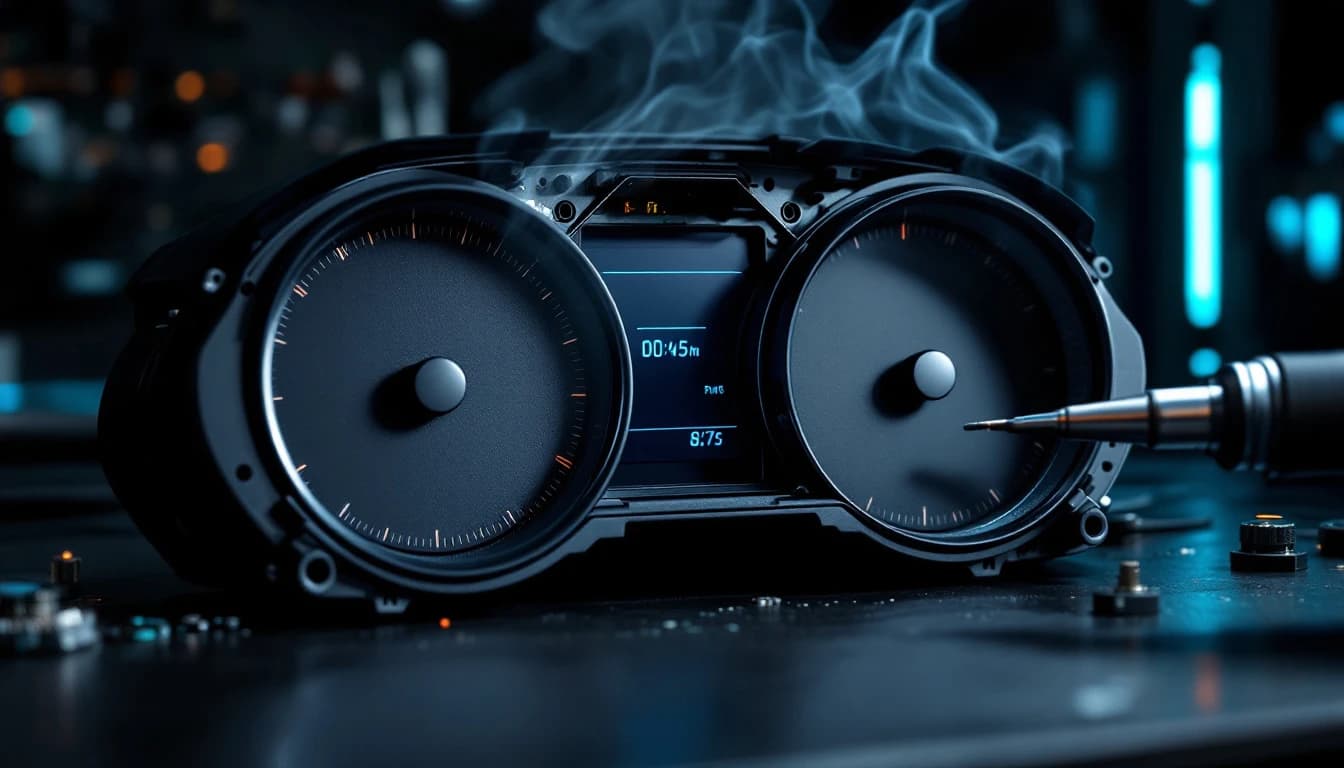
Larger surface-mount and ball-grid-array packages can suffer the same fatigue at the joints under the chip, which is why a careful reflow or a full reball is a recognized repair rather than a hail-mary. It is fiddly, temperature-controlled work, but it is repair — the board and its stored data survive.
Reflow has one honest limitation: it fixes a fatigued joint, not a failed silicon die. If the chip itself has died, reflowing it changes nothing. A competent bench read tells the two apart before anyone charges you for the optimistic version.
Backlight LEDs, dimming, and uneven illumination
Almost always: repair.
Gauges and display work fine, but the lighting is dim, patchy, one zone is dark, or the whole panel flickers with engine speed. Cluster backlighting is a string of surface-mount LEDs plus their driver circuit. LEDs age, dim unevenly, and occasionally open-circuit; drivers and dimming transistors fail.
Replacing LEDs and repairing the driver circuit is soldering-level work. This failure alone almost never justifies replacing a cluster, and it is worth saying plainly because a dim or dark panel is exactly the sort of complaint that gets an owner quoted a whole new instrument cluster.
LCD segment loss and ribbon-cable delamination
Usually: repair.
Missing rows of pixels, horizontal or vertical lines through the odometer, characters that fade in and out with temperature, half a display gone dark. The glass is bonded to the board through a flexible ribbon or a heat-seal connector, and that bond degrades. Pixels drop out exactly where the connection is failing.
Rebonding the ribbon, replacing the heat-seal, or fitting a replacement LCD are all established repairs. On many popular platforms the display module itself is available as a service part. What is not repairable is glass that is physically cracked or shattered — that is replacement of the display assembly at best, and on some clusters the display is not separately serviceable, which pushes the job into the data-transfer category.
Water damage and corrosion
It depends on how far it went — and this is the one that most often ends in replacement.
Water is the cluster killer. Windshield and cowl leaks, a plugged sunroof drain, a leaking heater core, a flood event — any of them can put moisture behind the dash. What matters is not that water arrived but what it did while it sat there.
- Light surface corrosion, caught early — often repairable. Ultrasonic cleaning, neutralizing residue, reworking affected joints and connectors.
- Corrosion that has eaten through traces or vias, or crept under chips — usually not economically repairable. Once the copper is gone under a package you cannot see, you are chasing an open circuit through a board that will keep failing.
- Full submersion, silt inside the case, green crust across the board — replace-only in practice.
Flood-damaged vehicles are not a rare edge case. The National Insurance Crime Bureau has repeatedly warned after major storms that flood-damaged vehicles re-enter the used market in large numbers — its post-hurricane advisories have described totals in the hundreds of thousands of vehicles — and electronics behind the dash are among the first things to suffer. If you bought a car with an unexplained cluster failure and any hint of a musty interior, factor that in.
Dead cluster: no power, no communication
Split: often repair, sometimes replace-only.
A cluster that does nothing at ignition, or one a scan tool reports as "no communication," splits into three cases:
- External — blown fuse, corroded ground, damaged connector, bus wiring fault. Not a cluster failure at all, and no amount of bench work will help. Rule this out first; it is the cheapest possible outcome.
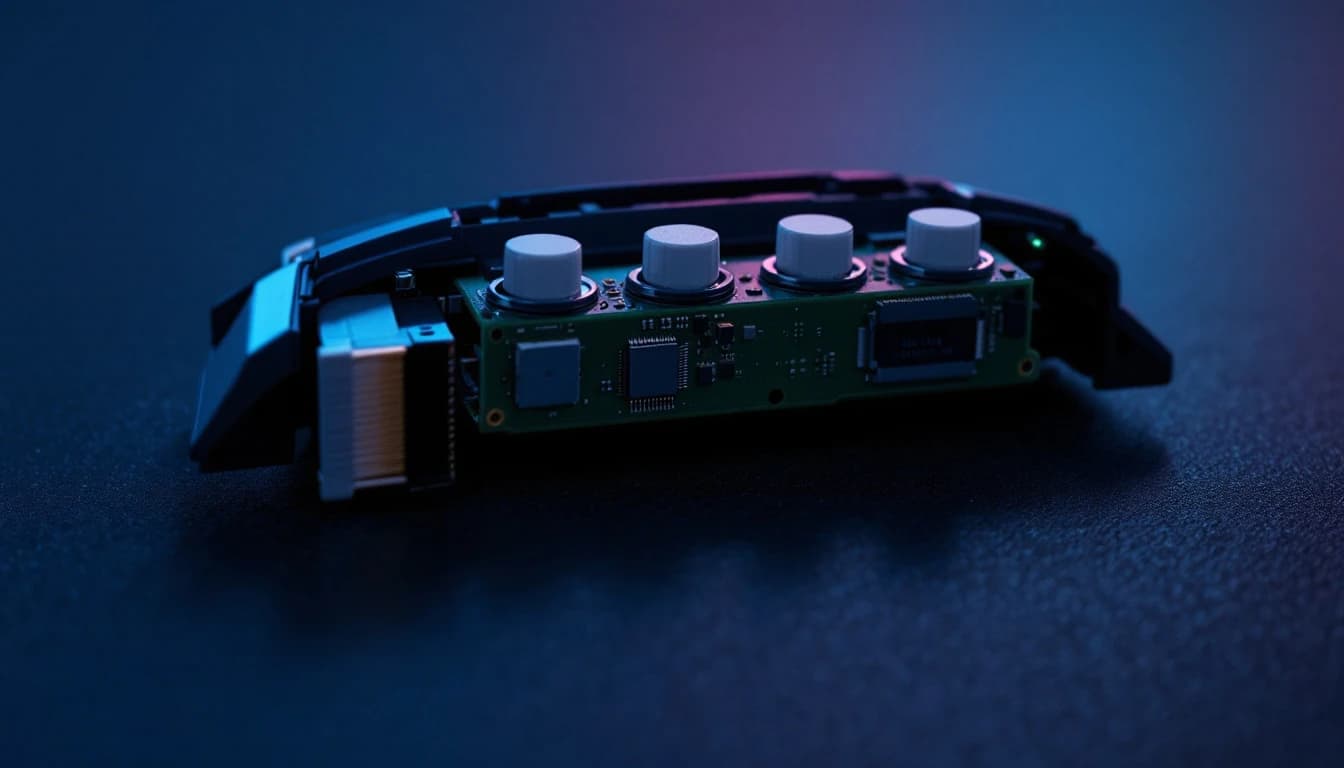
- Internal but repairable — a failed voltage regulator, a swollen or leaking electrolytic capacitor, a dead CAN transceiver. All component-level replacements.
- Internal and terminal — a burned power section that has taken the board with it, or a failed processor whose data cannot be recovered. This is where a data transfer to a donor becomes the realistic path.
The distinction between (2) and (3) is not something anyone can call reliably from a description over text. It is exactly what a bench read is for.
"The clusters I have to turn away are almost always water. Everything else — steppers, joints, LEDs, a ribbon, a regulator — I can usually put right and hand back the customer's own unit with their own miles in it. But once corrosion has been sitting under a chip for a winter, I am not doing anyone a favor by pretending a clean-up will hold." — Independent electronics repair technician, 14+ years in automotive dash and cluster boards (anonymized)
The feasibility matrix
| Failure mode | Typical outcome | Why |
|---|---|---|
| Single or multiple dead stepper motors | Repair | Commodity part, straightforward desolder and replace, needles recalibrated |
| Needles sweep erratically or stick | Repair | Motor or drive-circuit level, board and data intact |
| Cold-solder / cracked joints, BGA fatigue | Repair | Rework and reflow restore the connection; data untouched |
| Dim, patchy, or dead backlight | Repair | LED and driver replacement is soldering-level work |
| LCD segment or pixel loss, faded display | Repair | Ribbon rebond or display replacement where serviceable |
| Physically cracked or shattered LCD glass | Repair if display is a service part, otherwise data transfer | Glass cannot be mended; some clusters have no separate display part |
| Failed capacitors or voltage regulator | Repair | Component-level replacement on an otherwise sound board |
| Failed CAN transceiver | Repair | Single-chip replacement once bus wiring is cleared |
| Light surface corrosion, caught early | Repair, with honest odds stated up front | Cleaning and rework can hold if copper is intact |
| Corrosion through traces or under chips | Data transfer to a donor | Board integrity is gone; recurrence is likely |
| Flood submersion, silt, widespread green corrosion | Replace-only | Not economically recoverable |
| Burned power section, destroyed processor | Data transfer or replace-only | Depends on whether stored data can still be read |
| Fuse, ground, connector, or bus wiring fault | Not a cluster job at all | Fix the vehicle side; the cluster is innocent |
The pattern is worth stating: the overwhelming majority of cluster complaints land in the repair column. Replace-only is real but narrow, and it is dominated by water and physical destruction.
The economics: repair versus donor versus a dealer cluster
Here is where the decision actually gets made.
A bench instrument cluster repair with mileage sync is a flat $200. That figure covers the repair of your original unit and the synchronization of the odometer to your vehicle's true recorded mileage where the repair touches stored data. You add the return shipping tier you select at checkout — customer-paid, from $29.95 — and that is the job.
A dealer replacement is a different animal, and the sticker price on the part is only the first line. A new cluster has to be ordered against your VIN, then configured: mileage written to your true reading, VIN written, immobilizer and key data married on platforms where the cluster participates in security, and option coding set so the right telltales, units, and features appear. That is dealer labor on top of a dealer part, and it is why replacement quotes on late-model vehicles routinely land in four figures.
The middle path is the one owners rarely get offered. If your original truly is beyond repair, a donor cluster programmed to your car costs a fraction of a dealer part. The donor comes from a compatible vehicle, and the bench work makes it yours: your VIN, your true mileage, your configuration.
| Repair your original | Donor cluster, programmed | Dealer replacement | |
|---|---|---|---|
| What you ship | Your cluster | Your cluster plus the donor | Nothing — car goes to the dealer |
| Mileage | Preserved or synced to true reading | Synced to your true recorded mileage | Written to your true reading by the dealer |
| VIN and immobilizer | Unchanged — still your unit | Programmed to your VIN | Configured by the dealer |
| Option coding | Untouched | Matched where the platform allows | Set from build data |
| Bench price here | Flat $200 | Flat $200 (GM cluster upgrade or swap, $200) | Not applicable |
| Part cost | None | Cost of the donor unit | Dealer part pricing |
| Best when | Cluster is electrically sound | Original is water-damaged or destroyed | You want everything under one roof and accept the cost |
| Return shipping | Customer-paid, from $29.95 | Customer-paid, from $29.95 | Not applicable |
The arithmetic usually resolves the same way. If the board is sound, repairing your own unit is both the cheapest and the cleanest option because it changes nothing about the car's identity. Once the board is not sound, the comparison is between a donor plus flat-rate bench programming and a dealer part plus dealer labor — and that comparison rarely favors the dealer.
Why a replacement cluster is not plug-and-play
This is the single most expensive misunderstanding in cluster work, and it applies to a brand-new dealer part just as much as a salvage-yard unit.
Mileage lives inside the cluster. The odometer is stored in the cluster's own memory, not in some central vault in the car. A donor cluster arrives carrying the donor car's miles. A new dealer cluster arrives at zero or at a factory default. Either way the reading has to be set to your vehicle's true recorded mileage before the dashboard tells the truth.
VIN and immobilizer data can live there too. On a great many platforms the cluster is a security participant: it stores the VIN and takes part in the handshake that authorizes the engine to start. Fit a donor raw and the car may throw a mismatch, refuse to crank, or sit in a permanent security fault because the cluster and the rest of the network disagree about what car this is.
Key data can live there as well. On the VW and Audi platforms in particular the cluster is a core immobilizer component, which is why VW/Audi cluster key programming is its own $250 bench service. Because that work touches keys and vehicle security, proof of ownership is required — registration or title matching your identification. Any shop willing to do immobilizer work without it should worry you.
Option coding lives there. Trim level, gauge faces and units, which telltales exist, which features the cluster expects to see on the bus — all of it is configuration. A donor from a different trim can be electrically perfect and still show the wrong warning lamps or miss a function entirely if the coding is not addressed.
GM owners hit a related version of this on the infotainment side, where used radios and human-machine-interface modules stay VIN-locked to their donor car until they are cleared and re-tied to your vehicle. That is what GM HMI / radio / cluster VIN unlock at $250 exists to solve, and it is the reason a used GM radio that "should just plug in" sits there dead.
GM cluster swaps and trim upgrades run into all of the above at once. If you are fitting a higher-trim or newer GM cluster rather than simply replacing a failed one, the swap-specific detail is covered in the GM Denali cluster upgrade guide covering new versus salvage units and VIN programming, and the general cluster-swap walkthrough is in the GM instrument cluster upgrade and swap guide. The bench side is the flat $200 GM instrument cluster upgrade.
Mileage is synchronized to the truth, never altered
Because mileage physically lives in the cluster, every repair or replacement has to deal with the odometer — and there is exactly one legitimate way to do it.
Mileage is only ever synchronized to the vehicle's true recorded mileage. When a repair touches stored data, or when a donor cluster is programmed to your car, the odometer is set to the actual documented miles the vehicle has travelled. It is never rolled back, never rounded down, and never adjusted to misrepresent the vehicle to a future buyer. The customer certifies the true reading; the sync reflects reality.
That is not a house policy invented for marketing. Odometer accuracy sits inside a federal disclosure framework administered by the National Highway Traffic Safety Administration, which has estimated that more than 450,000 vehicles are sold each year in the United States with false odometer readings, costing buyers in excess of $1 billion annually. Vehicle-history data published by Carfax has put the number of vehicles on U.S. roads carrying rolled-back odometers at more than 2 million. The Federal Trade Commission treats odometer misrepresentation as consumer fraud, and organizations such as the National Insurance Crime Bureau track it as a measurable cost to buyers.
The legal boundary and the paperwork are covered properly in is odometer mileage correction legal. The short version: syncing a repaired or replacement cluster to true mileage during a legitimate repair is normal, lawful work. Rolling a number back to deceive someone is fraud. The first is the job; the second is never on offer.
Why so many clusters are failing right now
There is a demographic reason cluster repair has become such a common search.
The U.S. fleet is old. Reporting aggregated by Car and Driver has noted the average age of vehicles on American roads now exceeds 12 years — which is precisely the window in which solder joints have finished fatiguing, electrolytic capacitors have finished drying out, and stepper motors have finished wearing. Owner-experience research from J.D. Power has consistently found display, infotainment, and electronics complaints ranking among the fastest-growing problem categories owners report, ahead of many traditional mechanical gripes. Consumer surveys published by Consumer Reports have similarly flagged in-car electronics as a leading trouble area on aging vehicles.
None of that means your cluster is doomed. It means the failure you are experiencing is a well-mapped, well-understood, aging-electronics failure — the kind with an established repair, not a mystery.
When you genuinely cannot tell
Sometimes the honest position is that nobody can call it from the outside. The cluster is dark, the fuse and ground check clean, and the question of whether the board is recoverable can only be answered by putting it on a regulated supply and reading it.
That is what a bench evaluation at $150 is for. The unit is powered on the bench, read, inspected for corrosion and physical damage, and you get a straight answer: repairable, data transfer to a donor, or genuinely finished. It is the right first step when the alternative is guessing with a dealer quote in one hand.
The mail-in flow is the same for all of it. Text us the year, make, model, VIN, and exactly what the cluster is doing. Confirm the service and flat price before anything moves. Provide proof of ownership for any VIN, immobilizer, key, or mileage work. Remove the cluster and ship it, well packed in an anti-static bag inside a padded box, to the workshop at 1009 Oakwood Ln # 120241, Arlington TX 76012. The unit is read before any change, repaired or programmed, and returned with tracking on the customer-paid shipping tier you selected at checkout, from $29.95. Auto Module Lab is mail-in only and serves customers nationwide.
Frequently asked questions
Can a cracked instrument cluster screen be repaired? Cracked or shattered LCD glass cannot be mended, but on many clusters the display is a separately serviceable part that can be replaced on the bench while keeping your original board, VIN, and mileage. Where the display is not available separately, the practical answer is a donor cluster programmed to your vehicle.
Is repairing a cluster cheaper than buying a new one? In most cases yes, by a wide margin. A flat-rate bench repair of your original unit at $200 avoids both the cost of a dealer part and the configuration labor a replacement requires, because nothing about the car's VIN, mileage, or immobilizer identity changes when your own cluster goes back in.
Which cluster failures are actually not fixable? The genuinely replace-only failures are severe water damage where corrosion has eaten through circuit traces or crept under chips, full flood submersion, physically destroyed boards, and burned power sections that take the stored data with them. Nearly everything else — steppers, solder joints, LEDs, LCD ribbons, capacitors, and CAN transceivers — is component-level repair work.
Will a used cluster from a salvage yard work in my car? Not on its own. A donor cluster carries the donor vehicle's mileage and, on many platforms, its VIN and immobilizer data, so installing it raw produces a wrong odometer and often a no-start or a permanent security fault. It has to be programmed to your VIN and synchronized to your true recorded mileage first.
Can you change the mileage shown on my cluster? Mileage is only ever synchronized to the vehicle's true recorded mileage during a legitimate repair or replacement, with the customer certifying that reading. Odometers are never rolled back or altered to misrepresent a vehicle, which is fraud under the federal odometer-disclosure framework and is not a service we offer.
Do I need proof of ownership for cluster work? Yes, for anything touching VIN, immobilizer, key, or mileage data — registration or title matching your identification. That covers VW and Audi cluster key programming, GM VIN unlock work, and any donor-cluster programming, because all of it is security-related work on the vehicle's identity.
How do I know whether my cluster is repairable before I commit? Text the symptom, vehicle details, and VIN first, and if the answer is not clear from the description, a $150 bench evaluation puts the unit on a regulated supply and reads it. That produces a definitive call — repair, donor data transfer, or unrecoverable — instead of a guess.
The bottom line
Instrument cluster repair is one of the few areas of module work where the odds genuinely favor the owner. Stepper motors, cracked solder joints, fatigued BGA connections, dead backlight LEDs, delaminated LCD ribbons, failed capacitors and regulators, and dead CAN transceivers are all component-level repairs on your original unit — which means your mileage, VIN, and configuration never move.
The replace-only column is real but narrow: water that has corroded through the board, physical destruction, and burned power sections. Even then the answer is rarely a dealer cluster, because a donor unit programmed to your VIN and synchronized to your true recorded mileage does the same job for a fraction of the cost. And whichever path you take, a replacement is never plug-and-play — mileage, VIN, immobilizer participation, key data, and option coding can all live inside the cluster and have to be configured before the car reads right or starts at all.
The bench prices are flat and public: cluster repair with mileage sync at $200, GM instrument cluster upgrade or swap at $200, GM HMI / radio / cluster VIN unlock at $250, VW/Audi cluster key programming at $250, and a bench evaluation at $150 when nobody can call it from the outside. Proof of ownership is required for identity work, mileage is synchronized only to the truth, and everything returns with tracking on the customer-paid shipping tier you choose at checkout, from $29.95. Text us the symptom and your VIN and you will get a straight answer about which column your cluster falls into.
Ship it for the instrument cluster repair + mileage sync — $200 flat
Typical 24-Hour Turnaround, return speed your choice at checkout. Prepaid inbound label by email the minute you order.