
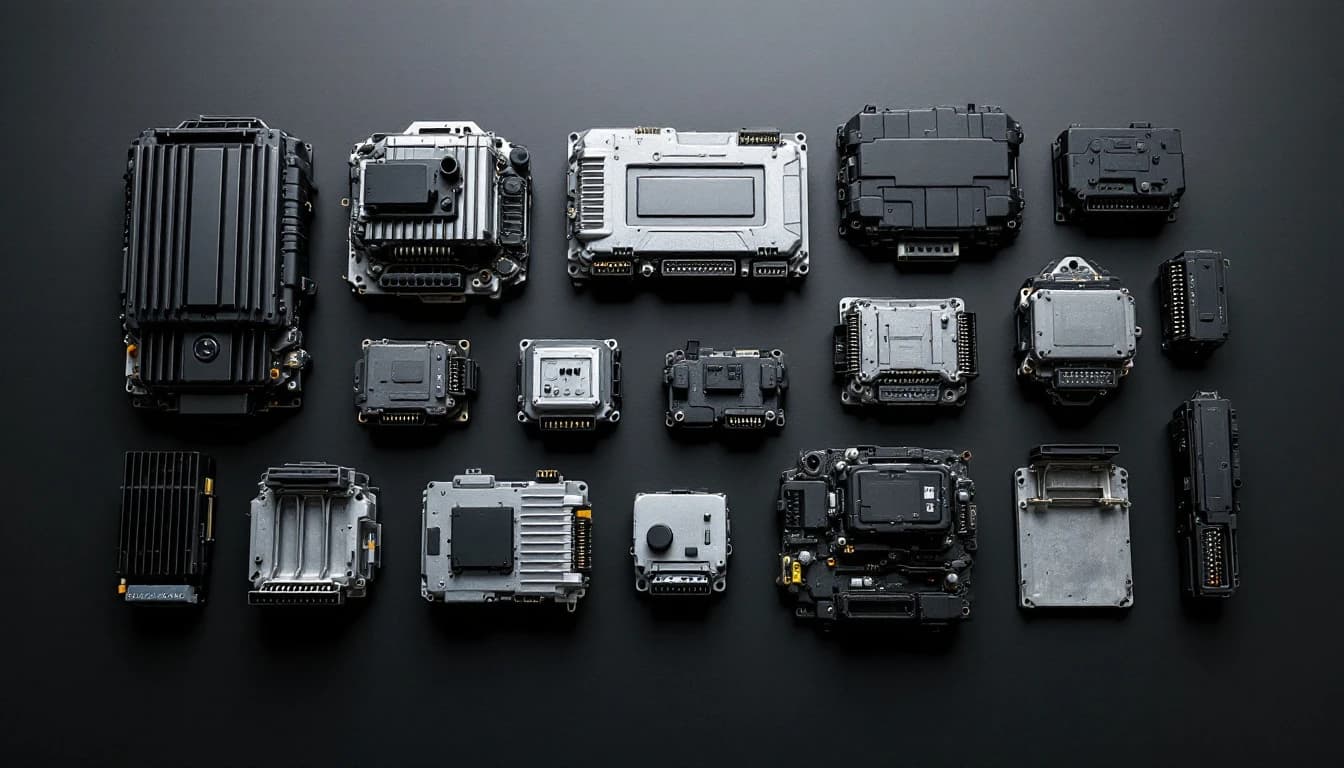
Every Control Module in a Modern Car, By System
Why a car needs this many computers
A vehicle built in the last fifteen years does not have "a computer." It has a distributed control system. Individual functions — fuel injection, brake pressure modulation, seat position memory, door locking, airbag deployment — are handled by dedicated control units that sense their own inputs, run their own software, and publish results onto a shared network so other units can act on them.
The scale surprises people. Supplier literature from Bosch, one of the largest producers of automotive electronics, describes premium vehicles as carrying on the order of 100 or more electronic control units, with the software content of a modern car now running to well over 100 million lines of code. Even an economy car with modest equipment will typically carry somewhere between 15 and 30 addressable modules — up from perhaps 2 or 3 on the same manufacturer's product line 30 years ago. SAE International, which standardizes much of the diagnostic and network layer this all runs on, has published the protocol families that make a hundred independent processors behave like one vehicle.
That architecture is why symptoms so rarely point cleanly at a part. A dead instrument cluster can be a dead cluster, or a gateway that stopped forwarding messages, or a body controller that stopped supplying it. This guide is organized to help you narrow that down, system by system.
One note on scope before we start. This article is about what each module does and how it fails. If what you actually want is the acronym decoder — ECU versus ECM versus PCM, what BCM stands for, why TCM and TCU mean different things to different manufacturers — that ground is covered separately in our car module acronyms explained glossary. The two articles are designed to complement each other: that one defines the vocabulary, this one maps the machine.
Powertrain: the modules that make the vehicle move
Engine control module (ECM / ECU / PCM)
The engine controller is the highest-authority computer in most vehicles. It reads crankshaft and camshaft position, mass airflow or manifold pressure, coolant and intake temperature, throttle position, oxygen or air-fuel-ratio sensors and knock sensors, then computes fuel quantity, injection timing, ignition advance, throttle angle, cam phasing and boost target — recalculated many times per crankshaft revolution. On many domestic platforms the same box also controls the transmission, in which case it is called a powertrain control module.
Failure modes cluster into three groups. Driver stage failures are the most common: the transistors that switch injectors, coils and solenoids sit closest to the outside world and die from shorted loads, chafed harnesses and heat. The signature is a single circuit that is permanently dead or permanently on, with a matching circuit-specific code. Environmental failures come from water intrusion and vibration, especially where a controller is mounted low or in a wheel well; corrosion migrates under conformal coating and takes out traces. Processor and memory faults are rarer and present as no-communication or as a controller that resets under load.
On the bench, engine controllers are the most-programmed category we handle — cloning a customer's data onto a working donor, writing a replacement unit to the vehicle's VIN, and unlocking read access on locked controllers so the data can be moved at all. Manufacturer-specific families each have their own path: Korean Continental and Kefico controllers are covered in our Hyundai and Kia ECU clone guide, and the Japanese approach to donor controllers is covered in the Nissan and Infiniti used ECM clone guide. To be explicit about one boundary: we do not perform emissions-equipment deletes of any kind, and no service described here touches emissions hardware or the diagnostics that monitor it. On-board diagnostics have been effectively universal on light-duty vehicles sold in the United States since the 1996 model year under rules administered by the Environmental Protection Agency, and that monitoring layer stays intact.
Transmission control module (TCM / TCU)
A transmission controller manages line pressure, shift scheduling, clutch and band apply timing, torque converter lockup, and — on dual-clutch and automated-manual boxes — actual clutch engagement position under closed-loop control. It also learns: adaptive values that compensate for clutch wear accumulate over the life of the unit, which is exactly why a used transmission controller dropped into a different car so rarely behaves.
Failure signatures are distinctive. Harsh or flared shifts on one specific gear change often means a solenoid driver or the solenoid itself. Limp mode with a locked-in third or fifth gear means the controller has detected a ratio error it cannot resolve and defaulted to a safe state. Internal-fault codes with no drivability symptom usually mean a controller that is beginning to fail its own self-test. Many transmission controllers live inside or bolted to the transmission itself, sitting in hot fluid and vibration, which is a brutal environment for solder joints.
Bench work on transmission controllers is common and well understood: cloning a customer unit onto a replacement so the adaptive and identity data survive, unlocking a locked unit so it can be read, and programming a replacement to the vehicle. See transmission control module programming for the mail-in path.
Fuel injection driver modules (FICM and relatives)
Some diesel and high-pressure injection systems separate the low-current logic from the high-current injector drive, putting the drive electronics in a dedicated module. The classic example is the fuel injection control module on the Ford 6.0L Power Stroke, which generates the high-voltage pulses that fire hydraulically actuated injectors.
These are power-supply failures more than logic failures. As the module's internal supply degrades, output voltage drops below what the injectors need to open reliably — the engine gets progressively harder to start cold, runs rough until it warms, then eventually will not start at all. Because the decline is gradual, owners often replace injectors, glow plugs and batteries before anyone measures the module's output. This is a board-level repair rather than a reflash, and it is one of the most reliably fixable modules on the list. Details are in the 6.0 Power Stroke FICM repair service page.
Chassis: braking, steering and ride
ABS / EBCM (anti-lock brake and electronic brake control module)
The brake controller reads a wheel-speed sensor at each corner, plus yaw rate, lateral acceleration and steering angle on stability-equipped vehicles, and modulates individual wheel brake pressure through a valve body it is bolted to. It is simultaneously a computer and part of a hydraulic assembly, which is what makes it unusual.
Two failure modes dominate. The first is solenoid or pump driver failure inside the module — pressure cannot be modulated, so the system disables itself and illuminates the ABS and stability lights. The second, and by far the most common on high-mileage vehicles, is solder joint fatigue at the internal connections between the control board and the valve body pins. Thermal cycling plus vibration cracks those joints, producing intermittent faults that come and go with temperature and road surface. That is a genuine repair, not a replacement, and it is the reason ABS module repair exists as a distinct service category rather than a parts sale.
The stakes here are not abstract. The Insurance Institute for Highway Safety has published research showing that electronic stability control and automatic emergency braking produce large, measurable reductions in crash involvement — front crash prevention systems have been associated with cutting rear-end collisions by roughly 50 percent in real-world data, and electronic stability control has been required equipment on new U.S. light vehicles since the 2012 model year. Those benefits all route through this module.
Electric power steering (EPS / EPAS)
An electric power steering module reads torque applied at the steering column, vehicle speed and steering position, then commands an electric motor to add assist. Assist is speed-dependent — heavy at parking speeds, light at highway speeds — and on many vehicles the same controller executes lane-keeping torque requests from a driver-assistance system.
Failures show up as intermittent loss of assist that returns after a restart, assist that fades when the system gets hot, or a hard fault that leaves the steering fully manual. The mechanism is usually a power stage or a torque sensor interface, and the module is often integrated into the rack or column assembly. The programming angle matters here: a steering controller carries VIN and calibration data, which is precisely why a used unit pulled from another car so often refuses to work until its identity is rewritten. That rewrite is the whole premise of programmed replacement steering modules for the platforms where used units are otherwise unusable.
Suspension and ride control
Adaptive damper and air suspension controllers read ride-height sensors and accelerometers and command valve current or compressor and solenoid operation. Failures are usually external — a leaking air strut, a failed compressor, a corroded height sensor — but the controller itself can fail from moisture, since these modules are frequently mounted low. Diagnose the pneumatics and sensors before condemning the controller; it is one of the categories where the module is most often innocent.
Body and comfort: the modules that run daily life
Body control module (BCM)
The body controller is the vehicle's general-purpose manager for everything that is not powertrain or chassis: exterior and interior lighting, wipers and washers, power locks, horn, chimes, courtesy illumination, and often the gateway between the interior networks. On most platforms it is also involved in immobilizer authorization, which is why body controller replacement is so much more involved than the part price suggests.
Failure signatures read like a haunting: interior lights that behave randomly, wipers that park in the wrong position, locks that cycle by themselves, or a parasitic drain that kills the battery over three days because the module never goes to sleep. Water intrusion is the leading physical cause, since body controllers are often mounted in the kick panel or under the dash where a plugged sunroof or cowl drain finds them first.
Replacing one requires programming: the new module needs the vehicle's configuration — which options exist on this car — and the VIN, and on immobilizer-linked platforms it needs to be introduced to the security system. That is the work behind programmed replacement body control modules.
Door, window and seat modules
Door modules handle window motors, mirror position and heating, lock actuators and door-mounted switches, communicating with the body controller over a deliberately slow single-wire bus so the wiring through the door hinge stays thin — the LIN networks used for this kind of duty run at roughly 20 kbit/s, standardized alongside the far faster powertrain networks by SAE International. They fail from exactly what you would guess: water running down inside the door skin past a torn vapor barrier, and flexing wiring in the hinge boot. Seat memory modules store position profiles and drive the seat motors, and are usually killed by objects rolling under the seat or by spilled liquid.
HVAC / climate control
The climate module reads cabin, ambient, evaporator and sometimes sun-load sensors and commands blend-door and mode-door actuators, blower speed and compressor engagement. Most complaints blamed on this module are actually failed blend-door actuators — a distinctive clicking or a temperature split between left and right is nearly always an actuator, not the controller. Genuine module failures present as a dead display, a blower stuck at one speed, or loss of communication.
Lighting and footwell modules
Some manufacturers split exterior and interior lighting control into its own unit. The best-known example is the BMW footwell module, which controls low beams, turn signals, interior lighting and the windshield wiper motor on many models, and which has a famously predictable failure that takes out lighting and window functions together. It is a board-level defect with a well-characterized fix, described in footwell module repair.
Security and access: the modules that decide whether the car starts
This is the category where programming, rather than repair, dominates — and the category where documentation requirements are strictest.
Immobilizer and access control
Every vehicle since the mid-1990s carries an immobilizer function: a cryptographic handshake between a transponder in the key and a control unit in the car, which then authorizes the engine controller to run. The physical implementation varies enormously by manufacturer — a steering-column ignition switch module on some platforms, a body-integrated unit on others, a dedicated access controller on newer European cars. What they share is that they store the vehicle's key relationships and a secret that the engine controller checks against.
Failure means no start with normal cranking, a security telltale, or keys that stop being recognized one at a time. Because the data inside is the vehicle's identity, replacement is never plug-and-play — the unit must be cloned from the original, or virginized and married to the car and its engine controller.
Theft context explains why manufacturers made this so hard. The National Insurance Crime Bureau has reported vehicle thefts in the United States running at well over 1 million vehicles per year in recent years, and immobilizer strength is one of the main countermeasures. When legitimate access to security data is needed, the industry has a formal channel: the National Automotive Service Task Force operates the secure data release framework that lets vetted, credentialed locksmiths and shops obtain theft-relevant information.
That is also why we require proof of ownership on every key, immobilizer and security-access job — vehicle registration or title in the customer's name, plus matching photo identification — with no exceptions. It is not a formality; it is the condition under which this work is legitimate.
Keyless entry receiver modules
Separate from the immobilizer, most vehicles have a radio receiver that listens for the remote fob and for tire-pressure sensors. When it fails, the symptom is precise and easy to misread: remotes stop working at any range while the key still starts the car normally, because the transponder handshake and the radio link are different systems. Owners replace fobs and batteries repeatedly before anyone suspects the receiver. See keyless entry module repair for the mail-in path on this one.
Electronic steering lock (ELV / ESL)
Many European vehicles lock the steering column with a motor-driven pin managed by a small dedicated module. When it fails — and on some platforms it is a wear item — the column stays locked, the vehicle will not crank, and the car is immobile in the worst possible way. The fix is either replacement and programming of the lock unit or, where appropriate, an emulator that satisfies the network while removing the failure-prone mechanism, which is what steering lock emulator programming addresses.
Power distribution hybrids (TIPM and similar)
Some modules are half computer, half fuse box. The totally integrated power module used across several domestic platforms combines the underhood fuse and relay center with a controller that switches loads electronically. This is why its failures are so bizarre: a fuel pump relay that sticks, wipers that run on their own, a horn that sounds at night, or a no-start that comes and goes with temperature. Diagnosis is complicated because the failing part supplies power to the things you would normally test. Replacement requires configuration and VIN programming, which is the scope of programmed replacement power modules.
Driver information: cluster, head-up display, infotainment
Instrument cluster
The cluster is not a display. It is a control unit that receives most of its data over the network, drives its own stepper motors and screens, runs the telltale logic, and — critically — stores the vehicle's odometer value in non-volatile memory. On many vehicles it also participates in the immobilizer chain, which is why swapping in a used cluster often produces a no-start.
Failures include dead or erratic gauges from stepper motor and driver faults, dim or dead segments in the display, backlight failure, and complete death from a cracked solder joint on the power input. Cluster work has a legal dimension: odometer data must be transferred so that it reflects the vehicle's true mileage, never rolled back. Federal odometer disclosure and anti-tampering rules are enforced by the National Highway Traffic Safety Administration, and true-mileage synchronization is the only kind of cluster mileage work we perform. That is the scope of cluster repair and mileage sync.
Head-up display
A separate projector module with its own controller, brightness sensor and mirror actuator. Failures are usually optical or mechanical — a dim image, a stuck focus or height adjustment, or a delaminated combiner — rather than logic faults.
Infotainment and integration modules
Radio, navigation, telematics and the integration module that bridges phone connectivity to the vehicle network. On several domestic platforms the integration unit is a genuine control module with VIN-linked configuration, so a replacement pulled from a donor car has to be programmed to the new vehicle before it will function, which is the premise behind programmed replacement integration modules. Typical failures are storage-memory wear, boot loops, and power-supply faults from a module that never fully sleeps.
Safety: the restraint control module
The airbag or restraint control module is the most tightly regulated computer in the vehicle. It reads crash accelerometers, seat occupancy and belt-buckle sensors, decides in milliseconds whether and which restraints to deploy, fires squibs and pretensioners, and continuously monitors every deployment circuit for resistance out of range.
It is also an event data recorder. Federal rules administered by NHTSA define a minimum set of roughly 15 data elements that a light vehicle EDR must capture when one is fitted — speed, throttle, brake application, belt status and more, sampled across a window of only a few seconds around the event, on vehicles whose frontal airbags have been mandatory equipment on new passenger cars since the 1998 model year. Data privacy and access to that record are governed by state and federal law, and it is not something to treat casually.
After a deployment, the module typically stores a permanent crash record that locks it out of further use. Clearing that record so the module can function again is legitimate repair work in the context of a properly repaired vehicle, and it is exactly what airbag and restraint module crash data clearing covers — with the obvious and non-negotiable condition that the physical restraint system, including every deployed component, must be correctly repaired first. Clearing a code is not repairing a car.
The network layer: gateways and central electronics
Finally, the plumbing. Vehicles run several networks at different speeds — a fast bus for powertrain and chassis, slower buses for body and comfort, and dedicated links for cameras and displays. The spread is enormous: the high-speed CAN protocols standardized by SAE International carry up to 1 Mbit/s, roughly 50 times the rate of the LIN buses running the doors and seats, which is precisely why a gateway has to exist to translate between them. A gateway module routes messages between them, enforces access, and increasingly acts as the security boundary for diagnostic access.
Gateway failures are the most confusing symptom set in the entire vehicle because they are not the failure of a function; they are the failure of communication about functions. A scan tool that cannot reach half the modules, an instrument cluster missing data it normally displays, and a scattering of lost-communication codes across unrelated systems are the fingerprints. Before condemning any module for no-communication, confirm the gateway and the physical bus, including terminating resistance and power and ground at the connector.
"The mistake I see most often is treating a scan report as a parts list. A car will hand you six modules with lost-communication codes, and five of them are perfectly healthy units that simply could not talk. Find out who stopped listening first — the gateway, the power feed, the ground — and the other five faults evaporate." — Independent vehicle network diagnostics technician, 19+ years across European and domestic platforms (anonymized)
Which of these can actually be mailed in
Here is the honest summary. Mail-in bench work suits any module whose problem lives inside the box — a board-level defect, a memory image, a VIN or configuration write. It does not suit problems that live in the car: harnesses, grounds, sensors, actuators and hydraulics. This distinction matters more every year, because the fleet keeps getting older — ownership and sales reporting summarized by Car and Driver puts the average age of a light vehicle on U.S. roads at more than 12 years, which is deep into the window where solder fatigue and water intrusion, not software, are what take a module down.
| System | Representative modules | Classic failure signature | Typical bench outcome |
|---|---|---|---|
| Powertrain | ECM / PCM, TCM, injection driver modules | Dead circuit, limp mode, no-start, hard cold start | Clone, VIN write, unlock, board repair — strong mail-in fit |
| Chassis | ABS / EBCM, EPS, ride control | Warning lights, intermittent assist, temperature-sensitive faults | Solder and driver repair, VIN write — good fit if hydraulics are sound |
| Body and comfort | BCM, door, seat, HVAC, lighting modules | Random lighting, parasitic drain, dead window or blower | Repair or programmed replacement — good fit once actuators are ruled out |
| Security and access | Immobilizer, keyless receiver, steering lock | No start with normal crank, remotes dead, column locked | Clone, key programming, virginize — strong fit, proof of ownership required |
| Driver information | Instrument cluster, head-up display, infotainment | Dead gauges, dim display, boot loops | Repair, true-mileage sync, VIN write — strong fit |
| Safety | Restraint control module | Airbag light on after a repaired collision | Crash-data clearing after proper physical repair — strong fit |
| Network | Gateway, central electronics | Multiple modules unreachable, scattered lost-communication codes | Usually a vehicle-side diagnosis first — weak fit until the bus is verified |
| Sensors and actuators | Wheel speed, blend door, height sensors | Symptom follows one function only | Not module work — repair on the vehicle |
If you want the money side of this rather than the technical side, our module programming cost guide breaks down what each category typically runs and where dealer pricing and mail-in pricing diverge.
How to decide what to actually ship
Four questions, in order, settle most cases.
Does the symptom follow one function or many? One function usually means a sensor, actuator or circuit. Many unrelated functions means a shared resource: power, ground, network or a body controller.
Does the module communicate? A module that answers a scan tool but reports internal faults is a candidate for bench work. A module that does not answer at all might be dead — or unpowered, or cut off by a gateway. Verify power and ground at the connector before assuming.
Is the fault temperature or vibration sensitive? Faults that appear when hot, disappear after sitting, or change over bumps are classic cracked-solder-joint behavior, and that is the single most repairable class of module defect.
Does this module hold identity data? Engine, transmission, body, cluster, steering and every security module do. That means a used replacement will not simply work, and the choice is between cloning your original's data onto a donor or programming a replacement to the vehicle.
When the answers still leave you unsure, the cheap move is to have the unit evaluated rather than guessing — powered on a bench, communicated with, and inspected. Plenty of modules that arrive here turn out to be healthy, and finding that out costs far less than replacing the wrong part twice. Our full catalog of bench services is at the services hub.
Frequently asked questions
How many automotive modules does a typical car have? An ordinary modern vehicle carries somewhere between fifteen and thirty addressable control units, while a well-equipped premium car can carry on the order of a hundred or more. The count rises with driver assistance, adaptive suspension, multi-zone climate and advanced infotainment, because each of those adds dedicated controllers rather than expanding an existing one.
What is the difference between module repair and module programming? Repair fixes a physical defect inside the unit — a cracked solder joint, a failed driver transistor, a degraded power supply. Programming writes data: software, calibration, configuration, VIN or security relationships. Many jobs need both, because a module that has been repaired still has to be configured for the specific vehicle it goes back into.
Can any control module be programmed by mail? Most can, but not all should be. Modules whose problem lives inside the box — memory contents, board-level defects, VIN and configuration writes — are excellent mail-in candidates. Problems that live in the vehicle, such as gateway and bus faults, wiring, grounds, sensors and hydraulics, need the car present and should be diagnosed before anything ships.
Why does a used module from a donor car usually not work? Because most modules store identity data tied to a specific vehicle: VIN, option configuration, adaptive values and, for security modules, the cryptographic relationship with the immobilizer and keys. A donor unit carries the wrong identity, so the vehicle either rejects it outright or runs with mismatched configuration until that data is rewritten or cloned from your original.
Which modules fail most often on high-mileage vehicles? Anything mounted in heat, vibration or water. In practice that means brake control modules with fatigued solder joints, body controllers damaged by water intrusion from plugged drains, transmission controllers living in hot fluid, and instrument clusters with worn stepper motors. These are also, conveniently, among the most repairable rather than replaceable units.
My scan tool shows faults in six modules. Are they all bad? Almost certainly not. Multiple modules reporting faults at once is far more often one shared cause — a weak battery, a bad ground, a failed gateway or a broken bus wire — than six simultaneous failures. Restore a clean power supply and verify network integrity, clear the codes, drive the vehicle and rescan; whatever remains is the real list.
Do I need proof of ownership to have security modules worked on? Yes, always. Any job touching keys, immobilizers, steering locks or security access requires vehicle registration or title in your name plus matching photo identification before work begins. This is a firm policy on every order, and it applies whether you are an individual owner or a shop acting on a customer's behalf.
The bottom line
Modern vehicles distribute their intelligence across dozens of specialized computers, and the practical skill in diagnosing them is not memorizing part numbers — it is recognizing which system a symptom belongs to. A symptom confined to one function points at a sensor, an actuator or a circuit. A symptom spread across unrelated functions points at something shared: power, ground, network, or a body controller. And a fault that comes and goes with heat or vibration points at a cracked solder joint inside a module, which is the most repairable defect in the entire vehicle.
Once you know which module is genuinely at fault, the question becomes what to do with it. Powertrain, chassis, body, security, cluster and restraint modules are all strong mail-in candidates, because their problems live inside the box: board-level repairs, memory images, VIN and configuration writes, and security relationships that have to be cloned rather than guessed. Network and gateway problems are the exception — verify the bus with the vehicle present before anything ships.
We are a mail-in bench operation serving customers nationwide, working out of our workshop at 1168 W Pioneer Parkway, Arlington, TX 76013. Modules go to PO Box 120241, Arlington, TX 76012 if you ship USPS, or to 1009 Oakwood Ln # 120241, Arlington, TX 76012 if you ship UPS or FedEx, since UPS and FedEx cannot deliver to a USPS PO Box. We buy and email you a prepaid inbound label; return shipping is your choice at checkout, starting at $29.95 for standard 3 to 5 business day service, with UPS 2nd Day Air at $54.95 and UPS Next Day Air at $94.95. Key, immobilizer and security work requires proof of ownership, and we do not perform emissions-equipment deletes of any kind.
If you are not sure which of the modules above is yours, text us the year, make, model, the exact symptom and what a scan tool reports, and we will tell you honestly whether the unit is worth shipping — or whether the answer is still in the car.
Ship your module today
Flat-rate pricing, typical 24-hour bench turnaround, return speed your choice at checkout. Most jobs back on your bench within a week.
More from the Lab
Battery Registration & Coding: A Hidden Module Killer
15 min · August 10, 2026
How Module Programming Works: Flashing vs Coding
16 min · August 1, 2026
Inside a Module Repair Lab: Bench Harnesses & Pinouts
16 min · August 1, 2026
ESD: How Static Kills Car Modules, and How to Pack One
14 min · August 1, 2026