
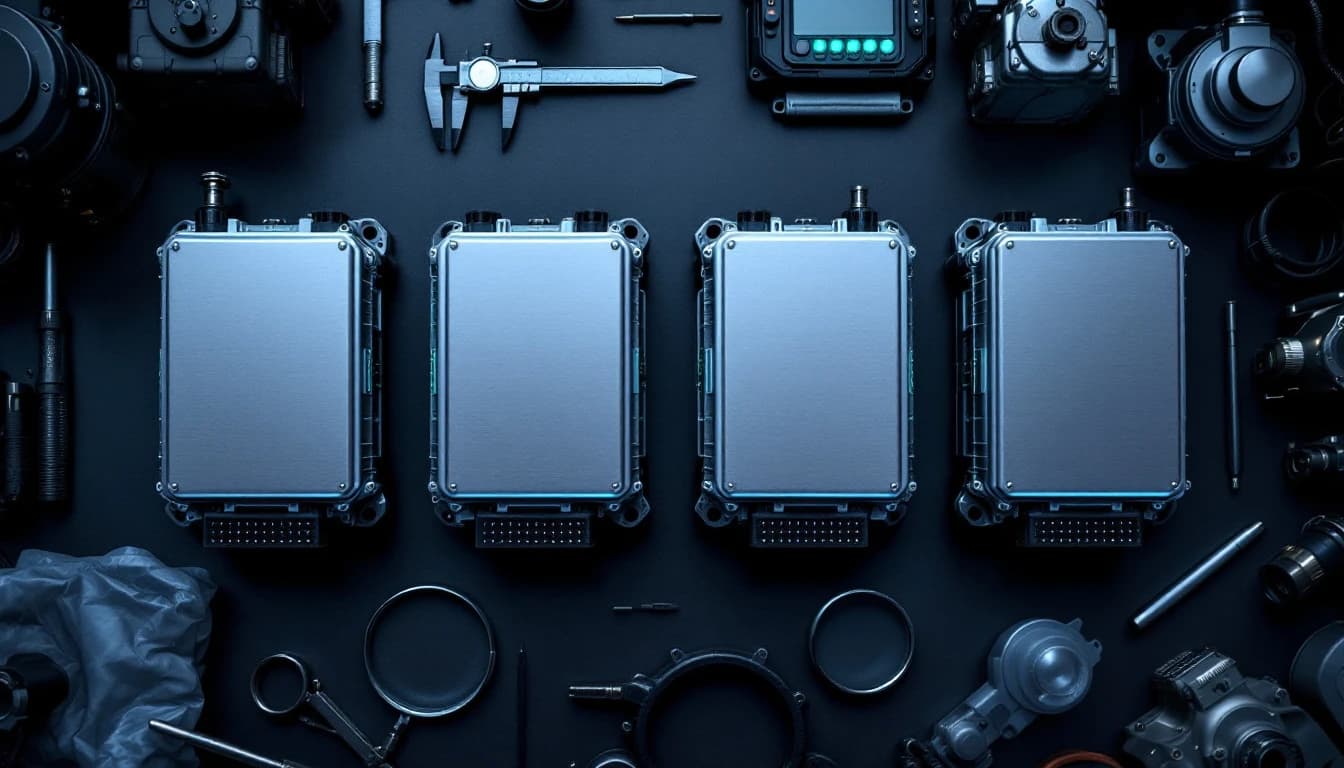
Identify a Heavy-Duty ECM: Cummins, Detroit, CAT, PACCAR
The label identifies the controller, not the engine
A heavy-duty controller is identified by the information printed on the module itself: the family or generation marking, the part number and the serial data, read together with the engine serial number. The engine name on the valve cover, the chassis badge and the model year do not identify it, because commercial trucks routinely carry replacement engines, swapped controllers and mixed generations.
This guide is the identification companion to our heavy-duty truck ECM repair cost guide. It covers the ten controller families we take enquiries on, what to record for each, and the mix-ups that waste the most money. It is written for owner-operators, fleet technicians and shops who need to be sure of the part before they spend anything on it.
Why the engine name is not enough
Four examples show why.
A Detroit Series 60 is an engine, not a controller. It can be run by a DDEC IV or a DDEC V, and the two are separate controller generations with separate repair assessments.
A Cummins ISX can be run by a CM871, a CM2250 or a CM2350, and an ISX12 and an ISX15 are not the same hardware application. The family name is not permission to substitute a controller from another engine or chassis.
A Caterpillar C15 does not by itself establish a 70-pin controller. Later hardware and different applications need their own match.
A Kenworth or Peterbilt truck can carry more than one engine make. Only a PACCAR MX11 or MX13 is a PACCAR controller, and the chassis badge tells you nothing about which engine is under the hood.
The consequence is practical. A wrong guess means a part that will not fit, a repair enquiry sent to the wrong service, or a used controller that arrives with the wrong hardware and a wrong calibration. Reading the label takes five minutes and prevents all three.
What to record before you do anything else
For every controller, whatever the family, record the same set. It is also what we ask for in an enquiry.
The complete label. Photograph the whole label in good light, square on, so every character is legible. A partial photograph is the most common reason an enquiry stalls.
The part number and any revision marking. Transcribe it from the photo and check it against the photo. Letters and digits get swapped easily.
The engine serial number. Read it from the engine data plate, not from paperwork. Engines get replaced.
The VIN. It links the controller to the truck for the conversation, even where the controller itself is not VIN-locked.
Both connector faces. Photograph them without probing or spreading terminals. Connector layout is part of identification, and damaged terminals are part of the diagnosis.
History. Note any earlier controller replacement, engine swap, harness repair, reflash or jump-start incident, and whether the module has been opened.
The symptom, in measured terms. Whether communication remains, whether the fault is cold or hot, and what the scan tool showed during the failure. For a no-connection fault, see our guide to a scan tool that will not connect to the ECU before blaming the module.
The ten families at a glance
| Family | Engines to confirm against the label | Example identification numbers | Starting repair price |
|---|---|---|---|
| Cummins CM2250 | ISX15 hardware | 4993120 | $565 |
| Cummins CM871 | ISX, on-highway | 3684275 | $725 |
| CAT 40-pin | Older electronic Caterpillar truck engines | none listed | $775 |
| CAT 70-pin | C15, C12, C10, 3126, 3406E | 157-3708, 10R-3571, 196-4172 | $775 |
| Detroit DDEC IV | Series 60 with a DDEC IV controller | none listed | $775 |
| Detroit DDEC V | Series 60 with a DDEC V controller | 23530802, 23535798 | $775 |
| Freightliner CPC4 | Cascadia, Western Star by label | A0034461002, A0034461102, A0034461202, A0034461302 | $795 |
| Cummins Celect / Celect Plus | N14, M11, L10 | 3619037, 3096662, 3084473 | $825 |
| Cummins CM2350 | ISX15, ISX12 variants | 5317106, 4384413 | $1,075 |
| PACCAR MX11 / MX13 | MX11, MX13 | 1877245, 1889041, 2037394, 2013285 | $1,250 |
The numbers in the third column are identification aids taken from our service pages. They are not an interchange list and they do not establish that two units are compatible. Starting prices are as of November 2026 and are confirmed in writing per job. The hub at heavy-duty truck module repair shows all ten together.
Cummins: three ECMs, one engine name
CM871. The CM871 is a particular Cummins controller family, and an ISX badge alone does not select it. CM870, CM2250 and CM2350 each belong to different hardware assessments. Record the CM871 identification, the ECM part number and the engine serial number. If the module will not connect to the diagnostic tool, it may have an internal supply or communication problem, but the external power supply and datalink must be checked first, and you should note whether the fault is permanent or temperature-dependent.
CM2250. This is scoped to CM2250 enquiries, with the engine application verified separately. The family name is not permission to substitute a controller from a different engine or chassis. If you have already tried a calibration or programming step, send the exact error from the failed or interrupted attempt, because an unsuccessful calibration attempt can be a software-access problem rather than a damaged board. Say whether the original still communicates and whether a backup exists.
CM2350. It covers different engine applications and suffixes, and the commercial-truck unit must not be confused with a Ram pickup CM2350B or with a CM2450. Include the entire identification label and say plainly whether the truck is a commercial tractor or a pickup. Our cost guide for Duramax and Power Stroke repair covers the pickup side.
Celect and Celect Plus. These older controllers, found on N14, M11 and L10 engines, share one enquiry page but are separated at intake. Identify which you have from the module label, and send the engine details and serial number. A no-start or a dead cylinder on an older working truck can be a deteriorated harness rather than the ECM, so include any fuel-system, injector and harness tests already done.
Across all four, the cleanest question to ask is which label is on the box, not which engine is in the frame.
Detroit: DDEC IV or DDEC V
DDEC IV and DDEC V are separate controller generations. We do not treat them as one service, and we do not promise a generation conversion or a universal replacement for all Series 60 engines.
To tell them apart, photograph the module label showing the DDEC generation and the complete part number, and record the engine serial number. The example numbers on our DDEC V page, 23530802 and 23535798, are identification aids only.
A frequent misdiagnosis here is an engine that cuts out with a simultaneous loss of ECM communication. That is a useful clue, but it can equally indicate interrupted vehicle power. Document power and grounds during the failure, not only with the engine stopped, and include active and inactive codes with their descriptions. Ask whether there was a jump-start, a battery reversal or water exposure before the failure. Our guide to charging-system and ground faults that repeatedly kill modules explains why that history matters.
Caterpillar: 40-pin versus 70-pin
The 40-pin service is separate from the 70-pin and from the 120-pin category. An older truck may have an engine or controller replacement in its history, so the chassis model year is not enough to select it.
For the 70-pin, identify the controller by its label and connector arrangement. A CAT C15 does not prove a 70-pin unit, and later hardware or a different application needs a separate match. The example numbers on our 70-pin page are 157-3708, 10R-3571 and 196-4172, again as identification aids.
What to send for either: engine serial number, ECM part number before removal, photographs of both connector faces, any engine swap or earlier controller replacement, and whether the fault appears cold, hot, under load or after sitting. Ask the installing shop to verify battery feeds and the ground voltage drop under load, and include the affected cylinder and the injector and harness test results.
A tempting shortcut is to ask whether a 70-pin replacement can be substituted for a 40-pin ECM. Our listing is a repair enquiry for the original controller, not a conversion service, and connector differences, wiring, engine configuration and calibration must be resolved before considering any other controller.
PACCAR MX11 and MX13
Kenworth and Peterbilt trucks can carry different engine makes, so confirm first that the engine is a PACCAR MX and then identify the controller. A chassis badge alone does not identify it, and it does not distinguish it from other vehicle modules.
Send the MX11 or MX13 engine identity and serial number, the full controller label and clear connector photographs. If diagnostic reports exist, include them with the active fault descriptions. A fault involving the emissions system may originate in sensors, wiring or another controller rather than in this one, so do not assume the controller is at fault because an emissions code is present.
The example numbers on our page, 1877245, 1889041, 2037394 and 2013285, are not interchangeable by default. Hardware revision, application and software requirements still need verification, and repair of the original module and programming a replacement are different jobs.
The CPC4 is not an engine ECM
The Freightliner CPC4 is a Common Powertrain Controller. It lives in the same repair category but it is not the engine-mounted ECM, and identifying the right module is essential when a diagnostic report names several controllers or reports a communication fault.
Photograph the CPC4 label before removing or opening the housing. Include a complete vehicle scan showing which modules communicate. Say whether the original is available and whether a replacement has already been fitted. A CPC5, replacement sourcing and configuration work are separate approvals, and a used controller should not be bought because its housing looks right. The example numbers are A0034461002, A0034461102, A0034461202 and A0034461302, which identify enquiries and do not make units interchangeable.
The mistakes that cost the most
Buying a used controller on the engine name. The part may fit physically and still be the wrong hardware or wrong calibration. A donor needs the same family, the right application and a configuration plan before it is worth buying. Our guide to what to check before buying a used module donor lists the questions, and why plug-and-play swaps fail explains the failure mode.
Condemning the module on a derate. A derate can be commanded because of a fault elsewhere on the truck. It is not proof that the controller has failed. Diagnose the reported cause first.
Probing or spreading terminals for a photo. Damaged terminals add a fault that was not there. Photograph the connector faces as they are.
Ordering by part number alone. A part number on a listing is a starting point, not a guarantee. Confirm the application and hardware revision.
Assuming the controller is VIN-free. Some are not. Whatever the platform, any security relationship or configuration is a separate question from the repair, and we confirm it before accepting a unit.
Skipping the paperwork. Photograph the label before removal, because once the module is out and the truck is moving again, nobody remembers which one it was.
How to use this guide with a quote
Once you have the label, the part number, the engine serial number and the photographs, text us. We will confirm whether it is a controller we accept, then reply in writing with scope, diagnostic-fee terms, warranty and turnaround. Heavy-duty enquiries do not go through ordinary checkout, and you should not ship before written acceptance. Return shipping is paid by you, chosen at checkout and starting at $29.95.
Pack the module as described in our guide to removing and packing a car module for shipping, and keep the connector face protected. If you cannot tell which module on the truck is at fault, our guide to how to know which module failed before you ship it comes first. For a wider look at the modules that share your truck's power and network, see every control module in a modern car, by system.
"Half the heavy-duty controller enquiries we see start with the wrong part number, copied off a listing for the right engine. The label on the module itself ends the guessing."
— Independent heavy-duty diesel technician, 20+ years, fleet and owner-operator work (anonymized)
Where to confirm engine details
Engine and controller details belong to the manufacturers: Cummins, Caterpillar, Detroit and PACCAR. Commercial-vehicle operating rules sit with the FMCSA, emissions compliance with the EPA, recall lookups with NHTSA, and communication standards with SAE International.
Frequently asked questions
How do I identify my heavy-duty ECM? Read the label on the controller itself, not the engine badge. Record the family or generation marking, the part number, the engine serial number and the VIN, and photograph both connector faces without probing terminals. The label, read with the engine serial number, identifies the controller. The chassis, model year and engine name do not.
Is a Cummins ISX always the same ECM? No. An ISX can carry a CM871, a CM2250 or a CM2350, and ISX12 and ISX15 applications differ. The engine name does not select the controller, so identify the family from the module label and include the engine serial number. Substituting a controller from a different engine or chassis is not supported by the family name alone.
What is the difference between DDEC IV and DDEC V? They are separate Detroit controller generations with separate assessments, and a Series 60 engine can carry either. Identify the generation from the module label and the engine serial number. We do not promise a generation conversion, and the part numbers on our pages are identification aids, not a statement that different versions interchange.
Does a CAT C15 always use a 70-pin ECM? No. The engine model, serial prefix, controller hardware and application all matter, and later hardware needs a separate match. Send photographs of the complete label and both connector faces. A similar housing or a matching engine badge is not a reliable interchange test.
Is the Freightliner CPC4 the engine ECM? No. It is a common powertrain controller, not the engine-mounted ECM, and it is a separate repair enquiry. A complete vehicle scan showing which modules communicate helps separate a CPC complaint from an engine-controller fault, a harness problem or another device on the network.
Can I buy a used heavy-duty ECM by part number? Not safely on the number alone. A listed number identifies a candidate, not an interchange, and hardware revision, application and calibration still have to match your engine. A used controller may also need configuration before the truck runs properly, so confirm the plan before you buy.
What do I send to get a repair quote? Send the complete label photograph, part number, engine serial number, VIN, both connector faces, the fault history and any earlier repairs. We reply in writing with acceptance, scope, diagnostic-fee terms, warranty and turnaround, and you should wait for that before paying or shipping.
The bottom line
The controller on a heavy-duty truck is named by its label, not by the engine, the chassis or the year. Record the label, the part number, the engine serial number and the connector faces before anything comes off the truck, treat listed part numbers as candidates rather than guarantees, and remember that a derate or a no-start does not prove the controller is at fault.
That five minutes of recording is what keeps a repair enquiry on the right service and a donor purchase from becoming a second bill. When you have it, text us the label photo and VIN, compare starting prices on the heavy-duty truck module repair hub, and wait for written acceptance before you ship.
Ship your module today
Flat-rate pricing, typical 24-hour bench turnaround, return speed your choice at checkout. Most jobs back on your bench within a week.
More from the Lab
Heavy-Duty Truck ECM Repair Cost — Mail-In Service (2026)
12 min · November 2, 2026
Diesel ECM/PCM Cloning: Duramax, Power Stroke, Cummins
13 min · July 30, 2026
Car Key Programming Cost — Mail-In Bench Programming (2026)
15 min · November 16, 2026
Stock ECM Reflash Cost — Mail-In Bench Programming (2026)
11 min · November 16, 2026