
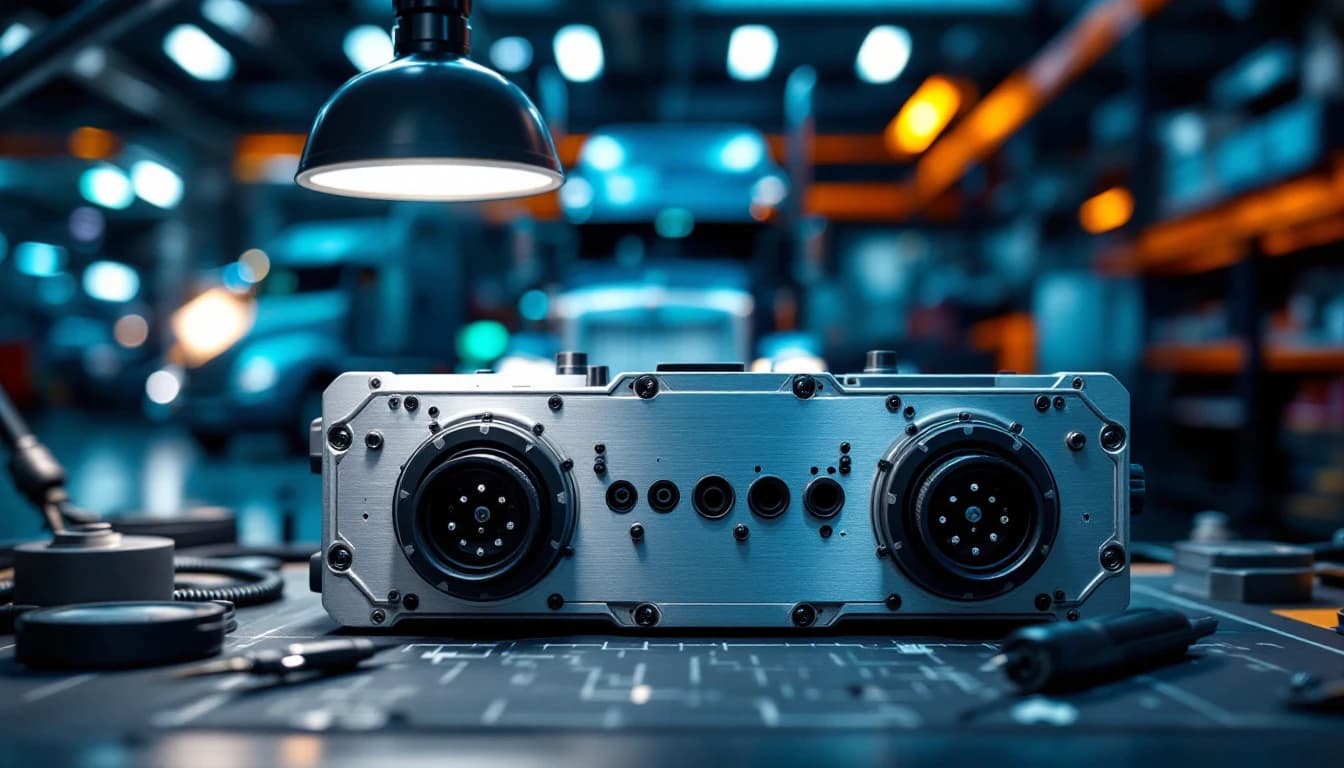
Heavy-Duty Truck ECM Repair Cost — Mail-In Service (2026)
What heavy-duty ECM repair costs in 2026
Repair of your own heavy-duty engine controller starts between $565 and $1,250 depending on the family: $565 for a Cummins CM2250, $725 for a CM871, $775 for CAT and Detroit DDEC units, $795 for a Freightliner CPC4, $825 for Cummins Celect, $1,075 for a CM2350 and $1,250 for a PACCAR MX11 or MX13. These are starting prices for assessment and repair of the module you already own, and the final quote is confirmed in writing before you pay or ship.
Those figures are our listed starting prices as of November 2026, taken from our live heavy-duty service pages. Unlike our pickup-diesel repairs, which are flat-rate, every heavy-duty job here is an individual enquiry. That is deliberate. A commercial controller is a lower-volume, higher-stakes part, and we would rather confirm that we can actually repair your exact unit than take a payment and find out afterward.
The starting prices, controller by controller
| Controller family | Typical applications to confirm from the label | Starting price |
|---|---|---|
| Cummins CM2250 | ISX15 hardware, other applications by approval | $565 |
| Cummins CM871 | ISX with a CM871 label, on-highway | $725 |
| CAT 40-pin | Older electronic Caterpillar truck engines, 3406-family by label | $775 |
| CAT 70-pin | C15, C12, C10, 3126, 3406E, confirm the controller | $775 |
| Detroit DDEC IV | Series 60 with a DDEC IV controller | $775 |
| Detroit DDEC V | Series 60 with a DDEC V controller | $775 |
| Freightliner CPC4 | Cascadia and Western Star by label, a powertrain controller rather than the engine ECM | $795 |
| Cummins Celect / Celect Plus | N14, M11, L10, confirm the ECM label | $825 |
| Cummins CM2350 | ISX15 and ISX12 variants by label | $1,075 |
| PACCAR MX11 / MX13 | MX11 and MX13 engines in Kenworth and Peterbilt applications | $1,250 |
Every row is repair of the original module, not an exchange unit and not a programming service. All ten live under one starting point, our heavy-duty truck module repair hub, where you can compare them side by side.
Two cautions about reading the table. First, an engine name does not select a row. A Detroit Series 60 can carry different DDEC generations, a Cummins ISX can carry different CM families, and a Kenworth or Peterbilt chassis can carry more than one engine make. The module label picks the row, not the badge on the valve cover. Second, a starting price is where the conversation begins. If the diagnosis shows more work than the starting scope, you hear about it and approve it before anything chargeable happens.
Why a Cummins CM2250 and a PACCAR MX cost so differently
A $565 start on one controller and $1,250 on another is a wide spread, and it is fair to ask why. We do not publish a line-by-line cost build, so treat the following as the general reasons commercial controller work varies rather than an itemised breakdown.
Hardware generation. Older controllers such as the DDEC IV or the Celect use simpler, better-understood boards. Newer units pack more functions, finer-pitch components and more protection circuitry into the same housing, and they take longer and more careful work to open, test and rework.
Test coverage. Repair is only as good as the bench test behind it. A controller we can power, communicate with and exercise across its outputs can be verified before it ships. One that needs more elaborate fixturing costs more to verify properly, and a price that skips verification is not a bargain.
Supply and downtime. The commercial market for the newest controllers is where replacement units are scarcest and slowest to arrive, which changes what repair is worth to the owner even though it does not directly change the bench price.
Risk. The more recent the platform, the more it matters whether the original configuration is still readable, and the more a failed attempt costs. Pricing reflects the care taken, not a premium for brand names.
The practical lesson: compare repair prices to the real alternative for your truck, which is a replacement controller plus whatever it takes to make that controller run, not to a different repair listing.
What changes the price on your specific job
The controller family. This sets the starting point in the table above, and it is the largest single variable.
How the unit failed. A clean internal supply fault is a different job from a module that has been through water, fire, a reversed battery or a previous repair attempt that lifted pads. Severe corrosion or earlier damage can make repair unsuitable, and in that case we say so rather than doing the work anyway.
Whether the fault is actually in the module. A sizeable share of the controllers people want quotes on are healthy. The cause is upstream: a battery feed, a ground, a chafed harness, a corroded connector, a failed sensor or a mechanical problem. We cannot price a repair the module does not need, and we would rather tell you early. The checklist near the end of this guide covers what to test first.
Whether your configuration is readable. If the original module still holds its parameters, repairing it avoids reconfiguration. If it is too damaged to read, any calibration or setup work is a separate conversation and a separate approval, and it requires lawful tooling access and a correct application match.
Whether the module has been opened before. Tell us. A unit with earlier rework changes what we expect to find.
Return shipping. You choose the return speed at checkout, and it starts at $29.95. It is a separate line from the repair, and it is the one part of the total you control. A heavy controller in a padded box is not a tiny package, so the faster tiers cost correspondingly more.
Diagnostic-fee terms. We confirm these in writing with the quote. We do not leave you to discover a diagnostic charge on the invoice.
Repair versus replacement: what the second bill looks like
Repair keeps the controller the truck already knows. It holds your serial relationships and, when it is readable, your configuration. A replacement keeps none of that. Whether it is new from a dealer, remanufactured, or pulled from another truck, it arrives with another vehicle's identity or none at all, and it has to be made to match your engine before the truck will run properly.
That second step is where a cheap-looking replacement gets expensive. On commercial diesels it can involve calibration files, parameter transfers, authorised software and an installer who has access to them. We do not promise that any controller is plug-and-play from its name alone, and neither should anyone selling you one. Our pickup-diesel cost guide for Duramax and Power Stroke ECM and FICM repair walks through the same repair-versus-replacement arithmetic on lighter trucks, and the broader diesel ECM and PCM cloning and programming guide explains where cloning fits.
"The expensive heavy-duty ECM jobs are almost never the repair. They are the truck that sat for a week on a replacement part nobody could configure. If your original board is recoverable, recover it."
— Independent heavy-duty diesel diagnostic technician, 20+ years, fleet and owner-operator work (anonymized)
What the repair actually involves
The sequence is the same disciplined one we use on every module, scaled up for commercial hardware.
Intake and identification. The module is photographed, its label is recorded and it is matched against what you described. This is the point where an engine-name assumption gets corrected.
Power-up and communication test. We establish whether the unit powers, whether it talks and whether it resets or drops out when warm.
Fault localisation under load. Intermittent faults are the rule, not the exception, on heat-cycled engine-mounted electronics, so a board is exercised rather than judged because it powered up once.
Component-level repair where diagnosis supports it. A failed supply component, an open trace, a cracked joint or a damaged output stage is repaired. Reballing and BGA work are considered only when the diagnosis points there. They are not a universal cure, and we do not sell them as one.
Verification and return. The agreed functions are checked against the agreed test scope, and your original module goes back to you with a written note on what was found and done. Bench testing cannot reproduce every operating condition on a truck, so the installing shop still verifies wiring, operation and any required configuration on the vehicle.
Before you pull the ECM: the checks that save the most money
A derate or no-start does not prove the ECM is bad. The first hour of diagnosis should happen on the truck, and a good shop will already have done most of this.
Measure power and ground under load, not parked. A voltage drop across a battery feed or ground that looks fine with the engine off can collapse when the starter and fans load the circuit. Many modules are replaced because a connector is corroded. Our guide to charging-system and ground faults that repeatedly kill modules explains why a module killed by its own supply will kill the next one.
Check the datalink and the other modules. A communication fault on the network is not the same as a dead ECM. A full vehicle scan that shows which controllers talk and which do not narrows it sharply. If you cannot get a connection at all, run through our guide on a scan tool that will not connect to the ECU before condemning anything.
Separate injector and harness faults from the module. If one or more cylinders are dead, a bank-wide pattern points toward a shared supply or a driver stage, while a single dead cylinder usually points at that injector or its wiring. Our diagnosis guide to multiple cylinders misfiring at once walks through the order.
Do not treat a derate as a module fault. A derate can be commanded because of a fault somewhere else on the truck, including fuel, sensors, wiring and aftertreatment equipment. Diagnose the cause the derate reports before assuming the controller is the culprit.
Record the evidence before removal. Engine serial number, controller part number, active and inactive fault descriptions, what the scan tool shows during the failure, and any earlier harness work or engine replacement. This is what lets us judge whether a repair is realistic before you ship. For a view across the whole electrical system, the guide to every control module in a modern car lists what else shares those power feeds and networks.
The Freightliner CPC4 is not an engine ECM
It appears in the same category and the same table, but a CPC4 is a common powertrain controller, not the engine-mounted ECM. That distinction matters when a diagnostic report names several controllers or when a communication fault is reported. A complete vehicle scan that shows which modules answer helps separate a CPC complaint from an engine-controller one, a harness problem or another device on the network. It is a CPC4 repair enquiry only. A CPC5, replacement sourcing and configuration work each need their own approval, and a used controller should not be bought on housing appearance alone.
What we do not do
We repair the original module. We do not sell exchange units, and a repair enquiry is not a core-surrender deal. We do not perform emissions edits of any kind, so no DPF, EGR, DEF or aftertreatment defeats, and we will not alter a controller to remove a derate. Software recovery or calibration work is considered only with confirmed lawful tooling access, the correct application and readable source data, and it is confirmed separately. And we do not take a heavy-duty module on the strength of a payment alone: you wait for written acceptance first.
How the mail-in process works for heavy-duty
Step one: the enquiry. Text us a photo of the complete module label, your VIN, the engine serial number, the fault history and photographs of the connector faces. Do not probe or spread terminals for the photos. This step costs nothing and prevents the most common wasted shipment: the right engine with the wrong controller.
Step two: written acceptance. We reply with whether we accept the unit, the repair scope, diagnostic-fee terms, warranty terms and an estimated turnaround. Wait for that before you pay or ship. Heavy-duty work does not go through ordinary checkout.
Step three: ship it. Pack the controller as described in our guide to removing and packing a car module for shipping, and see what to ship with your module by job type for the paperwork and extras. Use a carrier with tracking and declared value, and keep the connector face protected. The accepted quote tells you where to send it.
Step four: bench and return. The module is evaluated, repaired where the diagnosis supports it, verified against the agreed scope and returned by the speed you chose. For a commercial truck that is standing still, the return tier is a real decision: standard return shipping is $29.95, two-day is $54.95 and overnight is $94.95, chosen at checkout and paid by you. Those are separate from the repair price.
Ownership. We may ask for reasonable evidence that the module belongs to you or your fleet, and for any security-related work proof of ownership is required. Our proof of ownership guide explains what we ask for and why.
What downtime changes about the math
The price of the repair is the smaller number on most down trucks. A tractor that is not moving is not earning, and a fleet manager weighing a four-figure replacement against a repair has to count days, not dollars on the part. Two honest points follow.
Bench time for heavy-duty work is confirmed in the quote, not promised in advance, and transit adds days in each direction. If a replacement is available locally and the truck must roll tomorrow, a replacement may be the right call even though it costs more. Say so when you contact us.
If the repair is realistic, the other side of the ledger is the replacement lead time, the setup work it needs, and the risk that a donor carries a hidden history. A controller that is repaired and returned is a known quantity. That predictability is worth more to a shop with a bay waiting than a lower parts price.
For fleets, our shops and fleets mail-in partner guide covers volume arrangements, and the cross-module repair price menu shows where heavy-duty sits next to the flat-rate repairs.
Outside references worth bookmarking
For engine and controller specifics, go to the manufacturers: Cummins, Caterpillar, Detroit and PACCAR. For the regulatory background that explains why emissions edits are off the table, see the EPA and its vehicle and engine compliance pages. For commercial-vehicle safety and operation rules, the FMCSA is the authority. For the electronics and diagnostic standards behind heavy-duty communication, the SAE International standards catalogue is where they are published, and NHTSA covers recalls that sometimes touch engine controllers.
Frequently asked questions
How much does heavy-duty ECM repair cost? Starting prices run from $565 for a Cummins CM2250 to $1,250 for a PACCAR MX11 or MX13, with CAT and Detroit DDEC units at $775, the CPC4 at $795, Celect at $825, CM871 at $725 and CM2350 at $1,075, as of November 2026. These are starting prices for repair of your original controller, and the final scope and price are confirmed in writing before you pay or ship.
Is the price flat or a quote? It is a quote, starting from the listed price. Every heavy-duty job is an individual enquiry, so we review the exact controller, the fault history and our bench test coverage first, then confirm scope, diagnostic-fee terms, warranty and turnaround in writing. Nothing chargeable happens until you approve it, and no checkout is involved before written acceptance.
Can a derate or no-start prove my ECM is bad? No. A derate can be commanded because of a fault elsewhere on the truck, and a no-start can come from power, grounds, wiring, sensors, fuel delivery, a mechanical fault or aftertreatment equipment. Diagnose on the vehicle first, with power and ground measured under load, and send the findings with your enquiry so we can tell whether the module is a realistic suspect.
Should I repair my original ECM or buy a replacement? Repair when the original is recoverable, because it keeps the controller the truck already knows and, when readable, its configuration. A replacement, whether new, remanufactured or used, arrives with another identity or none and needs matching to your engine, which can be a second bill and a second delay. If your truck must move immediately and a configured replacement is on the shelf, replacement may still win.
Do you remove emissions equipment or derates? No. We do not perform emissions edits of any kind, including DPF, EGR, DEF or aftertreatment defeats, and we will not alter a controller to disable emissions equipment. Our heavy-duty work is limited to assessment and repair of the original module and, where separately confirmed and lawful, configuration work on accepted units.
How do I ship a heavy-duty ECM? Wait for written acceptance, then pack the controller in a rigid box with padding around it and the connector face protected, use a tracked and insured carrier, and follow the ship-to details in your accepted quote. Return shipping is paid by you, chosen at checkout, at $29.95 standard, $54.95 two-day or $94.95 overnight.
Does a CPC4 repair cover my engine ECM? No. The Freightliner CPC4 is a common powertrain controller, not the engine-mounted ECM, and it is a separate enquiry starting at $795. Photograph the CPC4 label, include a full vehicle scan showing which modules communicate, and tell us whether the original is still available, so we can tell which controller your fault points to.
The bottom line
Heavy-duty ECM repair starts at $565 to $1,250 depending on the controller family, and the honest version of that number is a starting price you confirm in writing before you pay a cent. The price is not the hard part. The hard part is knowing whether the module is really at fault, and that is decided on the truck, with power and ground measured under load, the datalink checked and the fault history written down.
If the evidence points at the controller, repair keeps the unit your truck already knows and spares you the second bill that comes with a replacement. If it does not, you have saved the cost of a repair you did not need. Either way, the cheapest first step is the same: text us a photo of the module label with your VIN and engine serial number, and we will tell you whether we can repair that exact unit. Browse the starting point for all ten families at the heavy-duty truck module repair hub, and send the label.
Ship your module today
Flat-rate pricing, typical 24-hour bench turnaround, return speed your choice at checkout. Most jobs back on your bench within a week.
More from the Lab

Identify a Heavy-Duty ECM: Cummins, Detroit, CAT, PACCAR
11 min · November 2, 2026

Mail-In Module Service: Total Cost With Shipping (2026)
11 min · November 2, 2026
Multiple Cylinders Misfiring: Coil, Driver or ECM? (2026)
14 min · November 2, 2026
Immo Off ECU Cost by Make — Mail-In Bench (2026)
14 min · October 30, 2026