
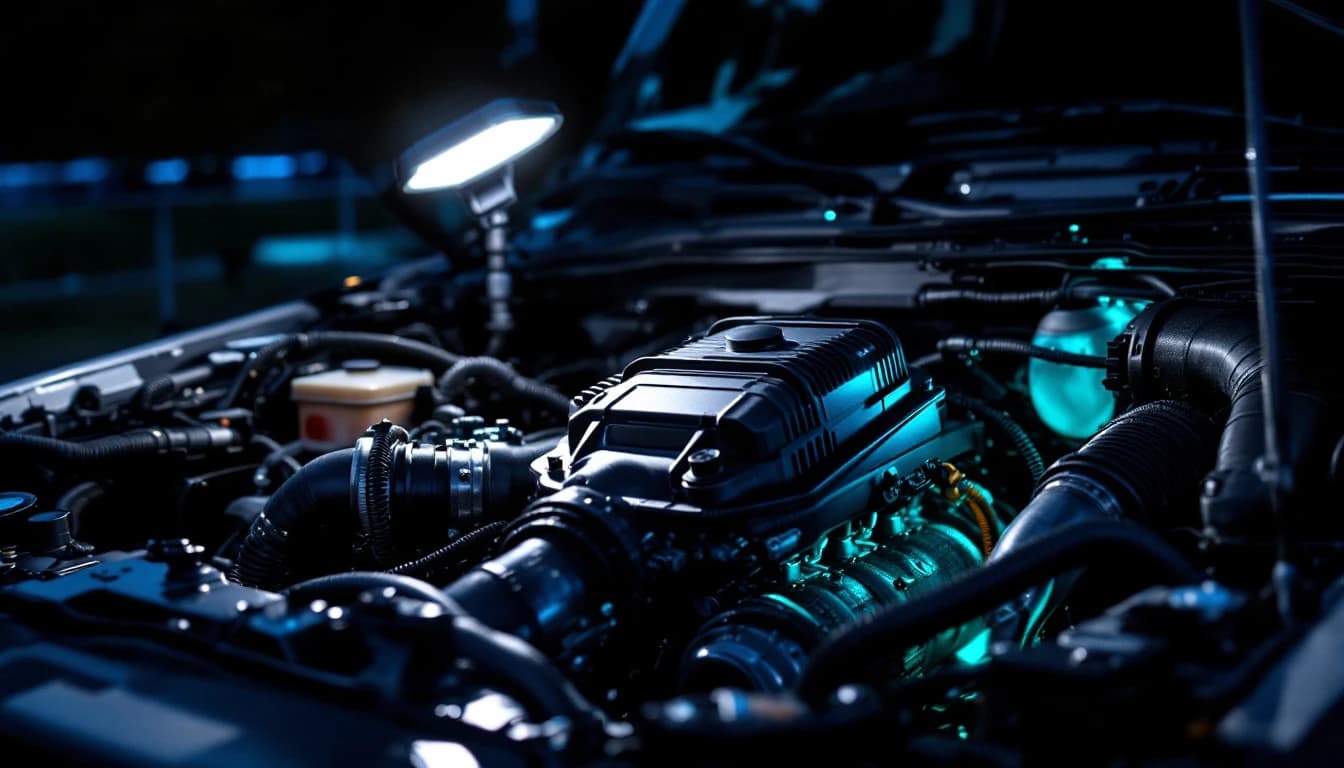
Diesel ECM/PCM Cloning: Duramax, Power Stroke, Cummins
Why a used diesel ECM will not just plug in
A used diesel controller with the right part number still will not run your truck, because the part number describes the hardware, not the identity. This is the single most expensive lesson in diesel electronics, and owners learn it the hard way over and over.
You find a same-part-number ECM or PCM from a donor truck that looked identical to yours. You bolt it in, turn the key, and the truck either cranks and will not start, starts and runs badly, or lights up an immobilizer warning and dies. Nothing went wrong with the swap. The controller is doing exactly what it was built to do: it is still the other truck's brain.
Three things live inside that controller that make it specific to one vehicle:
- The VIN. Modern controllers store the vehicle identification number and cross-check it against the cluster and other modules on the bus. A VIN mismatch alone can throw faults and, on some platforms, block operation.
- The calibration. The tune, the injector trim data, the transmission adaptations, the sensor scaling — all of it is matched to a specific truck's hardware and options. A donor's calibration may be close, or it may be for a different rear axle, transmission, or emissions configuration entirely.
- The immobilizer link. On trucks with a factory immobilizer, most notably the Cummins-powered Dodge and RAM trucks, the engine controller is tied into the security handshake. A donor unit knows the donor's key secrets, not yours.
The mistake is treating a used controller like a used alternator. Two ECMs can be electrically and functionally identical, share a part number, and still be permanently unwilling to run each other's trucks. Our broader explainer on why used-ECU plug-and-play fails covers the general principle; this article is the diesel-specific version, where the stakes are a work truck that has to earn its keep.
The industry direction makes this worse every year, not better. The National Highway Traffic Safety Administration has documented that a modern vehicle commonly carries well over 50 networked control units, and heavy-duty trucks sit at the top of that range. Coverage from Car and Driver has noted that electronics and software now account for a large and rising share of a new vehicle's value, by some estimates approaching 40%. The engine-controller architectures themselves are governed by standards from SAE International, whose diagnostic and networking specifications define how these controllers store identity and talk on the bus. A diesel controller is not a commodity box. It is a networked computer with an identity.
The three real bench paths
Before splitting by brand, here are the only three honest ways to resolve a dead or wrong diesel controller. Every legitimate fix is one of these.
Path one: clone your original data onto a donor. If your original controller can still be read — even when it is unreliable in the truck — its full identity and calibration can be copied onto a same-hardware donor. The truck then sees its own controller. The VIN matches, the calibration matches, the keys still work. This is the cleanest outcome and the one to want, because it drops in and nothing else on the truck has to change. The mechanics of where that identity physically lives on the board and how it moves are covered in our guide to how ECU cloning works at the EEPROM level.
Path two: program a new or blank replacement. Where cloning is not possible, a new or virgin controller is programmed to your vehicle — written with the correct VIN, the correct factory calibration for your truck's configuration, and where applicable joined to the immobilizer. This is the closest thing to what a dealer does, done on a bench.
Path three: unlock a locked controller. Many modern controllers ship read-protected, so they cannot be read or written until the lock is addressed. A PCM unlocking service at $250 removes that barrier so the controller can be read for cloning or written for programming. Unlocking is often the first step that makes path one or two possible, not a fix on its own.
Which path applies depends on whether your original still reads, whether a suitable donor exists, and whether the platform has a factory immobilizer. That is an intake conversation, not a guess.
GM Duramax — the E-series controllers
The Duramax family is controlled by GM's E-series engine control modules, the same E-family architecture used across GM's V8 lineup. Duramax trucks generally run controllers in the E-series range, and the bench work is data transfer and programming on those units.
The good news for Duramax owners is that these controllers are well understood and, in most cases, readable and writable on a bench. When your original E-series ECM has failed physically but its memory still reads, cloning your data onto a sound donor is usually the path — the GM E38 / E67 / E92 ECM clone service at $250 covers the family. The truck comes back seeing its own controller with its own calibration and VIN, and drops in.
Diesel trucks are worth this kind of care because they earn their long lives. Outlets that cover ownership and durability, including MotorTrend and Hagerty, have long documented that well-maintained heavy-duty diesels routinely run past 200,000 miles and often well beyond, which is exactly why a failed controller is worth cloning rather than a reason to scrap the truck. A controller replacement on a truck with a decade of service left in it is a repair, not a write-off.
A few Duramax realities worth stating plainly:
- The controller often ships read-protected. If the ECM cannot be read as received, unlocking comes first. That is normal, not a complication.
- Calibration matching is not optional. A Duramax calibration is matched to the specific truck — injector data, transmission adaptations, emissions hardware. A donor calibration for a different configuration is not a substitute, which is why cloning the original data is preferred over borrowing a donor's tune.
- This is not tuning. Programming a Duramax controller to its correct factory calibration to get the truck running is repair work. It is a different thing entirely from performance tuning, and it is the only thing this service does.
Ford Power Stroke — PCM programming and cloning
Ford's diesel trucks use a PCM (powertrain control module), and the modern Power Stroke era is where most owners land needing bench work. When a Power Stroke PCM fails or a truck needs a replacement brought onto the vehicle, the work is VIN transfer and calibration programming.
For modern Power Stroke trucks, the Ford PCM clone and VIN transfer service at $250 is the right reference. It copies your original PCM's identity and calibration onto a replacement, or writes the correct VIN and configuration to a replacement unit, so the truck accepts it. As with the Duramax, the aim is that the truck sees its own configuration and drops in without further drama.
One important distinction for Ford owners: the older EEC-V family is a different job. EEC-V is the earlier gasoline-era Ford controller architecture, and it has its own dedicated Ford EEC-V PCM clone service at $250. If your Ford is a modern Power Stroke, the PCM clone and VIN transfer path is yours; the EEC-V service is for the older gasoline platforms. Say which engine and year you have in the first message, because it changes the answer completely.
Ford PCM work also frequently touches the same lock question as everyone else. If the replacement PCM is read-protected, unlocking is the enabling first step before the identity and calibration can be written.
Dodge and RAM Cummins — the immobilizer chain is the catch
The Cummins-powered trucks are where diesel ECM work gets genuinely different, because they add a factory immobilizer to everything above. This is the part owners miss, and it is the reason a Cummins ECM swap fails when a Duramax swap of the same difficulty succeeds.
On these trucks the engine controller is tied into a security chain. Historically that chain runs through the SKIM (Sentry Key Immobilizer Module) or its later variants, sometimes referred to in the wider Chrysler world as SKREEM (Sentry Key Remote Entry Module), and on later trucks the security function moves into the body and gateway modules. The principle across all of them is the same: the engine controller will not authorize the engine to run unless the immobilizer handshake succeeds, and that handshake is keyed to the specific truck's security data.
Drop a donor Cummins ECM into your truck and it carries the donor's link to the donor's SKIM and the donor's keys. Your truck's immobilizer asks a question the donor controller answers wrong, and the engine is blocked. This is not a calibration problem you can tune around. It is a security verdict.
Resolving a Cummins controller therefore means addressing both halves — the calibration and identity, and the immobilizer link:
- Clone the original data where the original reads, so both the calibration and the immobilizer relationship come across intact and the keys keep working.
- Program and re-marry where a replacement is used, writing the correct VIN and configuration and joining the controller to the truck's immobilizer so the handshake succeeds.
- Address the SKIM side where the security module itself is involved. Chrysler-family immobilizer and Sentry Key work has its own dedicated path — the Chrysler SKIM Sentry Key delete service at $250 for the genuine dead-end cases, and stock configuration work through the Mopar OEM reprogramming service at $350 for factory-correct programming across the Chrysler, Dodge, Jeep, and RAM family.
Immobilizer-linked work carries a hard requirement: proof of ownership, without exception. Any security-linked work on a Cummins truck requires documentation tying you to the vehicle. A shop that does not ask should worry you.
The comparison — clone, program, or unlock
Put the three paths against each other and the choice usually makes itself once you know whether your original reads.
| Clone original onto donor | Program new / replacement | Unlock a locked controller | |
|---|---|---|---|
| Starting point | Your original still reads | Original is dead or unreadable | Controller ships read-protected |
| What the truck sees afterward | Its own identity and calibration | A replacement written to match | Prerequisite for clone or program |
| Keys / immobilizer | Preserved as-is | Re-married to the truck | Unaffected on its own |
| Calibration accuracy | Exact original | Correct factory cal for the config | Not changed by unlocking alone |
| Best for | The clean, drop-in fix | No recoverable original data | Enabling either path above |
| Representative bench service | E-series ECM clone $250, Ford PCM clone $250 | Ford PCM VIN transfer $250, Mopar OEM reprogramming $350 | PCM unlocking $250 |
The pattern is consistent: cloning is the preferred path whenever the original reads, programming a replacement covers the dead-original case, and unlocking is the enabler that often has to happen before either. Our decision-oriented companion piece, PCM repair versus clone versus replacement, walks the same fork from the money and timing angle.
What to ship, and what to tell us first
Because the right path depends on facts about your specific truck, the intake conversation happens before anything goes in a box. Send this before you remove anything:
- VIN, year, make, model, and engine — Duramax, Power Stroke, or Cummins, and the displacement and generation.
- The controller part number from the label, and a clear photo of that label.
- Whether the controller you have is your original or a donor. This determines whether cloning is even on the table.
- How many working keys you have, on immobilizer-equipped Cummins trucks especially.
- What failed and when — a hard no-start, an intermittent stall, a code, or damage.
Then ship what we ask for. Often that is just the controller. On a Cummins with immobilizer involvement it may be the ECM together with a security module or a working key. Both shipping labels are purchased at checkout, so you get a prepaid, pre-addressed inbound label by email and ship with nothing to print or address by hand. Pack the controller in an anti-static bag inside a padded box.
"The Cummins guys are the ones who get surprised. A Duramax owner drops in a used ECM and half the time it at least runs rough. A Ram owner does the exact same thing and the truck is dead, immobilizer flashing, because nobody told him the engine computer talks to the Sentry Key. If he'd sent me his original I'd have cloned it and kept his keys. Instead he bought a second used ECM thinking the first was bad. Neither one was bad. They just weren't his." — Independent diesel driveability technician, 17+ years (anonymized)
This is repair work, not emissions-defeat tuning
Here is the line we do not cross, stated plainly.
Everything above is about programming a diesel controller to its proper factory configuration to get a truck running again. Clone the original data, program a replacement to the correct factory calibration, unlock a controller so it can be read — all of it is restoration of a vehicle to a running, correctly configured state. That is the entire job.
It is not emissions-defeat tuning. We do not delete, disable, or program around emissions control systems, and the calibrations involved in this work are the vehicle's proper configuration, not a modified one. The Environmental Protection Agency has enforced the standards governing on-board emissions controls since standardized on-board diagnostics became mandatory on light vehicles beginning with the 1996 model year, and tampering with emissions controls carries real legal exposure. Diesel emissions enforcement in particular has been active and public. You are responsible for compliance with the emissions laws that apply to your vehicle and its intended use, and where a truck is a road-registered daily driver, factory-correct programming is the only path that keeps it legal.
The same clear-eyed framing applies to the immobilizer side. Any immobilizer-linked work is offered for legitimate repair and for cases where the original security data is genuinely recoverable or the platform is orphaned, and it always requires proof of ownership. It is not a way around a lost key or a way to run a truck you cannot document owning.
The honest limits
A workshop that tells you the truth also tells you what it cannot do.
- A read may not be possible. Cloning assumes your original controller still reads. Sometimes a failed processor or water damage means it does not, and then the options narrow to programming a replacement.
- Some late platforms require online factory access. On the newest trucks, certain authorization steps are designed to complete only through the manufacturer's secure systems. When a truck falls in that group, the honest answer is that the job belongs with a facility that has that access, and we say so before you ship.
- Software does not fix dead hardware. If a controller has a failed driver stage or a cracked board, no programming makes it run. That is a repair-or-replace decision.
- Calibration has to match the truck. A donor calibration for a different axle, transmission, or emissions configuration is not a shortcut. Cloning the original avoids this; programming a replacement means writing the correct configuration, not the nearest one.
Frequently asked questions
Why will a used diesel ECM with the correct part number not just plug in? Because the part number only describes the hardware, while the controller also stores the donor truck's VIN, calibration, and on Cummins trucks a link to the immobilizer. Dropped into your truck it carries the wrong identity, so it refuses to run, runs on the wrong calibration, or triggers an immobilizer fault until it is cloned, programmed, or re-married to your vehicle.
Can you clone my original diesel controller onto a replacement? Yes, whenever your original controller can still be read, its full identity and calibration can be copied onto a same-hardware donor so the truck sees its own controller and drops in. Cloning is the preferred path because it preserves your exact factory calibration and, on immobilizer-equipped trucks, keeps your existing keys working.
Do Cummins trucks have an immobilizer that blocks an ECM swap? Yes. Dodge and RAM Cummins trucks tie the engine controller into a factory immobilizer chain running through the SKIM or SKREEM security module and, on later trucks, the body and gateway modules. A donor ECM knows the donor's security data, so your truck's immobilizer blocks the engine until the controller is cloned or re-married to your truck's security.
Is diesel ECM programming the same as performance or delete tuning? No. This service programs a controller to its proper factory configuration to get a truck running again, which is repair and restoration work. It is not emissions-defeat tuning, and we do not delete or program around emissions control systems. You remain responsible for compliance with the emissions laws that apply to your vehicle.
What does it mean that a PCM is locked, and why does it matter? A locked controller is read-protected from the factory, so it cannot be read for cloning or written for programming until the lock is addressed. The PCM unlocking service at $250 removes that barrier, which is often the enabling first step before your original can be cloned or a replacement can be programmed to your truck.
Do I need proof of ownership for diesel controller work? Yes, for any immobilizer-linked work such as Cummins security programming, proof of ownership is required without exception. That means documentation tying your name to the vehicle, such as a registration or title, and a reputable shop will always ask for it before performing security-linked work.
What should I send in for a diesel no-start caused by the controller? Send the year, make, model, engine, VIN, and the controller part number with a photo of its label, and tell us whether the controller is your original or a donor and how many keys you have. Often only the controller ships, but on an immobilizer-equipped Cummins we may also need a security module or a working key, which the intake conversation sorts out first.
The bottom line
A dead engine controller on a diesel truck is expensive, but the fix is knowable and the paths are only three. Clone your original data onto a donor when the original still reads and the truck drops right in with its keys and calibration intact. Program a new or replacement controller to your vehicle when there is no recoverable original. Unlock a read-protected controller first when that is what stands in the way. Across GM Duramax E-series controllers, Ford Power Stroke PCMs, and Dodge and RAM Cummins ECMs the principle is identical — the controller has an identity, and identity does not transfer with a part number.
Bench pricing is flat and public: $250 for E-series ECM cloning, $250 for Ford PCM clone and VIN transfer, $250 for PCM unlocking, and $350 for Mopar OEM reprogramming, with return shipping chosen at checkout from $29.95. It is repair work — factory-correct programming to get a truck running — not emissions-defeat tuning, and immobilizer-linked jobs require proof of ownership. If you are holding a used diesel controller right now and the truck will not start, stop before you buy a second one. Message the lab with the VIN, the part number, a photo of the label, and whether you still have your original, and we will tell you which of the three paths your truck is actually on.
Ship your module today
Flat-rate pricing, typical 24-hour bench turnaround, return speed your choice at checkout. Most jobs back on your bench within a week.
More from the Lab
Duramax & Power Stroke ECM Repair Cost (2026)
13 min · September 11, 2026
Mercedes ME2.8 ECM by Engine: M112, M111 & Crossfire
11 min · September 17, 2026
Used Nissan/Infiniti ECM Won't Start? Cloning Fixes It
10 min · August 3, 2026
Ford 6.0 Powerstroke FICM Repair: Hard Start, No-Start
11 min · August 3, 2026