
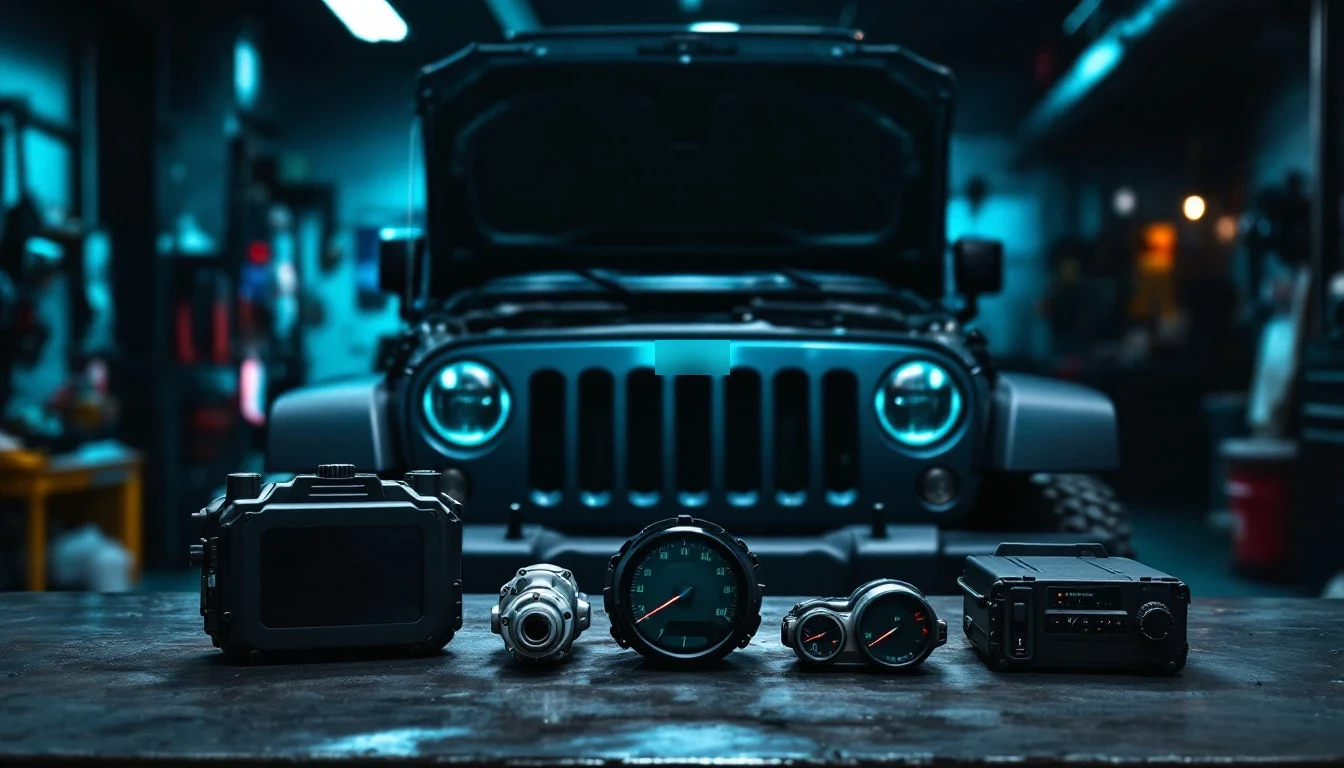
Jeep Wrangler JK Module Failure Map: TIPM, ABS, Cluster
Who this guide is for
You own a Jeep Wrangler JK, roughly the 2007 to 2018 generation, and something electrical is acting up: the engine will not start one morning and starts fine that afternoon, the dash lights up with ESP and BAS warnings, the gauges sweep and die, or the remote stops working. You have probably already read a forum thread where six people recommend six different parts.
This page is a map, not a repair manual. For each symptom it tells you which module is the most likely culprit, how to confirm that cheaply before you spend money, which mail-in service from our price list covers it, and what that service costs. Everything we price here comes from the services list. We are a national mail-in bench lab, so the whole workflow below assumes you remove the module yourself (or have a local shop do it), ship it to us, and reinstall it when it comes back.
A note on scope. We repair modules on the bench. We do not repair wiring harnesses, switches, sensors, or mechanical parts, and we say so in each section. A map that sends you to the wrong module is worse than no map, so each section ends with the faults that look like a module problem but are not.
Why a JK ends up with module problems at all
A modern vehicle is a network of small computers. A JK is on the simpler end of that spectrum, but it still carries a power distribution module, a brake controller, a gauge cluster, a body-side receiver and an engine controller, all talking over a data bus. If you want the wider picture of how those boxes relate, our guide to every control module in a modern car lays out the full system-by-system list, and it is the page to read if you hear the phrase car module and want the vocabulary first.
Age matters here. According to S&P Global Mobility's 2025 analysis, the average light vehicle on US roads is now 12.8 years old, with passenger cars averaging 14.5 years, and the fleet counts 289 million light vehicles in operation. A JK built in 2007 to 2018 sits right at or beyond that average. Electrolytic capacitors dry out, solder joints crack from thousands of heat cycles, relays wear, and connectors that live in an off-road engine bay take water and mud. None of that is a design scandal. It is just what happens to electronics that are fifteen years old and were used the way Wranglers are used.
Two more facts shape how we approach these repairs. First, a dealer will usually quote a new module, which is a high-priced part that may also need dealer programming. Second, most of these failures are repairable at component level, which is cheaper and keeps the module's own VIN and security data intact. That is the entire premise of mail-in bench work.
The five suspects at a glance
The table below is the whole guide in one place. Read down the symptom column until you find yours, then read the matching section for the confirmation steps.
| Module | Typical location | Symptoms it causes | Our mail-in service | Price |
|---|---|---|---|---|
| TIPM (power module) | Under the hood, driver side | Random no-start, fuel pump runs oddly, stalling, wipers, horn or locks acting up, lights dropping out | TIPM repair | $499 |
| ABS / ESP module | Engine bay, on the brake hydraulics | ABS, ESP, BAS and traction lights, brake pedal feel changes | ABS module repair | $699 |
| Instrument cluster | Behind the gauge hood in the dash | Dead or sweeping gauges, missing lights, wrong readings | Cluster repair and mileage sync | $200 |
| Keyless-entry / RKE module | Varies, photograph the label | Remote lock and unlock dead, fobs not responding | Keyless entry module repair | $125 |
| Engine controller (PCM) | Varies by engine, send the part number | Needs factory calibration back after a failed tune | Mopar stock OEM reprogramming | $350 |
Prices are the figures on each service page as of November 2026. Return shipping is separate: you choose a tier at checkout, from $29.95 for standard. We email you a prepaid inbound label for the trip to us.
Symptom 1: it will not start, then starts later
This is the signature JK complaint and the one that most often ends at the TIPM. The pattern: the engine cranks or does not crank, nothing you do helps, you walk away, and an hour later it fires on the first turn of the key. No stored codes, or codes that make no sense together.
Why the TIPM
The Totally Integrated Power Module is the fuse box and relay hub, plus electronics, under the hood. Among the relays inside it is the one that feeds the fuel pump. When that relay or the circuitry feeding it gets flaky, the pump gets power only some of the time, and the engine looks like it has a random fuel problem.
This is not folklore. When federal investigators looked at it, the finding was specific. According to the NHTSA investigation DP14-004 record, the defect was in the fuel pump relay inside the TIPM-7, and the resulting recalls covered approximately 188,723 model year 2011 Jeep Grand Cherokee and Dodge Durango vehicles under 14V-530, plus 338,216 more model year 2012 to 2013 vehicles under 15V-115. To be precise, those campaigns named the Grand Cherokee and Durango, not the Wrangler. We cite them because they prove the failure mechanism is real and well documented on the same family of power module, not because your JK is necessarily covered. Check your own VIN on the NHTSA recall lookup before paying for anything, because a recall repair at a dealer costs you nothing and ours does not.
Cheap confirmation before you pull anything
- Listen for the fuel pump prime when you turn the key to run, before cranking. Get a helper, or put your ear near the rear of the vehicle. A pump that primes sometimes and not other times, with the battery healthy, is the textbook TIPM signature.
- Note whether other loads misbehave at the same time: horn, wipers, power locks, a headlight that drops out. A single relay failing is one thing; several unrelated circuits flickering together points to the module that feeds them all.
- Check the basics first: battery terminals, main grounds, and the fuel pump itself. A tired pump or a corroded ground wastes everyone's time. Our service page is explicit that we do not fix a mechanical pump failure.
- Read the codes. A clean scan with an intermittent no-start is far more consistent with the TIPM than with a sensor.
Our diagnostic write-up on TIPM failure symptoms across Chrysler, Dodge and Jeep goes deeper on the symptom list.
What we do and what it costs
You remove the TIPM, ship it, and we bench-diagnose it for the failing relay, voltage regulator or body-control-side circuit and repair it. It is a flat $499 with typical 24-hour turnaround after we receive the part, and the repair preserves the module's VIN, coding and security data, so there is no reprogramming step when you reinstall. The line-by-line pricing logic is in TIPM repair cost. If the board is water-damaged beyond repair, the service page states the outcome: a refund minus a $150 bench evaluation fee and shipping.
What does not point at the TIPM: a truck that never starts, ever, with a dead pump and a blown fuse; a failed battery or alternator; a bad starter. Test those first.
Symptom 2: ESP, BAS and traction lights on the dash
The second most common JK complaint is a cluster of warning lights: ABS, the ESP lamp, BAS, sometimes the traction control indicator, and occasionally a brake light behavior change. The vehicle drives, but the stability system is offline.
Why the ABS module
The ABS module combines a hydraulic valve block and a small computer that watches wheel speed and drives the brake pressure. Its electronics fail in predictable ways: a cracked solder joint, a failed driver, a sensor input that reads nonsense. When the computer cannot trust itself, it disables ABS, stability control and brake assist and turns the lights on.
Cheap confirmation
- Scan for ABS-side codes, not just engine codes. Wheel speed sensor codes can be a sensor or its wiring rather than the module; a code pointing at the module's internal circuits, or no communication with the module, is the stronger signal.
- Inspect the four wheel speed sensors and their connectors. Mud, corrosion and a broken tone ring are common on trucks that see trails, and they trigger the same lights.
- Check the brake fluid level and the brake light switch. A low level or a misadjusted switch can also light the stability lamps.
- Confirm battery voltage. A weak battery makes several modules complain at once.
We have two dedicated JK write-ups with code-level detail: the ESP, BAS and brake lights repair guide and the 2014 to 2016 JK ABS module failure guide.
What we do and what it costs
ABS repair is $699 flat. If the board is beyond repair, a replacement board with your data transferred is $1,150 in total, with the $699 credited, and we ask before doing it. That is more than the other services here, because it is a bench-intensive job: roughly one week of bench time, or you can add rush repair for two to three business days for an extra $100. The module keeps its own coding in most cases, and the service page notes that for JK, Ram and 300 modules you clear the stored codes with a scan tool after reinstalling, so plan for that step. If you want to understand why the price lands where it does against a dealer replacement, read our breakdown of abs module repair cost.
What does not point at the ABS module: a seized caliper, worn pads, a hydraulic leak, or a failed pump motor mechanical fault. We repair electronics, not brake hardware. If your brakes feel wrong in a mechanical way, have the system inspected before you ship anything.
Symptom 3: gauges dead, sweeping, or showing nonsense
A cluster fault usually announces itself loudly. Needles that sweep full range at start-up and then drop, a speedometer that sticks, a fuel gauge that reads empty on a full tank, or a cluster that is simply dark while the truck runs.
Why the cluster
The gauge cluster is its own small computer with stepper motors driving the needles. Stepper motor failures, cracked solder joints on the connector, and failed display or lamp driver circuits are the usual faults. They are classic bench repairs, and repairing is far cheaper than a new cluster that needs programming to your VIN and mileage.
Cheap confirmation
- If every gauge fails together, think power and ground into the cluster, or the data bus, before the cluster itself. If one needle fails while the rest work, the cluster is the prime suspect.
- Check fuses that feed the cluster. A blown fuse is a five-dollar answer.
- Tap the dash gently with the key on. If the gauges recover and drop with vibration, that suggests a cracked joint inside the cluster.
What we do and what it costs
Cluster repair with mileage sync is $200 flat, typically 24 hours at the bench after the part arrives. Mileage handling matters, and we are careful about it: if a cluster is replaced or repaired such that the stored odometer value is lost, we sync it to the vehicle's true mileage and nothing else. We never roll back an odometer, and federal law makes that fraud. A cluster swapped from another vehicle needs VIN and mileage work, which is a different job from a straight repair; send us the vehicle details and we will tell you which path you are on. Proof of ownership is required for anything touching security data.
Symptom 4: the remote does not lock or unlock
If the key fob stopped working, the cheapest suspect is also the first one to test: the fob's own battery. Replace it, then try again. Also try a second fob if you have one. A second working fob proves the receiver in the vehicle is fine and the first fob is the problem.
Why the receiver module
If neither fob works and the batteries are good, the keyless-entry receiver or the comfort-module electronics that process the signal may have failed. This is the cheapest of the module repairs and one of the fastest.
What we do and what it costs
Keyless entry module repair is $125 flat with typical 24-hour turnaround after we receive the module. We repair or reprogram it and send it back ready to pair with your fobs. Our keyless entry module repair guide explains the test sequence in more detail. Because pairing fobs to a vehicle touches its security system, we require proof of ownership for any key, fob or immobilizer work, and the rule applies here as well.
Where the module sits varies, so photograph the label and text us before you start unbolting trim. We will tell you what we need to see.
Symptom 5: check-engine light, limp mode, or a tune gone wrong
The engine controller is the last suspect on the list because it fails less often than the others and is usually blamed too early. Before suspecting the PCM, rule out sensors, wiring, and the TIPM: a no-start that looks like an engine controller fault is more often the power module feeding it.
When the controller is the story
The PCM story is usually a modification story. Someone flashed an aftermarket tune, it failed or caused a problem, and you need the module back to factory calibration for a warranty visit, an emissions inspection, a resale or a lease return. That is exactly what our Mopar stock reprogramming does: we bench-flash the module back to the factory calibration matching your year, model and VIN.
Cost and scope
Mopar stock OEM reprogramming is $350 flat, typically 24 hours at the bench. We only support the controller families listed on the service page, so send us the part number from the controller label before you ship, and we will confirm coverage first. Two related services, GPEC2 clone and PCM unlocking, are for 2015-and-newer GPEC-family controllers and do not apply to the JK generation, which is why they are not in the comparison table above.
We do not perform emissions-system edits of any kind, and we do not do work that removes or disables required emissions equipment. Recovering a factory calibration is the opposite of that.
The airbag light is a different story
One more light deserves a note because it is easy to confuse with the others. An airbag warning that stays on after a collision may mean the SRS module stored crash data. Our airbag crash-data clear is $75 and does not need a new module. But an airbag light with no accident has several non-module causes: a seat belt buckle switch, a clockspring, a connector under the seat. Rule those out first. If a deployment did occur, the rest of the restraint system must be inspected by someone qualified before you rely on it; clearing a module does not make a damaged airbag system safe.
How to pick the right module when two symptoms overlap
A JK with a flaky power module can throw several symptoms at once, which tempts people to blame everything. A working rule helps.
- Start with the symptom that is most dangerous or most reproducible. A stalling, no-start vehicle outranks a dead remote.
- Look for a shared cause. Several unrelated circuits dropping out together suggest the TIPM or the battery and grounds, not four modules failing the same week.
- Fix power and ground first. A weak battery, corroded terminals or a poor engine ground can make the ABS, cluster and engine controller all complain. It costs almost nothing to check.
- Test, do not guess. A fuel pump prime check, a fob battery swap and a code scan cost minutes and cut the list of suspects.
- Photograph labels and text us. For a module you have not removed yet, a clear photo of the part and your VIN lets us confirm the service before any money moves.
If you run into an intermittent problem that does not match any of the above, our bench evaluation at $150 exists for exactly that case, where the symptom does not fit a standard service.
What mail-in actually looks like
The process is the same for every module here.
- Order the service online or text us. Pick the service for your symptom. If you are unsure, send photos and your VIN and we will tell you which one fits.
- Receive the prepaid inbound label. We email you a prepaid label for the trip to us, so the outbound shipping is handled.
- Remove the module. Disconnect the battery first. Photograph connector positions before unplugging anything. Do not pry on a module with a blind tool; the housings crack.
- Pack it carefully. Anti-static bag if you have one, snug box, no loose connectors rattling. Include the printed order confirmation, your VIN and a one-line description of the symptom.
- We bench it. Typical turnaround is 24 hours after receipt for TIPM, cluster, keyless entry and Mopar reprogramming, and about a week for ABS.
- Choose your return shipping at checkout. Standard from $29.95, two-day or overnight at higher tiers. Return shipping is paid by you; we do not pay or cover it.
- Reinstall. Reconnect the battery, start the vehicle, and for ABS clear the stored codes with a scan tool as described above.
A note on theft, immobilizers and what we will not do
Some of the modules on a JK sit in the security chain. According to the National Insurance Crime Bureau's annual analysis as reported by Insurance Journal, 659,880 vehicles were reported stolen nationwide in 2025, a 23 percent drop from 2024, which is good news and also a reminder that thefts are still common. That is why we require proof of ownership for any key, fob or immobilizer work, and why we will not help bypass a security system on a vehicle you cannot document as yours. Legitimate repairs, and recoveries on vehicles you own, are what mail-in bench work is for.
For background on how automakers and regulators treat these systems, the Jeep brand site and NHTSA are the authoritative places to check recall and service-bulletin status for your VIN, and SAE International publishes the standards behind vehicle data buses. For general ownership context, MotorTrend and Car and Driver cover Wrangler reliability and buying guides, and Kelley Blue Book is a fair way to judge whether a repair makes sense against the truck's value.
"On older Wranglers the expensive mistake is almost never the repair, it is the guessing before it. People replace a fuel pump, then a relay, then a battery, and the real problem was a power module that fails when it gets warm. Confirm the symptom pattern, test the cheap things, and then send out the one box that actually matches." — Independent Chrysler-platform driveability technician, 15+ years (anonymized)
Repair or replace: a quick decision frame
For each module, the economics differ, and the right call depends on the truck.
- TIPM at $499. Repair is almost always the sensible path on a truck you plan to keep. A replacement part is a larger expense and the original VIN and security data stay with a repaired unit.
- ABS at $699. Compare against the replacement cost for your exact module and whether it needs programming. Repair usually wins when the housing and valve block are healthy.
- Cluster at $200. Repair wins over a donor cluster unless the cluster is physically damaged, because a donor needs VIN and mileage work.
- Keyless entry at $125. Repair wins unless the fob itself is the failure.
- Controller at $350. This is a recovery service, not a repair, so the question is whether you need stock calibration back at all.
If the truck is worth very little and the quote is high, that is a legitimate reason not to repair. We would rather you know that before you ship.
Frequently asked questions
Is a random no-start on a Jeep Wrangler JK usually the TIPM?
Often, but not always. A no-start that comes and goes with a clean code scan and an inconsistent fuel pump prime is the classic TIPM pattern, and it is worth testing before anything else. Rule out the battery, grounds and the fuel pump first, because those are cheaper to check and can look identical.
How much does it cost to repair a Wrangler JK TIPM by mail?
TIPM repair is $499 flat on our service page, with typical 24-hour turnaround after we receive the module. Return shipping is chosen and paid at checkout, from $29.95 for standard, and the inbound label is prepaid by us. If the module is too damaged to repair, the service page states a refund minus a $150 bench evaluation fee and shipping.
Were the TIPM fuel pump relay recalls for the Wrangler?
No, the recalls we cite were for model year 2011 to 2013 Jeep Grand Cherokee and Dodge Durango vehicles. They are useful because they document the failure mechanism on the same family of power module, but you should check your own VIN on the NHTSA recall lookup, since a dealer recall repair costs you nothing.
Why is ABS module repair $699 when other repairs are cheaper?
ABS repair is a longer bench job on a more complex module, with about a week of bench time. If the board is beyond repair, a replacement board is $1,150 in total, with the $699 credited, and we ask first. You can add rush repair for 2 to 3 business days at an extra $100. The module typically keeps its own coding, but on JK modules you clear stored codes with a scan tool after reinstalling.
Can you roll back the odometer when you repair a cluster?
No. We sync mileage to the vehicle's true mileage and nothing else, because odometer rollback is illegal and we will not do it. A straight cluster repair usually leaves the stored value alone, and a swapped cluster needs VIN and mileage work, which we scope with you before you ship.
Do you need proof of ownership for a key fob or remote module?
Yes, for any key, fob or immobilizer-related work. The rule protects owners, because a fob paired to a vehicle controls access to it. Send your VIN and ownership documentation with the order, and we will confirm the service fits before the module ships.
Will my JK need reprogramming after the repair?
Usually not. A TIPM repair preserves the module's VIN, coding and security data, so you reinstall and start the truck. ABS modules typically keep their own coding but need stored codes cleared afterward, and a keyless entry module comes back ready to pair with your fobs.
The bottom line
A Jeep Wrangler JK has five modules that account for most of its electrical grief, and each one has a recognizable symptom pattern. Random no-starts point at the TIPM, $499. ESP, BAS and traction lights point at the ABS module, $699. Bad gauges point at the cluster, $200. A dead remote points at the keyless entry module, $125. A bad tune points at Mopar stock reprogramming, $350. Test the cheap things first, confirm the pattern, then send out the one box that matches. Text us your VIN and a photo of the module label and we will confirm the right service before you ship anything.
Ship it for the tipm chrysler/dodge/jeep repair — $499 flat
Typical 24-Hour Turnaround, return speed your choice at checkout. Prepaid inbound label by email the minute you order.
More from the Lab
Control Module Repair Cost by Type — Mail-In Bench (2026)
12 min · October 30, 2026
Why Summer Heat Kills Car Modules: Solder Fatigue
14 min · July 29, 2026
Car Starts With Spare Key, Not Main Key: Key or Module?
12 min · November 16, 2026
Fuel Gauge Stuck or Wrong: Sender or Instrument Cluster?
12 min · November 16, 2026