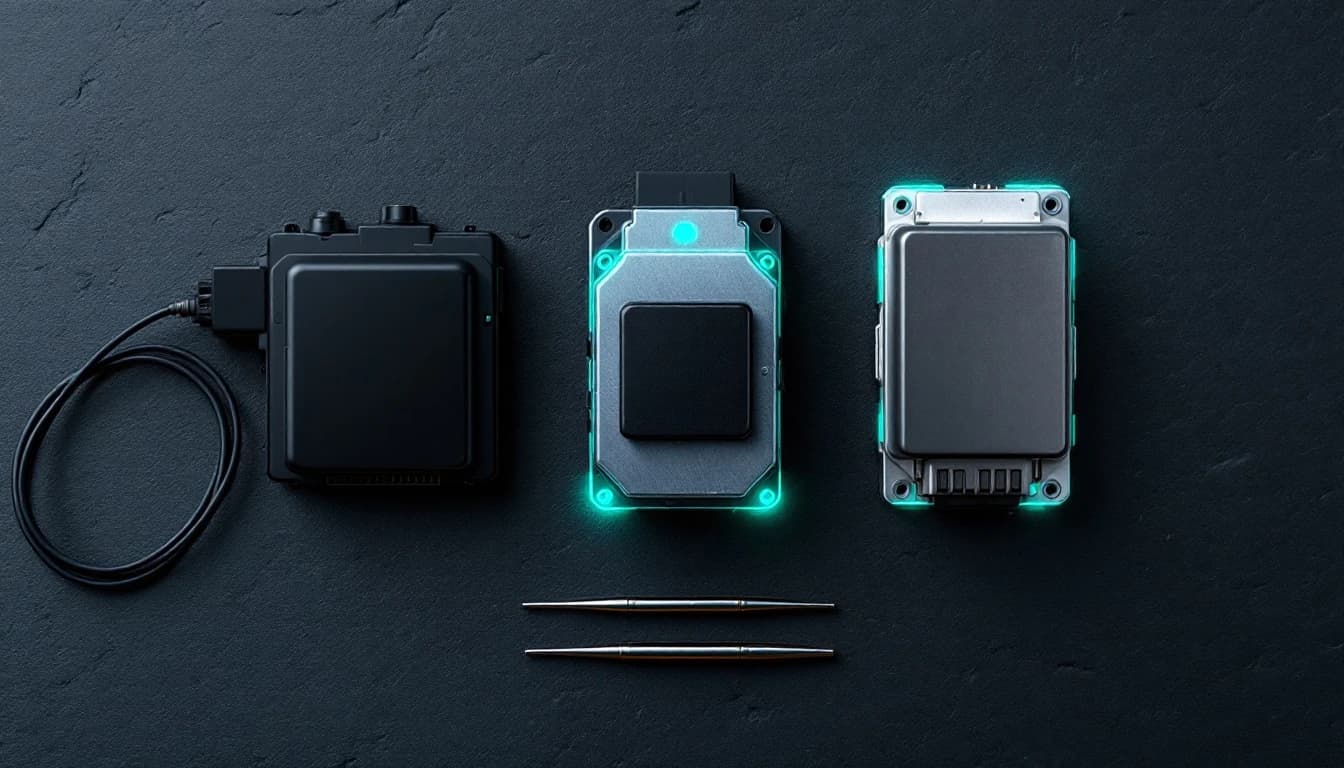
Maserati Module Cloning Cost - Mail-In Bench (2026)
What Maserati module cloning costs
Bench cloning a Maserati module by mail is $350 — the same price whether it is the engine ECU, the Magneti Marelli Body Computer, or the CFC electro-actuated gearbox TCU. Removing the immobilizer requirement from a Bosch ME7 engine ECU is a separate service at $500. You supply a part-number-matched donor unit for clone work, and a technician verifies the match against your VIN and module label before anything ships either direction.
As of September 2026, those are the live catalog prices for these four services. Return shipping is chosen at checkout and paid by you, from $29.95. Turnaround is confirmed once we have the module in hand and can see the part number and board revision, because a Bosch ME7 unit from a 2006 Quattroporte and a modern Bosch controller out of a Levante are not the same job.
This is module work, not key replacement
Before going further, it is worth drawing a hard line, because these two jobs get confused constantly and the confusion costs people money.
Key replacement is about getting a new transponder key or proximity fob to work in a car that is otherwise healthy. On a Maserati that work centers on the Body Computer, which holds the key data. If that is what you are dealing with — a lost key, all keys lost, or a spare that needs adding — the Maserati Body Computer key programming guide is the article you actually want, not this one.
Module cloning, which is what this article prices, is about a failed control unit. Your engine ECU has died, or your Body Computer has gone unresponsive, or the gearbox TCU no longer talks. You have sourced (or plan to source) a replacement unit from a donor car, and you need that donor to take on your car's identity so it works in your vehicle instead of somebody else's.
Same brand, same tooling in some cases, completely different jobs. If you buy the wrong one you will have paid for a service that does not address your fault.
The four services and what they cost
| Service | Mail-in bench price |
|---|---|
| Maserati engine ECU clone | $350 |
| Maserati BCM / Body Computer clone | $350 |
| Maserati CFC gearbox TCU clone | $350 |
| Maserati ECU immobilizer-off | $500 |
That is the entire price list for this lane. There is no diagnostic fee buried underneath and no per-module surcharge for a harder part number. What varies is whether your job is a clone at all, which the next few sections walk through.
Why a used Maserati module does not just drop in
This is the single fact that sends most people to this page, usually after the fact.
Modern Maseratis, like every other manufacturer's cars built since the late 1990s, tie their major control units together with a security relationship. The engine ECU is married to the Body Computer through the VIN and a shared security handshake. When you switch the ignition on, the Body Computer confirms that a valid key is present and then confirms that the engine ECU it is talking to is the one that belongs to this car. Only if both checks pass does the engine ECU get permission to fuel and spark.
Drop in a used engine ECU from a different Quattroporte and you have satisfied none of that. The starter turns, the engine cranks, and it never fires. That is not a fault in the donor unit. That is the immobilizer doing precisely the job it was designed to do.
These interlocks exist for a real reason. The National Insurance Crime Bureau continues to report well over 1 million vehicle thefts in the United States in recent years, and the Insurance Institute for Highway Safety has long credited electronic engine immobilizers with meaningful reductions in theft rates on the models that adopted them early. Federal theft-protection requirements administered by NHTSA, which oversees a national fleet of more than 280 million registered vehicles, pushed the industry the same direction. The unavoidable consequence is that a legitimate repair in 2026 is a data job as much as a hardware job.
"The call I get most often is from a shop that already bought the used ECU. The part number is right, the connectors are right, and the car still will not fire, and nobody warned them the engine computer is married to the Body Computer. Cloning is the cheap end of that mistake. A dead original is the expensive end." — Independent European marque specialist, 18+ years (anonymized)
If you want the underlying mechanics rather than the Maserati-specific version, our guide to how ECU cloning actually works covers the EEPROM and immobilizer data side in general terms, and why a plug-and-play used ECU swap fails covers the failure mode above across brands.
Engine ECU cloning — $350
The Maserati engine ECU clone service covers the Bosch ME7 and ME9 families and the Ferrari-derived F136 V8 controllers. In practical terms that spans:
- Quattroporte M139 with the 4.2L V8
- GranTurismo and GranCabrio on the F136 4.2L and 4.7L
- Ghibli, Quattroporte and Levante on later Bosch ME9 and modern Bosch controllers
The work itself is a data transfer. Your original ECU is read on the bench, and the identity and immobilizer relationship it carries is written onto the donor you supply. Critically, cloning preserves the immobilizer. Nothing about the car's security is removed or weakened. The donor simply stops being a stranger and starts being your ECU, so your existing keys and your existing Body Computer carry on exactly as before.
That is the outcome most owners actually want. The car goes back to stock behavior, the anti-theft system is intact, and there is no lingering "this car has been modified" footnote hanging over a vehicle that, for a GranTurismo, may well be appreciating. Values on the better F136 cars have been tracked closely by outlets like Hagerty, and preserving a factory-correct security chain is not a trivial consideration on a car like that. It matters more every year, too: the average age of vehicles on American roads now sits above 12 years, as Car and Driver has reported from industry registration data, so keeping an ageing specialist car correct is increasingly the normal case rather than the exception.
Body Computer cloning — $350
The Maserati Body Computer clone service handles the Magneti Marelli Body Computer — the module that carries the immobilizer relationship in the first place.
This is the counterpart problem to the engine ECU. When the Body Computer is the unit that failed, a donor BCM arrives carrying another car's immobilizer data and key set. Fitting it means the car does not recognize your keys, and depending on the model you can also lose body functions that the module drives. Cloning writes your original configuration and security data onto the donor so it becomes your Body Computer.
It is worth being clear about the ordering here, because it trips people up: if the Body Computer is dead and you need keys, those are two pieces of work with a dependency between them. Get the BCM right first, then deal with keys.
CFC gearbox TCU cloning — $350
The Maserati CFC gearbox TCU clone service covers the Cambiocorsa / DuoSelect electro-actuated gearbox transmission control unit.
The CFC system is the automated single-clutch manual fitted to a generation of Maseratis that owners either love or fight with, and its TCU carries adaptation and configuration data specific to your car's hydraulic unit and clutch history. A donor TCU dropped in without that data is not simply "unlearned" — it is carrying a different car's calibration picture. Cloning moves your unit's data across so the replacement starts from your vehicle's own state rather than a stranger's.
Immobilizer-off is a different service — $500
The Maserati ECU immobilizer-off service is deliberately not the same thing as a clone, and it is priced differently at $500 because it is a fundamentally different piece of work.
What it covers: Bosch ME7 engine ECUs, including the 0261208592 family of part numbers, on GranTurismo, GranCabrio and Quattroporte with the M139 and M145 4.2L and 4.7L F136 V8, roughly 2004 through 2018.
What it does: removes the immobilizer requirement from the engine ECU so that the ECU runs without the Body Computer handshake. The engine no longer waits for permission from the car's security system before it will fuel and spark.
That is the exact opposite of what a clone does. A clone preserves the immobilizer; an immobilizer-off removes the requirement for it.
The rules on immobilizer-off, stated plainly
Immobilizer-off is anti-theft-defeat work. Proof of ownership is required, without exception, and it is offered for legitimate cases only:
- Genuine repair, where the immobilizer chain itself has failed and the Body Computer side cannot be restored
- Off-road and competition use
- Engine swaps and standalone builds, where the donor engine's ECU has been separated from its original car
- Orphaned-platform cases, where the original immobilizer hardware no longer exists in any usable form
It is also immobilizer-only. We do not touch, remove, or defeat any emissions system, on this service or any other. That boundary is not negotiable and it is not a pricing question. Our proof-of-ownership requirements guide sets out exactly what documentation satisfies the requirement and why the requirement exists.
If your car is a normal registered street Maserati with a working Body Computer, a clone at $350 is almost always the better answer than an immobilizer-off at $500. It is cheaper, it keeps the anti-theft system intact, and it leaves the car factory-correct.
What changes the price
The catalog price is flat, but which service you land in — and whether your job is doable at all — depends on several real variables.
Which module failed. Engine ECU, Body Computer and CFC TCU all clone at $350, so the module itself does not swing the price. It does determine which service you buy, and buying the wrong one wastes a shipping cycle.
Clone versus immobilizer-off. This is the only genuine price difference in the lane, $350 against $500, and it is driven by the nature of the work rather than the hardware. Choosing immobilizer-off when a clone would have done means paying $150 more for a worse outcome on a street car.
Whether your original still reads. This is the big one, and it is binary rather than a sliding scale. A clone is a copy operation. If your original module will not power up on the bench or will not respond to a read, there is nothing to copy, and the clone service simply does not apply. Water ingress, a burned power stage, or physical damage to the memory device can all put a module past the point of being readable.
Donor sourcing and part-number match. The customer supplies the donor, and it must match by part number. A "close enough" unit from a different model year with a different hardware or software revision is not a match. Sourcing a correct donor on a low-volume Italian platform is frequently the slowest part of the whole exercise, and it is entirely outside our control — which is one reason turnaround is confirmed once the modules are in hand rather than promised up front.
Component protection. Some modules carry component protection, a mechanism that binds a module to a specific vehicle beyond the basic immobilizer relationship. Where it is present, it has to be accounted for during the read rather than discovered afterward.
Return shipping. Chosen and paid by you at checkout, from $29.95, with faster tiers available. This is separate from the service price and is never included.
What has to be true before we start
Honest scope, stated up front so nobody ships a module on a false assumption:
- Your original must still power up and respond. A dead or unreadable original cannot be cloned. If your unit is in that state, cloning is off the table and you are into a different conversation about what options remain on that specific platform.
- You supply the donor, matched by part number.
- A technician verifies part numbers by VIN and module label before anything ships. Send photos of the labels. This step exists to stop you paying return freight on a unit that was never going to work.
- Proof of ownership is required for immobilizer-off work, and for any security-related job.
Clone versus a used module — the general case
The Maserati situation is a specific instance of a pattern that runs across every European manufacturer, and the reasoning transfers directly. Our BMW DME clone versus used DME programming guide works through the same fork in detail on a platform where both paths are well documented, and it is worth reading if you want to understand the logic rather than just the price.
The short version: cloning is the right call when your original is readable, because it is simpler, it preserves the security chain, and your keys keep working untouched. The alternative approaches — matching a donor's identity into the car's security system instead — are what you reach for when the original is genuinely gone, and they are not available on every platform.
How the mail-in bench job runs
Every one of these services is nationwide mail-in bench work. There is no vehicle visit at any point.
- Text us your VIN, the module part number, and clear photos of the module label and connectors.
- A technician confirms the service, the coverage, and the donor requirements.
- You order online. Return shipping is chosen at checkout.
- You ship the module — and, for clone work, the donor — to the Arlington workshop.
- The work is done on a regulated bench supply, not in the car. Bench work removes the voltage-sag risk that bricks modules during in-vehicle flashing, which is a large part of why this category of work moved to the bench in the first place. Controller suppliers including Bosch — a group employing roughly 400,000 employees worldwide — along with Continental and Hella, all build units whose reprogramming behavior is voltage-sensitive, and an unstable supply mid-write is how a repairable module becomes scrap.
- The unit is verified and shipped back on your chosen service.
You can see the full catalog of what the bench covers on the services page.
Frequently asked questions
Can a Maserati Body Computer be cloned? Yes. The Magneti Marelli Body Computer is one of the three Maserati modules covered at $350 on the mail-in bench service. Your original configuration and immobilizer data are read and written onto a part-number-matched donor you supply, so the donor becomes your module rather than the one it came out of. Your original has to still power up and respond to be read.
What is the difference between Maserati ECU cloning and immobilizer-off? Cloning preserves the immobilizer and immobilizer-off removes the requirement for it — they are opposite outcomes. A clone at $350 copies your identity and security relationship onto a donor so the car behaves exactly as before, keys included. An immobilizer-off at $500 makes a Bosch ME7 ECU run without the Body Computer handshake, and is intended for repair, off-road, engine-swap, standalone and orphaned-platform cases only.
Do I have to supply the donor module myself? Yes, the customer sources the donor for all three clone services, and it must match by part number. A technician verifies that match against your VIN and the module label before anything ships, which is the step that stops you paying freight on a unit that could never have worked. Sourcing a correct donor is often the slowest part of the job on these platforms.
Can you clone a Maserati module that is completely dead? No. Cloning is a copy operation, so your original has to power up and respond on the bench for there to be anything to read. A module killed by water ingress, a burned power stage, or damage to the memory device may be past the point of being readable, and no price changes that. Send photos and a description first and a technician will tell you honestly where you stand.
Does immobilizer-off require proof of ownership? Yes, always, without exception. Immobilizer-off is anti-theft-defeat work, so proof of ownership is mandatory and the service is offered for legitimate repair, off-road, engine-swap, standalone and orphaned-immobilizer cases only. It is also strictly immobilizer-only — no emissions system is touched, removed or defeated on this or any other service we offer.
Will my keys still work after a Maserati module clone? Yes. Because a clone copies the immobilizer relationship verbatim from your original module, the Body Computer and your existing keys never see a different value and carry on working unchanged. That is one of the main reasons cloning beats other approaches on a street car with a healthy security system — nothing about the car's anti-theft chain is disturbed.
How long does a Maserati module clone take? Turnaround is confirmed once we have the module in hand and can see the part number and board revision, because the work varies across the Bosch ME7, Bosch ME9 and F136 controller families. Rather than quote a number that might not hold for your specific unit, a technician gives you a real timeframe after the intake check. Donor sourcing on your side is frequently the longer pole.
The bottom line
Maserati module cloning is $350 on the bench for the engine ECU, the Body Computer, or the CFC gearbox TCU, and it is the right answer for the large majority of owners because it preserves the immobilizer and leaves your keys working. Immobilizer-off on a Bosch ME7 ECU is $500, it is a genuinely different service with the opposite effect, and it requires proof of ownership because it is anti-theft-defeat work — offered for repair, off-road, engine-swap, standalone and orphaned-platform cases, and never touching emissions.
The one condition that decides everything is whether your original module still reads. If it does, a clone is straightforward. If it does not, be glad you found that out before buying a donor.
All of it is nationwide mail-in bench work, with return shipping chosen and paid by you at checkout from $29.95. Text us your VIN, the module part number, and a photo of the label, and a technician will confirm the coverage and the donor requirements before you spend anything.
Ship it for the maserati engine ecu clone — $350 flat
Fast Turnaround, return speed your choice at checkout. Prepaid inbound label by email the minute you order.