Mercedes SAM Module Failure: Symptoms & Diagnosis
The symptom pattern that points at a SAM
If you are reading this, something on your Mercedes is behaving in a way that does not map to a single component. A turn signal flashes fast on one side with good bulbs fitted. The tail lights work, then do not, then do. The wipers park in the wrong place or sweep when you did not ask. A door lock misbehaves. Occasionally the car will not crank at all. And a scan tool has handed you a fault that names a "SAM control unit" rather than anything you can point at under the hood.
That cluster of unrelated-looking electrical faults is the signature of a SAM module in trouble.
SAM stands for Signal Acquisition and Actuation Module — in German, Signalerfassungs- und Ansteuermodul. Mercedes uses them as intelligent fuse boxes. Rather than running a thick loom from every switch to every lamp, the car puts a module at each end, feeds it power and a data bus, and lets the module do the switching locally. The front SAM lives in or near the engine-bay fuse box; the rear SAM lives in the trunk or cargo area. Depending on model and year, the units are supplied by Temic (now part of Continental) or by Hella, both long-standing tier-one suppliers of body electronics.
Because a SAM drives lighting, wipers, and power distribution, a sick one produces exactly the scattered, "that can't all be related" symptom set described above. It usually is all related.
Why the rear SAM fails, and it is almost always water
Here is the honest ranking of causes, and the order matters more than the list.
1. Water. By a wide margin. The rear SAM sits low — trunk floor, spare wheel well, or behind a side trim panel at cargo-floor height. That is the lowest point water reaches when it gets into the back of the car. It does not need a flood. A steady drip over a season is enough to corrode connector pins and creep into the module.
The water gets in through a small number of well-known routes:
- Tail-light housing seals. The gasket hardens, the housing loosens, and rain runs down the inside of the quarter panel straight into the trunk.
- Blocked trunk-lid or body drains. Every Mercedes trunk area has drains. They clog with leaf litter and road grit, the channel fills, and the water finds the next-lowest exit, which is the inside of your car.
- Blocked sunroof drains. Sunroof water is routed down channels inside the pillars and out near the sills. When those clog, the water backs up and can travel a surprising distance before it surfaces — often at the rear.
- Third brake light and antenna base seals.
- Trunk lid weatherstrip that has flattened with age.
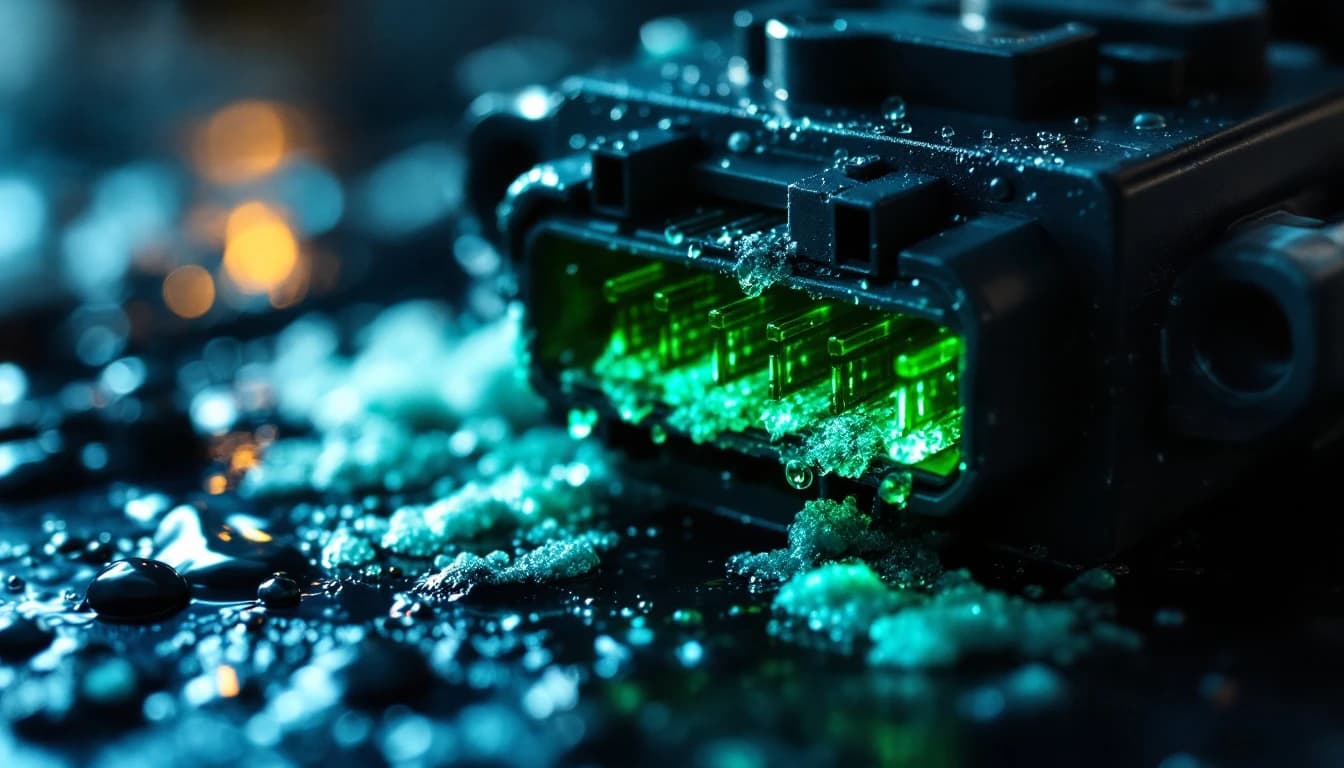
2. Corroded grounds and connector pins. Not the module itself, but the interface to it. Green or white powder on pins, a ground strap that has corroded where it bolts to the body, or a pin that has backed out of its housing. This produces symptoms identical to a failing module while the module is perfectly healthy.
3. Charging-system and voltage problems. Modules that are repeatedly fed bad voltage — an over-charging alternator, a failing ground, jump-start spikes — fail earlier than they should. A healthy charging system holds roughly 13.5 to 14.5 volts at idle with the battery in good condition; excursions above that range are hard on body electronics, and suppliers including Bosch design and validate controllers against defined supply-voltage envelopes rather than whatever the car happens to deliver. If you have already replaced a module once, read our guide on charging-system and ground faults that cause repeat module failure before spending again.
4. Rodent damage. Chewed insulation in the cargo area or under the rear seat can short circuits the SAM drives, and the module takes the blame. Our guide to rodent wiring damage versus module failure covers how to tell them apart.
5. Genuine internal electronic failure with no external cause. It happens. These modules are decades old on some platforms — the average age of vehicles on American roads now sits above 12 years, as outlets like Car and Driver have reported from industry data, and solder joints and electrolytic components do not last forever. But this is the last cause to conclude, not the first.
"Nine out of ten rear SAMs I see are drowned, not dead. And the ones that come back a second time are the ones where somebody fitted a module and never lifted the trunk carpet. If the carpet padding is damp, you have not finished the job — you have just bought yourself a second module." — Independent Mercedes specialist, 20+ years (anonymized)
Symptom-to-cause triage table
| Symptom | What it usually means | How to confirm | Typical path |
|---|---|---|---|
| Damp or wet trunk carpet, musty smell | Active water ingress — the root cause, not a side effect | Lift carpet and padding, check the spare-wheel well; pour water on the tail-light seal and sunroof drains and watch | Find and fix the leak before touching the module |
| Fast-flash turn signal, good bulbs both sides | SAM output stage or a corroded pin, not a bulb | Swap bulb to prove it, then inspect SAM connector pins for corrosion | Clean or repair connector; module work only if pins are clean |
| Tail or marker lights intermittent | Corroded connector or failing SAM output driver | Wiggle test at the connector with lights on; check for green or white residue | Repair connector; clone the module if it is genuinely faulty |
| Wipers park wrong, sweep unbidden | Rear or front SAM logic fault, or a wet module | Confirm which SAM controls wipers on your model, then check for moisture | Dry and inspect first; module work if fault persists dry |
| No-crank with dash lights on | SAM failing to pass a circuit, or a corroded ground | Test the main ground straps; check SAM faults before condemning starter | Ground repair first; module work if grounds are clean |
| Multiple unrelated body faults at once | Classic SAM signature | Scan for stored SAM control unit faults across modules | Inspect module and its environment before ordering parts |
| Faults return weeks after a module swap | Water source never fixed, or a charging fault | Re-check carpet for damp; measure charging voltage | Fix the cause, then address the module |
Diagnostic steps, in the order that saves you money
Step 1 — Lift the carpet before you do anything else. Not the trunk mat, the carpet, and the padding beneath it. Put your hand on the padding. If it is damp, you have found the headline. Check the spare-wheel well, which is where water pools and sits.
Step 2 — Find the water route. Run a hose gently over the tail-light housings and watch inside with the trim off. Pour a cup of water into each sunroof drain channel and confirm it exits at the sill. Clear the trunk-area body drains with a soft trimmer line, never a stiff wire that can puncture the hose. This is unglamorous work and it is the part that actually fixes the car.
Step 3 — Identify which SAM you are dealing with. Front and rear SAMs control different things and are different part numbers. Read the label on the module — part number, supplier, and revision — and photograph it. Which functions have failed is usually the fastest clue: exterior lighting front and headlamp circuits point front, tail lights, trunk, and rear body functions point rear.
Step 4 — Inspect the connectors. Unplug with the battery disconnected and look at every pin under good light. Corrosion shows as green, white, or dull grey deposits. A single corroded pin will reproduce a "failed module" perfectly and costs nothing to find.
Step 5 — Check grounds and charging voltage. Body ground straps corrode where they bolt to sheet metal, especially in salt regions. Measure charging voltage at idle and at speed.
Step 6 — Check whether the module is keeping the car awake. A wet or damaged SAM can fail to enter sleep and flatten the battery overnight, which is a very common secondary complaint. Our parasitic drain diagnosis guide walks through the current-draw test.
Step 7 — Only now conclude the module is dead. If the trunk is dry, the connectors are clean, the grounds are solid, the charging voltage is right, and the faults persist, the module itself is the problem.
Why a junkyard SAM usually does not work
This is the trap that catches most people at exactly the moment they think they are nearly done.
A brand-new SAM has to be coded to the car before it functions correctly, because it arrives blank and knows nothing about your vehicle's equipment list. That coding is dealer-level work.
A used SAM out of a donor car is worse in a specific way: it is not blank. It carries the donor car's identity and configuration. Bolt it in and it is still, as far as it is concerned, working for a different vehicle. It will not simply drop in, and no amount of clearing codes changes that. This is the same principle that defeats used-ECU swaps generally, covered in why a plug-and-play used ECU swap fails.
The Volvo CEM is the same idea from another manufacturer — a central body module that carries the car's identity, which is why a donor CEM has to be dealt with as a data problem rather than a parts problem. Our Volvo CEM programming and clone guide covers that platform if you are comparing approaches across brands.
Vehicle security and configuration binding of this kind is not arbitrary. Standards work through bodies such as SAE International, which convenes more than 100,000 engineering professionals, and federal safety and anti-theft requirements administered by NHTSA — which oversees a national fleet of well over 280 million registered vehicles — pushed manufacturers toward tightly bound, configuration-aware modules. The side effect is that legitimate repairs became data work.
The fix when the module genuinely is dead
The bench answer is a data clone. The Mercedes SAM module clone service is $350.
What that means concretely: your original SAM's coding, configuration and stored data are read on the bench and written onto a used donor SAM that you supply, matched by part number. The donor stops being the donor car's module and becomes yours, so it is plug-and-play when you fit it. Your car's equipment list, options and configuration come across intact.
Two clarifications that matter:
- This is not on-car SCN coding. It is a bench data transfer between two physical modules. If what you actually need is online coding of a new unit, that is a different process — our SCN coding explained guide covers the distinction.
- Some SAMs carry component protection, a binding mechanism that ties a module to a specific vehicle. Where it is present, it is accounted for during the read rather than discovered afterward.
The customer sources the matching donor. A technician verifies part-number compatibility against your VIN and the module label before anything ships — that check exists specifically to stop you paying freight on a unit that was never going to work. Turnaround is confirmed once we have the module in hand and can see the part number and revision.
If you want the wider picture of which Mercedes modules can and cannot be handled this way, see which Mercedes modules can be cloned, or browse the full services catalog.
Realistic cost expectations
It helps to see the whole ladder rather than just the part price, because the cheapest rungs are the ones most likely to actually fix your car.
Fixing the water source is frequently the least expensive thing on this list and sometimes costs nothing but an afternoon — clearing drains, reseating a tail-light housing, replacing a hardened gasket. It is also the rung nobody wants to stand on, because it does not feel like progress. It is.
Connector and ground repair is labour, not parts. A corroded pin cleaned or a ground strap replaced can resolve the entire symptom set.
Drying the car out properly matters and is often skipped. Soaked padding holds moisture for months and will keep corroding whatever you fit.
Bench cloning the module is $350, plus return shipping chosen and paid by you at checkout, from $29.95. You also bear the cost of sourcing the donor unit.
A new dealer SAM plus coding is the most expensive route by a clear margin, which is precisely why the clone path exists.
The economic point is simple: on a car with real value — and values on the better Mercedes platforms are tracked closely by outlets like Hagerty — the difference between correctly diagnosing a blocked drain and reflexively replacing a module twice is substantial.
When to call a professional
Some of this is genuinely DIY. Clearing drains, lifting carpet, checking whether padding is damp, swapping a bulb to prove a fast-flash, and photographing a module label are all reasonable owner tasks.
Call a professional when:
- You cannot find the water route. Leak tracing is a skill, and guessing is expensive.
- Multiple modules are reporting faults. That can point at a bus or supply problem rather than any one module.
- The car will not crank and you are not confident testing grounds and starter supply safely.
- Airbag or restraint faults appear alongside the SAM faults. Restraint systems are not a place to experiment; occupant-protection performance is exactly what organisations like the Insurance Institute for Highway Safety evaluate, and it deserves qualified attention.
- You have already fitted one module and the fault returned. Something upstream is unresolved.
For the module work itself, you do not need anyone local. This is nationwide mail-in bench service — you remove the module, ship it with your donor, and it comes back ready to fit. Text us the VIN, the part number and a photo of the label, and a technician will confirm coverage and donor requirements before you buy anything.
Frequently asked questions
What are the most common Mercedes SAM module failure symptoms? The classic pattern is several unrelated-looking electrical faults at once: turn signals flashing fast with good bulbs, tail or marker lights dropping in and out, wipers parking wrong or sweeping unbidden, occasionally a no-crank, and stored faults naming a SAM control unit. Because the module drives lighting, wipers and power distribution, one sick unit produces symptoms across systems that seem unconnected.
Where is the rear SAM module located on a Mercedes? The rear SAM sits low in the trunk or cargo floor area — commonly in the spare-wheel well or behind a side trim panel at cargo-floor height. That low position is exactly why it is a classic water-damage failure point, because it is the first electronic component that water reaching the back of the car will find. Lift the trunk carpet and padding to inspect it.
Can water damage cause SAM module failure? Yes, and it is by far the most common cause. A leaking tail-light seal, a blocked sunroof drain, or a plugged trunk drain will put water straight onto the rear SAM and its connectors, corroding pins and eventually the module itself. This is why the water source has to be found and fixed first — a replacement fitted into a still-damp trunk will fail the same way.
Why will a used SAM module from a scrapyard not work in my car? Because a used SAM still carries the donor car's identity and configuration rather than yours, so it is not a straight bolt-in swap. A brand-new module is blank and has to be coded to your vehicle, while a used one is configured for somebody else's. The bench answer is a data clone that writes your original module's coding and configuration onto the donor so it becomes yours.
How much does a Mercedes SAM module clone cost? The mail-in bench clone service is $350, plus return shipping chosen and paid by you at checkout, from $29.95. You supply the used donor module matched by part number, and a technician verifies part-number compatibility against your VIN and the module label before anything ships. That verification step exists to prevent wasted freight on an incompatible unit.
Is SAM cloning the same as SCN coding? No. SCN coding is an online, on-car process that configures a module in the vehicle, whereas a SAM clone is a bench data transfer between two physical modules — your original and the donor you supply. The clone copies your coding, configuration and stored data across so the donor behaves as your module did, without needing the car present at any point.
How do I know whether my front or rear SAM has failed? Work backwards from which functions stopped: failures in headlamp circuits and front body functions point to the front SAM, while tail lights, trunk and rear body functions point to the rear SAM. They are different part numbers and are not interchangeable. Confirm by reading the label on the module itself and by checking which control unit the stored faults actually name.
The bottom line
A Mercedes SAM module fault announces itself through scattered lighting, wiper and power-distribution symptoms, and on the rear unit the cause is water far more often than electronics. Find the leak first. Lift the carpet, check the padding, clear the drains, reseal the tail lights, and inspect the connector pins and grounds. A cloned module dropped into a wet trunk will die exactly like the one before it.
When the trunk is dry, the pins are clean, the grounds and charging voltage check out, and the faults persist, the module really has failed. At that point a junkyard unit will not simply drop in, because it still carries the donor car's identity. The bench fix is a $350 data clone onto a donor you supply, matched by part number and verified against your VIN before anything ships — nationwide mail-in, with return shipping chosen and paid by you at checkout from $29.95.
Text us the VIN, the part number and a photo of the module label, and a technician will tell you honestly whether cloning is the right answer for your car.
Ship it for the mercedes sam module clone — $350 flat
Fast Turnaround, return speed your choice at checkout. Prepaid inbound label by email the minute you order.