Parasitic Drain: When a Module Will Not Go to Sleep
The symptom, stated precisely
The car sits for two or three days and will not crank. Jump it, drive it, and it is fine — for another two or three days. A parts store tests the battery and it passes, or you replace the battery and the same thing happens six weeks later. Nobody left a light on.
That is a parasitic drain, and in a vehicle built in the last fifteen years the most likely cause is not a shorted wire. It is a control module that should have powered down and did not.
This matters commercially as well as technically, because the wrong conclusion here is expensive in a specific way: people identify a suspect module, pull it out, and mail it somewhere to be repaired, when the module was never faulty. It was being held awake by something else. Half of this article is about the diagnosis; the other half is about telling those two categories apart before you spend money shipping metal.
What normal sleep actually looks like
A modern vehicle does not switch off. It powers down in a sequence, and understanding that sequence is the whole diagnostic.
When you shut the ignition off and take the key or fob away, the networks stay awake deliberately. Modules finish writing learned data to memory. The body module keeps watching door, hood and trunk switches. The keyless entry receiver keeps listening for a fob. Telematics units may hold a cellular connection open for a while. Infotainment finishes storing state. Only when every participant on a bus has released its wake request does the bus itself shut down, and only then does current fall to its true resting value.
Two numbers matter.
The timeout. Depending on platform, the full shutdown can complete in a couple of minutes or take the better part of an hour, and on some vehicles the last stage — telematics or a stored-data write — happens even later. Manufacturer service literature typically instructs the technician to wait for a stated interval before taking any measurement, and it is not unusual for that instruction to specify tens of minutes — the technical service information portals published by makers such as General Motors and Ford each state model-specific wait times, and they do not agree with one another. If you clamp a meter on the battery cable, see 600 milliamps, and declare a fault, you have measured a car that is still awake.
The resting current. Once asleep, a healthy modern vehicle typically settles somewhere in the region of roughly 20 to 50 milliamps, with higher figures normal on vehicles carrying telematics, alarm systems, or several always-on comfort modules. The engineering literature published through SAE International on vehicle electrical architecture and quiescent-current budgeting reflects the same order of magnitude, and manufacturers publish their own per-model specifications — always prefer the specific figure for your vehicle over a rule of thumb.
The arithmetic that follows from those two numbers explains everything about the symptom. A typical modern battery holds on the order of 60 to 80 amp-hours, and you should not plan on using more than roughly half of that before cranking becomes unreliable in cold weather — an effect Car and Driver and other outlets regularly quantify at well over a 30 percent loss of available cranking capacity near freezing. At 40 milliamps a car will sit for weeks. At 300 milliamps — the sort of figure a single module stuck awake produces — the usable reserve is gone in about four to five days. At an amp, you get a day. That is why the classic complaint is not "the battery is dead" but "the battery is dead if I leave it over a long weekend."
One more thing about batteries before we move on. Battery and charging failures consistently rank among the most-reported problem areas in the vehicle dependability studies published by J.D. Power, and owner reliability surveys from Consumer Reports list battery and electrical trouble among the most common problems reported across model years. A repeatedly flattened battery is also a battery being destroyed: deep cycling an automotive starting battery shortens its life sharply, so a drain that goes undiagnosed for months typically claims two or three batteries on its way. If your last replacement also involved a battery management system, our guide to battery replacement, registration and coding covers the registration step that a surprising number of drain complaints trace back to.
Step one: let the car go to sleep, and prove that it did
Every reliable parasitic-drain diagnosis starts the same way, and skipping the boring part is why most of them fail.
Set the car up honestly. Close every door, the hood and the trunk. Where a latch has to stay open for access, hold the switch closed with a screwdriver or magnet rather than leaving the door ajar, because an open door is a legitimate wake request and you will spend an hour chasing your own test setup. Turn off any accessory that has a switch. Leave the key or fob well away from the vehicle — several platforms will keep the receiver alive if a fob is sitting on the seat or in your pocket next to the car.
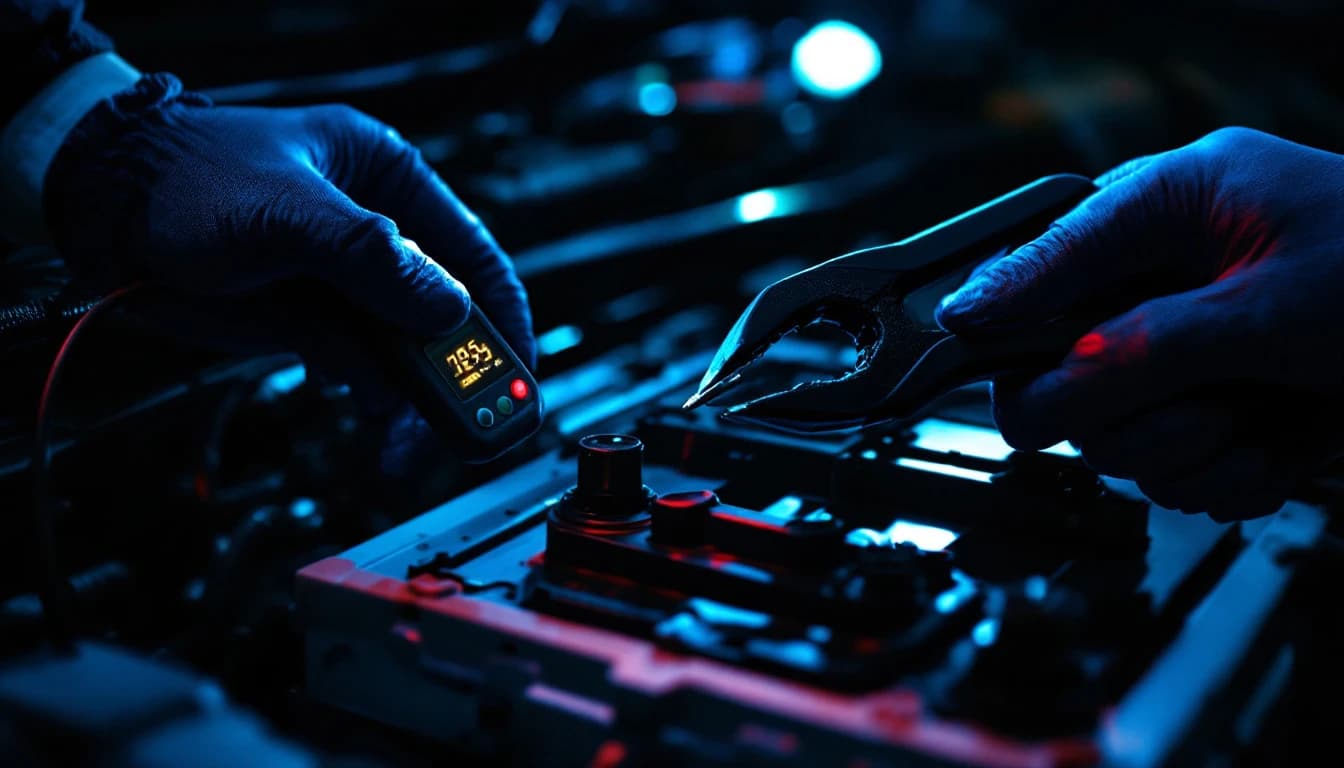
Connect without breaking the circuit. This is where the low-current clamp earns its keep. A DC clamp meter with milliamp resolution goes around the negative battery cable and reads current without disconnecting anything, which matters because disconnecting the battery restarts the entire wake sequence and forces you to wait out the timeout again. If you are using an in-line ammeter instead, fit it with a bypass switch across the meter so the car never loses power while you are connecting.
Then wait, and watch it fall. Do not take a number. Watch the trend. A healthy car steps down in stages as each bus drops out, and the final step is unmistakable — the reading drops and stays flat. If you never see that final step, you have found your fault before you have found the circuit: something is holding the network up.
Confirm the car really is asleep. A scan tool that still enumerates modules half an hour after shutdown is telling you the bus is alive. On many platforms you can watch bus activity directly, and a bus that never quiets down is a stronger diagnostic clue than any single current reading.
Step two: find the circuit
Once the vehicle is genuinely asleep and the current is genuinely too high, you are looking for which circuit the extra current is flowing through.
The fuse-drop method is still the best first pass. Instead of pulling fuses — which wakes things up and resets your timeout — measure the millivolt drop across each fuse in place. A fuse is a known small resistance, so current through it produces a tiny but measurable voltage across its test points. Most drains large enough to flatten a battery in days produce a readable drop. Work through the interior, engine-bay and any auxiliary fuse boxes systematically and write the numbers down. The circuit with an unexpected drop is your branch.
If you must pull fuses, accept the cost. Pulling a fuse can wake the module behind it, and reinserting it certainly will. If you go this route, pull one fuse, wait for the current to settle again, record, replace, and wait again. It works and it is slow. On a car with a long shutdown timeout it can consume an entire afternoon, which is exactly why the millivolt-drop method exists.
Then narrow within the branch. A fuse usually feeds more than one thing. Once you have the circuit, disconnect loads on it one at a time — again watching for the current to settle — until the reading drops to normal.
Waking the bus deliberately is the sharpest tool you have. Here is the trick most people never learn. With the car asleep and the meter watching, trigger a wake event — press a door handle, unlock with the fob, open and reclose a door — and watch the current step up and then step back down. Time how long each stage takes. A module that consistently fails to release after a wake event is your candidate, and you can often provoke it repeatedly to confirm. On platforms where a scan tool can show you which module is holding the wake request, the answer arrives in minutes rather than hours.
Read the network codes too. Lost-communication and bus-off codes stored alongside a drain complaint are not a coincidence — a module stuck in a communication error state frequently refuses to sleep, because from its point of view the shutdown handshake never completed. Our guide to U0100 and U0140 lost communication codes explains why those codes name a symptom rather than a culprit, which is doubly true when a drain is involved.
Finally, check whether the manufacturer already knows. Before spending a day on a car, search the complaint and recall records at the National Highway Traffic Safety Administration for your year, make and model. Known module-sleep problems tend to leave a trail there and in service bulletins, and a documented pattern failure will save you the whole diagnostic.
The usual suspects, and what each one actually means
Certain modules turn up again and again in drain complaints. Knowing which ones are typically a module fault and which are typically something else is the point of this section.
Body control module. The BCM is the central switchboard for lighting, locks, chimes, wipers and switch inputs, and it is a frequent drain suspect for a reason: it has more inputs than anything else, and any one of those inputs can look like a legitimate reason to stay awake. A BCM that is genuinely faulty internally — a failed regulator, a damaged output driver, corrupted memory after a voltage event — will hold current up on its own. But a BCM held awake by a sticking door-jamb switch, a shorted courtesy-lamp circuit or a water-damaged switch pack is not faulty at all. It is doing its job with bad information.
Radio and infotainment head unit. Head units are power-hungry and they hold a lot of state, so they sit at the end of the shutdown sequence and are among the most commonly identified drains. Aftermarket installations are heavily over-represented here, usually because of an accessory feed wired to a constant-hot circuit instead of a switched one.
Telematics and connected-services module. These are designed to wake periodically, which makes them uniquely confusing: a telematics unit drawing current at three in the morning may be behaving exactly as intended. A unit that never releases, or that retries a cellular connection continuously because of a failed antenna path, is a genuine fault.
Keyless entry and RKE receiver. A receiver that stays in a high-current listen state instead of dropping to its low-power duty cycle is a classic module-side drain, and it is one of the cases where a board-level repair genuinely solves the problem. The failure modes are ordinary — a bad voltage regulator, a failed receiver IC, EEPROM corruption after a voltage surge. Symptoms usually include intermittent remote operation alongside the drain. We covered the diagnostic separately in the write-up on keyless entry receiver module failure, and the associated bench work is our keyless entry / RKE module repair at $125 with a typical 24-hour turnaround once it arrives.
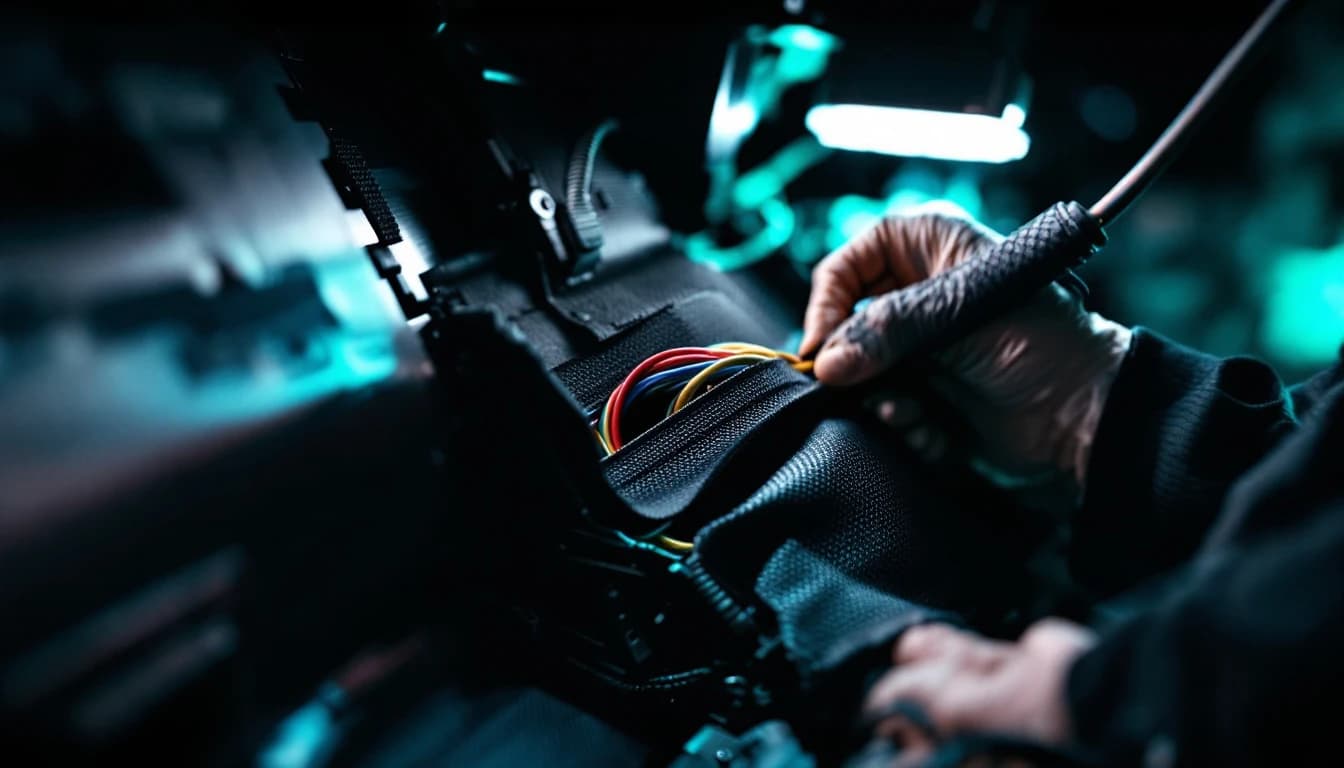
Door modules. Each door on many platforms has its own module, and a door module with a corroded connector in the harness boot between the door and the body is one of the most common real-world drains on the road. The connector flexes every time the door opens. The failure is mechanical, in a place nobody looks.
Gateway and network modules. A gateway that cannot complete the shutdown handshake will keep whole buses alive. That is a network problem more than a power problem, and it usually comes with a scan-tool picture that looks wrong in other ways too.
Aftermarket accessories. Alarms, remote starters, dash cameras with parking mode, trackers, amplifiers, lightbars and trailer controllers. If any of these were fitted before the problem began, look there first regardless of what else you suspect. Two common patterns: a device wired to constant power that never sleeps, and — worse — a device spliced into a vehicle bus that keeps sending frames and therefore keeps the entire network awake. On the consumer-rights side, fitting an aftermarket accessory does not automatically void a vehicle warranty; the Federal Trade Commission has published guidance on warranty rights and aftermarket parts under the Magnuson-Moss Warranty Act, though a device that actually causes damage is a different matter.
Charging system and grounds. Not a drain at all, but it presents like one. A failed diode in an alternator can leak current back, and a corroded ground can produce a phantom drain reading. Our article on charging system and ground faults behind repeat module failures covers why these get misdiagnosed so often.
The honest split: what a bench repair fixes and what it does not
This is the table that should stop somebody from mailing a healthy module.
| Finding | Real cause | Does mailing the module fix it? |
|---|---|---|
| RKE receiver stuck in high-current listen, remotes intermittent | Module-internal: regulator, receiver IC, EEPROM corruption | Yes — board-level repair is the correct fix |
| Module drawing high current with connector unplugged from the rest of the harness | Module-internal short or failed driver | Yes — bench repair or programmed replacement |
| BCM awake because a door-jamb or hood switch reads closed-open | Switch, harness, corrosion | No — repair the switch circuit in the vehicle |
| Drain follows the door, gets worse with the door open and closed repeatedly | Chafed harness in the door boot | No — harness repair, in the vehicle |
| Whole network never sleeps, multiple modules awake | Bus fault, gateway handshake, or a device spliced to the bus | No — network diagnosis first |
| Drain started after an alarm, remote start, tracker or dash cam was fitted | Aftermarket accessory wiring | No — correct or remove the accessory |
| Alternator leaks current back with the engine off | Failed diode in the rectifier | No — charging system repair |
| Module bricked or memory corrupted after a jump-start or voltage event | Module-internal damage | Often yes — evaluate on the bench |
Read the middle column, not the first one. The symptom is nearly identical across every row; the cause is not. This is the reason the single most useful thing you can do before shipping anything is to isolate the suspect module from the rest of the harness and see whether it still draws current on its own. If it does not, the module is innocent.
"Most of the drain modules that land on my bench test perfectly. The car killed batteries because a door harness was chafed or somebody spliced a tracker into the bus, and the module was just the last thing on the list somebody could unbolt. I would rather talk a customer out of shipping a good part than take the money for testing it." — Independent automotive electrical diagnostician, 20+ years, anonymized
Our guide to working out which module actually failed before you ship it walks the same logic across other symptom classes, and what a bench evaluation finds that a scan tool cannot explains what board-level inspection adds once a module genuinely is the suspect.
Special cases worth knowing
The car that only drains sometimes. Intermittent drains are usually a wake event happening when it should not — a marginal door switch closing as the vehicle cools, a proximity sensor triggering, a fob left within range. Data-logging over several nights is the only reliable way to catch these.
The car that drains only when cold, or only when hot. Thermal behaviour points at a physical fault: a cracked solder joint that opens as the board contracts, corrosion that conducts better when damp, a connector that loses tension at temperature. These are genuinely module- or connector-side, and they are the drains most likely to benefit from a bench repair.
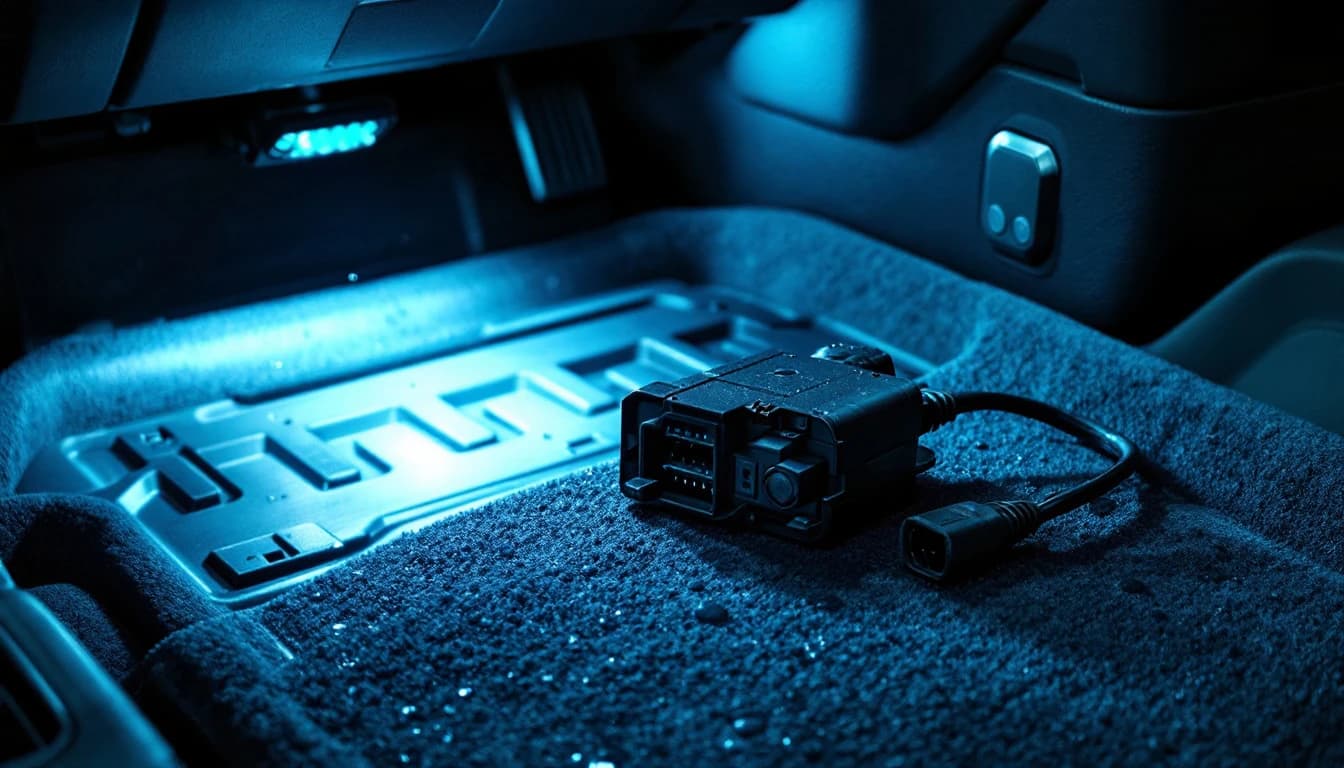
The car that started draining after body or glass work. Water intrusion is the single most under-reported cause of module drain. Windshield replacements, sunroof drains and blocked cowl drains put water into places that hold modules, and a wet connector conducts a small, steady current forever. Check the carpet under the passenger footwell before you buy anything.
The car that started draining after rodent activity. Chewed insulation produces exactly this symptom, and it is visible if you look. We covered the differential in rodent-chewed wiring versus module failure.
The vehicle that sits for weeks by design. A collector car, a fleet spare or a seasonal vehicle with 30 to 50 milliamps of perfectly normal quiescent draw will still be flat after a month. That is not a fault. That is arithmetic, and the fix is a maintainer, not a diagnosis.
If the module really is the problem
Once isolation shows the module drawing current on its own, the options are repair, clone, or a programmed replacement — and which one applies depends on what data lives inside it.
For a receiver or comfort module holding no vehicle identity, a board-level repair is usually the cleanest answer. For a body control module, the identity matters: VIN, mileage, theft-system data and option coding all live inside, which is why a used donor cannot simply be bolted in. On GM vehicles that is handled either by cloning your original onto a matching donor, or by a supply-a-part GM BCM programmed to your VIN at $349, where you send nothing and the module arrives configured to your build. Where a module is unfamiliar or the fault is unclear, our bench evaluation and custom job service at $150 covers diagnosis, board photography and an honest quote — credited toward the repair if you proceed, with $95 refunded if the unit turns out to be unrepairable.
Any work that touches immobilizer, keyless-entry or anti-theft data requires proof of ownership before it starts. That applies to keyless-entry receivers and body modules as much as it does to keys, and it is not something we waive.
Everything is mail-in and nationwide. Ship USPS to PO Box 120241, Arlington, TX 76012, or use 1009 Oakwood Ln # 120241, Arlington, TX 76012 for UPS and FedEx, which cannot deliver to a USPS PO Box. Work is done at our Arlington bench. Return shipping starts at $29.95 for standard service with faster tiers available, chosen at checkout. Before you ship, text us the VIN, the module part number from the label, and — most usefully — the actual current readings you measured and how you isolated the module. That last detail is what tells us whether we are the right stop.
Frequently asked questions
How much parasitic draw is normal on a modern car? Most vehicles settle somewhere around 20 to 50 milliamps once fully asleep, with higher figures normal on cars carrying telematics, alarms or several always-on comfort modules. Always check the specification for your model rather than trusting a general figure. The critical point is that the number is only meaningful after the full shutdown sequence has completed, which on some platforms takes tens of minutes.
How long do I have to wait before measuring? Long enough for every module to release its wake request, which ranges from a few minutes to well over an hour depending on platform, and occasionally longer where a telematics unit is involved. Rather than trusting a fixed number, watch the current fall in steps and take your reading only after it flattens out. A measurement taken during shutdown will always look like a fault.
Will replacing the battery fix a parasitic drain? No. A new battery lasts longer before it goes flat, which delays the complaint by a few weeks and hides the real fault. Worse, repeated deep discharge shortens a starting battery's life sharply, so an undiagnosed drain typically destroys two or three batteries before anyone finds it.
Which module drains a battery most often? In practice the body control module, the radio or infotainment head unit, the keyless-entry receiver, telematics units and door modules turn up most frequently, along with any aftermarket accessory wired to constant power. But frequency is not diagnosis — a body module held awake by a failing door switch looks identical to a failed body module and needs a completely different repair.
Should I just ship the module I suspect? Only after you have isolated it and confirmed it still draws current with its connector separated from the rest of the harness. If the drain disappears when the module is unplugged but the module itself draws nothing on the bench, the fault is in the wiring or in something else on that circuit, and no repair to the module will help.
Can a bad ground or a bad alternator cause this? Yes, and both are frequently misread as a module drain. A leaking diode in the alternator rectifier can pass current back with the engine off, and a corroded ground can produce misleading current readings. Check the charging system and the main grounds before condemning any control module.
Does an aftermarket alarm or dash cam really keep the whole car awake? It can. A device wired to constant power draws current forever by design, and a device spliced into a vehicle data bus can keep the entire network from shutting down by continuing to send frames. If the drain began after an accessory was fitted, that accessory is the first thing to disconnect and retest.
The bottom line
A car that flattens a battery every few days is telling you that something never went to sleep. The diagnosis is not difficult, but it is unforgiving of shortcuts: let the vehicle complete its shutdown sequence, watch the current fall in steps rather than taking a single reading, use millivolt drop across fuses so you do not restart the timeout, and then provoke wake events while you watch the current so the offending module names itself.
What matters most is the step after that. Isolate the suspect module and see whether it still draws current on its own. A receiver stuck in listen mode, a module with a failed regulator, a board damaged by a jump-start — those are real module faults, and a bench repair or a programmed replacement genuinely fixes them. A chafed door harness, a sticking jamb switch, a wet connector, a leaking alternator diode, a tracker spliced into the bus — those are the majority, and no module we could send back would change anything.
If you have done the isolation and the module is the culprit, text us the VIN, the part number and your measurements and we will tell you whether it is a repair, a clone or a programmed replacement before you ship. If you have not done the isolation yet, do that first. It is the cheapest hour in this entire job.
Ship your module today
Flat-rate pricing, typical 24-hour bench turnaround, return speed your choice at checkout. Most jobs back on your bench within a week.