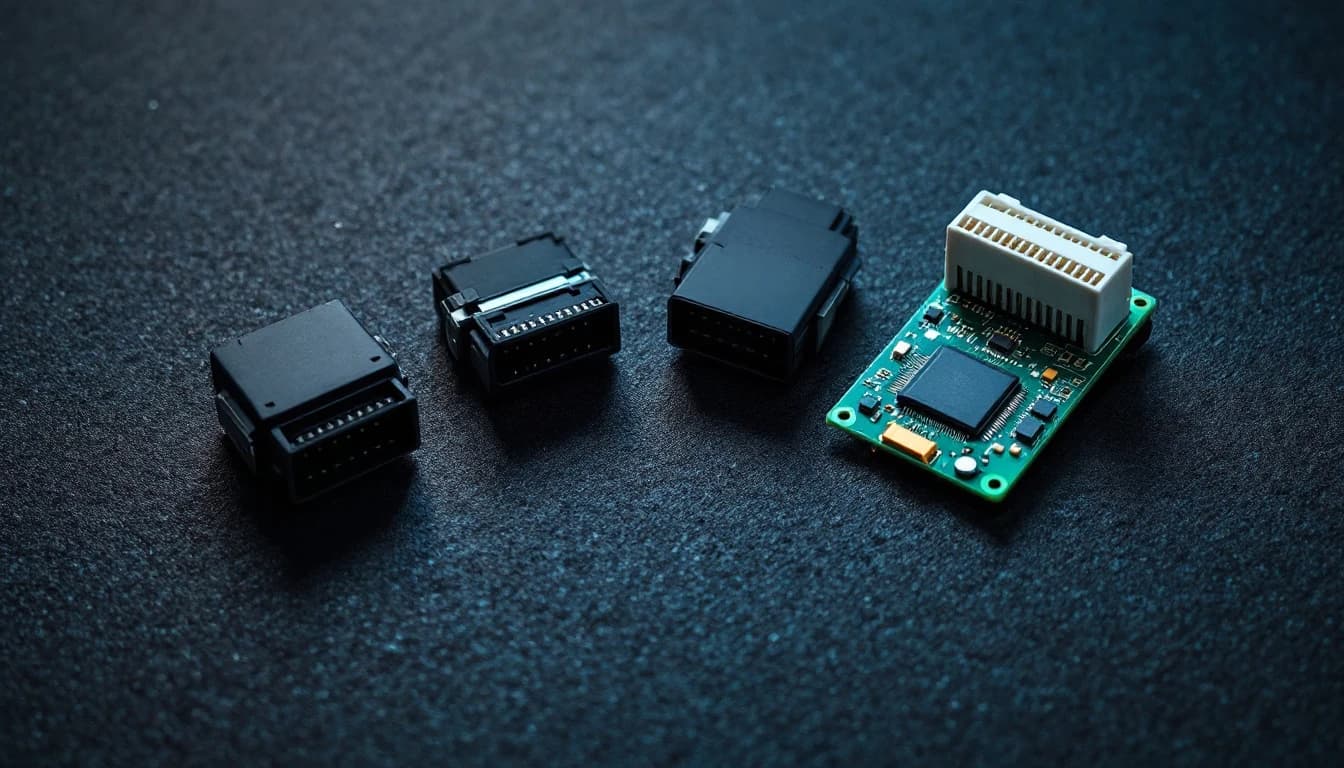
BMW FRM by Chassis: Which Footwell Module Do You Have?
Start here: FRM or FEM/BDC?
Before anything else, settle which module family your car actually uses, because the two are not interchangeable and the repair paths are completely different.
If your BMW is an E-chassis car — roughly 2004 through 2013 — you have an FRM, the Footwell Module. It is a body-electronics controller that runs exterior lighting, turn signals, power windows, mirrors and, on most builds, the wipers.
If your BMW is an F-chassis car — roughly 2011 onward — you do not have an FRM at all. You have a FEM (Front Electronic Module) or BDC (Body Domain Controller), which merged the body-electronics job with the gateway and the immobilizer. A bricked FEM/BDC is a different job with different risks, covered in our BMW FEM/BDC bricked-module recovery guide.
Everything below is about the FRM.
What the FRM controls, and why failure looks catastrophic
The FRM sits low in the driver's footwell area, behind the kick panel near the left A-pillar on left-hand-drive cars. It is not a big module, and it is easy to underestimate what runs through it:
- All exterior lighting — low beam, high beam, side lights, tail lights, brake lights, turn signals, hazards
- Bulb and lighting-fault monitoring, which is why a failing FRM often produces a dashboard full of lighting warnings
- Power windows, including the one-touch up/down and anti-trap logic
- Exterior mirrors — adjustment, fold, and heating on equipped cars
- Wiper control on most builds
- Portions of the central-locking and interior-lighting logic
That list is why FRM failure reads as a whole-car electrical collapse rather than a single dead accessory. One module goes quiet on the bus and the owner loses windows, mirrors, wipers and lights in the same instant.
It also puts the FRM squarely in the middle of a safety system. Federal Motor Vehicle Safety Standard 108, administered by the National Highway Traffic Safety Administration, governs required vehicle lighting equipment — a car whose low beams cannot be commanded on is not roadworthy, whatever else still works. The stakes are not cosmetic: NHTSA has long reported that roughly 50 percent of traffic fatalities occur in dark conditions even though far less driving happens after dark. The Insurance Institute for Highway Safety reinforced how much headlight performance varies when it began publishing headlight ratings in 2016 — in that first round just one of the 31 vehicles tested earned the top "good" grade, with the majority rated marginal or poor.
The version map: FRM1, FRM2, FRM3 and FRM3R
"FRM" is a family, not a part. The distinction that matters most for repair is the microcontroller generation inside, because it determines how — and whether — the module can be read and rewritten on a bench.
Broadly:
- FRM1 / FRM2 — the earlier generations, built around Freescale/Motorola MC9S12 microcontrollers of the DG/DT class. These are comparatively forgiving. They fail, but they do not exhibit the signature self-corruption that made the later generation notorious.
- FRM3 — the generation everyone has heard about, built on the Freescale MC9S12XE family (XEQ384 and XET256 parts are the common ones). This device emulates its EEPROM in a partitioned D-Flash region, and that emulation layer is exactly where the well-known corruption occurs.
- FRM3R — a later hardware revision of the same basic architecture, encountered on the tail end of E-chassis production.
If you want the deeper background on why controller silicon dictates bench access, we wrote it up separately in our guide to module microcontroller families and bench read access.
Which FRM is in which chassis
This is the lookup most owners actually arrive looking for. Treat it as a strong starting point rather than an absolute: BMW changed suppliers and hardware revisions mid-cycle, so late-production cars in a given chassis can carry the next generation up. The label on the module is the final authority.
| BMW chassis | Model | Approx. years | FRM generation usually fitted | Bench-serviceable |
|---|---|---|---|---|
| E81 / E82 / E87 / E88 | 1 Series | 2004–2013 | FRM2 early, FRM3 from roughly 2007 | Yes |
| E90 / E91 / E92 / E93 | 3 Series | 2005–2013 | FRM2 early, FRM3 from roughly 2007 | Yes |
| E60 / E61 | 5 Series | 2007–2010 late builds | FRM2 / FRM3 | Yes |
| E63 / E64 | 6 Series | 2007–2010 | FRM2 / FRM3 | Yes |
| E70 | X5 | 2007–2013 | FRM3 | Yes |
| E71 / E72 | X6 | 2008–2014 | FRM3 | Yes |
| E83 | X3 | late builds | FRM2 | Yes |
| E84 | X1 | 2009–2015 | FRM3 | Yes |
| E89 | Z4 | 2009–2016 | FRM3 | Yes |
| R55 / R56 / R57 | MINI | 2007–2013 | FRM2 / FRM3 | Yes |
| F-chassis (all) | 2011+ BMW | 2011 onward | None — FEM/BDC instead | Different service |
The 1 Series deserves a specific note, because it generates more FRM searches than any other chassis. E87 and E81 hatchbacks and E82/E88 coupes and convertibles from roughly 2007 onward are overwhelmingly FRM3 cars, and they are now old enough that the battery and charging-system conditions that trigger the failure are extremely common. An E87 arriving with dead windows and no lights is close to a textbook case.
Why FRM3 corrupts itself
The FRM3 failure is not random. It has a mechanism, and understanding it is what keeps you from paying for the same failure twice.
The MC9S12XE does not have a separate physical EEPROM. It emulates one inside a partitioned area of flash. Writing to emulated EEPROM is a multi-step operation, and it requires stable supply voltage to complete. If voltage sags below the write threshold part-way through — during a coding session, a firmware update, a battery replacement, or simply a jump start on a car with a tired battery — the write can be left half-finished. The partition ends up in a state the bootloader cannot make sense of, and on the next power-up the module never comes alive. To a scan tool it is simply absent from the bus.
That is why the failure clusters around three moments: a coding or programming attempt, a battery replacement or registration, and the first cold morning when a marginal battery finally sags on crank.
The FRM3 is not a fragile module in normal service. It is fragile in exactly one situation — being written to while the supply voltage is falling — and almost every bricked one I open got there during a coding session or a battery event on a car nobody had load-tested first. — Independent BMW electronics technician, 19+ years (anonymized)
The practical lesson is upstream of the module: fix the electrical system first. A weak battery is not a side issue, it is the cause. We cover the wider pattern in our guides to battery replacement, registration and coding damage and charging-system and ground faults that keep killing modules. Given that industry reporting now puts the average age of a light vehicle on US roads at well over 12 years — a figure Consumer Reports and other outlets have tracked climbing for more than a decade — a large share of E-chassis BMWs are running on batteries and grounds well past their best.
How to confirm it is the FRM before you spend anything
Work in this order. Each step is cheap and each one rules out a more common, less expensive fault.
- Load-test the battery, properly. Not a voltage reading — a load test. A battery that shows 12.4V at rest and collapses under load is the single most common root cause here, and replacing the FRM without fixing it invites a repeat.
- Check grounds and the fuse carrier. Corroded or loose body grounds produce symptom sets that mimic module failure closely. Clean and torque them before condemning anything.
- Try to communicate with the FRM. With a BMW-capable scan tool, attempt to reach the module. A healthy-but-misbehaving FRM answers and reports faults. A bricked FRM3 does not answer at all — no communication, module effectively missing.
- Read the symptom pattern. Simultaneous loss of windows, mirrors, wipers and exterior lighting points hard at the FRM. A single dead window points at a motor, switch or regulator.
- Check for network-wide faults. If you are collecting lost-communication codes across many modules, the problem may be the bus or the power supply rather than one controller — see our U0100/U0140 lost-communication code guide.
If steps one through five land on the FRM, you have a real diagnosis. If you are still unsure, that ambiguity is precisely what a bench evaluation exists to resolve — it costs less than guessing wrong on a module.
What bench service can and cannot do, by generation
Here is the honest scope, which is the part most listings skip.
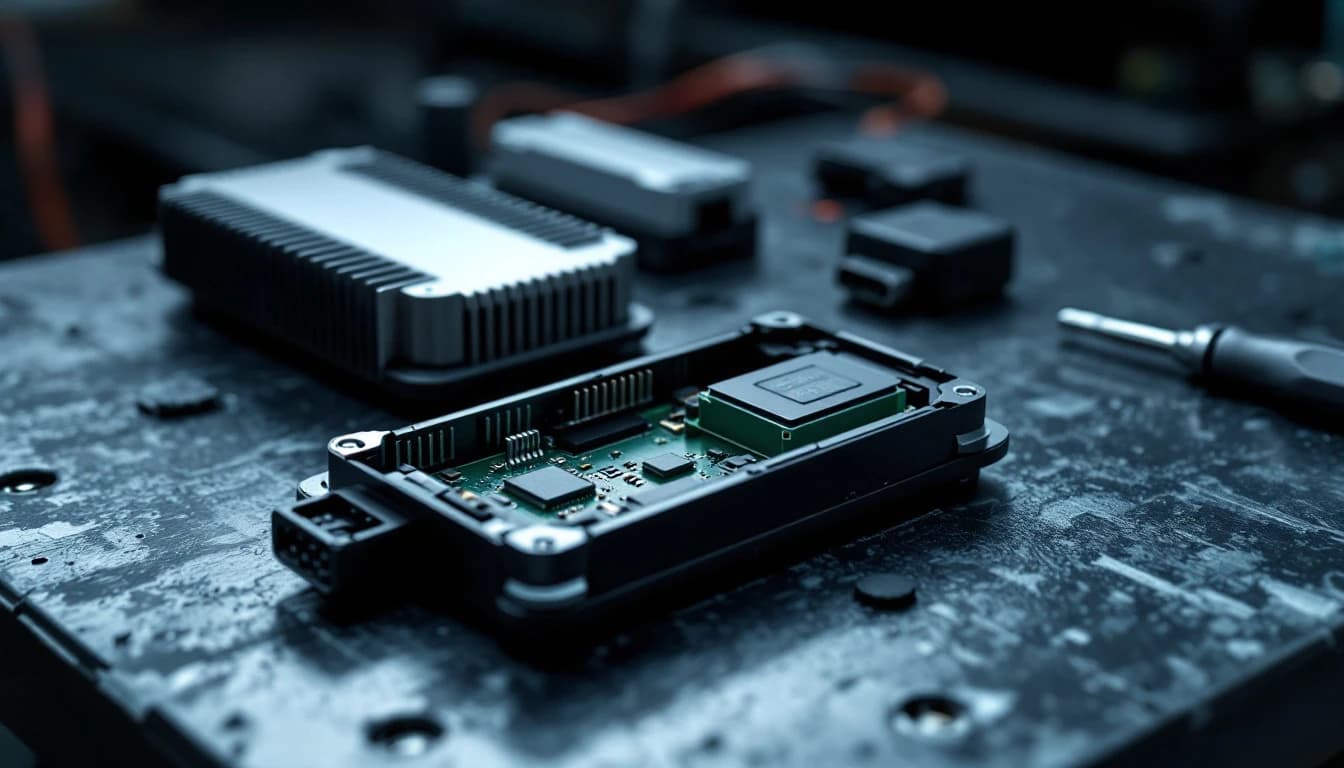
FRM3 and FRM3R bricked by a corrupted D-Flash partition are the ideal case. The microcontroller is reachable through its BDM (Background Debug Mode) interface on the bench, the corrupted region can be repaired, and — critically — the module's own VIN, coding and vehicle-order data are preserved. The module goes back into the same car and behaves as it did before, with no re-coding scramble. That is the outcome you want, and it is why recovering your original module beats sourcing a used one.
FRM1 and FRM2 modules are read and written through the same general bench approach, though the specific failure mode is usually different — these tend to fail from physical causes rather than partition corruption.
Physical damage is a different question. Water ingress, a burned output driver, a blown trace, or corrosion on the board is a board-level repair problem, not a data problem. Sometimes it is fixable and sometimes the module is genuinely finished. We are direct about that boundary in our guide to what is actually repairable at board level. Software recovery does not repair burned silicon, and no honest lab will tell you otherwise.
A used FRM is not plug-and-play. It carries the donor car's VIN and coding, and its equipment configuration has to match yours — xenon versus halogen, folding mirrors, cornering lights, market-specific lighting. Mismatch and you get a fresh set of faults. That is the general trap described in our VIN-locked module explainer and, for the wider BMW picture, in BMW module repair versus replacement by module.
Cost, turnaround and what to send
FRM bench service is $175 flat on the BMW FRM footwell module repair service. Flat means flat — there is no diagnostic surcharge bolted on afterward.
Return shipping is chosen at checkout and is paid by the customer, from $29.95 for standard ground, with two-day and overnight tiers available if the car is blocking a bay. We buy and send you the inbound label so the module reaches us correctly packed and tracked.
Send the FRM only — no wiring harness, no kick panel. Photograph the label before you box it. Anti-static handling matters more than people expect on a module this age; our ESD handling guide and how to remove, package and ship a module cover the mechanics.
Ship to the correct address for your carrier — USPS goes to PO Box 120241, Arlington, TX 76012, while UPS and FedEx cannot deliver to a PO Box and must use 1009 Oakwood Ln # 120241, Arlington, TX 76012. Bench work is performed at the workshop at 1168 W Pioneer Parkway, Arlington, TX 76013.
Because the FRM participates in vehicle security and lighting configuration, proof of ownership is required before we perform the work — a registration or title matching the VIN. That requirement is not negotiable and it protects you as much as it protects us.
When the module goes back in, expect to re-initialize the window one-touch and anti-trap function; that is normal, not a fault. Our post-install relearns and calibrations guide covers what to expect after any mail-in module returns.
Why the numbers favor repair on these cars
The economics here are unusually clear, and they are worth stating plainly.
E-chassis BMWs are now firmly in the used-value band where a dealer-priced electronics repair can approach a meaningful fraction of the car's worth. Valuation services including Kelley Blue Book and J.D. Power show typical 2008–2012 1 Series and 3 Series retail values that make a four-figure module-and-programming bill hard to justify. Meanwhile the enthusiast press — Car and Driver and Hagerty among them — has spent years documenting how electronics complexity, not mechanical wear, increasingly decides whether an older German car stays on the road.
Vehicle electrical architecture is the reason. In-vehicle networking standards developed through SAE International mean a modern car commonly runs 70 or more networked controllers on shared buses, so a single silent module presents as a systemic failure. J.D. Power measures durability in problems per 100 vehicles, and electronics and infotainment categories have persistently ranked among the most-reported problem areas across the industry — a reminder that on a fifteen-year-old car, the module is now a wear item alongside the suspension bushings.
Recovering the original module at a flat bench price, with its coding intact, is simply the cheapest correct answer for most of these cars.
Frequently asked questions
How do I know if I have an FRM2 or an FRM3? Read the label on the module itself — that is the only definitive answer. As a strong rule of thumb, E-chassis BMWs built from roughly 2007 onward carry FRM3, and earlier cars carry FRM2, but BMW changed hardware mid-cycle so late-production cars can carry the newer generation. Photograph the label before you ship and we confirm the generation before any work begins.
My BMW has no lights and the windows are dead. Is that definitely the FRM? That combination is the classic FRM signature, because one module runs exterior lighting, windows, mirrors and wipers. Confirm it by attempting to communicate with the module: a bricked FRM3 does not answer a scan tool at all. Load-test the battery and check the grounds first, since both can produce similar symptoms far more cheaply.
Can a bricked FRM3 be recovered, or do I need a new module? A bricked FRM3 can usually be recovered on the bench, and recovery is the better outcome. The corruption sits in an emulated-EEPROM partition that can be repaired through the microcontroller's debug interface while preserving the module's VIN and coding, so it returns to your car ready to work. A used replacement carries someone else's coding and equipment configuration.
Will a used FRM from a salvage car just work in mine? Usually not. The module stores the donor vehicle's VIN and its equipment coding, so a mismatch in lighting type, mirror options or market specification produces a new set of faults even when the part number matches. Recovering your original module avoids that entire problem, which is why it is our default recommendation.
Why did my FRM fail right after a battery replacement? Because the FRM3 emulates its EEPROM in flash, and completing a write to that region requires stable supply voltage. A voltage sag during a battery change, registration, coding session or jump start can interrupt a write and leave the partition unreadable. Fixing the battery and charging system before reinstalling the module is what prevents a repeat.
Does my F-chassis BMW have an FRM? No. BMW F-chassis cars from roughly 2011 onward use a FEM or BDC instead, which combines body electronics with the gateway and immobilizer functions. Those modules fail differently, carry immobilizer data, and need a different bench procedure, so identifying your chassis correctly is the first step.
How long does FRM bench service take? Bench turnaround is typically one business day once your module arrives, and the total door-to-door time is driven mainly by shipping. Standard return shipping runs three to five business days, with two-day and overnight tiers available at checkout if the car is occupying a bay you need back.
The bottom line
The FRM is one module doing an outsized job — lights, windows, mirrors and wipers — which is why its failure feels like the car's entire electrical system quit at once. Identify the generation before you spend anything: E-chassis cars from roughly 2004 to 2013 have an FRM, F-chassis cars from 2011 onward have a FEM or BDC instead, and within the FRM family the FRM3 built on the MC9S12XE is the one with the well-documented self-corruption mechanism.
That mechanism is the useful part of the diagnosis. FRM3 bricking is a voltage-during-write failure, not bad luck, so the repair is only durable if the battery and charging system get fixed alongside it. Recovering the original module preserves its VIN and coding and puts it back in your car as the part it already was, at $175 flat, with customer-paid return shipping from $29.95 and proof of ownership required.
Photograph your module's label, load-test your battery, and see the BMW FRM footwell module repair service page to confirm fitment — text us the label photo and your VIN and we will tell you which generation you have before anything ships.
Ship it for the bmw frm footwell module repair — $175 flat
Typical 24-Hour Turnaround, return speed your choice at checkout. Prepaid inbound label by email the minute you order.