Chrysler, Dodge & Jeep BCM Failure Symptoms Guide
The short answer: what a bad Chrysler BCM looks like
A failing body control module on a Chrysler, Dodge, Jeep or Ram usually announces itself with several unrelated electrical faults at the same time — interior and exterior lights, power locks, wipers, chimes, the horn — or with a module that stops communicating entirely. A battery that dies overnight because the BCM never goes to sleep is the other classic sign. The catch is that a weak battery, a bad ground, water intrusion or a failing TIPM produces almost identical symptoms.
That catch is the point of this guide. A BCM is an expensive part to buy by mistake, and shipping a healthy one off for repair wastes a week you did not have. The sections below go symptom by symptom, rank the causes honestly, give you a diagnostic order that eliminates the cheap problems first, and explain what the fix costs when the module really is the fault.
If you are not sure what a body control module does in the first place, our guide to what a BCM is covers the basics. This article is strictly about the BCM module on Chrysler group vehicles — not keys, not remotes, and not key programming.
Which vehicles this guide covers
The BCM discussed here is the Chrysler group body control module used across roughly the 2011-2023 range, which is what our Chrysler, Dodge and Jeep BCM clone service covers. That includes Ram 1500 in the DS and DT generations, Dodge Charger, Challenger, Durango and Journey, Jeep Grand Cherokee WK2, Wrangler JK and JL, Compass and Renegade, and the Chrysler 300 and Pacifica, among others. Heavy-duty Ram trucks, the Gladiator and some Town and Country vans share BCM generations with those vehicles, and we verify them by the label.
One family deserves a special mention. On the roughly 2013-2018 Dodge Dart, Chrysler 200 and Jeep Cherokee KL, the BCM and the fuse block are a single integrated assembly. That changes the diagnostic picture, because a fuse-box fault and a BCM fault live in the same physical part.
These vehicles are not young. The average light vehicle on U.S. roads reached a record 12.8 years in 2025, according to S&P Global Mobility, so many of the vehicles in this range are now old enough for corroded connectors, tired batteries and leaking seals to be the real story behind an electrical fault.
The BCM is not the TIPM, the RF hub or the SKIM
Most confusion on these vehicles starts with part names, so settle them before anything else.
The BCM is the body computer. It decides what the lights, locks, wipers, chimes, horn, and many comfort features do, and it carries the vehicle's configuration — which options your specific vehicle has. It talks to the rest of the vehicle over the CAN network.
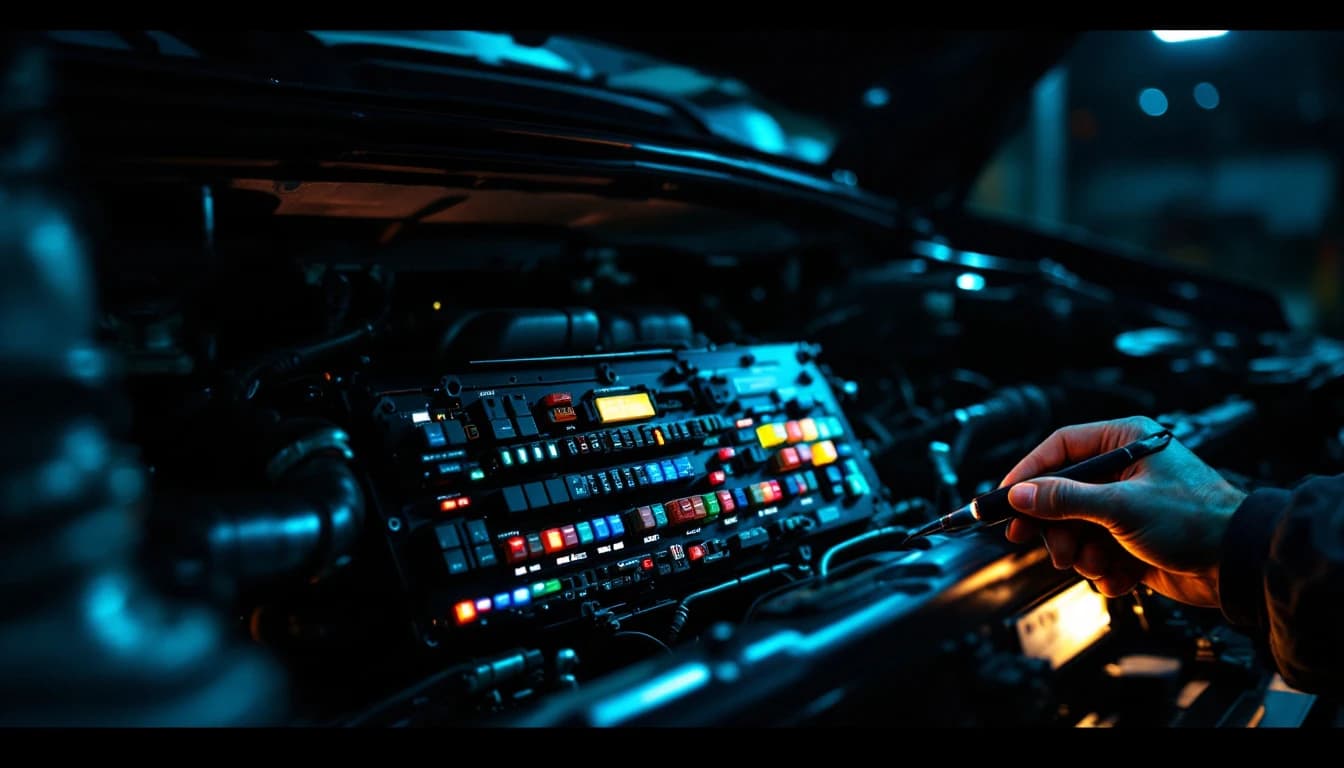
The TIPM, or Totally Integrated Power Module, is the under-hood power distribution center on many 2007-2014 Chrysler group vehicles. It holds fuses and relays and switches power to things like the fuel pump, horn, wipers and cooling fan. When a TIPM fails, the symptoms overlap heavily with a BCM — horn sounding by itself, wipers running on their own, a no-start from a dead fuel-pump relay. It is a different part with its own services: TIPM repair and the TIPM supplied and programmed to your VIN. Our TIPM failure symptoms guide covers that side in depth.
The RF hub handles the wireless side on many later vehicles — keyless entry, the key fob signal and often tire-pressure sensor reception. A remote that stops working on a keyless vehicle points toward the RF hub or the fob before it points at the BCM.
The SKIM, SKREEM or wireless ignition node is the immobilizer side. A security light with an engine that starts and dies after a couple of seconds is an immobilizer or PCM problem, not usually a BCM problem. The no-start diagnosis guide for Dodge, Ram and Jeep separates TIPM, PCM and SKIM faults.
Keep these four apart and half the misdiagnoses disappear.
Symptom table: what you see, and what usually causes it
| Symptom | Most likely cause | Check first | BCM? |
|---|---|---|---|
| Several unrelated body features fail at once | Low voltage, bad ground, water intrusion | Battery load test, main grounds, footwell carpet | Possible, after those checks |
| Battery dead after sitting overnight | Module not sleeping, aftermarket accessory, weak battery | Sleep-current measurement after the timeout | Possible, if the draw is traced to it |
| No communication with the BCM on a scan tool | Power or ground feed, blown fuse, connector corrosion | BCM fuses, grounds, connector pins | Likely, if power and ground are good |
| Horn or wipers operate by themselves | TIPM relay fault, water in a switch or connector | TIPM (on TIPM-era vehicles), switch, harness | Less likely |
| Engine cranks, starts, then dies with security light | Immobilizer or PCM security fault | Key, SKIM or wireless ignition node, PCM | Rarely |
| Remote and keyless entry stop working | Fob battery, RF hub, antenna | Fob battery, second fob, RF hub | Rarely |
| Used BCM installed and nothing works | Configuration and VIN not transferred | Part-number match of the donor | Yes — needs cloning |
| Lights stay on or flicker after shutdown | Switch fault, water, module not sleeping | Headlamp switch, connectors, sleep current | Possible |
| Faults start after rain or a car wash | Water entering at cowl, windshield, sunroof drains | Wet carpet, corrosion at footwell connectors | Possible, as a result of water |
Notice how often the right-hand column says "possible" rather than "yes". That is deliberate. The BCM is a common failure, but it is also the part that gets blamed for problems it merely reports.
Likely causes, ranked honestly
1. A weak battery or charging problem
Modern body electronics need stable voltage. A battery that tests fine unloaded but sags under load produces exactly the multi-system chaos people attribute to a BCM: flickering lights, locks that cycle, chimes, warning lights and modules dropping off the network. Most car batteries last 3 to 5 years, according to AAA, so on a vehicle in this age range a tired battery is a leading suspect. Load test it, check the alternator output with the engine running, and look at the terminals for corrosion. Our guide to charging-system and ground faults that keep killing modules explains why this matters even after a new module is installed.
2. Bad grounds
A single corroded body or engine ground can make a healthy BCM behave erratically. Grounds degrade quietly with age and moisture. Find the main battery-to-body and engine-to-body grounds, remove, clean and retighten them, and do a voltage-drop test across them under load rather than trusting a simple continuity check.
3. Water intrusion
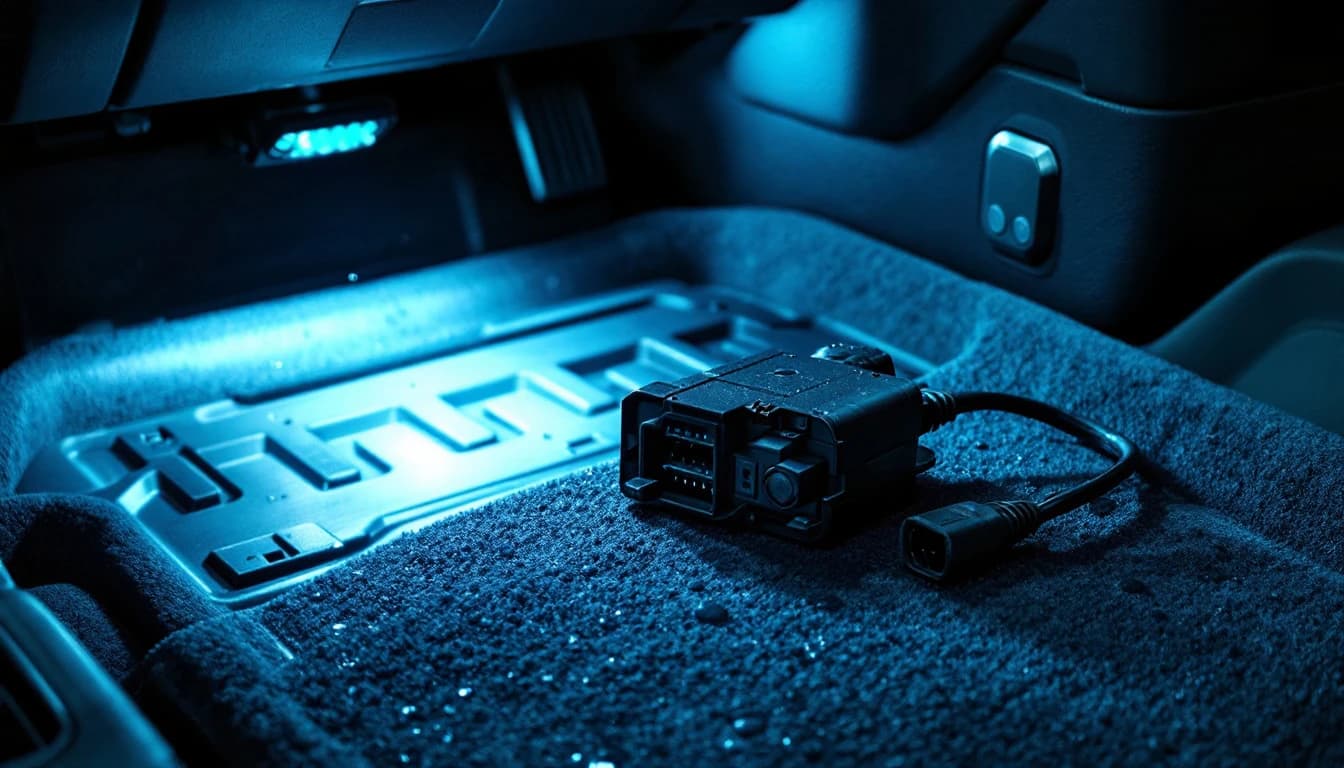
Water is the most common way a BCM genuinely dies, and it is also the most common way a BCM gets wrongly blamed, because water attacks connectors and harnesses long before it kills a circuit board. Clogged cowl drains, failed windshield seals, blocked sunroof drains and torn door vapor barriers can all put water into the cabin. The National Weather Service warns that as little as 6 inches of water reaches the bottom of most passenger cars, and 12 inches of rushing water can carry many vehicles away — a vehicle that has sat in standing water should be treated as a water-damage case until proven otherwise. Pull back the carpet, feel the padding, and inspect the connectors near the BCM for green or white corrosion.
4. Blown fuses and connector damage
The BCM needs several power feeds and grounds to wake up. A blown fuse on one feed can leave it partly alive — responding to some commands and ignoring others. Check every fuse that feeds the BCM, then inspect the connectors for pushed-back or corroded pins.
5. Aftermarket accessories
Remote starters, alarm systems, trailer wiring, lighting and audio installs often tap into body circuits. A poor splice can create faults the BCM then reports, and some accessories keep the network awake so modules never sleep. If the trouble started after an install, start there.
6. The BCM itself
After all of that, the BCM does fail. Internal damage from water, a failed driver circuit, or corrupted memory can leave it unresponsive or erratic. The tell is that the fault survives good voltage, clean grounds, dry connectors and intact fuses — and that the module either will not communicate or behaves wrongly with correct inputs.
"Most BCMs I get asked about are healthy. The real problem is a battery that sags under load, a green ground stud or a wet carpet. Fix the power and the water first. If the module still misbehaves after that, it has earned its trip to the bench." — Body-electrical diagnostician, 20+ years on Chrysler group vehicles (anonymized)
Parasitic drain from a BCM that will not sleep
A dead battery every morning is one of the most frustrating BCM-related symptoms, and it deserves its own section. After you lock the vehicle and walk away, the modules are supposed to go through a shutdown sequence and drop into a low-power sleep state. That can take a while — on some vehicles the network stays awake for a considerable time after the doors close — so a reading taken too early looks like a drain when it is not.
The correct test is to connect an ammeter in series at the battery, close the doors (fooling the door switches if you need access), lock the vehicle, and wait for the modules to sleep before reading. A healthy vehicle usually settles at a small draw measured in tens of milliamps. If the draw stays high, pull fuses one at a time and watch which circuit drops it. If the drain disappears only when the BCM's feeds are removed, and nothing downstream of the BCM is holding it awake, the module itself is the likely cause. Our full parasitic battery drain diagnosis guide walks through the method step by step.
Two cautions. An aftermarket device can keep the whole network awake, so the BCM looks guilty when it is simply responding to a neighbor. And a battery that is already weak will die from a normal sleep draw, so test the battery before chasing the drain.
Diagnostic steps, in order
Work through these in sequence. Each step is cheaper than the one after it, and each one rules out a common false alarm.
- Load test the battery and check charging. Replace or charge the battery before any further diagnosis. Many "BCM" faults end here.
- Clean and verify the main grounds. Voltage-drop test them under load.
- Look for water. Check the footwell carpet, cowl drains, windshield and sunroof drains, and the connectors near the BCM.
- Check every fuse that feeds the BCM, and on TIPM-era vehicles, inspect the TIPM relays and connectors too.
- Scan every module, not just the BCM. A professional scan tool reading all modules shows whether the BCM is communicating and whether other modules report lost communication with it. Our U0100 and U0140 lost-communication guide explains how to read those codes without condemning the wrong module.
- Measure the sleep current if the complaint is a dead battery.
- Check for recalls and service bulletins. Enter your VIN on the National Highway Traffic Safety Administration recall lookup. An open recall is repaired free at the dealer.
- Only then condemn the BCM — and before you buy anything, photograph its label so the part number is on record.
If you do not have a scan tool that reads body modules or an ammeter, this is the point to involve a professional. There are more than 700,000 automotive service technicians and mechanics in the United States, according to the Bureau of Labor Statistics, and a competent electrical diagnostician will get through this list quickly.
Why a used BCM from a salvage yard will not just plug in
Here is the trap that catches the most people. A used BCM from another vehicle carries that vehicle's configuration and VIN. Plug it in and the result ranges from features that do not work to a vehicle that ignores the module entirely. A same-year, same-model donor is not automatically a match either; the Chrysler part number, including its hardware and software levels, has to match your original.
That is what the Chrysler, Dodge and Jeep BCM clone solves. You send your original BCM and a part-number-matched donor. On the bench we read your original's configuration, coding and VIN and write them to the donor, so the donor reports as your module and installs without a dealer wiTECH configuration session. Before you buy a donor or ship anything, text us your VIN and photos of both labels, and we confirm the match first.
Two limits are worth knowing up front. A BCM that is internally dead and will not power up or respond cannot be cloned, because nothing can be read from it. And some newer vehicles have a secure gateway that affects the at-the-car steps; the clone is a bench service and does not include an at-the-car gateway unlock. Where the configuration is linked to the immobilizer, proof of ownership is required.
What it realistically costs
The honest answer depends on which part actually failed and what you already have.
If the problem is the battery, a ground, a fuse or water, the cost is the battery or the labor to find and fix the leak or the corroded connection. This is the most common outcome, and it is why the diagnostic order above matters.
If the BCM has failed and still reads, the BCM clone is 250 dollars flat at Auto Module Lab as of September 2026, plus return shipping chosen at checkout — standard 29.95 dollars, UPS 2-day 54.95 dollars, or UPS overnight 94.95 dollars. The donor BCM is not included; you source a used unit with a matching part number. Salvage prices vary widely by model and year.
If the fault is the TIPM rather than the BCM, TIPM repair is 299 dollars and a TIPM supplied and programmed to your VIN is 599 dollars for the common 2011-2013 part numbers, with other years quoted first.
If the no-start is really the engine controller, a Chrysler PCM supplied and programmed to your VIN is 399 dollars. For a legitimate immobilizer delete on an owner's own vehicle — such as an engine swap or an orphaned PCM on supported older controllers — the SKIM or Sentry Key delete is 250 dollars, with proof of ownership required and no emissions changes of any kind.
A dealer path for a new BCM involves the module, installation labor and a configuration session on the dealer's diagnostic system. That bundle is often the right call on a vehicle under warranty or recall, and it costs more out of warranty. For a fuller comparison, see BCM programming cost: mail-in vs dealer.
When to call a professional
Call a professional electrical diagnostician if you cannot measure voltage drop or sleep current, if the vehicle has been in standing water, or if faults come and go without a pattern. Intermittent faults are the hardest to find and the easiest to misattribute.
Call us once the BCM has been proven to be the fault and it still powers up. Text us your VIN and a photo of the BCM label, and we will confirm the donor part number and the right service before you buy or ship anything. If the vehicle is under warranty or has an open recall, go to the dealer first; that repair should cost you nothing. For background on the automotive networks these modules share, SAE International publishes the standards that the diagnostic tools are built around.
If it really is the BCM: how the mail-in works
You order the BCM clone online and we email a prepaid inbound label. You remove the original BCM and pack it with the part-number-matched donor, each in anti-static protection with padding. On the bench we verify both parts, read the original, write the configuration, coding and VIN to the donor, and verify the result. Most standard jobs are typically completed within 24 hours of receipt, and the modules return on the shipping tier you chose at checkout. You install the donor, clear codes, and test every body function.
A properly cloned BCM should bring back your lighting, locks, wipers, chimes and option content exactly as before. If the original fault returns after a clean install, that is strong evidence the root cause was power, ground or water all along — which is why we push those checks first.
Frequently asked questions
What are the symptoms of a bad BCM on a Jeep, Dodge or Ram?
The usual signs are several unrelated body features failing together — lights, locks, wipers, chimes, the horn — a BCM that will not communicate on a scan tool, or a battery that dies overnight because the module will not sleep. Rule out the battery, grounds and water intrusion first, because they cause the same symptoms.
Is the BCM the same as the TIPM?
No. The TIPM is the under-hood power distribution center with fuses and relays on many 2007-2014 Chrysler group vehicles, while the BCM is the body computer that controls lighting, locks, wipers and chimes. Their symptoms overlap, so diagnose which one has failed before buying either part.
Can a bad BCM drain my battery overnight?
Yes. A BCM that fails to go to sleep after the vehicle is locked can hold the network awake and drain the battery. Confirm it with a sleep-current test after the modules have had time to shut down, and rule out aftermarket accessories and a weak battery before blaming the module.
Can I just install a used BCM from a salvage yard?
Not by itself. A used BCM carries the donor vehicle's configuration and VIN, so it usually will not work correctly in your vehicle. It needs your original's data cloned onto it, and the donor's Chrysler part number must match your original, which we verify from photos before you ship.
Can you clone a BCM that is completely dead?
No. If the original BCM will not power up or respond on the bench, there is no data to read, so it cannot be cloned. In that case the fix is a new or dealer-configured module, and it is worth confirming power and grounds first in case the module is not actually dead.
Will water damage kill a Chrysler BCM?
It can, but water usually damages connectors and wiring before it kills the module. After any water intrusion, dry the area, clean the connectors, fix the leak and retest before condemning the BCM. Fixing the leak matters most, because a replacement module will fail the same way if the water keeps coming in.
How much does a Chrysler, Dodge or Jeep BCM clone cost?
The BCM clone is 250 dollars flat at Auto Module Lab as of September 2026, plus return shipping chosen at checkout from 29.95 dollars. You supply the part-number-matched donor, and the lab emails you a prepaid inbound label after purchase.
The bottom line
On a Chrysler, Dodge, Jeep or Ram, a failing BCM looks like several electrical faults at once, a module that stops talking, or a battery that dies overnight — but so does a weak battery, a corroded ground, water in the footwell or a failing TIPM. Test the battery, clean the grounds, look for water, read every module and measure the sleep current before you buy anything.
When the BCM really has failed and still reads, cloning it onto a part-number-matched donor for 250 dollars plus return shipping gets you a module that installs without a dealer configuration session. Text us your VIN and photos of the module labels, and we will confirm the right part and service before you ship or pay.
Sources and further reading: S&P Global Mobility, AAA, National Weather Service, National Highway Traffic Safety Administration, Bureau of Labor Statistics, SAE International, Stellantis.
Ship your module today
Flat-rate pricing, typical 24-hour bench turnaround, return speed your choice at checkout. Most jobs back on your bench within a week.