
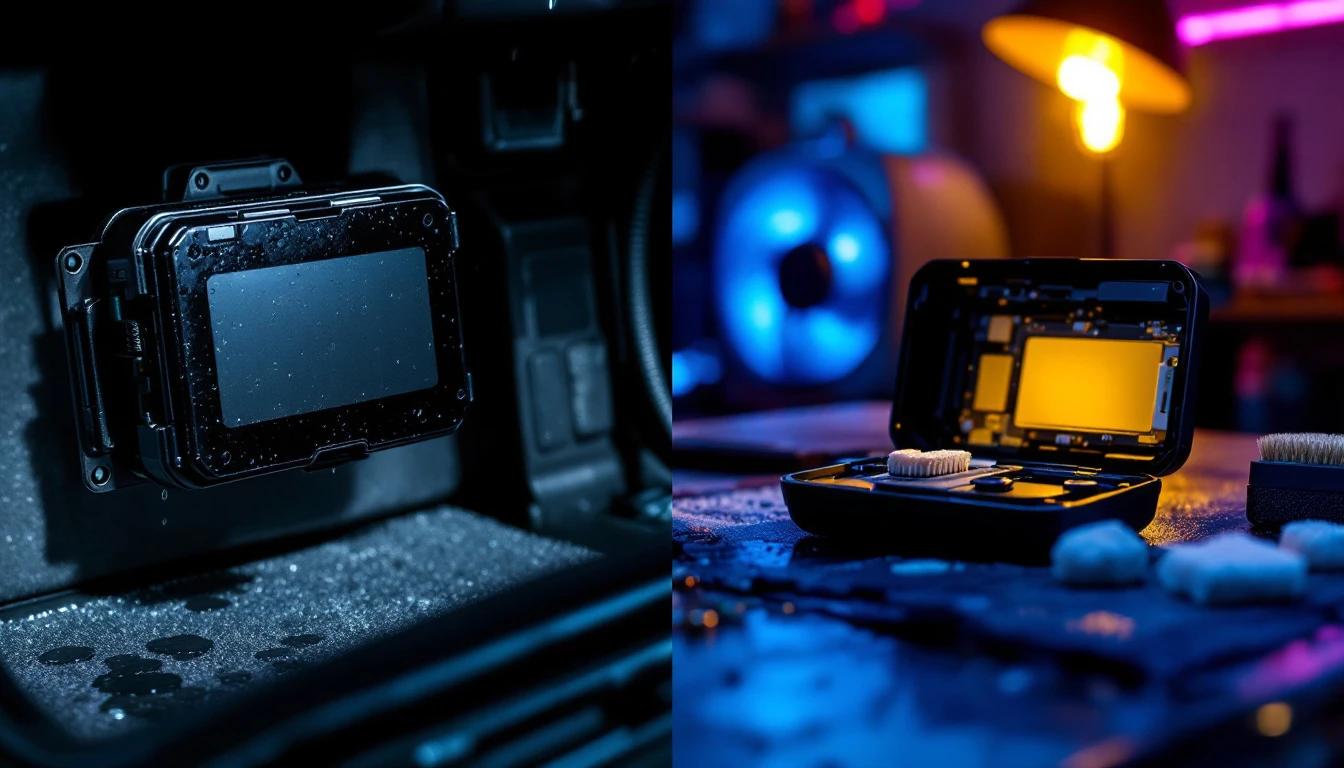
Water-Damaged Car Modules: What Can Be Repaired
The short answer: can a water-damaged car module be repaired?
Often yes, if you act before corrosion spreads and if the module was not submerged in salt water for a long time. Water by itself does not usually kill an electronic module. The damage that follows does: electrolytic corrosion on connector pins, white or green crust on circuit boards, shorted traces and failed voltage regulators. Those are bench-level faults, and many of them are repairable. A module that sat in standing flood water, especially salt or brackish water, for a long period is a poorer candidate, and some are beyond saving.
This guide covers the three common ways water reaches car electronics (flood, heavy rain and leaks, and washing), the symptoms by module, the safe first steps, what the mail-in repairs cost from our own price list, and when you should stop and talk to your insurer instead.
Three ways water gets into the electronics
Standing flood water. Water that rises above the sill reaches the modules mounted low in the cabin: body control modules under the seats or in the footwell, and sometimes the keyless receiver and the airbag controller on the floor or under the center console. If the water goes higher, it reaches the dash and the engine bay.
Rain and leaks. This one is more common and quieter. A blocked cowl drain, a failed windshield seal, a leaking sunroof drain or a bad door membrane lets water run into the cabin or onto a module bracket. The vehicle works for weeks, then a module fails after a wet spell. The problem is that the car never looked flooded, so the connection between the water and the fault is easy to miss.
Washing and engine-bay moisture. Pressure washing an engine bay can drive water into connectors and into the under-hood power module. This is a classic trigger for a car that will not start the morning after a wash.
Why corrosion, not the water, is what kills modules
Dry electronics tolerate a lot. Add moisture and a little current, and metal ions migrate between pins and across the board. Fresh water does this slowly. Salt water does it fast, because dissolved salt makes the water conductive and corrosive. That is why a car that was in a coastal storm surge is a much harder case than a car with a wet carpet from a sunroof leak.
The practical lesson is the one every restoration technician repeats: time matters. A module that is cleaned and dried promptly has a good chance. A module left connected in a damp footwell will keep corroding. If the car is parked and wet, the clock is running.
First steps: what to do in the first hour
- Do not start the car. Turning the key on powers the modules and can short a wet board.
- Disconnect the battery. Take off the negative terminal first. This removes the power that drives corrosion and stops a short from doing more damage.
- Photograph the water line. Photos of how high the water reached help you, your insurer and us decide what is likely affected.
- Do not use a hair dryer or heat gun on a module. Heat can crack solder joints and warp plastic. Let the cabin dry with airflow and time.
- Do not spray electrical cleaner into a sealed module. It can push contaminants further in. Cleaning belongs on the bench.
- Call your insurer if it was a flood. Comprehensive coverage often applies to flood damage, and the claim process can affect what you are allowed to repair. That conversation comes before any repair spend.
For general handling precautions, our guide to static damage and car modules explains how to pull a module without making it worse.
Symptoms by module
The table maps what you see to the module that most often explains it. It is a starting map and not a diagnosis, because water can affect more than one box at once. For the wider picture of how those modules relate, see our guide to every control module in a modern car.
| What you see | Likely module | Why water causes it | Our mail-in service | Price |
|---|---|---|---|---|
| Dead or sweeping gauges, missing lights, dim display | Instrument cluster | Moisture behind the dash or a leaking cowl | Cluster repair | $200 |
| No-start, fuel pump or relays acting up after a wash or rain (Chrysler, Dodge, Jeep, Ram) | Under-hood power module (TIPM) | Water sits in the module's connectors and relay cavity | TIPM repair | $499 |
| ABS, traction and brake warning lights | ABS module | Corroded pins at the module, or a wet harness connector | ABS module repair | $699 |
| Remote lock and unlock dead | Keyless entry receiver | Water at a floor- or kick-panel-mounted module | Keyless entry repair | $125 |
| Several unrelated systems failing together | Body control module or network | Water at a shared module or a corroded ground | Bench evaluation first | $150 |
Prices are the figures on each service page as of November 2026. Return shipping is separate and chosen at checkout from $29.95 for standard. We email a prepaid inbound label, so the trip to us is not billed to you.
Symptom 1: warning lights everywhere after a wet spell
When a car has been wet and every dash light comes on at once, the cause is often a lost network connection or low supply voltage rather than a dozen separate faults. Our guide to all dashboard warning lights on at once explains the difference between a cluster fault and a network fault. With water in the picture, a corroded connector or ground is as likely as a dead module, so inspect and clean accessible connectors before you condemn anything.
Symptom 2: it will not start, and the module under the hood is wet
On Chrysler, Dodge, Jeep and Ram vehicles, the under-hood power module (TIPM) is a known place for moisture to cause trouble, and it is also a known failure point for reasons that have nothing to do with water. The two causes look identical at the symptom level. If water is involved, look for crust at the connectors and inside the relay cavity. Our TIPM failure symptoms guide goes through the symptom list, and the TIPM repair service is $499 flat as of November 2026.
Symptom 3: ABS and brake lights after rain
ABS modules mount low and near the wheels' brake lines, and the connector faces the weather. Corrosion in the connector produces intermittent communication loss, which shows as ABS, traction and brake lights. The first cheap check is the connector: unplug it, inspect for green or white deposits and look at the pins. If a pin is eaten away, the module may need a connector repair as well as a bench repair. Our ABS module repair cost guide explains what is repairable and what the price covers. The bench repair is $699 flat as of November 2026.
Symptom 4: Mercedes SAM or body modules
Some designs are notorious for water problems because of where the module sits. Mercedes SAM modules are the best known, and our Mercedes SAM failure and water damage guide covers the typical pattern in detail. If you drive one of those vehicles, start there.
Symptom 5: it ran fine for weeks, then failed after rain
A slow leak is the harder diagnosis. Look for water stains on the carpet, a musty smell, damp padding under the front seats or fogging on the inside of the glass. Then trace the water to its source: cowl drains, sunroof drains, door seals and the windshield seal are the usual suspects. Repairing the module without fixing the leak only buys a few weeks, so find the water before you order a repair.
What we can repair on the bench, and what we cannot
Our work is at module level. We repair circuit boards, regulators, connectors on the board and corrupted memory. That covers a lot of water damage, but not all of it.
- Repairable in many cases: corroded connector pins on the board, shorted or lifted traces, failed voltage regulators, damaged driver chips and corroded component leads, provided the board is not eaten through.
- Less likely to be saved: a module that sat submerged in salt water for a long period, a board with heavy corrosion under components, or a housing that is cracked and full of silt.
- Not our work: wiring harness repair, corroded body grounds, door lock actuators, sensors and mechanical parts. We say so on every service page, and a bench repair does not fix a harness that is green inside its insulation.
- Airbag modules. Water exposure to a restraint system is a safety question. Follow the manufacturer's guidance and your insurer's instructions. A crash-data clear is a different service for a different problem, and it is not a fix for water damage.
If you are not sure which module is the real problem, our hourly bench evaluation exists for that case. It is a separate service with its own price on its page, and our explainer on what bench evaluation finds when scan tools cannot describes the work.
Repair or replace: the decision
The honest comparison depends on the car's value and the number of affected modules. A flat-rate bench repair is typically far below the price of new modules plus dealer programming, and it keeps the original VIN and security data. But a flood car with ten affected modules and a wet harness is a different problem from a car with one wet cluster.
| Situation | Sensible route |
|---|---|
| One module, fresh-water leak, caught early | Bench repair of that module |
| Several modules, fresh-water flood, car otherwise sound | Evaluate each; repair what is repairable |
| Salt-water flood or long submersion | Talk to your insurer first; the car may be a total loss |
| Slow leak, intermittent faults | Fix the leak, then repair modules as needed |
| Car worth less than the repair total | Weigh repair against the market value before spending |
For cars with a flood or salvage history, the module and programming side has its own wrinkles, so read our salvage and rebuilt title module guide and our guide to buying a used donor module before you source a replacement. If your claim involves theft or vandalism rather than water, see insurance claims and module replacement.
A realistic cost range
We do not publish a single number for "flood repair" because the range is set by how many modules are involved, and inventing a total would mislead you. What we can give you is the per-module price from our price list: $125 for a keyless entry receiver, $200 for a cluster repair with mileage sync, $499 for a Chrysler, Dodge, Jeep or Ram power module and $699 for an ABS module, all as of November 2026. Add return shipping from $29.95 per order, not per module, so a box with two modules pays one return tier. A single wet module therefore runs from roughly $155 to about $730 all-in at the standard return tier, and a second module in the same box adds only its own repair fee.
Why this matters more as cars age
According to S&P Global Mobility's 2025 analysis, the average light vehicle on US roads is 12.8 years old, passenger cars average 14.5 years in service, and the fleet counts 289 million light vehicles in operation. Older vehicles have older door seals, drains and gaskets, so slow leaks are more common, and the replacement cost of a module is a larger share of the vehicle's value. That is why a repair that keeps the original module is the sensible default. For consumer guidance on buying or driving a vehicle with a flood history, NHTSA and Carfax both publish material on flood-damaged vehicles, and Kelley Blue Book helps you judge market value. For electronics standards context, see SAE International, and for insurance-claim background, see the National Insurance Crime Bureau, which reported more than 268,000 vehicles stolen in the first six months of 2026, down 21% from a year earlier. Flood and theft claims alike go through the same adjusters, so document everything.
Water damage looks random until you remember it is a corrosion problem. The pins and the board are what we fix. If the harness is green, we can repair the module and you will still have the fault. Always check the connectors first. — Independent automotive electronics technician, 15+ years of module repair (anonymized)
How to ship a water-damaged module
- Disconnect the battery and keep it disconnected until the module is out.
- Label what you removed. Photograph the module in place, the connector and the part number label.
- Let it air dry. Do not bake it. Keep it away from heat.
- Pack it with desiccant if you have it. Put it in an anti-static bag in a padded box. Include a printed copy of the order confirmation, the VIN, and a short note about how the water got in.
- Order the matching service and print the prepaid inbound label we email. Our guide to removing, packaging and shipping a module has the details, and our list of what to ship by job type tells you what to include.
- Tell us if the vehicle was in salt water. It changes our expectations and we would rather tell you early.
Frequently asked questions
Can a car module work again after getting wet?
Often yes. Water by itself rarely kills a module, and the corrosion that follows is what causes failure. A module cleaned and repaired promptly has a good chance, while one left connected and damp, or submerged in salt water for a long period, is much less likely to be saved. Disconnect the battery and have it assessed.
Should I try to start the car after a flood?
No. Starting the car powers every module, and current through wet circuits can short a board that might otherwise have been repaired. Disconnect the battery first, photograph the water line, call your insurer if it was a flood, and let a professional assess the vehicle before you turn the key.
How much does it cost to repair a water-damaged module by mail?
From our price list as of November 2026: $125 for a keyless entry module, $200 for a cluster repair, $499 for a Chrysler, Dodge, Jeep or Ram power module and $699 for an ABS module. Return shipping is extra, from $29.95, and one tier is charged per order, not per module.
Can I dry a wet module with a hair dryer?
No. Heat can crack solder joints, warp plastic housings and drive moisture deeper into the board. Let the module air dry at room temperature, away from heat, and do not spray electrical cleaner into a sealed housing. Cleaning belongs on the bench, where we can inspect the board properly.
Does salt water make the damage worse?
Yes. Salt makes water conductive and corrosive, so damage develops faster and spreads under components. A module that was submerged in salt or brackish water for a long period is a poor candidate for repair, and the vehicle may be a total loss. Talk to your insurer before you spend money on repairs.
Will my insurance cover module repair after a flood?
It may. Comprehensive coverage often applies to flood damage, but terms vary, so check your policy and contact your insurer before repairing anything. They may require their own assessment, and the claim can decide whether the vehicle is repaired or written off. A repair invoice from us can support the claim.
The bottom line
Water-damaged car modules are often repairable, because the damage is corrosion on pins and boards that a bench can clean or replace. The exceptions are long salt-water submersion and heavy corrosion. Stop powering the car, disconnect the battery, photograph the water line, find the water source and check the connectors before you pull anything. From our price list as of November 2026, a single module repair runs $125 to $699 plus return shipping from $29.95, and a box with several modules pays one return tier. If you are not sure which module is the real problem, start with a bench evaluation or text us your symptoms and vehicle details, and we will tell you whether the repair fits.
Ship it for the abs module repair — $699 flat
About 1 Week Bench Time (Rush 2–3 Days Available), return speed your choice at checkout. Prepaid inbound label by email the minute you order.
More from the Lab
Parasitic Drain: When a Module Will Not Go to Sleep
15 min · August 17, 2026
Control Module Repair Cost by Type — Mail-In Bench (2026)
12 min · October 30, 2026

MINI R50/R53 Body Control Module Failure: Diagnosis
15 min · October 2, 2026
Chrysler, Dodge & Jeep BCM Failure Symptoms Guide
13 min · September 23, 2026