
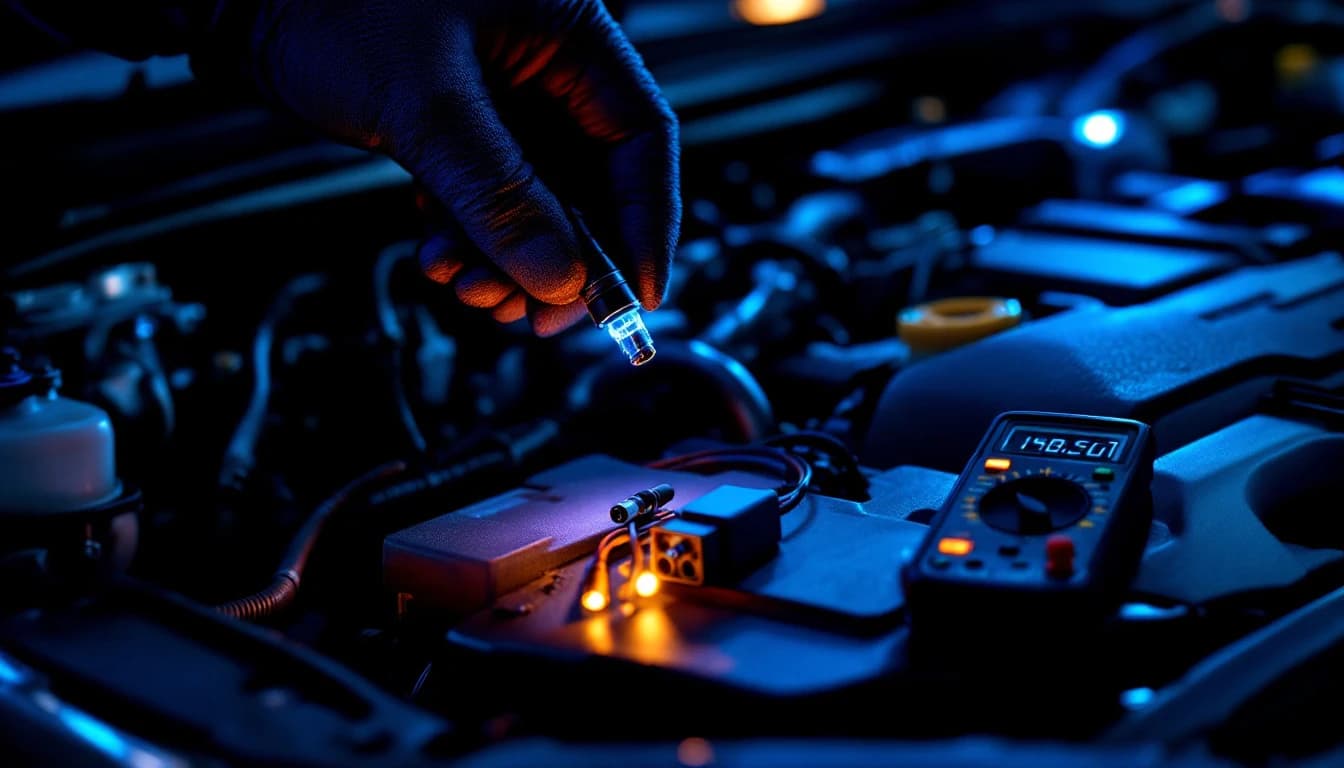
Car Stalls While Driving: Computer, TIPM or Sensor?
First, get the car off the road safely
When an engine quits at speed, the car keeps its steering and its brakes, but both get much harder to use. A belt-driven hydraulic steering pump stops with the engine, and some electric systems cut back their assist as soon as they see the engine stop. The brake booster holds enough vacuum for a press or two of assisted braking; after that the pedal goes hard and needs a much firmer push.
Hazard lights on, a firm grip, and steer for the shoulder while you still have momentum. On many automatics you can shift to neutral and try a restart while rolling. Do not switch the ignition fully off or pull the key while the car is moving.
Once you are stopped, write down the speed, the temperatures, the fuel level, the road surface, whether it had rained, and exactly how the engine died. That note is the most valuable diagnostic tool in this guide. If the car has stalled at speed more than once, stop driving it in traffic until the cause is found. A tow costs less than a crash.
Read how the engine died before you read the codes
The way an engine dies tells you which of its needs went missing. On many vehicles the tachometer is driven from the engine computer's crankshaft signal, so a needle that falls straight to zero while the car is still rolling points at a lost crank signal rather than fuel. A sputter or surge first points at fuel, and a dash that goes dark with the engine points at the power feed. Stalls that come only over bumps, only when hot or only after rain are connection, heat or moisture faults, and they are the ones most often misdiagnosed as a bad computer.
| What the stall looked like | Most likely cause | First test | Is it the module? |
|---|---|---|---|
| Instant shutoff, tach drops to zero, dash stays lit | Crankshaft or camshaft position sensor, or its wiring | RPM and crank sync in live data; heat-test the sensor | Rarely; only if the crank signal arrives and it still stops firing |
| Sputter, surge or power loss, then dies | Weak fuel pump, clogged filter, regulator, relay or pump driver | Fuel pressure logged while driving | Rarely; on Chrysler-group TIPM vehicles, the relay inside the TIPM |
| Everything electrical dies at once | Worn ignition switch, battery cable or terminal, main fuse, main ground | Wiggle the key and cables at idle; voltage-drop the grounds | Almost never |
| Battery light, dimming lights, then a stall | Alternator, belt or charging wiring | Charging voltage at idle and under load | No |
| Dies coming to a stop or at idle | Throttle body, vacuum leak, airflow sensor, EGR, converter clutch | Fuel trims, idle data, smoke test for leaks | Rarely; occasionally a transmission controller |
| Dies over bumps | Loose connector or ground, ignition switch, ignition node | Wiggle test with live data running | Sometimes; a cracked solder joint in a module |
| Dies hot, restarts after cooling | Crank or cam sensor, ignition module, weak pump, cracked solder | Heat gun and freeze spray with live data | Sometimes; the classic module-fault pattern |
| Starts, then dies within seconds, security light on | Immobilizer authorization | Read the immobilizer and engine computer codes | Possibly, but that is a no-start, not a stall at speed |
The usual causes, ranked by how often they turn out to be the answer
This order reflects general repair-shop experience, not a statistic, and your vehicle can reorder it: a Chrysler-group truck from the TIPM years moves item seven much higher.
1. Fuel delivery
An engine that cannot get fuel at the right pressure and volume dies, usually with a stumble first. The in-tank pump is the most common culprit, followed by a clogged filter where one is still serviceable, a failed pressure regulator, and the relay or controller that switches the pump. On many Ford trucks and SUVs that controller is a fuel pump driver module bolted to the frame, where road salt corrodes it. A fuel gauge that reads a quarter tank on a nearly empty tank strands people too, and many older Fords carry an inertia fuel shutoff switch that a hard pothole can occasionally trip; it has a reset button.
Check recalls before you buy a pump. Toyota, Lexus, Honda and Subaru have all recalled vehicles in recent years over a Denso-supplied low-pressure fuel pump that can fail and stall the engine while driving, and the recall lookup on the National Highway Traffic Safety Administration site takes a VIN and a minute.
2. Crankshaft and camshaft position sensors
The engine computer fires the injectors and coils from the crankshaft signal. Lose it and the engine stops at once, with no stumble. These sensors are famous for failing when hot: the electronics inside open up as they heat, the engine dies, and after 20 or 30 minutes of cooling it starts as if nothing happened. That pattern plus an instant shutoff is a sensor until proven otherwise. It may or may not set P0335 for the crank circuit or P0340 for the cam, and oil in the connector or metal debris on a magnetic tip causes the same dropout. The parts are usually cheap, so rule them out before anyone mentions a computer.
3. Battery, alternator and grounds
Everything on a modern engine runs on voltage. When the alternator quits, the car runs on its battery until the voltage falls too low to fire the coils and injectors, usually after a battery light and dimming lights. A corroded main ground or battery terminal can collapse voltage for a split second over a bump, and the engine computer resets mid-drive. A healthy, fully charged battery rests at roughly 12.6 volts, and most charging systems hold around 13.5 to 14.7 volts with the engine running.
Battery and charging trouble is consistently among the most common reasons drivers call AAA for roadside help, and one of the most common reasons a good module gets blamed. The charging system and ground fault guide explains why a bad ground keeps killing replacement modules.
4. Throttle body, idle control and vacuum leaks
If the car stalls as you come to a stop, look here first. Carbon builds up around the throttle plate of many electronic throttle bodies until the engine cannot pull enough air to idle, especially with the air conditioning on. A split vacuum hose or a leaking intake gasket sets lean codes such as P0171 and P0174, and a contaminated mass airflow sensor or a stuck-open EGR valve upsets the idle from the other side. Cleaning a throttle body is cheap, but some vehicles need an idle relearn with a scan tool afterward or the stall continues.
5. The ignition switch and the key
A worn key switch that loses its RUN contact shuts the engine off and darkens the dash with it, and a heavy key ring speeds the wear. GM's 2014 ignition-switch recall on several small cars was about exactly this: a switch that could slip out of RUN under a heavy key ring or a jolt and shut the engine off while driving.
On Chrysler, Dodge, Jeep and Ram vehicles with the slot-type FOBIK key, roughly 2008 through 2018, the switch is part of the Wireless Ignition Node. A failing WIN can cut the engine over a bump and let it restart, and that failure was the subject of a recall on some of these vehicles. A used WIN stays married to the vehicle it came from, so we supply a brand-new WIN programmed to your VIN for $650, with your FOBIK keys paired when you send them in with the old module; proof of ownership is required. The FOBIK and WIN diagnosis guide shows how to tell a worn key from a failing node.
6. A torque converter clutch that will not release
On an automatic, the converter clutch locks the engine to the transmission at cruise and must release as you slow down. If it sticks on, the engine stalls as you roll to a stop, like letting the clutch out on a manual. The cause is usually a solenoid or valve-body problem, occasionally the transmission controller, and the transmission limp mode and TCM diagnosis guide separates the two.
7. The TIPM on 2007-2014 Chrysler, Dodge, Jeep and Ram
On these vehicles the Totally Integrated Power Module is both the fuse box and a computer, and it switches the fuel pump through an internal relay. When that relay or its circuit fails, you get the textbook complaint: a stall at a random speed, a restart minutes later, intermittent no-starts, sometimes a pump that keeps running with the key off, and often no stored code. Stellantis, the parent of those brands, used the TIPM across a long run of models, and recalls in 2014 and 2015 covered TIPM fuel-pump relay problems on specific vehicles from that era, so check the VIN before you spend anything.
If no recall applies, a TIPM bench repair is $299 and fixes the failing internal relay, voltage regulator or body-side circuit on your own unit, so its VIN and coding stay intact and nothing needs programming. It will not fix a worn-out pump or a failing alternator, and a severely water-damaged TIPM is beyond bench repair; then a TIPM programmed to your VIN starts at $599 for the common 2011-2013 part numbers, confirmed against your part number before you order. If the pump is your only symptom, ask first, because the failure is often just the relay. The TIPM failure symptoms guide lists the other signs.
8. The engine computer itself
Engine computers do fail, and they usually leave evidence. A cracked solder joint in the power supply opens with heat or vibration and resets the module, producing a stall that looks just like a sensor dropout. Water that gets past a failed seal corrodes the board, and a burned-out driver transistor kills an injector or coil circuit. The module's self-test may set an internal-fault code from the P0601 to P0606 family; the P0606 processor fault guide explains why that code is often a power problem rather than a dead computer.
The other fingerprint is on the network. When the engine computer drops off the bus mid-drive, the transmission, body and ABS modules often log a U0100 lost-communication code at the same moment. That says the computer went quiet, not why, and the U0100 and U0140 lost communication guide covers the power, ground and network checks that come first.
9. The immobilizer, which rarely does it
On most vehicles the immobilizer authorizes the start and does not check again until the next one. A failed authorization usually means a crank with no start, or a start that dies within a second or two with a security light flashing. A few systems do re-check while running, and a failing antenna ring or a cracked transponder can cause trouble, but that almost always shows up as start-then-die, not a shutoff at highway speed. If that is your pattern, the immobilizer vs module no-start guide is the right next read.
"A lot of the 'bad computers' that roll into my bay turn out to be a crank sensor that quits when it gets hot, a pump that cannot hold pressure, or a ground strap nobody looked at. When it really is the computer, the data shows it: powers and grounds good, crank signal present, and it still will not fire an injector. That is the only time I order one." — Independent driveability technician, 20+ years on domestic and import engine management (anonymized)
The diagnostic order that saves money
Work in cost order. Each step either finds the fault or clears a whole group of suspects.
- Check recalls and service bulletins. Fuel pumps, ignition switches, TIPMs and engine calibrations have all been recalled, and a recall repair costs you nothing.
- Scan every module, not just the engine. Save the stored, pending and history codes plus the freeze frame, which records engine speed, vehicle speed, load, coolant temperature, fuel trims and often system voltage when a code set. Lost-communication codes in several modules at the same moment point at power or the engine computer. No code at all is common on fuel and TIPM faults, so silence is not a clean bill of health.
- Test the battery, the charging system and the grounds. Load-test the battery, check charging voltage at idle with the lights and blower on, and voltage-drop the main grounds under load. A common rule of thumb is no more than a few tenths of a volt across a ground connection while it carries current.
- Catch it in the act. Log fuel pressure, with a gauge you can see or the rail pressure reading on returnless systems, along with engine speed, crank synchronization and system voltage. When it stalls, the signal that dropped first is your answer.
- Wiggle test with live data. At idle, flex the engine computer, sensor, fuel pump, relay box and ignition switch connectors, the battery cables and the ground straps. A dip in RPM finds the bad connection.
- Heat test the suspects. Warm one component at a time with a heat gun on a low setting, or heat-soak the car and revive a failed part with freeze spray. The intermittent heat fault guide covers the technique and its limits.
- Only then suspect the module. It is the engine computer when its powers and grounds test good, the crank signal reaches its connector, and it still stops commanding injectors and spark; when an internal-fault code survives a clean electrical baseline; or when tapping or heating the module itself reproduces the stall.
What the repair is likely to cost
Most stall repairs cost far less than an engine computer, which is the whole argument for testing in order. A battery terminal, a ground strap or a vacuum hose is the cheap end. A crank or cam sensor is usually modest, and a throttle body cleaning is a short job. A fuel pump is often one of the bigger items, because many pumps live inside the tank.
Labor drives most of these bills. Hourly shop rates are commonly reported in the low-to-mid hundreds of dollars per hour by outlets such as Kelley Blue Book and RepairPal, and RepairPal publishes typical price ranges by vehicle that are worth checking against any quote. An hour or two of real diagnosis is the best money in the process. The age of the fleet makes all of this more common: the average light vehicle on U.S. roads was about 12.6 years old in 2024, according to S&P Global Mobility, and older vehicles bring more heat-cycled sensors, corroded grounds and tired pumps.
When it really is the module
If the evidence points at the engine computer, the choice depends on whether the original can still be read.
- It can still be read. Its VIN, immobilizer relationship and calibration can be cloned onto a matching unit so it installs without dealer programming. The PCM repair vs clone vs replacement guide compares the paths.
- It is dead and you want a module ready to install. On GM, our programmed ECM is $399 for E38, E67, E92 and E80 controllers on roughly 2007-2020 trucks, SUVs and performance cars, flashed with the current factory calibration for your VIN. On Chrysler, Dodge and Jeep, the programmed PCM is $399 with the VIN written and the SKIM immobilizer side handled. On Ford, the programmed PCM is $379 flat for 1996-2014, with 2015 and newer priced by quote; a readable original is cloned so the PATS anti-theft carries over, and otherwise the car needs a one-time PATS reset with two keys.
- It is dead and its data matters. After water, fire or an overvoltage event, advanced ECU recovery is $350 when the data comes back: board-level repair, or a direct memory read moved onto a donor you supply. It is evaluated first, and recovery is never guaranteed.
- You are not sure. A $150 bench evaluation tells you whether the module failed, and the fee is credited toward the repair if one is possible and you go ahead.
Programming is why a replacement engine computer is never a simple swap. The pass-thru tools the industry uses are built on the SAE J2534 standard, and service-information rules from the Environmental Protection Agency give independent shops access to factory procedures. Because engine computers carry immobilizer data, proof of ownership is required for that work. The Chrysler, Dodge and Jeep module cost guide lists every module price on those vehicles side by side.
You or your technician diagnose the vehicle, and we service the module on our Arlington, Texas bench; a bench test verifies the module, not the car. For a module you mail in, we email a prepaid inbound label after purchase, and you choose and pay for return shipping at checkout: standard $29.95, UPS 2-day $54.95 or UPS overnight $94.95. Modules we supply ship to you at the speed you pick from the same three tiers. Run the which-module-failed checklist before you ship anything.
When to stop and call a professional
Some stalls should go straight to a driveability specialist: a car that stalls at speed more than once, a stall with a raw fuel smell, a stall you cannot reproduce without a fuel pressure gauge and a scope, or one that started right after other repair work. A good specialist logs the car while it fails rather than guessing, and can show you which signal dropped first. Ask for that evidence before you agree to a new module.
Frequently asked questions
Can a bad engine computer cause a car to stall while driving? Yes, but it is one of the least common causes. A failing engine computer usually leaves evidence: internal-fault codes such as P0606, lost-communication codes in other modules, or a stall you can reproduce by tapping or heating the module. Test fuel, sensors, charging and grounds first.
Why does my car stall when it gets hot and restart after it cools down? The classic cause is a crankshaft or camshaft position sensor whose electronics open up when hot and recover when cool. A weak fuel pump, an ignition module or a cracked solder joint in a control module can do the same, so heat-test each suspect with live data running.
Can a bad battery or alternator make a car stall while driving? Yes. A failed alternator leaves the car running on its battery until the voltage is too low to fire the coils and injectors, usually after a battery light. A corroded ground or loose terminal can also drop voltage for an instant over a bump and reset the engine computer.
Can the immobilizer shut off my engine while I am driving? Rarely. On most vehicles the immobilizer only authorizes the start and does not check again until the next one. A failing antenna ring or transponder usually shows up as an engine that starts and dies within seconds with a security light, not a shutoff at highway speed.
Why does my car stall when I come to a stop? Stalling at a stop usually means the engine cannot hold its idle: a carbon-fouled throttle body, a vacuum leak, a dirty airflow sensor or a stuck EGR valve. On an automatic, a torque converter clutch that will not release causes the same stall. These are rarely computer faults.
Is the TIPM causing my Dodge, Jeep or Ram to stall? On 2007-2014 Chrysler, Dodge, Jeep and Ram vehicles it is a leading suspect, because the TIPM switches the fuel pump through an internal relay that commonly fails. Expect random stalls, restarts minutes later and often no code. Check recalls first, then consider the $299 bench repair.
The bottom line
A car that stalls while driving lost fuel, spark, voltage or its key switch for a moment, and the engine computer is the least likely culprit. Get off the road safely, write down how it died, and let that pattern point you toward fuel delivery, a crank or cam sensor, the charging system and grounds, idle control or the ignition switch. Check recalls, scan every module, test voltage and grounds, then catch the fault in the act. On 2007-2014 Chrysler-group vehicles, put the TIPM near the top of the list. Suspect the computer only when its powers, grounds and crank input are proven, or when it reports its own internal failure. When it truly is the module, text us the VIN and a photo of the module label, and we will tell you which path fits before you ship or buy anything.
Ship it for the tipm chrysler/dodge/jeep repair — $299 flat
Typical 24-Hour Turnaround, return speed your choice at checkout. Prepaid inbound label by email the minute you order.
More from the Lab

Car Cranks but Won't Start: Immobilizer, Module or Key?
12 min · July 10, 2026
Power Steering Heavy or EPS Light On: Is It the Module?
13 min · October 13, 2026
Ram 1500, 2500, 3500 ABS Module Failure by Generation
10 min · October 10, 2026
2014-2016 Jeep Wrangler JK ABS Module Failure Guide
10 min · October 10, 2026